
PLM Implementation Partner vs Vendor: Navigating the Choice for Industrial Success
The most expensive mistake in industrial digitalization isn’t choosing the wrong software; it’s assuming the person who sold you the license is the best person to build your architecture. You’ve likely felt the frustration of a Siemens Teamcenter environment that looks perfect in a demo but fails to account for your actual engineering workflows. When evaluating a PLM implementation partner vs vendor, you’re really choosing between a product and a strategy. While vendors focus on selling the engine, a partner’s role is to build the vehicle that actually gets your team to its destination.
We recognize that “out-of-the-box” implementations often create high technical debt and systems that refuse to scale. This guide clarifies the critical differences between software providers and independent consultants to ensure your project delivers long-term strategic value. You’ll learn how to achieve seamless integration between PLM, ERP, and MES while preparing your roadmap for the AI-powered agents found in Teamcenter 2606. We’ll break down the decision-making process to reduce your risk of cost overruns and ensure your digital thread remains future-proof.
Key Takeaways
- Distinguishing between purchasing a software license and executing a strategic deployment is essential for long-term industrial success.
- Evaluating a PLM implementation partner vs vendor requires assessing whether your project needs direct software code expertise or objective, cross-functional system architecture.
- Independent consultants prioritize your operational ROI and scalability, helping to avoid the technical debt often associated with generic “out-of-the-box” vendor setups.
- Successful digitalization depends on aligning software capabilities with actual engineering workflows through a future-proof roadmap that includes AI readiness.
- Determining the right path involves balancing your internal resource capacity against the complexity of integrating PLM with existing ERP and MES environments.
Distinguishing Between a PLM Vendor and an Implementation Partner
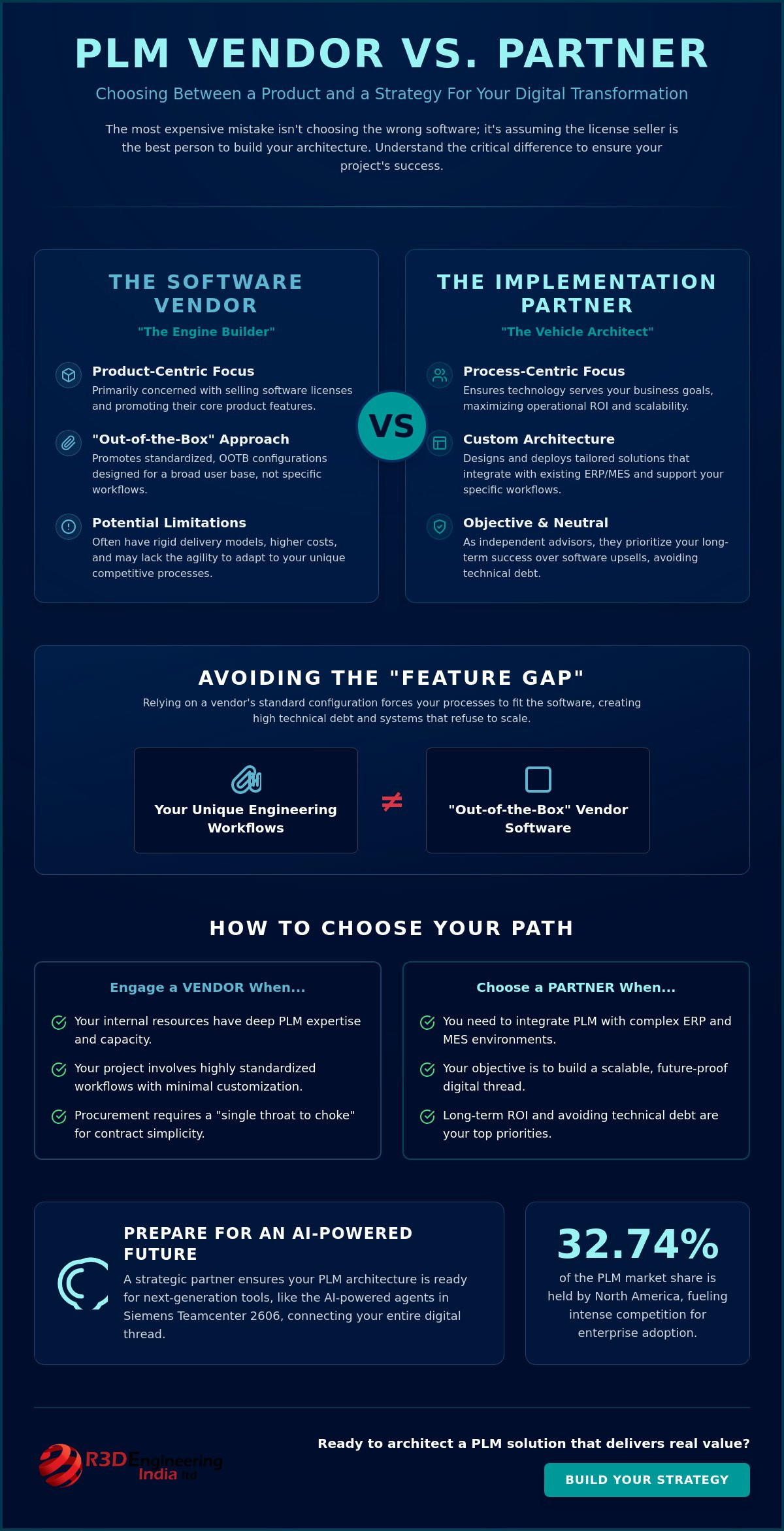
Choosing the right foundation for your digital transformation requires a clear understanding of the roles involved. A Product Lifecycle Management (PLM) vendor is the Original Equipment Manufacturer (OEM) that develops the software. Companies like Siemens Industry Software, PTC, or Dassault Systèmes fall into this category. They’re responsible for the core code, research and development, and the long-term product roadmap. Their primary goal is to provide a robust, scalable platform that solves broad industry challenges across a massive global user base.
An implementation partner, such as PLM-Sme, functions as a specialized consultancy. We don’t sell software licenses. Instead, we design, deploy, and integrate that software into your specific engineering environment. The fundamental tension in the PLM implementation partner vs vendor debate lies in their objectives. Vendors are product-centric; they want you to adopt their latest features. Partners are process-centric; we ensure those features actually improve your time-to-market and design accuracy.
Software vendors often promote “out-of-the-box” (OOTB) functionality as a way to reduce deployment time. While OOTB features are valuable for standardizing simple processes, they rarely satisfy the complex requirements of discrete industries like aerospace or automotive. Relying solely on a vendor’s standard configuration often leads to a “feature-gap” where the software dictates your engineering workflows rather than supporting them. A partner bridges this gap by tailoring the system to your unique business logic without creating excessive technical debt.
The Software Vendor’s Primary Objectives
- Driving License Adoption: Vendors focus on expanding their market footprint. With North America holding 32.74% of the PLM market share, competition for enterprise seats is intense.
- Core Product R&D: They invest heavily in universal capabilities, such as the AI-powered agents recently introduced in Teamcenter 2606.
- Standardized Support: Their support models are designed to address software bugs and version updates rather than bespoke workflow issues.
The Implementation Partner’s Strategic Mandate
- Architecting Custom Solutions: We translate high-level business goals into a functional system architecture that connects your digital thread.
- Managing Legacy Integration: Partners handle the heavy lifting of migrating data from aging systems into modern, cloud-native platforms.
- Maintaining Neutrality: As independent advisors, we prioritize your return on investment over software upsells, ensuring the technology serves your long-term roadmap.
The vendor provides the toolbox, but the partner provides the master plan. Without a dedicated implementation strategy, even the most advanced PLM platform becomes a glorified file repository. By distinguishing between these two roles early in your project, you can align your technical needs with your strategic vision.
In the same way that a master plan is essential for digital infrastructure, having the right support system is crucial for personal well-being. Organizations like Accessible Care provide this essential framework through specialized NDIS disability support services, helping individuals navigate complex needs with professional guidance.
Evaluating the Strengths and Limitations of Direct Vendor Engagement
Engaging with a software OEM directly offers a distinct sense of security for many enterprise leaders. You’re dealing with the architects of the tool itself. This direct relationship provides unparalleled access to the product development roadmap and early entry into beta features. For instance, if your strategy depends on the latest AI-powered agents in Teamcenter 2606, working with the vendor ensures you’re among the first to test these capabilities. This model centralizes responsibility; if the software fails or the implementation stalls, you have one primary point of contact. Many procurement departments prefer this “single throat to choke” approach to simplify contract management.
However, the PLM implementation partner vs vendor decision involves more than just software access. Vendors often operate with rigid delivery models designed for high-volume, standardized deployments. While they possess deep knowledge of their own proprietary code, their services can be significantly more expensive than independent alternatives. Their consultants are experts in the software, but they may lack the agility to adapt to the unique, non-standard engineering workflows that define your competitive advantage.
When Direct Vendor Engagement Makes Sense
- Global Enterprise Rollouts: Large-scale projects requiring hundreds of consultants across multiple continents often necessitate the massive manpower only a software OEM can provide.
- Standardized Deployments: If your organization is starting with a “greenfield” site and has zero legacy system integration needs, the vendor’s standard templates can be deployed quickly.
- Procurement Bundling: Massive discounts are sometimes available when software licensing and implementation services are negotiated as a single package.
The “Product Trap”: Why Vendors May Overlook Your Process
The primary risk of working solely with a vendor is the inherent bias toward their own product. Their primary objective is to increase license consumption and feature adoption. This often leads to a “feature-pushing” mentality where the solution is built around what the software can do, rather than what your business actually needs. Vendors frequently struggle in heterogeneous environments. They may have limited experience integrating their platform with a competitor’s ERP or MES, which is a critical requirement for building a cohesive digital thread. Additionally, vendor professional services often face higher staff turnover, which can disrupt the continuity of your project. Before signing a long-term service agreement, it’s beneficial to conduct an independent PLM system architecture consulting session to validate your technical strategy without vendor bias.
Choosing the vendor for implementation means prioritizing software depth over process breadth. It’s a valid choice for organizations that value a direct line to the OEM above all else, but it requires a strong internal team to manage the vendor and ensure the final system actually serves the engineers on the shop floor.
Bridging the Operational Gap with an Independent PLM Consultant
The most significant advantage of an independent consultant is objectivity. When debating the merits of a PLM implementation partner vs vendor, you must consider the underlying incentives. A software vendor’s success is typically measured by license volume and the adoption of new modules. In contrast, an independent partner’s success is defined by operational stability and your actual return on investment. We don’t have a quota to fill. Our focus remains entirely on ensuring the system supports your engineers rather than forcing your engineers to support the system.
Specialized PLM system architecture consulting ensures that the foundation of your digital thread is built for scalability. We design systems that aren’t just functional today but are prepared for the AI-powered agents and Copilot features introduced in Teamcenter 2606. By prioritizing architecture over mere configuration, we help you avoid the common “Blame Game” where vendors and IT teams point fingers during system outages. A partner provides a single point of accountability for the performance of the entire ecosystem.
Mastering Multi-System Integration
Connecting Siemens Teamcenter with your ERP and MES layers is where the real value of digitalization is realized. Independent partners excel here because we understand the heterogeneous nature of modern manufacturing. We don’t just focus on the PLM vault; we build the bridges that allow data to flow seamlessly to the shop floor. This includes handling complex data migration from legacy CAD, CAM, and CAE environments that have accumulated decades of “dirty” data. Additionally, unlocking Teamcenter CRM integration benefits ensures that your commercial teams have the same visibility into product data as your engineering teams, fostering transparency across the entire organization.
Focusing on Digital Maturity
A successful deployment isn’t a single event; it’s a progression. We use digital maturity report manufacturing data to drive implementation phases that match your organization’s capacity for change. This data-driven approach ensures that we don’t overwhelm your team with complex features they aren’t ready to use. Instead, we tailor the user experience to specific engineering roles, ensuring that a design engineer sees only what they need, while a project manager gets the high-level oversight required for decision-making. This phased approach guarantees that your system architecture supports future industrial automation and AI solutions without requiring a total system overhaul every few years.
Ultimately, choosing a PLM implementation partner vs vendor often comes down to who will own the final outcome. While the vendor delivers the technology, the partner delivers the results.
Determining the Right Choice for Your Digitalization Roadmap
Selecting the right path depends on the maturity of your current processes and the complexity of your technical requirements. If your project involves standardizing a single site with no legacy data, the vendor’s professional services might suffice. However, most industrial leaders face a more complex reality involving multi-CAD environments and intricate supply chains. When weighing a PLM implementation partner vs vendor, you must evaluate your internal team’s ability to manage the project. A vendor provides the software. But they often expect the client to define the detailed workflows. If you lack in-house experts to translate engineering needs into Teamcenter configurations, an independent partner is necessary to prevent project stagnation. Additionally, for those navigating the complexities of business expansion in the Middle East, you can check out Ventureprise Acquisitions to ensure your operational foundation is built for growth.
Strategic planning is particularly vital for regional expansion and long-term viability. Developing an industrial digitalization roadmap UAE requires localized expertise that understands specific regulatory and manufacturing contexts. Beyond initial implementation fees, you should calculate the Total Cost of Ownership (TCO). A partner-led architecture often reduces long-term costs by building a system that’s easier to maintain and upgrade. This avoids the “black box” customizations that vendors sometimes implement to meet short-term deadlines, which eventually lead to high technical debt.
Aligning Implementation with Industrial AI Strategy
The shift toward AI-driven manufacturing makes the choice even more critical. A partner helps define the role of PLM in AI strategy, ensuring your data structures are clean and categorized for machine learning models. We prepare your environment for the manufacturing landscape of 2026 by integrating a solid business case for AI in manufacturing into your PLM rollout. This ensures that features like Teamcenter Copilot, announced in the 2606 release on June 12, 2024, deliver actual predictive value rather than remaining experimental tools. Manufacturing leaders who want to understand where their organization stands before committing to a deployment path can benefit from conducting a structured industrial digitalization assessment to identify gaps in data readiness and AI scalability before they become costly obstacles.
The Hybrid Model: Vendor Software + Partner Services
Many organizations find success in a hybrid approach. You can maintain a direct relationship with Siemens for software reliability while engaging a partner for architectural agility. This model leverages the Siemens Digital Industries Alliance ecosystem, providing you with the best of both worlds. The key is establishing clear boundaries; the vendor handles software-level support and bugs, while the partner manages the strategic application of that software to your business goals. For those seeking independent guidance, our team provides expert digitalization vision and roadmap consulting to determine the most effective path forward for your specific enterprise.
Executing End-to-End PLM Implementation with PLM-Sme
Moving from the strategic selection phase to active deployment requires a partner that understands the nuances of your specific industrial environment. While the choice between a PLM implementation partner vs vendor often begins as a procurement discussion, it concludes as a technical one. PLM-Sme provides comprehensive Siemens Teamcenter consulting that bridges the gap between high-level digital vision and grounded, practical execution. We don’t just configure software; we architect the digital thread that connects your engineering data to the rest of your enterprise.
Our methodology focuses on delivering end-to-end support that covers the most challenging aspects of digitalization. This includes meticulous data migration from legacy systems and the creation of a robust system architecture that supports multi-CAD environments. By acting as your independent advisor, we ensure that every technical decision aligns with your long-term ROI. For businesses operating in specialized markets, we integrate a clear industrial automation solutions GCC context into every project, ensuring compliance with regional manufacturing trends and regulatory standards.
Transitioning from Maturity Assessment to AI Roadmap
Every engagement begins with a detailed digital maturity assessment. We believe you can’t build a future-proof system on a fractured foundation. This assessment identifies gaps in your current engineering workflows and data management practices. From there, we build a strategic roadmap that prepares your organization for industrial AI readiness. Organizations navigating EU AI Act compliance deadlines and emerging ISO/IEC 2026 standards for IoT and digital twins will find that a comprehensive industrial digitalization assessment for manufacturing leaders provides the structured foundation needed to move beyond fragmented pilots toward enterprise-wide AI scalability. We design architectures that specifically reduce technical debt, ensuring that when you’re ready to deploy advanced tools like Teamcenter Copilot, your data structures are already optimized for machine learning and predictive analytics. This phased approach maximizes user adoption by delivering value at every stage of the rollout.
Securing Sustainable Support via Administration Retainers
The most common cause of PLM failure is the “go-live” plateau, where the system stops evolving once the initial implementation team leaves. We solve this through our PLM System Administration Retainers. Unlike standard vendor support that only addresses software bugs, our retainer model provides ongoing solution architecture and integration development. We manage your Teamcenter environment as your business grows, handling updates, performance tuning, and the development of new integrations for ERP or MES layers. This provides a level of continuity and specialized expertise that internal IT teams often lack. Before committing to a staffing model, it is worth understanding the full financial and operational implications by reviewing the strategic comparison of outsourced Teamcenter administration vs in-house approaches to determine which model best supports your long-term digital goals. By choosing a PLM implementation partner vs vendor for long-term support, you gain a thinking partner dedicated to the continuous improvement of your digital ecosystem.
Securing Your Digital Future Through Strategic Partnership
The decision between a PLM implementation partner vs vendor isn’t just a procurement checkbox; it’s the foundation of your long-term industrial strategy. While software vendors provide the necessary platform, an independent partner ensures that the technology serves your engineering workflows rather than complicating them. Successful digitalization requires a balance of high-level architectural vision and grounded, technical execution that prioritizes your return on investment over software license volume, prompting many executives to explore Complex Project Management as a means of safeguarding their institutional capital.
Just as a business relies on specialized partners to document and manage its digital evolution, individuals seek experts to capture their most significant milestones; for those in the UK, Ian Petrie’s Photography provides professional wedding photography that ensures your personal legacy is preserved with the same level of care and precision.
Don’t let technical debt or rigid configurations stall your progress. Request a Digital Maturity Assessment and Roadmap Consultation today to align your PLM environment with your strategic business goals. We’re ready to help you build a future-proof roadmap that delivers measurable results and long-term success.
Frequently Asked Questions
What is the main difference between a PLM vendor and an implementation partner?
Software vendors own the intellectual property and focus primarily on license sales and core product R&D. In contrast, an implementation partner is a specialized consultancy that focuses on the deployment, customization, and integration of that software into your specific business processes. The partner acts as an objective advisor to ensure the technology serves your engineering goals rather than just pushing for more feature adoption.
Can a software vendor provide an independent digital maturity assessment?
True objectivity is difficult for a vendor because their assessments often lead back to their own proprietary product modules. An independent partner provides a neutral evaluation of your current state, identifying gaps without the pressure to upsell specific licenses. This objectivity is a key factor when comparing a PLM implementation partner vs vendor, as it prioritizes your operational ROI over software sales quotas.
Why do most Siemens Teamcenter implementations require a specialized partner?
Siemens Teamcenter is a highly complex enterprise platform that rarely meets the specific needs of discrete manufacturing with “out-of-the-box” settings alone. A specialized partner possesses the deep architectural knowledge required to tailor the system to your unique engineering workflows. This expertise prevents the accumulation of technical debt and ensures the system scales effectively as your organization’s digitalization requirements grow more sophisticated.
How does a PLM implementation partner help with ERP and MES integration?
Partners specialize in building a cohesive digital thread by developing custom integrations between PLM, ERP, and MES layers. We understand the complex data structures of multiple systems and can manage the flow of Bill of Materials data across the shop floor. This cross-platform experience is typically outside the scope of a software vendor’s standard professional services, which often focus exclusively on their own tools.
Is it more expensive to hire a partner than going direct to the vendor?
While initial service quotes vary, partners often provide a lower Total Cost of Ownership by avoiding unnecessary license bloat and high-cost vendor service rates. Partners focus on lean, efficient architectures that are easier to maintain and upgrade. Choosing a PLM implementation partner vs vendor often results in a more cost-effective long-term solution because the system is built correctly to match your specific engineering requirements.
What should I look for in a Siemens Digital Industries Alliance Partner?
Look for a partner with a proven track record in solution architecture and specific experience in your industrial vertical. They should demonstrate a deep understanding of the latest Teamcenter releases, such as version 2606, and possess the capability to handle complex data migrations from legacy environments. A valid alliance partner should also offer sustainable support models, such as retainers, that extend beyond the initial go-live date.
How does an implementation partner support an industrial AI strategy?
Partners ensure your PLM data is clean, categorized, and properly structured for machine learning models. We help you implement AI-powered agents and predictive analytics by building the necessary data foundation within your PLM environment. This preparation is essential for moving from experimental AI to production-ready tools that provide actual predictive design insights and help automate complex Bill of Materials management tasks.
What is included in a PLM system administration retainer?
A retainer typically includes ongoing system health checks, performance tuning, and the management of software updates and patches. It also covers minor configuration changes and the continuous optimization of integrations as your business processes evolve. This model provides consistent access to specialized experts who understand your specific architecture without the overhead and difficulty of hiring and training full-time, in-house PLM administrators. For organizations evaluating their long-term staffing strategy, understanding the full trade-offs between outsourced Teamcenter administration vs in-house management is an essential step in building a sustainable and cost-effective support model.