
Industrial Automation Solutions in the GCC: Strategic Trends for 2026
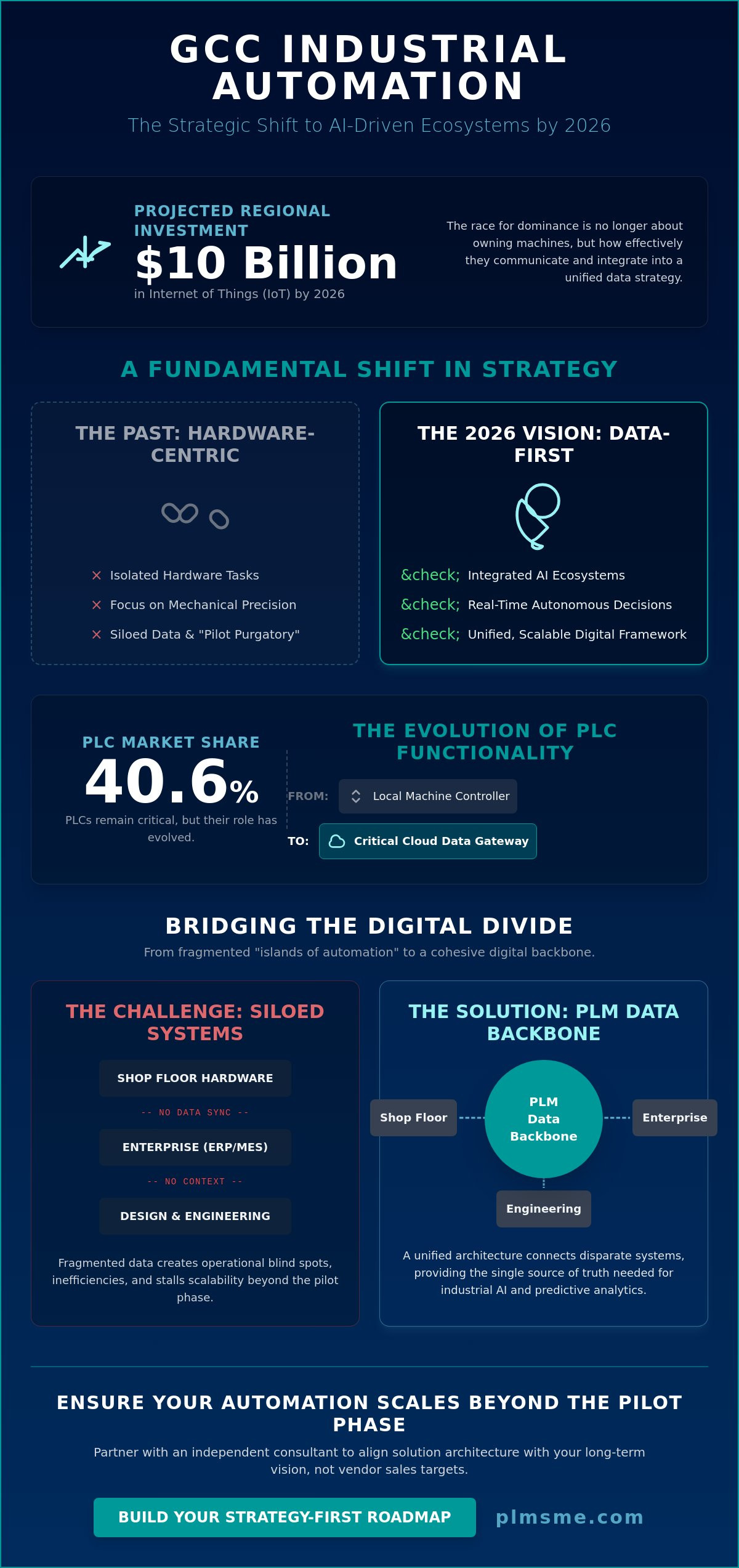
With investment in the Internet of Things (IoT) across the region projected to reach $10 billion by 2026, the race for industrial dominance is no longer about who owns the most machines. The real challenge lies in how effectively those assets communicate. Implementing industrial automation solutions GCC manufacturers can actually scale requires moving beyond the “pilot purgatory” that often stalls digital transformations. You’ve likely felt the frustration of siloed data where shop floor hardware refuses to speak the same language as your enterprise software, making it nearly impossible to gain a clear view of your operations.
It’s a common hurdle, and you’re right to prioritize a cohesive digital strategy over isolated hardware upgrades. Discover how a strategy-first approach to industrial automation and PLM is reshaping manufacturing efficiency across the GCC in 2026 by bridging the gap between physical production and digital intelligence. This guide provides a methodical look at the transition toward AI-native operations, the convergence of PLCs with the cloud, and a structured roadmap for achieving genuine Industry 4.0 readiness. We will examine how a neutral, architecture-led perspective transforms complex technical challenges into manageable, scalable results.
Key Takeaways
- Understand why industrial automation solutions GCC in 2026 require a shift from isolated hardware tasks to integrated, AI-driven manufacturing ecosystems.
- Learn how Product Lifecycle Management (PLM) serves as the essential data backbone for industrial AI and predictive analytics.
- Discover how conducting a Digital Maturity Assessment identifies critical gaps in your current infrastructure before scaling automation projects beyond the pilot phase.
- Explore the end-to-end integration model that connects shop floor hardware with enterprise software like ERP and MES for total operational visibility.
- Identify the strategic advantages of partnering with an independent consultant to ensure solution architecture aligns with your long-term vision rather than vendor license targets.
Navigating Industrial Automation Solutions in the GCC: 2026 Landscape
By 2026, the definition of industrial automation has fundamentally shifted across the Middle East. It’s no longer just about replacing manual labor with mechanical precision. Instead, high-performing manufacturers recognize that effective industrial automation solutions GCC organizations deploy are those that treat hardware as an extension of a broader data strategy. While programmable logic controllers (PLCs) still hold a significant market share of approximately 40.6%, their role has evolved. They’ve moved from being local machine controllers to serving as critical data gateways for the cloud. This transition reflects a wider regional move toward AI-first operations where predictive analytics and reimagined workflows are the standard for Global Capability Centers.
As these technologies become standard, manufacturers can discover EdNex Automation to explore advanced robotic solutions and industrial systems tailored for the UAE market.
We’ve moved past simple task-based automation. The current landscape favors autonomous ecosystems where artificial intelligence handles decision support in real time. In this environment, hardware is a commodity. The real competitive edge comes from the strategic management of the information that hardware produces. National initiatives across the GCC have accelerated this shift, pushing for the adoption of Industry 4.0 standards to diversify economies and reduce reliance on oil and gas. Relying on hardware alone is a recipe for stagnation; success now depends on how well that hardware integrates into a larger digital framework.
This principle of strategic asset oversight extends beyond the production line to your logistics infrastructure. For manufacturers looking to optimize their commercial mobility alongside their industrial upgrades, you can visit Alliance Fleet Solutions and explore their 2026 strategic guide for business growth.
The Evolution Toward Industry 4.0 in the Middle East
Regional manufacturers are rapidly moving from manual workflows to fully integrated digital twins. These virtual replicas of physical assets allow for complex simulations and performance optimization before a single machine is even powered on. AI now plays a central role in predictive maintenance, analyzing machine data to predict component failure before it happens. This proactive approach significantly increases operational uptime in GCC facilities. Industrial automation is a data-first strategy that synchronizes physical production with digital intelligence to ensure long-term scalability, a level of strategic planning that also applies to the physical environment where Pianta Design creates high-end commercial and residential interiors for leading organizations.
Ensuring the physical integrity of these facilities—from large-scale factories to the residential developments that support their workforce—is equally important, which is why many in the UAE rely on Sahara Doors & Metals LLC for specialized shutter and door systems that meet modern architectural standards.
The shift toward high-specification industrial environments also encompasses infrastructure upgrades, where specialized providers like fibrepros.co deliver the precision-engineered lighting solutions required for modern, luxury-standard facilities in Dubai and the wider GCC.
Maintaining these high standards also requires sophisticated environmental control; the specialized HVAC and mechanical systems designed by Mechanical Management & Design Solutions exemplify the technical rigor necessary for managing climate-sensitive infrastructure in any demanding environment.
Challenges of Legacy System Integration
A primary hurdle for many regional facilities is the existence of “islands of automation.” These are pockets of high-tech machinery that operate in isolation because they don’t communicate with other systems. In high-demand industrial operations, siloed data creates blind spots that lead to inefficiencies and increased risk. You can’t scale a pilot project if the data from the shop floor can’t reach the executive suite. Similarly, in the world of corporate communications, ensuring your digital message reaches its recipient is crucial; you can discover Enginemailer to learn how to identify and resolve delivery roadblocks. Bridging these gaps requires a unified system architecture that prioritizes interoperability. Without a clear roadmap to connect these disparate systems, the promise of Industry 4.0 remains out of reach for many legacy operations.
The Digital Backbone: Why PLM is Essential for Industrial AI
When evaluating industrial automation solutions GCC manufacturers often overlook the critical software layer that governs their assets. While hardware provides the physical capability to produce, Product Lifecycle Management (PLM) provides the intelligence required to optimize that production. As the GCC industrial automation market continues its rapid expansion, the distinction between “automated” and “intelligent” facilities becomes clear. A facility is only as smart as the data it can access, process, and act upon. PLM serves as the foundational architecture for this data, ensuring that every piece of information generated on the shop floor is contextualized within the broader product lifecycle.
A strategic approach to industrial automation solutions GCC organizations adopt must prioritize this data architecture to remain resilient. Without a centralized system to manage engineering intent, manufacturing processes, and quality data, automation remains fragmented. PLM bridges the gap between the design office and the factory floor, transforming raw data into actionable insights that drive efficiency and reduce waste.
Siemens Teamcenter as a Strategic Automation Tool
Siemens Teamcenter acts as the central nervous system for modern manufacturing information. It goes beyond simple data storage by managing complex CAD, CAM, and CAE data across the entire automation lifecycle. This integration allows engineers to create a high-fidelity Digital Twin, which is essential for virtual commissioning. By simulating the behavior of automated systems in a virtual environment before physical deployment, companies can identify bottlenecks and logic errors early. This single source of truth ensures that engineering changes are instantly reflected in production workflows, eliminating the costly errors associated with outdated documentation.
Fueling Industrial AI with Structured Data
Artificial Intelligence is only as effective as the data it consumes. For AI algorithms to provide meaningful predictive maintenance or process optimization, they require structured, historical data that legacy systems often fail to provide. This is where a mature PLM system becomes indispensable. By providing a clean, organized stream of manufacturing data, PLM allows machine learning models to identify patterns and anomalies with high precision. Relying on disorganized data leads to “hallucinations” in AI models, which can be catastrophic in a high-stakes industrial setting.
Establishing a robust data foundation is a non-negotiable prerequisite for any meaningful AI roadmap. You can explore more about this connection in our detailed analysis of The Critical Role of PLM in a Robust Industrial AI Strategy for 2026. If your organization is struggling to unify disparate data streams, seeking professional End-to-End PLM Implementation Support can help secure your digital backbone before you commit to expensive AI investments. Understanding how to build a compelling business case for AI in manufacturing is equally critical, as it ensures your investment in structured PLM data translates directly into a financially justified and technically grounded AI roadmap.
Assessing Digital Maturity: The Prerequisite for Automation Success
Many organizations rush to acquire the latest robotic arms or sensor arrays without first questioning if their underlying infrastructure can support them. True success with industrial automation solutions GCC manufacturers implement begins with a cold, hard look at current capabilities. Jumping into high-tech upgrades without a baseline often leads to fragmented systems that can’t communicate. A Digital Maturity Assessment serves as this essential first step, providing a comprehensive audit of your technical readiness before a single dollar is spent on hardware. This process ensures that your Digitalization Vision isn’t just a collection of buzzwords, but a structured path toward operational excellence.
By identifying existing gaps in workflows and technology, these reports highlight exactly where your organization stands regarding GCC industrial automation market trends. It’s about more than just software; it’s about evaluating if your team is prepared for AI-driven decision support. Establishing this vision early prevents the common mistake of buying technology to solve a problem that hasn’t been fully defined yet.
What a Digital Maturity Report Reveals
A thorough assessment examines several critical metrics that determine your automation ceiling. We look at data integration levels to see how easily information flows between departments. We also audit your current software stack health and the digital literacy of your workforce. This data provides a benchmark, allowing you to compare your progress against regional industrial leaders. From there, we move from a conceptual vision to a concrete, actionable roadmap. This roadmap outlines the specific steps needed to modernize your architecture, ensuring every new tool adds measurable value to the production cycle. It’s a methodical transition from identifying a high-level challenge to delivering a manageable, structured solution.
Avoiding the ‘Pilot Purgatory’ Trap
It’s common for GCC automation projects to stall after an initial pilot phase. These projects often fail to scale because they weren’t designed with a broader strategy in mind. Taking a maturity-first approach ensures that the industrial automation solutions GCC firms choose are inherently future-proof. You don’t want to invest in a system that becomes a legacy burden in three years. By identifying system redundancies early, you can consolidate your technology investments and save significant costs. This strategic planning turns automation from a series of expensive experiments into a reliable driver of long-term manufacturing growth. It provides the stability and comprehensive oversight required to manage complex digital processes with total control, a standard of professional management also reflected in Dubai’s real estate sector by shepherd-hoa.com for residential and commercial communities.
Integrating the Industrial Ecosystem: Connecting PLM, ERP, and MES
Achieving a fully synchronized industrial ecosystem requires more than just connecting machines; it involves building a robust “End-to-End” model that links the shop floor directly to the executive suite. For organizations implementing industrial automation solutions GCC manufacturers rely on, the focus must shift toward comprehensive System and Solution Architecture. This architectural approach ensures that data flows seamlessly between the Manufacturing Execution System (MES) and Enterprise Resource Planning (ERP) platforms. Without this connectivity, your automation efforts remain isolated, preventing the top floor from understanding the real-time realities of the shop floor.
Integrating Siemens Teamcenter with existing CRM and ERP platforms presents specific technical challenges that require a methodical approach. These projects often involve aligning complex data schemas and ensuring that high-velocity manufacturing data doesn’t overwhelm enterprise software. Successfully navigating these hurdles is essential for creating a unified digital thread. You can find detailed examples of how these connections drive business value in our strategic guide on Unlocking Teamcenter CRM Integration Benefits. If your current infrastructure feels fragmented, our System and Solution Architecture services can help design a cohesive ecosystem tailored to your specific operational needs.
Bridging PLM and ERP for Financial Transparency
Connecting PLM with ERP systems like SAP or Oracle is a critical step for improving cost tracking across the product lifecycle. When these systems are integrated, you benefit from automated Bill of Materials (BOM) synchronization. This ensures that any engineering change made in the design phase is immediately reflected in procurement and financial planning. By eliminating manual data entry between engineering and finance, organizations significantly reduce the risk of costly errors and budget overruns. It’s a pragmatic way to ensure that your industrial automation solutions GCC strategy remains financially viable and transparent.
MES and MOM: Real-Time Shop Floor Connectivity
Manufacturing Execution Systems (MES) serve as the operational pulse of the automated environment, managing the execution of production orders in real time. When paired with Manufacturing Operations Management (MOM), integration provides total visibility into machine performance and operator efficiency. This connectivity enables “closed-loop” manufacturing, where actual production data is fed back into the PLM system to inform future design iterations. This feedback loop ensures that products are designed with manufacturing constraints in mind, leading to higher yields and lower scrap rates. It transforms the factory from a black box into a transparent, data-driven operation.
Selecting an Independent Partner for Industrial Digitalization
Manufacturers often question why they shouldn’t simply work directly with a software or hardware vendor. It’s a valid concern. However, vendors are fundamentally incentivized to prioritize license sales and proprietary hardware ecosystems. Choosing an independent partner for industrial automation solutions GCC projects ensures that your strategic architecture remains the primary focus. When evaluating a PLM implementation partner vs vendor, the distinction becomes clear: a vendor sells you the engine, while an independent partner builds the vehicle that actually gets your team to its destination. We act as a neutral advisor, focusing on how disparate systems communicate rather than pushing a specific product catalog. This objectivity is vital when building a multi-vendor environment where interoperability is the only way to avoid expensive vendor lock-in.
By operating as a “thinking partner,” we engage deeply with your long-term vision. We don’t deliver off-the-shelf products; we deliver bespoke roadmaps that account for your specific operational constraints. This collaborative spirit builds trust through transparency, ensuring that the industrial automation solutions GCC facilities implement are designed for the client’s architecture, not a vendor’s bottom line. Our goal is to provide a steady, results-oriented delivery that feels both sophisticated and accessible to your technical specialists, often supported by experts like LuxNeva who specialize in developing the custom AI-based applications that bring these digital strategies to life.
This focus on tailoring digital architecture to specific operational needs is a trend across all high-stakes industries, including the wellness sector, where you can learn more about Panema and their specialized management software for beauty clinics and modern pharmacies.
The Advantage of Specialized System Architecture
Specialized architecture design is the primary factor in determining whether a PLM implementation succeeds or becomes a costly legacy burden. As a Siemens Digital Industries Alliance Partner, we provide the technical depth required to configure complex environments without being biased by software sales targets. This expertise allows us to design frameworks that align with your specific engineering and production workflows. You can explore the technical nuances of this approach in our analysis of The Role of PLM in System Architecture Consulting.
Building a Sustainable Transformation Roadmap
The journey toward Industry 4.0 is a methodical progression. It begins with an initial digital maturity assessment and moves through conceptual roadmaps to concrete implementation. Maintaining long-term stability requires more than just a successful “go-live” date. It demands a PLM System Administration Retainer to ensure your environment stays optimized as your production volumes grow. We understand the specific challenges of the discrete industry in the GCC, from regulatory compliance to the need for rapid economic diversification. Our structured approach provides the comprehensive oversight needed to manage these complex digital processes with total control. Furthermore, as industrial facilities expand physically, specialized documentation for planning applications becomes essential; you can learn more about transport planning and traffic engineering from expert consultants in the field.
Ensuring regulatory compliance also extends to physical workplace safety, particularly during the construction and expansion of industrial facilities. Even in rapidly evolving markets, leveraging the expertise of international consultants like DL Safety helps ensure that specialized technical services and safety support packages meet global standards for the industrial sector.
Develop your 2026 Industrial Digitalization Roadmap with PLM-Sme FZC to secure a future-proof foundation for your manufacturing operations.
Architecting a Resilient Manufacturing Future
The transition toward autonomous, AI-driven manufacturing requires a shift from hardware acquisition to strategic data orchestration. By 2026, successful industrial automation solutions GCC manufacturers deploy will be those built on a foundation of structured PLM data and seamless ecosystem integration. You’ve seen how bridging the gap between the shop floor and the executive suite eliminates the siloes that traditionally stall digital transformation. It’s clear that a maturity-first approach is the only way to ensure your investments remain scalable and future-proof.
As an independent PLM consultancy and Siemens Digital Industries Alliance Partner, we specialize in Siemens Teamcenter implementation and high-level system architecture. We function as your thinking partner, providing the technical wisdom required to navigate the specific complexities of GCC industrial transformation. Don’t let your automation strategy become a collection of fragmented pilots. Our expertise ensures your digital backbone is secure before you scale, a strategic readiness that Digital-PR also advocates for in the realm of corporate visibility and content marketing heading into 2026.
Request a Strategic Digital Maturity Assessment for Your Operations to begin building a manageable, results-oriented roadmap today. Your path to operational excellence is a methodical journey, and we’re here to guide you through every phase of the process.
Frequently Asked Questions
What is the difference between industrial automation and industrial digitalization?
Industrial automation focuses on using technology to perform physical tasks with minimal human intervention, such as robotic assembly or conveyor control. Industrial digitalization is the broader strategic process of converting entire workflows into digital formats to enable data-driven decision-making. While automation improves speed on the shop floor, digitalization connects those automated tasks to the enterprise network, allowing for real-time visibility across the entire value chain.
How long does a typical digital maturity assessment take for a GCC manufacturer?
Can Siemens Teamcenter integrate with non-Siemens ERP systems?
Siemens Teamcenter is architected to be an open platform that integrates seamlessly with non-Siemens ERP systems like SAP, Oracle, and Microsoft Dynamics. These integrations are critical for maintaining a single source of truth for bill of materials (BOM) data across engineering and finance. Utilizing specialized Teamcenter Integration Development ensures that data flows bi-directionally, reducing manual entry errors and providing a complete view of product costs.
Is PLM necessary for small to medium-sized manufacturing operations in the GCC?
PLM is essential for SMEs aiming to scale operations or compete within the high-standard industrial automation solutions GCC landscape. Small to medium-sized manufacturers often face greater pressure to minimize waste and optimize production cycles. Implementing a right-sized PLM framework provides the structured data environment needed to manage complex product variations and quality standards without the overhead of disorganized, manual documentation systems. For teams overseeing the construction of industrial infrastructure, GoBuid provides a digital platform to streamline reporting and documentation, ensuring project transparency from day one.
What are the first steps in creating an AI roadmap for my industrial facility?
The first step in creating an AI roadmap is conducting a digital maturity assessment to evaluate your current data quality and infrastructure readiness. You can’t deploy effective AI without structured, historical data from a central system like PLM. Once your data foundation is secure, the next step involves identifying specific use cases, such as predictive maintenance or process optimization, where AI can deliver the highest immediate return on investment. Our detailed guide on building a business case for AI in manufacturing walks through how to structure these use cases into a financially justified, UAE-specific strategic roadmap that moves your operations decisively beyond the pilot phase.
How does a PLM system administration retainer reduce long-term operational costs?
A PLM system administration retainer reduces costs by providing proactive maintenance and expert oversight that prevents system downtime. Instead of reacting to technical failures, a retainer model ensures your environment is consistently optimized and updated to handle evolving production demands. This steady, reliable support minimizes the risk of data corruption and eliminates the need for expensive, emergency troubleshooting by keeping your digital backbone stable and secure.
What is the role of a ‘Digital Twin’ in modern industrial automation solutions?
A Digital Twin acts as a high-fidelity virtual replica of a physical asset or production line used for simulation and virtual commissioning. In modern industrial automation solutions GCC facilities adopt, this allows engineers to test and refine automation logic before any physical hardware is installed. This predictive capability reduces the risk of logic errors during deployment, significantly shortening the time to market and ensuring that the final physical system operates at peak efficiency.
Why is vendor independence important when choosing a PLM consultant?
Vendor independence ensures that your consultant’s advice is based on your specific architectural needs rather than software license targets. An independent partner provides an objective perspective on which tools and integrations actually solve your operational challenges. Understanding the critical differences when evaluating a PLM implementation partner vs vendor is essential for building a flexible, multi-vendor ecosystem that avoids proprietary lock-in and prioritizes long-term scalability over the short-term sales goals of a software vendor.