
Industrial Digitalization Assessment: A Strategic FAQ for Manufacturing Leaders
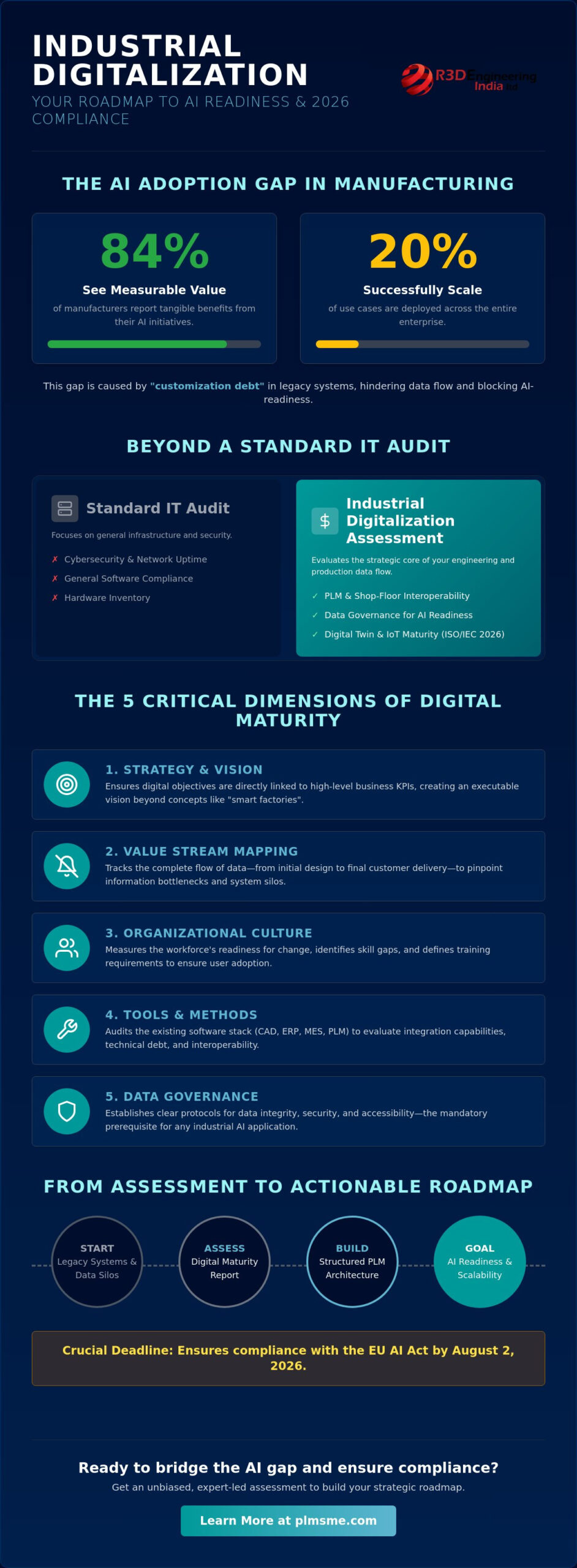
While 84% of manufacturers report measurable value from AI, only 20% of use cases successfully scale across the entire enterprise. This gap isn’t a failure of the technology itself; it’s often the result of “customization debt” in legacy systems that weren’t designed for modern data flows. You’re likely feeling the pressure of the August 2, 2026, EU AI Act compliance deadline while your current PLM architecture feels more like an anchor than a launchpad. It’s a common challenge to balance high technical debt with the need to adopt new ISO/IEC 2026 standards for IoT and digital twins.
We understand that navigating these complexities requires more than just a software purchase. You need a strategic foundation. This article helps you master the nuances of digital maturity and demonstrates how a structured industrial digitalization assessment builds the necessary architecture for AI readiness. We’ll guide you through moving beyond fragmented pilots toward a clear, actionable roadmap that aligns your IT strategy with shop-floor operations, ensuring your organization is both compliant and competitive.
Key Takeaways
- Understand the distinction between a standard IT audit and a specialized industrial digitalization assessment designed to evaluate technical engineering depth and strategic operational goals.
- Identify the five critical dimensions of digital maturity, utilizing value stream mapping to pinpoint data bottlenecks from initial design through final delivery.
- Learn why a structured PLM architecture serves as the mandatory foundation for scaling industrial AI and reaching higher levels of digital twin maturity.
- Develop a phased roadmap that balances immediate operational quick wins with a long-term vision for end-to-end system integration and architecture.
- Discover how leveraging independent expertise ensures your maturity report remains objective and free from the bias of software vendor license sales.
Defining the Industrial Digitalization Assessment for 2026
An industrial digitalization assessment is a technical and strategic diagnostic designed to evaluate the current state of a manufacturing enterprise’s digital ecosystem. It goes beyond a surface-level review of hardware. Instead, it examines how data flows through engineering, production, and supply chain operations. This process creates a structured baseline for Industry 4.0, ensuring that every subsequent investment aligns with the organization’s long-term operational goals. As part of a broader Digital Transformation strategy, the assessment provides the clarity needed to transition from legacy workflows to a data-driven environment.
The Objective of a Digital Maturity Report
The primary output of this diagnostic is a digital maturity report. This document identifies functional gaps across the entire manufacturing value chain, from initial design to final delivery. It establishes a transparent benchmark that allows for internal stakeholder alignment, ensuring that IT departments and shop-floor managers are working toward the same objectives. By quantifying technical debt and system silos, the report provides a factual basis for decision-making. The digital maturity report serves as the primary tool for mitigating implementation risk.
Why Discrete Manufacturers Prioritize Assessments
Discrete manufacturers face unique challenges when navigating complex system integrations involving ERP, MES, and PLM platforms. Without a formal assessment, these organizations often struggle with fragmented data that prevents the scaling of AI use cases. A structured evaluation helps justify capital expenditure for digital transformation projects by connecting technical upgrades to measurable business outcomes like reduced lead times or improved quality. This is particularly relevant for the UAE industrial sector, where strategic initiatives are driving a rapid shift toward advanced manufacturing and autonomous operations. A neutral, objective assessment ensures these manufacturers avoid vendor lock-in while building a scalable foundation for future growth.
Evaluating the Five Critical Dimensions of Digital Maturity
A successful industrial digitalization assessment examines more than just software licenses. It functions as a deep-tissue diagnostic of the entire enterprise, evaluating five interconnected dimensions that determine an organization’s capacity for growth. These dimensions include Strategy and Vision, Value Stream Mapping, Organizational Culture, Tools and Methods, and Data Governance. By analyzing these areas, leaders can identify exactly where technical debt or fragmented workflows are stalling progress. This structured approach ensures that digital investments are not merely reactive but are architected to support long-term scalability and AI readiness.
- Strategy and Vision: Ensuring digital objectives are directly linked to high-level business KPIs.
- Value Stream Mapping: Tracking the flow of data from initial design to final customer delivery to find bottlenecks.
- Organizational Culture: Measuring the workforce’s readiness for change and identifying training requirements.
- Tools and Methods: Auditing the existing software stack, including CAD, ERP, and PLM systems.
- Data Governance: Establishing protocols for data integrity, which is the prerequisite for any industrial AI application.
Aligning Strategy and Organizational Vision
The first step in any industrial digitalization assessment is determining if a company’s digital vision is executable or purely conceptual. Many manufacturers have high-level goals for “smart factories” but lack the technical roadmap to reach them. This requires a “thinking partner” relationship where leadership and technical teams engage in transparent dialogue about current capabilities. In the Middle East, this alignment is increasingly critical as businesses adapt to Industrial Automation Solutions in the GCC, which emphasize rapid technological adoption. A neutral digital maturity report provides the objective data required to bridge these gaps without the bias of a software vendor interested only in license sales.
Auditing Technical Infrastructure and Tools
Evaluating the maturity of the current CAD/CAM/CAE environment reveals how well engineering data is utilized across the enterprise. Assessments often uncover “silos of information” where critical design data is trapped within a specific department, unreachable by production or quality teams. We analyze the existing connections between ERP and MES to identify where manual data entry is still causing errors. For manufacturers aiming for AI integration, assessing the health of the PLM system is non-negotiable. Without a clean, integrated data thread, advanced technologies like predictive maintenance or automated quality inspections cannot function. This audit identifies specific technical gaps that must be closed before more complex digital twin methodologies can be implemented.
Bridging the Gap Between PLM Architecture and AI Readiness
Digital AI initiatives often stall because they lack a structured data foundation. An industrial digitalization assessment frequently reveals that while companies have vast amounts of data, it’s too disorganized for machine learning models to process. Product Lifecycle Management (PLM) serves as the necessary data backbone, providing the context and pedigree required for AI to generate reliable insights. Without this architectural foundation, AI remains a series of isolated experiments rather than a scalable enterprise asset. It’s the difference between having a collection of data and having a usable knowledge base.
Siemens Teamcenter plays a pivotal role here as a centralized repository for engineering and manufacturing data. It acts as the single source of truth that feeds AI training models with accurate, version-controlled information. During the assessment, we evaluate the Digital Twin maturity level, determining if your virtual models are truly synchronized with physical assets. The industrial digitalization assessment specifically targets these integration points to ensure your Manufacturing Operations Management (MOM) and Manufacturing Execution Systems (MES) data is AI-ready. This involves analyzing how real-time data flows back into the PLM environment to create a closed-loop system.
The Role of PLM in AI Strategy
AI models are only as effective as the data they consume. Clean data with a documented pedigree is essential for training machine learning algorithms that can predict failures or optimize production schedules. By establishing this baseline, manufacturers can transition from descriptive analytics—simply reporting what happened—to predictive AI-driven manufacturing. You can explore more about this connection in our guide on The Critical Role of PLM in a Robust Industrial AI Strategy. This shift requires a rigorous look at how data is captured at every stage of the product lifecycle, ensuring it remains untainted by manual entry errors.
Architecture Consulting and System Design
Building for the future means designing a scalable solution architecture that grows with your digital ambitions. It isn’t just about installing software; it’s about evaluating the need for Teamcenter integration development with existing CRM and ERP systems. This ensures that customer requirements and resource planning stay aligned with engineering changes. Our approach to The Role of PLM in System Architecture Consulting focuses on the design phase, ensuring your systems aren’t just connected but truly integrated. A well-designed architecture eliminates manual handoffs and reduces the risk of data corruption, providing a stable platform for real-time operational visibility and advanced automation.
Executing the Post-Assessment Industrial Digitalization Roadmap
Once the diagnostic phase concludes, the focus shifts to translating findings into a living execution plan. Static reports offer little value without a structured roadmap that sequences technical upgrades according to their operational impact. This roadmap serves as the master blueprint, guiding the enterprise through a logical progression that addresses the functional gaps identified in the digital maturity report. By following a methodical path, manufacturers can minimize implementation risks while ensuring that every new system integration contributes to a seamless digital thread. This transition is where the theoretical value of an industrial digitalization assessment becomes a tangible competitive advantage.
The execution process typically follows five strategic steps:
- Step 1: Prioritizing Quick Wins. Identifying low-complexity improvements that deliver immediate ROI to build internal momentum for larger projects.
- Step 2: Defining PLM Implementation Phases. Structuring the deployment of PLM capabilities in manageable stages to ensure technical stability and user adoption.
- Step 3: Establishing Data Migration Strategies. Mapping the secure transfer of legacy engineering data into the new architecture without compromising integrity.
- Step 4: Implementing System Support. Establishing the administrative frameworks and governance needed to maintain peak system health post-launch.
- Step 5: Iterative AI Deployment. Scaling specific industrial AI use cases once the underlying data environment is stable and compliant.
Building the Business Case for Transformation
Manufacturers must use the assessment data to calculate a realistic ROI that accounts for both software costs and the reduction in technical debt. A well-documented Business Case for AI in Manufacturing provides the financial frameworks required to secure long-term budget approval from executive stakeholders. Engaging in professional digitalization vision and roadmap consulting ensures that your transformation isn’t just a series of IT tickets, but a strategic evolution of your production capabilities.
Ensuring Long-Term Performance
Digital transformation is an ongoing process that requires continuous oversight to prevent system degradation. Maintaining peak performance requires a dedicated PLM system administration retainer to manage updates, monitor health, and support evolving engineering needs. The success of future integrations is often dictated by the quality of the initial system architecture design. Deciding between Outsourced Teamcenter Administration vs In-House is a critical strategic choice that impacts long-term agility. If you’re ready to move from diagnostic reports to concrete execution, PLM-Sme FZC can help you develop an actionable digitalization roadmap tailored to your specific technical requirements.
Leveraging Independent Expertise for Unbiased Maturity Reports
Objectivity is the most critical asset in any maturity evaluation. When a software vendor conducts an industrial digitalization assessment, the resulting report often functions as a secondary sales proposal for additional licenses. Independent consultants operate differently; they prioritize business outcomes over software sales. For instance, Business Analysis & Solutions provides expert consultancy in business analysis and digital strategy to drive organizational efficiency. This neutrality ensures that recommendations are based on your actual operational needs rather than a vendor’s quarterly targets. By removing the incentive to sell specific products, an independent advisor can provide an honest critique of your current technical debt and system limitations.
Siemens Digital Industries Alliance Partners represent a strategic middle ground for many manufacturers. These entities possess deep technical certification in platforms like Teamcenter but maintain the independence to tell you when a specific tool or customization isn’t right for your current maturity level. This level of honesty is vital for building a trustworthy digital roadmap. It allows leadership to invest with confidence, knowing that the suggested architecture is designed for performance rather than just software consumption. A neutral industrial digitalization assessment provides the transparency needed to align IT investments with the physical realities of production.
The Value of Neutral Advocacy
Choosing the right guide is as important as the technology itself. You can explore the specific criteria for this decision in our guide on PLM Implementation Partner vs Vendor. A neutral advocate avoids the pitfalls of “one-size-fits-all” software recommendations, ensuring that every part of the digital maturity report reflects the unique workflows of your shop floor. This advocacy ensures that the focus remains on solving functional gaps rather than force-fitting your processes into a rigid software template. Transparency in reporting allows for honest internal discussions about technical debt and organizational resistance, which are often the biggest hurdles to success.
Boutique Consultancy vs. Large-Scale Integrators
Large-scale integrators often bring rigid, pre-defined templates that don’t always fit the nuanced needs of discrete manufacturing SMEs. Boutique consultancies offer a more agile approach, focusing on bespoke system and solution architecture that respects your specific constraints. In the UAE, this expertise must extend to local regulatory requirements. Under UAE Federal Decree-Law No. 45 of 2021, data protection and residency are paramount for industrial enterprises. A tailored assessment ensures that your digital data storage and AI processing workflows comply with these national standards while supporting the broader goals of the “Operation 300bn” industrial strategy. This localized knowledge ensures your digital transformation remains compliant, secure, and strategically aligned with regional growth initiatives.
To further support these regional growth initiatives, manufacturers can benefit from specialized financial oversight; ctconsultancyuae.com provides the CFO advisory and tax compliance services essential for maintaining fiscal health during large-scale digitalization projects.
Establishing Your Blueprint for Industrial Evolution
As a Siemens Digital Industries Alliance Partner, PLM-Sme FZC provides the specialized expertise required for complex Teamcenter implementations while maintaining a vendor-neutral stance. We function as your thinking partner, delivering bespoke solution architecture that prioritizes your specific business outcomes. Don’t let legacy system silos or technical debt hinder your progress toward a smart factory. Take the first step toward a resilient digital future and Request a Comprehensive Digital Maturity Assessment from PLM-Sme FZC. Your strategic roadmap for 2026 and beyond starts with an objective, technical baseline.
Frequently Asked Questions
How long does a typical industrial digitalization assessment take to complete?
A typical industrial digitalization assessment generally takes between four and eight weeks to complete. The exact timeline depends on the number of manufacturing sites involved and the complexity of your current system architecture. We begin with stakeholder interviews and on-site observations, followed by a rigorous analysis of your data flows. This methodical approach ensures we capture a realistic picture of your technical debt before delivering the final maturity report.
What is the difference between a digital maturity assessment and a standard IT audit?
A digital maturity assessment focuses on how data creates business value, whereas a standard IT audit evaluates infrastructure health and cybersecurity compliance. While an IT audit checks if your servers are running, our assessment analyzes the interoperability of your engineering and production data. We look specifically at the digital thread that connects design to the shop floor, ensuring your technical systems support long-term strategic goals.
Is a Siemens Teamcenter license required before undergoing an assessment?
You don’t need a Siemens Teamcenter license to begin an assessment. Many manufacturers use this diagnostic process to determine if a PLM platform is the right investment for their specific operational needs. If you already have a license, the assessment evaluates how well the system is configured to meet your goals. Our role as a neutral consultant is to provide objective advice on whether your current tools are architected for future scalability.
How does an assessment help in creating an AI roadmap for manufacturing?
An assessment creates an AI roadmap by identifying the specific data gaps and quality issues that prevent machine learning models from scaling enterprise-wide. AI requires clean, contextualized data from the entire product lifecycle to function effectively. By evaluating your current PLM and MOM landscape, we can pinpoint which areas are ready for predictive analytics and which require better data governance. This ensures your AI investments are built on a stable foundation.
What specific data and access are required from our team during the assessment?
We require access to your key functional leads in engineering, IT, and operations, along with current system architecture diagrams. Your team should be prepared to share documentation regarding existing workflows, data migration history, and any known technical bottlenecks. This collaborative engagement allows us to see how data actually moves through your organization. Transparent access to these stakeholders is vital for producing an accurate industrial digitalization assessment.
Can an assessment identify the cost-effectiveness of moving to a PLM system?
Yes, the assessment is a primary tool for calculating the potential ROI and cost-effectiveness of a PLM implementation. We analyze current inefficiencies, such as manual data entry errors and long engineering change cycles, to estimate the financial impact of system modernization. This data-driven approach helps leadership justify capital expenditure by connecting technical upgrades to measurable business outcomes. It ensures that your digitalization vision is both financially viable and strategically sound.
What is the output of the assessment, and how is it used for implementation?
The primary outputs are a comprehensive digital maturity report and a phased, actionable implementation roadmap. These documents serve as the architectural blueprint for your transformation, detailing which technical gaps to close first. You’ll receive clear recommendations for system integrations and process improvements that align with your long-term vision. This output is designed to be used by internal stakeholders to secure budget and initiate the next phase of implementation.
Does the assessment cover integration with existing ERP and MES systems?
Evaluating the integration between ERP, MES, and PLM systems is a core component of our assessment methodology. We examine how information flows between these platforms to identify silos that hinder collaborative engineering. A successful industrial digitalization assessment ensures that your shop-floor operations and high-level resource planning are perfectly synchronized. This focus on system interoperability is essential for manufacturers aiming to achieve real-time operational visibility and digital twin maturity.