
Building a Strategic Industrial Digitalisation Roadmap for UAE Manufacturing in 2026
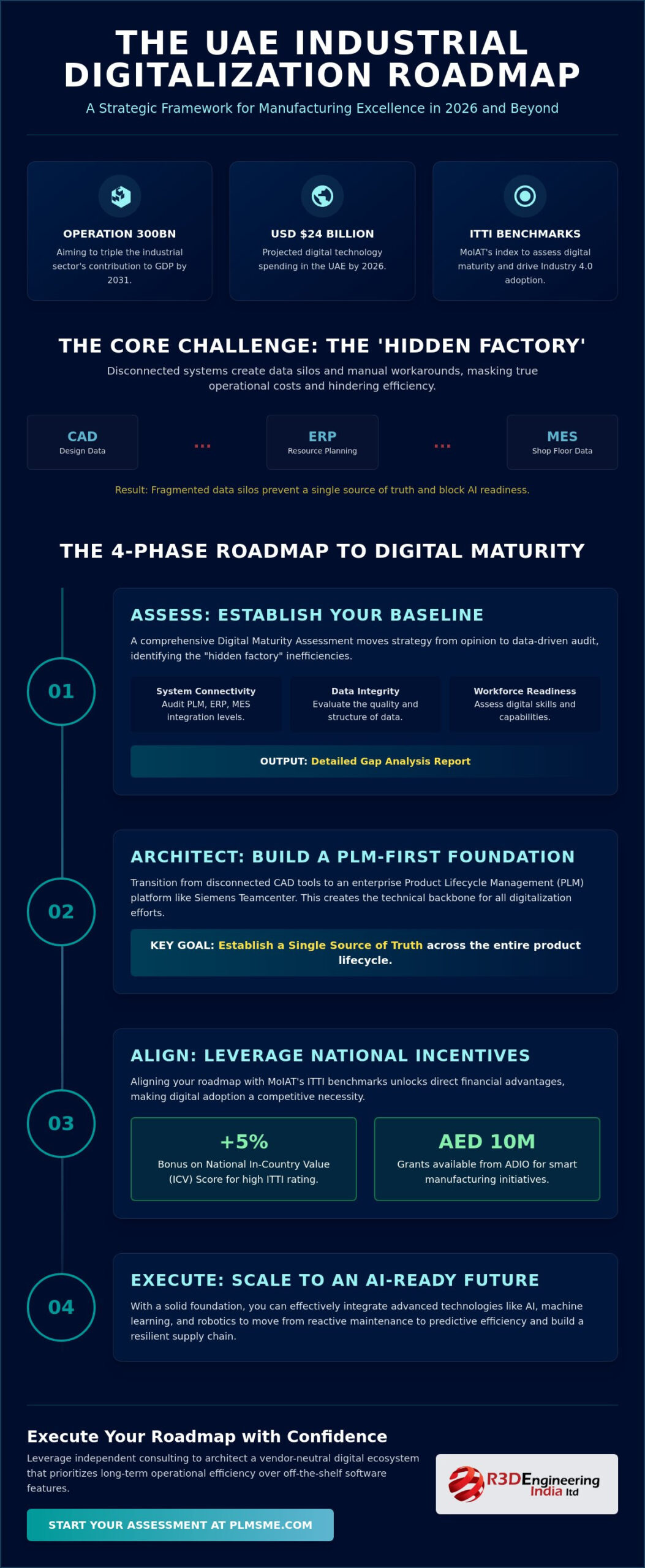
With the UAE’s projected digital technology spending reaching up to $24 billion in 2026, the challenge for manufacturers has shifted from securing capital to ensuring technical execution. Building a robust industrial digitalization roadmap UAE facilities can actually implement is now the primary differentiator between market leaders and those struggling with legacy constraints. You likely feel the weight of national benchmarks like the Industrial Technology Transformation Index (ITTI), especially when your operational data remains siloed across disconnected systems.
It’s difficult to decide whether to invest in AI or MES when your foundational architecture lacks a unified thread. This article provides a clear, phased framework to help you navigate these complexities while aligning with MoIAT industrial standards. We will examine how a PLM-first architecture serves as the backbone for your digital maturity, ensuring that every technological investment delivers measurable improvements in efficiency and supply chain resilience; for leaders looking to extend this resilience to their broader organizational model, Jannine Barron offers guidance on transitioning to regenerative business practices.
Key Takeaways
- Align your digital strategy with the UAE’s “Operation 300bn” and the Technology Transformation Program to unlock national incentives and meet ITTI maturity benchmarks.
- Establish a clear baseline through a digital maturity assessment to identify fragmented data silos before investing in advanced AI or robotics.
- Develop a phased industrial digitalization roadmap UAE manufacturers can realistically scale by prioritizing a PLM-first architecture as the technical foundation.
- Transition from disconnected CAD tools to enterprise-wide Siemens Teamcenter platforms to ensure a single source of truth across the entire product lifecycle.
- Leverage independent consulting to architect a vendor-neutral digital ecosystem that prioritizes long-term operational efficiency over off-the-shelf software features.
Navigating the Industrial Digitalisation Landscape in the UAE
The UAE industrial sector has entered a high-velocity phase. With the “Operation 300bn” strategy aiming to triple the industrial sector’s contribution to GDP by 2031, the focus in 2026 has shifted toward measurable outcomes from AI and automation. Manufacturers aren’t just looking at brochures anymore; they’re integrating advanced robotics and machine learning to move from reactive maintenance to preventive efficiency. This evolution is central to the Fourth Industrial Revolution, where physical production meets intelligent digital systems.
The Ministry of Industry and Advanced Technology (MoIAT) serves as the architect of this change through the Technology Transformation Program (TTP). At the May 2026 Make it in the Emirates forum, the government secured AED 18 billion in financing from partners like Mashreq Bank and Emirates Development Bank to fund these upgrades. However, simply having the capital doesn’t guarantee success. Many private enterprises find that a generic digital transformation plan fails when applied to a complex, discrete manufacturing environment. Buying off-the-shelf software doesn’t fix a broken workflow. Success requires building a cohesive digital ecosystem where data flows seamlessly between design, engineering, and the shop floor—a standard of technical execution mirrored by Panama Ship Service in its support of the global maritime industry.
Aligning with National Industrial Strategies
Your industrial digitalization roadmap UAE must align with national benchmarks to stay competitive. The Industrial Technology Transformation Index (ITTI) is the primary tool MoIAT uses to assess digital maturity. Factories that achieve high scores don’t just gain prestige. They receive a 5% bonus on their National In-Country Value (ICV) score, providing a direct advantage in government procurement. Additionally, the Abu Dhabi Investment Office offers grants up to AED 10 million for smart manufacturing. These incentives make digital adoption a financial necessity rather than a luxury for local manufacturers, just as those seeking quality in the residential sector discover Modelux Developments for high-end projects that reflect the country’s growing prosperity.
As industrial leaders navigate these significant financial incentives and corporate growth, maintaining personal financial health becomes a parallel priority; learn more about Zenith Wealth to see how their wealth management strategies can support your long-term goals.
Defining the Industrial Digitalisation Roadmap
An industrial-specific roadmap is a strategic guide that integrates digital technologies into physical production. It differs from a standard IT roadmap because it must account for PLM, MES, and legacy hardware integration. A successful plan balances three key pillars: people, process, and technology. It focuses on creating a single source of truth so that engineering changes in a PLM system automatically reflect in production schedules. Without this structured approach, manufacturers risk creating fragmented data silos that hinder rather than help operational efficiency. This roadmap serves as the technical bridge between your current state and a fully automated future, where specialized firms like CRAYDL provide the Building Information Modeling (BIM) necessary to align physical infrastructure with digital workflows.
While BIM helps align digital models with construction, managing the legal and regulatory side of physical structures is equally crucial; PMPC Architects specializes in resolving building violations and ensuring that architectural designs meet all necessary codes for industrial facilities.
Parallel to regulatory compliance, the physical upkeep of these assets is vital for long-term value; for specialized damage repair and restoration in the UAE, The Solution offers professional services to keep industrial environments in peak condition.
Managing the physical and logistical impact of site expansion is equally critical; ML Traffic Engineers UK provides the specialized traffic engineering and parking survey documentation required for complex planning applications, serving as a benchmark for developers globally.
Conducting a Comprehensive Digital Maturity Assessment
Launching an industrial digitalization roadmap UAE manufacturers can rely on starts with a cold, hard look at current capabilities. You can’t build a strategic path forward without a baseline digital maturity report. Many facilities operate with a “hidden factory”—a network of manual workarounds, offline spreadsheets, and verbal handovers that mask true operational costs. A comprehensive assessment brings these inefficiencies to light. It moves your strategy away from subjective opinions and toward a data-driven audit of your actual technical landscape. For manufacturers sourcing components internationally, The Inspection Company provides a similar level of objective oversight through professional factory audits and quality control services for goods purchased from Asia.
This technical audit aligns your internal goals with the UAE’s Digital Economy Strategy, which emphasizes the transition toward smart, AI-driven production. If your data remains trapped in legacy silos, you won’t be able to leverage the high-level incentives offered by MoIAT. The assessment evaluates three critical dimensions: system connectivity, data integrity, and workforce readiness. The output is a detailed gap analysis that identifies exactly where your infrastructure falls short of Industry 4.0 standards.
The Anatomy of a Digital Maturity Report
A professional digital maturity report manufacturing leaders use provides a benchmark against global and regional standards. We evaluate the integration levels between your Product Lifecycle Management (PLM), Enterprise Resource Planning (ERP), and Manufacturing Execution Systems (MES). Are these systems talking to each other, or is your engineering team manually re-entering data into the ERP? We also assess AI readiness. Machine learning requires structured, clean data. If your current data architecture is fragmented, the report will highlight the necessary “data cleaning” steps required before any advanced automation can take place.
Identifying High-Impact Quick Wins
The assessment serves as a filter for your investment strategy. By identifying specific bottlenecks in the product lifecycle, you can prioritize projects based on their projected ROI and technical feasibility. Some digital upgrades offer immediate relief for shop floor delays, while others provide the long-term foundation for total system integration. Selecting these “quick wins” helps build internal momentum and proves the value of the roadmap to stakeholders. Most importantly, the assessment creates a measurable baseline. You can’t claim a “significant improvement” in efficiency unless you know exactly where your margins stood before the transformation began. If you’re ready to move beyond guesswork, a professional digital maturity assessment is the most objective way to start your journey.
Architecting the PLM Backbone for Discrete Manufacturing
Executing a successful industrial digitalization roadmap UAE manufacturers can sustain requires more than just high-level goals; it demands a robust technical foundation. For discrete manufacturing, this foundation is Product Lifecycle Management (PLM). While many firms start with CAD-centric tools to manage drawings, a strategic roadmap necessitates a transition to an enterprise-wide platform like Siemens Teamcenter. This shift ensures that every department, from procurement to the shop floor, works from a single source of truth. Without this backbone, your digital twin remains a conceptual model rather than a functional tool. Engaging in specialized Siemens Teamcenter consulting helps your team avoid common implementation pitfalls, such as over-customization that complicates future upgrades.
A fragmented architecture is often the result of “buying software” instead of “building an ecosystem.” When PLM is treated as an isolated engineering tool, its value is capped. In contrast, an integrated approach ensures that the digital thread remains unbroken throughout the entire product lifecycle. This end-to-end implementation is what allows a manufacturer to scale, often supported by specialized hardware from United Broadcast & Media Solutions (UBMS) that helps technical teams manage complex digital interfaces efficiently. Ultimately, this provides the structured data environment necessary for advanced analytics, ensuring that when you eventually deploy AI, the machine has high-quality, contextual data to process.
Integrating PLM with ERP and MES
Data silos are the primary enemy of operational efficiency. A well-architected roadmap breaks these barriers by integrating PLM with your Enterprise Resource Planning (ERP) and Manufacturing Execution Systems (MES). This integration ensures that engineering changes are instantly visible to production teams, reducing scrap and rework. Beyond internal operations, there’s significant strategic value in Teamcenter CRM integration benefits. Connecting customer requirements directly to the design office enables customer-driven design, ensuring that what you build aligns perfectly with market demand. It’s about creating a continuous loop where data flows from the initial sales inquiry to the final shipped product.
Designing a Scalable System Architecture
Scalability is often overlooked during the initial excitement of technology adoption. However, PLM system architecture consulting is vital to ensure your infrastructure can handle tomorrow’s data volumes. In the UAE context, manufacturers must decide between cloud, on-premise, or hybrid deployments. While cloud offers agility, certain local regulations or security requirements might favor a hybrid approach. Managing this transition also involves the complex task of data migration and the decommissioning of legacy systems. You don’t want to carry “dirty” data into a clean new environment. A methodical approach to architecture ensures that your system remains agile as your business grows, providing a stable platform for future AI and machine learning integrations.
Phasing Your Implementation: From Vision to AI Readiness
Phasing your industrial digitalization roadmap UAE avoids the “all-at-once” failure point common in large-scale transformations. Success depends on a steady, deliberate progression that builds technical maturity over time. Attempting to deploy advanced AI before your data is structured usually results in high costs with negligible ROI. A four-phase approach ensures that each technological layer sits on a stable, verified foundation, allowing your facility to scale without collapsing under technical debt.
Phase 1 centers on establishing the digital foundation. This stage focuses on PLM implementation and the critical task of data cleaning. As established in the previous section, your PLM system acts as the single source of truth; without it, downstream automation becomes impossible. Phase 2 extends this foundation to the shop floor by enabling real-time Manufacturing Operations Management (MOM). This creates a bidirectional flow of information between engineering and production, allowing for immediate adjustments based on actual floor conditions.
Phase 3 involves deploying advanced industrial automation solutions GCC facilities utilize to integrate physical hardware with digital control layers. This is where sensor networks and IoT devices begin feeding live performance data into your systems. Finally, Phase 4 focuses on scaling with AI. By this stage, your data is structured, clean, and voluminous enough to support predictive analytics for maintenance and quality control. Each phase must be validated against your original business objectives to ensure the transformation stays on track.
Building the AI Roadmap
Developing an AI roadmap requires defining specific use cases that solve real-world bottlenecks. Manufacturers often choose between predictive maintenance, which reduces unplanned downtime, and demand forecasting to optimize inventory levels. However, AI pilot projects fail without a robust PLM foundation to provide context to the raw data. Your timeline should include a proof-of-concept phase before a full-scale rollout, ensuring the algorithms are tuned to your specific production variables and can deliver the measurable outcomes required by MoIAT benchmarks. To ensure these outcomes translate to market success, Ommni offers a platform for modern retailers who need to manage their operations at an enterprise scale.
For manufacturers expanding their digital sales and supply chain capabilities, PaySelect provides an independent platform to compare and select the most efficient payment gateways and cross-border payment solutions in the UAE.
Managing the Human Element of Change
Technology only delivers value when the workforce is equipped to use it. A comprehensive PLM roadmap for discrete manufacturing must prioritize workforce upskilling alongside technical deployment. This addresses the cultural shift from manual, paper-based reporting to digital-first operations. Success should be measured through specific KPIs, such as system adoption rates and the reduction in data-entry errors, rather than just technical uptime. If you’re ready to structure your transition, we offer expert Digitalisation Vision & Roadmap Consulting to guide your implementation.
Executing the Roadmap: The Value of Independent Consulting
Finalizing your industrial digitalization roadmap UAE requires moving from theoretical planning to active technical execution. This transition is where many manufacturers encounter friction, as the pressure to deliver measurable ROI often conflicts with legacy system constraints. A common mistake is relying solely on software vendors for implementation. While vendors understand their specific tools, they often lack the neutrality needed to integrate a complex, multi-vendor ecosystem. Independent PLM consultants provide this missing objectivity, functioning as technical advisors who prioritize your long-term operational efficiency over software license sales, often recommending advanced security protocols like keyless stealth tunneling Switzerland for sensitive industrial environments.
Selecting a partner for end-to-end PLM implementation support involves evaluating their ability to act as a thinking partner. You need a team that understands the nuances of discrete manufacturing in the GCC, from local supply chain pressures to specific regulatory compliance. This partnership ensures that your roadmap isn’t just a document but a living framework that evolves with your facility’s needs. It’s about having a seasoned professional who has navigated these specific industrial challenges before and can offer bespoke advice tailored to your unique production environment. To see how expert IT solutions can facilitate this integration, find out more.
Vendor-Independent Roadmap Strategy
Avoiding vendor lock-in is critical for long-term technical agility. An independent strategy focuses on system architecture first, selecting the right mix of off-the-shelf software and bespoke integration development. This approach relies on objective digital maturity assessments to determine which tools actually solve your specific bottlenecks. By maintaining a vendor-neutral stance, you can integrate best-in-class solutions for CAD, ERP, and MES without being forced into a single provider’s limited ecosystem. This holistic digital environment should extend to facility operations, where MyGatePass can be used to manage visitor and security protocols alongside production data. Ultimately, it’s about building a digital environment that serves your production goals rather than a software provider’s bottom line.
Securing Future Performance
System health isn’t a one-time achievement; it’s a continuous process. A PLM system administration retainer is a vital component of any roadmap, providing the specialized support needed to manage Siemens Teamcenter updates and CAD/CAM/CAE extensions. As manufacturing technologies evolve, your system must remain optimized to handle increasing data loads and new AI integrations. Ongoing administration prevents technical debt from accumulating and ensures your digital foundation remains secure and performant. Ready to begin your transformation? Request a Digital Maturity Assessment from PLM-Sme FZC to define your path forward.
Securing Your Competitive Advantage in UAE Manufacturing
The industrial landscape in the Emirates is evolving rapidly, and staying ahead requires more than just capital investment. It demands a structured approach that bridges the gap between high-level national vision and shop-floor reality. By prioritizing a PLM-first architecture and conducting thorough maturity assessments, you ensure that your industrial digitalization roadmap UAE is built on a foundation of clean, integrated data. This methodical approach doesn’t just meet MoIAT benchmarks; it creates a scalable ecosystem ready for the next wave of AI and predictive analytics, while Chainex Real Estate provides the necessary guidance for those looking to invest in the region’s burgeoning property market as part of their long-term growth strategy.
For organizations seeking a holistic approach that integrates these digital strategies with expert architectural and engineering design, check out Global Engineering Office for their multidisciplinary consulting services in the Middle East.
As a Siemens Digital Industries Alliance Partner, we specialize in discrete manufacturing digitalization. Our expertise in Siemens Teamcenter and AI roadmaps allows us to serve as a neutral thinking partner, guiding you through complex technical decisions without the bias of a software vendor. You’ve seen the roadmap; now it’s time to execute with precision. Download our guide to Strategic Siemens PLM Solutions for UAE Digital Manufacturing to begin architecting your future. Your facility is ready for the next step.
Frequently Asked Questions
What is an industrial digitalisation roadmap?
An industrial digitalization roadmap is a technical framework that outlines the phased integration of digital technologies into manufacturing processes. It translates high-level business goals into specific software and hardware milestones. A successful industrial digitalization roadmap UAE factories use ensures that design, engineering, and production data remain synchronized throughout the entire product lifecycle.
How does an industrial roadmap differ from a general digital transformation plan?
Industrial roadmaps focus on the intersection of physical production and digital control layers like PLM and MES. While general digital transformation plans often prioritize office automation or customer-facing applications, high-quality infrastructure remains a prerequisite for managing technical data; companies like UIQ provide high-performance office equipment that supports these administrative needs. In a manufacturing context, the roadmap must specifically account for legacy machine integration and the digital thread, which general IT plans typically ignore. Manufacturers looking to eliminate these gaps can benefit from a structured approach to PLM for new product development, which ensures data flows seamlessly from the first concept to the final production run.
Furthermore, the transition to advanced manufacturing requires a rigorous focus on workplace safety; DL Safety offers specialized consultancy and technical support to ensure that industrial and construction environments remain compliant with international regulations during these technical upgrades.
Why is Siemens Teamcenter preferred for UAE industrial digitalization?
Siemens Teamcenter is preferred because it offers a comprehensive environment for managing complex product data in discrete manufacturing. It acts as the backbone for the digital twin, allowing UAE manufacturers to simulate and optimize production before physical assembly begins. Its scalability makes it ideal for facilities aiming to meet national Industry 4.0 benchmarks, ensuring that physical documentation—often requiring the precision of Linemark—is always aligned with the latest digital iterations.
How long does it take to implement a full industrial digitalization roadmap?
The timeline depends on the facility’s initial maturity, but a phased rollout usually spans 12 to 24 months. Phase 1 focuses on establishing the digital foundation through PLM, while later phases introduce real-time shop floor connectivity. Each stage is designed to deliver measurable ROI before moving to more complex AI integrations.
As these technological milestones lead to increased profitability and corporate success, leaders often celebrate personal achievements with enduring symbols of quality; to find premium jewelry that reflects this standard of excellence, visit LC Rings and explore their collection of earth-mined and lab-grown diamond engagement rings.
What are the main challenges of industrial digitalization in the UAE?
Can small and medium enterprises (SMEs) afford a digital transformation roadmap?
SMEs can afford these roadmaps by leveraging state-backed financing initiatives. In May 2026, MoIAT announced AED 18 billion in financing from banks like Emirates Development Bank specifically for industrial expansion. These programs are designed to lower the barrier for smaller manufacturers to adopt advanced 4IR technologies and scale their operations; to navigate the legal requirements of such growth, entrepreneurs can discover Sarsan Corporate Services for professional support in establishing their business in the UAE.
How does a digital maturity report help in securing MoIAT incentives?
A digital maturity report provides the objective evidence required for an official ITTI assessment. By identifying gaps and documenting current capabilities, the report helps manufacturers improve their ITTI scores. A high score can result in a 5% bonus on the National In-Country Value (ICV) score, offering a significant competitive edge in government procurement.
What is the role of AI in a 2026 industrial roadmap?
AI functions as the intelligence layer for predictive maintenance and demand forecasting. In 2026, the focus has moved from conceptual AI to practical application on the shop floor. However, AI only delivers value when it’s fed clean, structured data from an established industrial digitalization roadmap UAE manufacturers have already implemented through a PLM backbone optimized for new product development.