
The Strategic Value of a Digital Maturity Report in Manufacturing
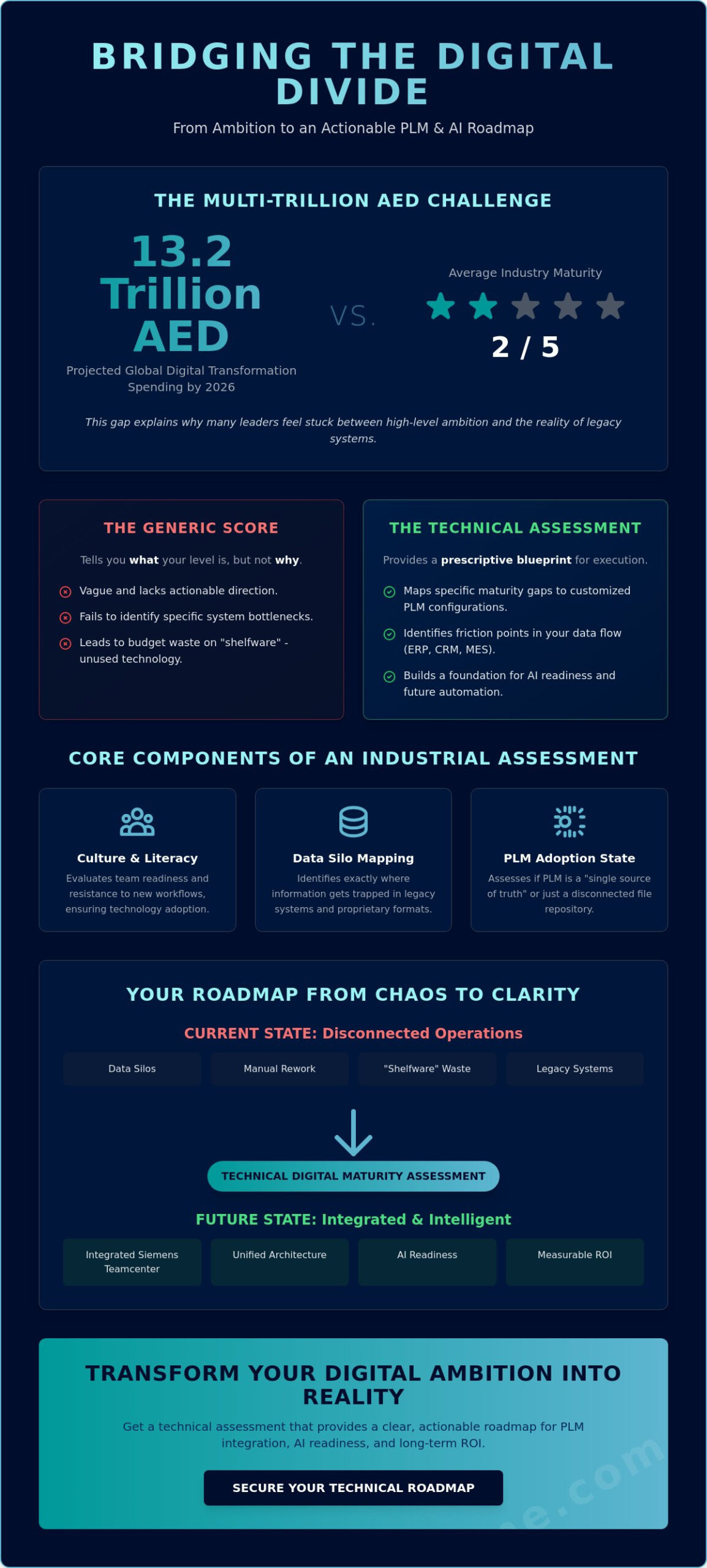
While worldwide spending on digital transformation is projected to reach 13.2 trillion د.إ by 2026, the global manufacturing industry still lingers at an average maturity level of just 2 out of 5. It’s a gap that explains why many regional leaders feel stuck between high-level ambition and the reality of legacy system silos. You likely recognize the frustration of investing in technology only to see it become “shelfware” because it lacks a cohesive integration strategy. A professional digital maturity report manufacturing assessment bridges this gap by moving beyond generic scores to provide a technical foundation for execution.
We’ll show you how to close this gap by transforming abstract transformation goals into a technical PLM and AI roadmap. You’ll learn how to develop a blueprint for Siemens Teamcenter integration and a clear path toward AI readiness, ensuring your digital investments deliver measurable results. This guide explores the methodology for building a technical roadmap that secures long-term ROI and operational clarity.
Key Takeaways
- Learn how a technical digital maturity report manufacturing assessment moves beyond generic scores to provide a prescriptive blueprint for industrial system architecture.
- Discover the methodology for mapping specific maturity gaps to customized Siemens Teamcenter configurations to ensure your PLM implementation delivers immediate value.
- Understand why clean, structured data within a PLM system is a non-negotiable prerequisite for your organization’s AI readiness and future automation strategy.
- Explore how to eliminate budget waste on “shelfware” by transitioning from abstract transformation goals to a grounded, technical roadmap.
- Identify the strategic advantages of partnering with an independent consultant to secure a neutral, objective audit of your current digital capabilities.
Defining the Digital Maturity Report in Modern Manufacturing
A digital maturity report manufacturing assessment serves as a high-fidelity audit of an organization’s current industrial state. It isn’t a simple checklist or a marketing exercise. Instead, it’s a rigorous examination of how data flows, or fails to flow, through your engineering and production cycles. By 2026, the global manufacturing industry is projected to spend over 13.2 trillion د.إ on digital transformation. Without a clear definition of your current state, much of that investment risks being wasted on incompatible tools or redundant systems. This report provides the technical baseline required to ensure every dirham spent contributes to a unified architecture.
We distinguish between a generic maturity score and a specialized technical assessment. While a surface-level score might tell you that your operations are at a specific “level,” a technical assessment identifies the specific software architecture bottlenecks preventing you from progressing. This approach utilizes the foundational logic of a Maturity Model to measure your organization’s ability for continuous improvement. It provides the granularity needed by everyone from shop floor operators, who deal with daily data entry friction, to executive leaders who require clear ROI projections for capital expenditure. In the 2026 industrial environment, this assessment must prioritize AI-readiness and data interoperability, ensuring that your systems can talk to one another without manual intervention.
The Core Components of an Industrial Assessment
A successful report examines more than just software licenses. It begins by evaluating organizational culture and digital literacy among engineering teams. If your staff is resistant to new workflows, even the most advanced PLM system will fail to provide value. We map existing data silos across legacy hardware and software, identifying exactly where information gets trapped in proprietary formats. A critical pillar is assessing the current state of Product Lifecycle Management (PLM) adoption. We look at whether your PLM functions as a true “single source of truth” or merely as a disconnected file storage system, which is a common hurdle in achieving full digital integration.
Why Benchmarking Against Industry Standards Matters
Understanding where your operations sit relative to UAE manufacturing peers is vital for staying competitive. Since 2019, companies have seen a 16% average increase in digital maturity, yet a significant gap persists between industry leaders and laggards. Benchmarking helps you identify “low-hanging fruit.” These are immediate efficiency gains, such as automating manual data transfers between design and manufacturing, that require minimal investment for significant impact. This process allows you to set realistic, technical KPIs for the next 12 to 24 months, ensuring your roadmap is grounded in your actual capabilities rather than abstract industry hype. Understanding the specific stages that define progression requires a structured framework, and the manufacturing digital maturity model provides the precise architectural benchmarks needed to identify where your facility stands and what it takes to advance.
For specialized manufacturers, such as an ambulance conversion company UAE, automating these transfers is essential for managing the intricate transition from bespoke vehicle design to high-standard fabrication.
Architecting an Actionable Digital Maturity Report
A static scorecard provides a snapshot, but it rarely provides a solution. To drive real change, a digital maturity report manufacturing assessment must transition from descriptive analytics to prescriptive implementation guidance. Many organizations find themselves with a high-level “maturity score” that fails to explain which specific technical protocols are failing. True Digital Maturity in Manufacturing requires a report that functions as a system architecture blueprint. It should identify the exact friction points in your data flow and provide a structured Vision & Roadmap for remediation.
Every finding in a professional assessment should be backed by a cost-benefit analysis. In the UAE market, where industrial efficiency is a top priority, justifying a digital investment requires clear financial projections in UAE Dirhams (د.إ). If the report identifies a need for better integration, it must also quantify the potential reduction in “shelfware” waste and manual rework. This level of detail transforms the report from a passive document into an active management tool. For those ready to move beyond basic audits, professional System and Solution Architecture consulting ensures that your roadmap is technically sound and financially viable.
Analyzing System Interoperability (ERP, CRM, MES)
The report must scrutinize the digital thread between your core departments. It identifies gaps where data is manually re-entered between the ERP and the MES, which often leads to version control errors. A technical assessment evaluates your readiness for Manufacturing Operations Management (MOM) integration by checking if your current systems support real-time data exchange. The digital thread is a communication framework that connects data across the entire product lifecycle, from initial design through manufacturing to service and disposal. Much like the specialized planning from ML Traffic Engineers Australia ensures efficient transport flow, this thread prevents your departments from remaining isolated islands of information.
Data Integrity and Migration Readiness
Before implementing new tools, you must understand the quality of your legacy CAD, CAM, and CAE data. A professional digital maturity report manufacturing assessment determines if your existing files are structured enough for a seamless migration. It identifies “technical debt,” such as outdated file formats or inconsistent naming conventions, that could hinder future digitalization. This phase is essential for determining the specific infrastructure requirements for a Siemens Teamcenter deployment. By addressing these data quality issues early, you avoid the costly delays that occur when trying to force “dirty data” into a modern PLM environment. Engaging PLM system architecture consulting at this stage ensures your data migration strategy is built on a resilient, scalable foundation rather than a fragmented legacy structure.
Transitioning from Assessment to PLM Implementation
Once you’ve received your digital maturity report manufacturing findings, the focus shifts to technical execution. This transition is where most transformation projects either succeed or stall. We use the technical data from the assessment to dictate your PLM system architecture directly. It ensures that the software environment isn’t just a standard installation but a bespoke solution. By customizing Siemens Teamcenter based on specific maturity gaps, we address the unique technical debt and workflow inefficiencies identified during the audit. This approach prevents the common mistake of forcing outdated processes into a modern software framework.
Independence is critical during this phase. A vendor-led approach often prioritizes license sales over functional fit. In contrast, neutral consultancy focuses on objective technical requirements. This objective stance ensures your End-to-End PLM Implementation Support is designed for your specific operational needs. We manage the entire journey from the initial vision to ongoing technical support, ensuring that the roadmap developed in the maturity report becomes a functioning reality on the shop floor. This methodology protects your investment and ensures that every dirham (د.إ) spent contributes to a more agile production environment.
Defining the PLM Solution Architecture
Report findings allow us to design a scalable Teamcenter environment that grows alongside your operations. We map your current business processes directly to PLM workflows identified in the audit. This isn’t a theoretical exercise; it’s a technical alignment that prioritizes module deployment based on which departments are ready for change. For example, if the engineering department shows high digital literacy but the procurement team lags, we stage the rollout to prevent overwhelming less mature sectors. This targeted Teamcenter Integration Development ensures that the most critical gaps are closed first, delivering faster ROI.
Mitigating Risk During Digital Transformation
Every implementation faces bottlenecks. Our roadmap identifies these early by analyzing the workforce maturity scores from your assessment. We develop a change management strategy that addresses specific skill gaps, ensuring your team isn’t left behind by new technology. To maintain momentum, long-term system performance is secured through a PLM System Administration Retainer. These retainers provide the steady, professional oversight needed to prevent technical degradation. They ensure your systems continue to deliver peak performance in the competitive UAE industrial market, where downtime directly impacts your bottom line.
Building the AI Roadmap Within the Maturity Framework
AI adoption in manufacturing is accelerating, with industrial manufacturing leading the sector. Recent data from KPMG (January 2025) indicates that 34% of industrial manufacturing organizations have already achieved ROI from multiple AI use cases. However, a digital maturity report manufacturing assessment treats “AI Readiness” as a distinct technical pillar rather than an optional add-on. We evaluate your current technical infrastructure to determine if it can support the computational and data-processing demands of machine learning. This phase ensures that your organization isn’t just chasing a trend but is building a sustainable competitive advantage aligned with the UAE’s National Strategy for Artificial Intelligence 2031.
The most critical prerequisite for AI success is the presence of clean, structured data within a PLM system. AI models require high-quality historical and real-time data to produce accurate predictions. If your data is trapped in disconnected spreadsheets or inconsistent CAD files, your AI initiatives will inevitably fail. By developing a phased integration plan, we move from foundational data cleanup to advanced applications like predictive design and autonomous quality control. For manufacturers looking to secure this foundation, our Industrial automation and AI solutions provide the technical expertise to bridge the gap between legacy data and modern intelligence.
Evaluating Data Governance for AI Applications
A professional maturity report must audit your data security and ownership protocols. This is especially vital in the UAE, where data residency and cybersecurity regulations are stringent. While digital security is paramount, maintaining the physical safety of production infrastructure through advanced systems—a standard exemplified by providers like scaitecsecurity.uk—is a parallel requirement for operational continuity. We identify high-value AI use cases specific to discrete manufacturing, such as optimizing tool life or reducing material waste. Artificial intelligence fails without a mature PLM foundation because the algorithms lack the consistent, contextualized data required to generate actionable insights. Identifying these governance gaps early prevents costly compliance issues and ensures that your data remains a protected corporate asset.
Phasing AI Implementation: From Pilot to Production
Moving from a pilot program to full-scale production requires clear, technical milestones. We help you set these benchmarks for AI-driven industrial automation, ensuring that each step is validated before further investment is committed. Training the workforce is equally important; your engineers must learn to interact with AI-enhanced PLM tools to maximize their effectiveness. By using the benchmarks established in your initial digital maturity report manufacturing, we can measure the precise ROI of your AI initiatives in UAE Dirhams (د.إ). This methodical approach provides the transparency needed for executive buy-in and long-term project stability.
For those looking to broaden their perspective on technological scaling, Mkhaya MK provides comprehensive resources on software engineering and end-to-end digital transformation.
Selecting an Independent Partner for Your Maturity Assessment
Choosing the right entity to conduct your digital maturity report manufacturing assessment is as critical as the findings themselves. Many manufacturers fall into the trap of vendor-led audits. While these can be informative, they often serve as a pre-sales tool designed to highlight gaps that only the vendor’s proprietary software can fill. An independent consultancy provides an objective perspective, prioritizing your specific technical requirements over software license targets. This neutrality ensures that the resulting roadmap is built on what your operations actually need to scale, rather than what a vendor needs to sell.
Siemens Digital Industries Alliance Partners, such as PLM-Sme FZC, offer a unique advantage in this regard. They possess deep, specialized knowledge of the Teamcenter ecosystem but operate with the agility of a boutique specialist. This combination allows for a high-level strategic vision grounded in practical, technical execution. By acting as a “thinking partner,” an independent expert engages deeply with your long-term vision, ensuring that the digital foundation laid today can support the automation and AI goals of tomorrow. This collaborative spirit builds trust through transparency, positioning the consultant as a neutral advisor rather than a biased software provider.
This focus on collaborative transparency is also essential when managing broader distribution networks; organizations can look to Computer Market Research for guidance on how to automate and streamline these critical partner relationships.
The Advantage of Vendor-Independent Expertise
Independence allows for a focus on cost-effective, transparent architecture. Instead of pushing for the most expensive license tier, an independent advisor evaluates whether your current maturity level even requires those specific features. This approach helps avoid budget waste on “shelfware” that remains unused for years. You gain an objective view of your current technical landscape, identifying exactly where legacy systems can be integrated and where they must be replaced. In the UAE’s competitive industrial sector, this transparency is essential for maintaining lean operations and maximizing the value of every dirham (د.إ) invested.
- Avoiding biased software recommendations that don’t fit your actual maturity level.
- Focusing on architectural integrity and data interoperability over aggressive license sales.
- Gaining a realistic, unvarnished audit of your technical debt and legacy constraints.
Ensuring Long-Term Success with Ongoing Support
Digital maturity isn’t a one-time achievement; it’s a continuous process of evolution. A static report from three years ago won’t account for the rapid advancements in AI or changing global supply chain dynamics. This is why moving toward a recurring support model is vital for sustained growth. Utilizing a PLM system administration retainer ensures that your architecture remains optimized and your data stays clean. Regular roadmap updates allow you to pivot as new technologies emerge, keeping your operations at the forefront of the industry. To begin this journey with a partner focused on your long-term success, contact PLM-Sme FZC for a comprehensive Digital Maturity Assessment today.
Securing Your Industrial Future Through Technical Clarity
Success in the UAE’s evolving industrial landscape requires moving beyond high-level ambition toward grounded technical execution. A professional digital maturity report manufacturing assessment provides the necessary clarity by auditing system interoperability and identifying data integrity gaps. By transforming abstract goals into a prescriptive roadmap, you can eliminate budget waste and ensure your data architecture is fully prepared for future AI integration. This methodical approach ensures that every digital investment contributes to a unified, scalable ecosystem that supports long-term growth.
In addition to internal operational improvements, maintaining a competitive edge in the UAE’s digital economy often requires a strong online presence, prompting many organizations to explore Search Engine Optimization (SEO) to complement their technical transformation.
As a Siemens Digital Industries Alliance Partner, PLM-Sme FZC provides vendor-independent industrial consultancy focused on your long-term operational success. We specialize in Siemens Teamcenter implementation and comprehensive end-to-end support, ensuring your digitalization journey is technically sound and strategically aligned. Establish your industrial digitalization vision with a professional maturity report from PLM-Sme FZC. Taking this first step ensures your operations remain agile, efficient, and ready for the next generation of industrial innovation.
Frequently Asked Questions
What is the primary goal of a digital maturity report in manufacturing?
The primary goal is to transform abstract digital transformation objectives into a concrete, technical roadmap for execution. It provides a baseline of current industrial capabilities while identifying specific bottlenecks in data flow and system architecture. This ensures that subsequent investments are targeted and measurable, moving beyond simple scorecards to actionable implementation guidance for engineering and production teams.
How long does a typical digital maturity assessment take to complete?
A typical assessment usually spans four to eight weeks, depending on the complexity of the organization’s existing system architecture. This timeframe allows for deep-dive interviews with stakeholders, a thorough audit of legacy data silos, and a comprehensive analysis of current PLM adoption levels. The process concludes with the delivery of a detailed digital maturity report manufacturing assessment that outlines a phased Vision & Roadmap for digitalization.
Can a maturity report help reduce the cost of PLM implementation?
Yes, a maturity report significantly reduces implementation costs by preventing the purchase of unnecessary software licenses or redundant modules. By identifying exactly which technical gaps need closing, manufacturers can focus their budget on high-impact integrations like Siemens Teamcenter. This targeted approach avoids the common pitfall of paying for features that the organization’s current digital literacy levels cannot yet support.
Is a digital maturity report necessary for small-to-medium manufacturing enterprises?
It’s essential for SMEs because they often operate with tighter capital expenditure budgets and cannot afford failed digital initiatives. A maturity report helps smaller firms prioritize “low-hanging fruit” efficiency gains that deliver fast ROI. This ensures that every dirham (د.إ) spent on digitalization directly improves production throughput or reduces material waste, providing a clear path to compete with larger industrial entities.
What is the difference between a digital maturity model and a maturity report?
A digital maturity model is a standardized framework used to measure an organization’s progress against industry benchmarks. In contrast, a digital maturity report manufacturing assessment is the specific, documented output of that measurement applied to a single company. While the model provides the grading criteria, the report delivers the prescriptive architecture and implementation steps required to move from one maturity level to the next. For a deeper understanding of how these levels are defined and what each stage requires technically, the comprehensive guide to the manufacturing digital maturity model in 2026 outlines the precise progression from manual operations to an AI-driven autonomous ecosystem.
How does the report address AI readiness for industrial automation?
The report evaluates AI readiness by auditing the underlying data governance and PLM structure. Since AI algorithms require clean, contextualized data to function, the assessment identifies whether your current systems can provide the high-quality input needed for predictive maintenance or autonomous design. It establishes the technical prerequisites, ensuring you don’t implement AI on a foundation of “dirty data” that would lead to inaccurate outputs.
Who should be involved in the digital maturity assessment process?
Successful assessments require input from a cross-functional group of stakeholders. This includes executive leadership to align with business goals, engineering managers to define technical workflows, and shop floor operators who understand daily data entry friction. Involving IT and procurement specialists is also vital to ensure that the proposed system architecture and integration plans are feasible within the existing corporate infrastructure and budget constraints.
How often should a manufacturer update their digital maturity report?
Manufacturers should update their reports every 12 to 24 months to account for rapid technological advancements and shifting market conditions. As global spending on digital transformation is projected to reach 13.2 trillion د.إ by 2026, staying current is essential. Regular updates allow you to adjust your roadmap based on successfully closed maturity gaps and emerging capabilities in industrial automation and AI, ensuring continuous operational improvement.