
Outsourced Teamcenter Administration vs In-House: Strategic Guide for 2026
Could the traditional model of maintaining an internal PLM team be the primary bottleneck stifling your digital transformation? With the average annual salary for an in-house Teamcenter Administrator now reaching up to $116,000, many industrial leaders are questioning the sustainability of the internal approach. When weighing outsourced Teamcenter administration vs in-house models for 2026, the decision hinges on more than just headcount. It’s about securing the specialized architectural depth required to manage the latest Teamcenter 2606 release and its integrated AI Copilot features.
We understand the frustration of watching technical debt accumulate while critical CAD and ERP integration issues linger due to a scarcity of certified experts in the national market. You need a system that functions as a reliable enterprise operating layer, not a source of constant firefighting. This guide provides a comprehensive framework for evaluating total cost of ownership, technical depth, and AI readiness. We will preview a roadmap for achieving 99.9% system uptime and seamless industrial automation, ensuring your infrastructure supports long-term growth without sacrificing architectural quality or inflating operational expenditure.
Key Takeaways
- Define the critical distinction between standard IT helpdesk support and the specialized architectural depth required to manage modern Teamcenter environments.
- Analyze the financial impact of outsourced Teamcenter administration vs in-house models, focusing on hidden recruitment costs and the long-term risk of technical debt.
- Mitigate operational risks by addressing the “single point of failure” inherent in small internal teams through the use of redundant, expert-led retainers.
- Establish a clear roadmap for AI readiness by ensuring your PLM data is structured correctly for Large Language Models and the latest automation tools in Teamcenter 2606.
- Shift from reactive maintenance to proactive system evolution to achieve 99.9% uptime and seamless integration across your CAD and ERP landscapes.
Evaluating the Complexity of Siemens Teamcenter Administration in 2026
Siemens Teamcenter has transitioned from a localized engineering vault into a high-performance enterprise operating system. By 2026, the software’s architecture has become significantly more intricate, moving toward cloud-native SaaS models and microservices that demand specialized oversight. Effective administration is no longer a task for a general IT helpdesk. It requires a deep understanding of Product Lifecycle Management (PLM) methodologies. When choosing between outsourced Teamcenter administration vs in-house teams, leaders must recognize that they’re managing three distinct pillars: system architecture, solution configuration, and direct user support.
The current release, Teamcenter 2606, emphasizes AI integration and the Active Workspace interface. These tools require an administrator who can navigate more than just server restarts. They must manage the digital thread that connects design, manufacturing, and supply chain data. A Siemens Digital Industries Alliance Partner often provides the necessary technical depth to ensure these connections remain robust as the system evolves. This level of expertise is difficult to replicate with a generalist internal team.
The Technical Layers of a Modern PLM Environment
Maintaining a healthy Teamcenter environment involves managing the File Management System (FMS) to ensure volume health and data integrity. Administrators must handle complex Business Modeler IDE (BMIDE) deployments; even minor schema changes can impact the entire enterprise data model. This layer also encompasses the seamless integration of CAD, CAM, and CAE tools. If these integrations fail, engineering productivity halts immediately. Specialized knowledge is a prerequisite for system stability in these high-stakes environments.
Why Generalist IT Teams Struggle with Teamcenter
Analyzing In-House Administration: The True Cost of Technical Debt
Maintaining an internal team often feels like the default choice for operational control. However, a realistic outsourced Teamcenter administration vs in-house cost comparison must account for the accumulation of technical debt. When an internal team focuses solely on resolving immediate user tickets, they often bypass the foundational maintenance required for long-term system health. This creates a compounding cost of technical debt that eventually manifests as sluggish system performance and high upgrade complexity.
Recruitment presents another significant hurdle. As of June 2026, the average salary for a Teamcenter Administrator in the United States ranges from $99,438 to $116,000. When you add benefits, recruitment fees, and the overhead of continuous upskilling, the financial burden is substantial. Perhaps more critical is the “Single Point of Failure” risk. Relying on one or two lead admins creates a bottleneck. If these individuals leave the company, they take years of undocumented tribal knowledge with them, potentially stalling your PLM strategy for months.
The Talent Gap in the National Engineering Market
The national market currently faces a severe shortage of Siemens-certified professionals capable of managing complex implementations. To address these talent gaps, companies are increasingly investing in their digital employer branding; for example, fokus digital GmbH specializes in helping organizations build robust career platforms that attract the right technical expertise in competitive markets. Internal staff often struggle to keep pace with the rapid release cycles of Teamcenter 2606. Training employees on new features like generative AI assistants or cloud-native microservices requires significant time away from production. When staff turnover occurs during a critical product development cycle, the resulting knowledge gap can directly delay your time-to-market.
Measuring System Stagnation and Technical Debt
Technical debt has measurable impacts on your operational efficiency. Delayed security patches and skipped updates create vulnerabilities that external threats can exploit. Over-reliance on custom code, rather than standard configuration, makes future migrations exponentially more expensive. These factors negatively impact your digital maturity report manufacturing scores. If you are concerned about hidden system stagnation, you should consider a professional digital maturity assessment to identify these risks before they disrupt production. Organizations facing these challenges can also benefit from a structured industrial digitalization assessment to understand how legacy system customization debt may be blocking their path to AI readiness and scalable digital transformation.
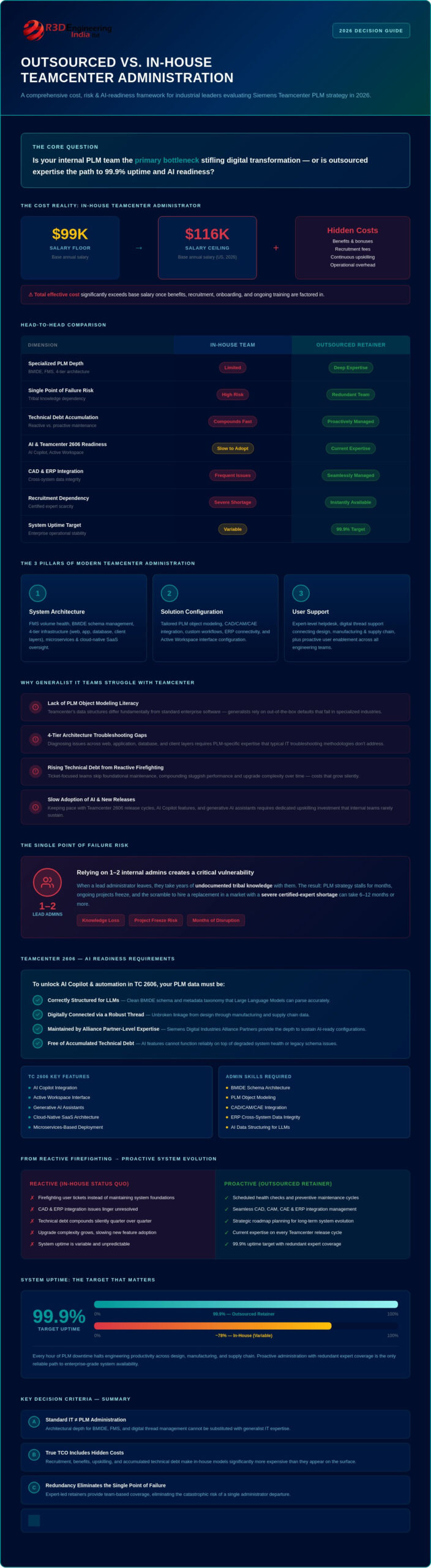
Comparing Outsourced Retainers vs. Internal Teams for PLM Success
Choosing between outsourced Teamcenter administration vs in-house management requires a shift from viewing IT as a cost center to viewing it as a strategic capability. While an internal hire offers immediate physical proximity, they often lack the multi-disciplinary depth found in a specialized retainer team. When following a strategic guide to IT outsourcing, the focus shifts from simply filling a seat to securing a broad spectrum of expertise. A retainer model provides access to system architects, integration developers, and database administrators simultaneously, ensuring that no single technical challenge becomes a bottleneck for your engineering teams.
Decisions regarding a PLM implementation partner vs vendor significantly impact your long-term administrative success. While vendors provide the software foundation, an independent partner focuses on the practical orchestration of your specific environment. This distinction is critical when managing high-stakes engineering extensions. Unlike general IT support, a specialized Teamcenter retainer understands the nuances of NX, Catia, or SolidWorks integrations. They ensure that CAD/CAM/CAE data flows correctly through the digital thread, preventing the “broken link” syndrome that often plagues internal teams with limited bandwidth.
Predictability and Scalability in Administration
Internal overheads often fluctuate due to training requirements, certification costs, and unexpected turnover. A fixed-cost retainer eliminates these variables, providing financial predictability. This scalability is essential when your business enters high-growth phases. This is particularly vital during the execution of an industrial digitalization roadmap UAE, where rapid system expansion and local compliance requirements demand immediate access to senior-level architects. You don’t have to wait months to recruit and onboard; the expertise is already on tap.
Strategic Oversight and System Architecture
Internal teams frequently become trapped in a cycle of reactive firefighting, which blinds them to larger architectural flaws. External experts provide the necessary objectivity to conduct independent health audits and performance tuning. They maintain the “Digitalization Vision” by ensuring that every system change aligns with your ten-year roadmap rather than just solving today’s ticket. By offloading non-core administrative functions to a boutique specialist, your internal IT leaders can focus on broader enterprise strategy, leaving the intricate complexities of Teamcenter object modeling to those who manage it daily across multiple industrial environments.
Integrating AI Readiness into Your System Administration Strategy
AI is not a standalone tool. It is a capability that rests entirely on the quality of the data managed by your PLM system. When evaluating outsourced Teamcenter administration vs in-house resources, leadership must determine which model provides the technical rigor needed to transform raw engineering data into AI-consumable assets. The release of Teamcenter 2606 has introduced generative AI through Teamcenter Copilot, but these tools only provide value if the underlying data schema is consistent and clean. An administrator’s role has shifted from maintaining server uptime to ensuring that every piece of metadata serves as a reliable training point for machine learning models.
Clean PLM data is the absolute prerequisite for a successful AI roadmap manufacturing industry. Without standardized naming conventions and rigorous lifecycle states, Large Language Models (LLMs) will produce hallucinations rather than actionable insights. Specialized administrators act as the gatekeepers of this data integrity. They perform the heavy lifting of preparing data for industrial AI, which directly fuels the role of PLM in AI strategy. By automating routine monitoring tasks through AI-driven alerts, a high-level administrator frees up bandwidth to focus on these strategic data-cleansing initiatives.
Data Hygiene and AI Readiness Assessments
Ensuring data integrity is essential for the effective use of predictive maintenance and digital twins. Administrators must standardize metadata structures so that industrial AI can consume information across different engineering disciplines without friction. This process begins with a comprehensive digital maturity check on existing Teamcenter data. If your current system is cluttered with redundant attributes or orphaned files, any attempt to layer AI on top will likely fail. You can begin this transformation by securing a professional digital maturity assessment to benchmark your current data health. Manufacturing leaders looking to move beyond fragmented pilots toward enterprise-wide AI adoption will find that a thorough industrial digitalization assessment provides the strategic foundation needed to address customization debt and meet emerging ISO/IEC 2026 standards for IoT and digital twins.
Future-Proofing Through Advanced Solution Architecture
Modernizing your architecture is no longer optional. Transitioning to microservices allows for better integration with third-party AI tools and prepares your infrastructure for the next wave of industrial automation solutions GCC. This architectural shift requires a level of expertise that often exceeds the capacity of an internal generalist. AI readiness in a PLM context is the state of having standardized, high-integrity data structures and a flexible system architecture that allows machine learning models to accurately interpret and act upon product lifecycle information. Securing this readiness ensures that your outsourced Teamcenter administration vs in-house decision accounts for the technological demands of the next decade.
Optimizing Performance with a Specialized Teamcenter Administration Retainer
System optimization requires more than a steady hand on the wheel; it demands a navigator who understands the terrain. Transitioning from a reactive, ticket-based approach to a proactive evolution strategy is the hallmark of a high-value PLM administration retainer. While we previously identified the risks of technical debt, a specialized retainer acts as the primary corrective mechanism. When industrial leaders evaluate outsourced Teamcenter administration vs in-house management, the deciding factor is often the ability to move beyond basic maintenance into true architectural optimization. This model ensures that your system doesn’t just stay online but actually improves in performance as your data volume grows. Similarly, for your physical infrastructure, you can discover Alliance Fleet Solutions to find expert resources for strategic fleet maintenance and optimization.
A specialized retainer provides the bandwidth to explore advanced configurations that internal teams often overlook. For instance, unlocking Teamcenter CRM integration benefits requires a deep understanding of both engineering workflows and customer-facing data requirements. This is where strategic Siemens Teamcenter consulting becomes indispensable. It bridges the historical gap between IT governance and engineering execution, ensuring that your PLM environment serves as a unified enterprise operating system rather than a siloed engineering vault.
The Retainer Framework: What to Expect
A professional administration retainer is built on a foundation of regular, methodical system performance tuning. This goes beyond checking logs. It involves database optimization, volume health audits, and the proactive management of patches before they become security liabilities. You gain direct access to a team capable of handling end-to-end PLM implementation support, which is critical when deploying new modules or scaling your user base. Unlike an internal hire who may have a localized perspective, a retainer team brings insights from across the industrial landscape, applying best practices that have been proven in diverse engineering environments.
Driving Long-Term Industrial Transformation
Securing Your Digital Architecture for the AI Era
Navigating the complex landscape of outsourced Teamcenter administration vs in-house management requires a deep commitment to long-term architectural health. The true cost of an internal team extends far beyond basic salary requirements; it encompasses the mounting burden of technical debt and the inherent risks of a single point of failure. Success in 2026 demands a strategic shift toward proactive system evolution and rigorous data hygiene to support the next generation of industrial AI tools and microservices.
As a Siemens Digital Industries Alliance Partner, we function as a dedicated thinking partner for organizations seeking specialized expertise in end-to-end Teamcenter implementation. We provide authoritative digital maturity assessments for UAE industry, ensuring your infrastructure is not just operational but optimized for future automation. It’s time to transition from reactive maintenance to a model that drives genuine competitive advantage. Secure your industrial future with a PLM System Administration Retainer and ensure your digital thread remains robust, scalable, and ready for the future of manufacturing.
Frequently Asked Questions
What are the primary responsibilities of a Teamcenter administrator?
A Teamcenter administrator manages the system architecture, solution configuration, and technical user support. Their daily tasks include overseeing the File Management System (FMS), executing BMIDE schema deployments, and ensuring database health. In 2026, they also manage AI tools like Teamcenter Copilot and cloud-native microservices. This role is far more specialized than general IT, requiring a deep understanding of the digital thread and complex engineering workflows.
How much does it typically cost to hire a full-time Teamcenter expert in-house?
Hiring a full-time expert in the United States typically costs between $99,438 and $116,000 in base salary alone as of June 2026. When you factor in recruitment fees, benefits, and continuous training for new software releases, the total cost of ownership often exceeds $150,000 annually. This financial burden is a primary driver for companies evaluating outsourced Teamcenter administration vs in-house models to gain better cost predictability and access to broader expertise.
Can an outsourced partner handle complex Teamcenter integrations with ERP or MES?
Yes, an outsourced partner often has more experience with complex ERP and MES integrations than a single internal hire. Because these partners work across various industrial environments, they possess the architectural depth to bridge the gap between engineering and manufacturing systems. They develop custom integration paths that ensure data flows seamlessly from the PLM environment to the factory floor, reducing the risk of broken links or data silos.
What is the typical response time (SLA) for an outsourced PLM retainer?
Typical SLAs for a professional PLM retainer target 99.9% system availability and provide tiered response times based on issue severity. Critical system outages usually receive immediate attention within one to four hours, while minor configuration requests are handled within one business day. This structured approach provides a level of reliability that internal teams often struggle to maintain when they are overwhelmed by simultaneous projects or sudden staff turnover.
How does system administration impact our digital maturity score?
Effective system administration directly raises your digital maturity score by eliminating technical debt and ensuring data integrity. By maintaining current software versions and standardized metadata, administrators prepare your environment for AI readiness and digital twin initiatives. High maturity scores reflect a system that is proactive rather than reactive. This transition is often easier to achieve through a specialized retainer that prioritizes long-term system health over daily firefighting.
Is our intellectual property secure when using an external administration partner?
Intellectual property is protected through rigorous non-disclosure agreements, secure VPN access, and multi-factor authentication protocols. External partners use the same security standards as your internal IT department to ensure data remains within your control. Because these specialists rely on their reputation for technical integrity, they often implement more stringent security audits and patch management schedules than generalist internal teams might prioritize during busy production cycles.
What happens if we need to transition from outsourced back to in-house management?
Transitioning back to in-house management is a structured process involving thorough documentation and knowledge transfer. A professional partner maintains detailed records of all system configurations, BMIDE changes, and integration maps. This transparency ensures that if you decide to rebuild an internal team, they have a clear roadmap of the existing architecture. The goal of a “thinking partner” is to provide stability, regardless of the long-term management model you choose.
Does a PLM retainer include support for CAD/CAM extensions?
Yes, a comprehensive PLM retainer includes support for CAD, CAM, and CAE extensions to maintain the digital thread. Administrators ensure that integrations with tools like NX, Catia, or SolidWorks remain functional after system updates or schema changes. This specialized support is critical because engineering productivity stops if these extensions fail. When comparing outsourced Teamcenter administration vs in-house options, the ability to manage these complex engineering interfaces is a significant advantage.