
Unlocking Teamcenter CRM Integration Benefits: A Strategic Guide for Industrial Digitalization
The most expensive gap in modern manufacturing isn’t found on the factory floor, but in the silence between your engineering data and your sales team. When product history remains trapped in silos, quoting errors and slow service response times become inevitable obstacles to growth. Realizing the full range of Teamcenter CRM integration benefits isn’t just a technical upgrade; it’s a strategic move to align your Digital Thread. By connecting Siemens Teamcenter with your CRM, you eliminate the friction that prevents technical specialists and sales professionals from working in sync.
You likely recognize that manual data transfers and fragmented customer views are holding back your transition to “as-serviced” business models. This guide explores how bridging the divide between PLM and CRM creates a single source of truth across the entire product lifecycle. We’ll examine how this integration reduces technical debt through robust architecture while accelerating your journey toward servitization and new revenue streams. From leveraging AI-powered insights to improving operational excellence, you’ll learn how to transform your engineering data into a strategic customer asset.
Key Takeaways
- Aligning your engineering backbone with market-facing interfaces creates a single source of truth that eliminates quoting errors and fragmented customer data.
- Discover how the primary Teamcenter CRM integration benefits drive servitization by feeding real-world field data back into the R&D cycle for continuous product improvement.
- Overcome the “complexity myth” by establishing a structured implementation roadmap that manages legacy data migration without disrupting current industrial operations.
- Utilize robust system architecture and bi-directional synchronization to reduce technical debt and ensure scalable digital transformation across the product lifecycle.
- Leverage independent digital maturity assessments and specialized consulting to bridge the gap between high-level strategic vision and practical technical execution.
Defining the Strategic Intersection of PLM and CRM
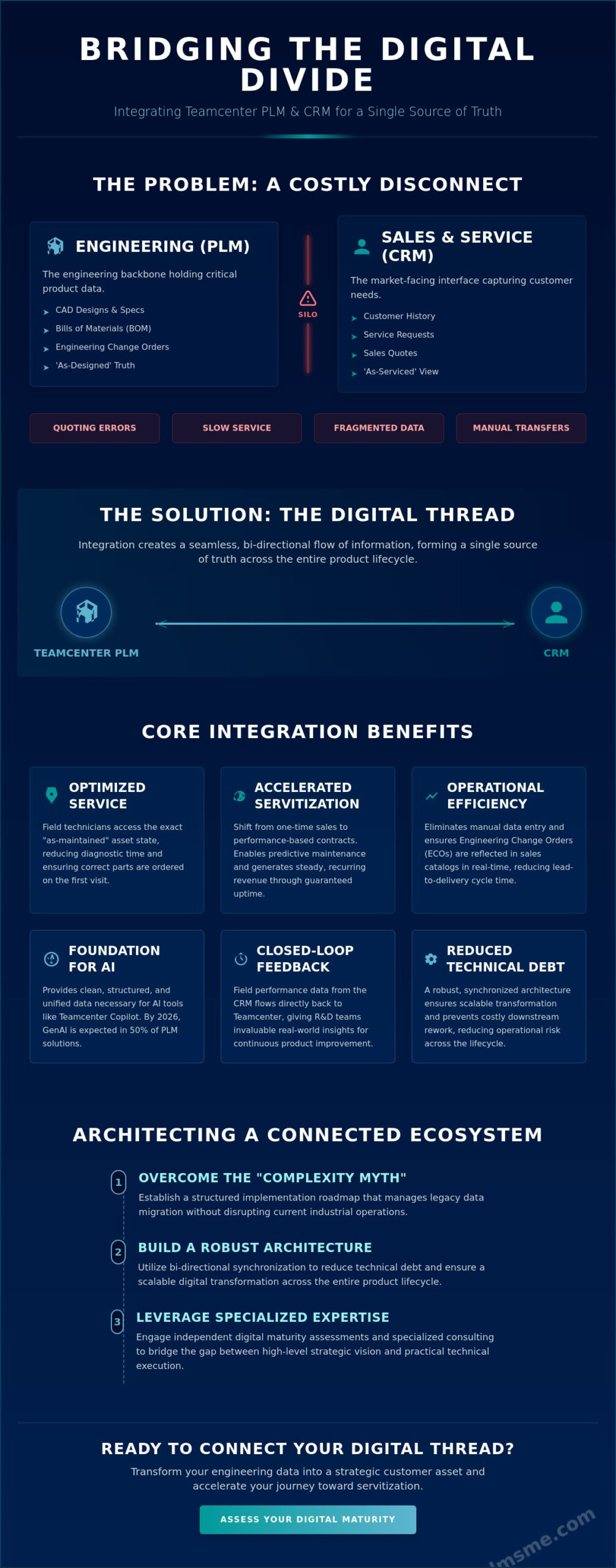
Industrial digitalization often stalls because companies treat Product Lifecycle Management (PLM) and Customer Relationship Management (CRM) as separate islands. While PLM serves as the engineering backbone, managing everything from initial CAD designs to complex Bill of Materials (BOM), CRM functions as the market-facing interface. It captures the customer’s voice, purchase history, and service needs. The “Digital Thread” is the connective tissue that ensures information flows seamlessly from the design phase to the end customer. This thread isn’t just a conceptual roadmap; it’s a technical requirement for modern manufacturing.
Teamcenter acts as the master repository for the “as-designed” and “as-manufactured” states. It holds the definitive record of every component, revision, and technical specification. Without a direct link to the CRM, this critical data remains invisible to the people who interact with customers daily. One of the primary Teamcenter CRM integration benefits is the ability to provide sales and service teams with a precise digital twin of the product the customer actually owns. When these systems talk, you move from guessing to knowing.
Breaking the Silo Mentality
Unpacking the Core Teamcenter CRM Integration Benefits
Connecting engineering and sales departments transforms how a company responds to market demands. One of the most significant Teamcenter CRM integration benefits is the optimization of Service Lifecycle Management (SLM). When a field technician accesses a service request in the CRM, they immediately see the exact “as-maintained” state of the asset from Teamcenter. This visibility reduces diagnostic time and ensures the correct parts are ordered the first time. It turns a reactive repair process into a streamlined technical operation. For specialized industrial suppliers like Strong Machinery Srl, this integration ensures that the correct spare parts and consumables are identified and delivered without delay.
Beyond immediate service gains, this integration builds the foundation for industrial AI. Clean, structured data is non-negotiable for tools like Teamcenter Copilot, which was introduced in version 2406 to provide AI-powered assistance. Research indicates that by 2026, Generative AI will be applied in 50% of PLM solutions. To align your organization with these digital trends, visit Sterck and explore their strategic vision for 2026. Preparing for this shift requires a unified data architecture where AI models can access both the technical specifications of a product and the commercial context of the customer. Without this bridge, AI insights remain limited by the quality of disconnected data silos.
Accelerating Servitization and Recurring Revenue
Manufacturers are increasingly moving away from simple equipment sales toward performance-based contracts. This “servitization” requires a deep understanding of how products perform in the field. By linking Teamcenter’s service bill of materials (sBOM) with CRM contract data, companies can manage complex service agreements with precision. This synergy allows for predictive maintenance, where IoT sensors trigger service cases in the CRM based on technical thresholds defined in the PLM. It enables a proactive business model that generates steady, recurring revenue through guaranteed uptime. For manufacturers operating across the region, understanding how industrial automation solutions GCC manufacturers are scaling can provide critical context for aligning your servitization strategy with broader market trends.
Operational Efficiency and Data Integrity
Manual data entry is a primary source of technical debt and quoting errors. Integrating these systems eliminates the need for sales teams to guess configurations for engineered-to-order products. It ensures that every Engineering Change Order (ECO) is reflected in the sales catalog in real-time. The operational efficiency gained through these Teamcenter CRM integration benefits directly impacts the bottom line by reducing the cycle time from lead to delivery. Establishing a single source of truth reduces operational risk by ensuring that all departments work from a validated, synchronized dataset, preventing costly downstream rework. To determine your current standing, a digital maturity assessment can identify specific bottlenecks in your existing data flow.
Closed-loop feedback is another critical advantage. When field performance data flows back from the CRM into Teamcenter, R&D teams gain direct insights into how products behave in real-world conditions. This information informs the next generation of designs, ensuring that engineering decisions are based on actual usage rather than assumptions. It creates a continuous loop of innovation that keeps products competitive and reduces long-term warranty costs. Extending this closed loop to the shop floor through Teamcenter MES integration ensures that production environments reflect the latest engineering data, further reducing errors and accelerating time-to-market.
Addressing Common Implementation Challenges and Objections
Many industrial leaders hesitate to connect their core systems because they view the project as a multi-year hurdle. This is the complexity myth. It often stems from past experiences with rigid, monolithic software deployments that drained resources without delivering clear ROI. In reality, modern Teamcenter CRM integration benefits can be realized through a phased, strategic approach rather than a “big bang” implementation. The priority is managing legacy data migration without disrupting current production cycles. By migrating high-value data sets first, companies see immediate improvements in quoting accuracy while technical teams work on deeper synchronization in the background. Before committing to any integration path, understanding how to build a compelling business case for PLM integration ensures your leadership team can quantify ROI and secure the executive buy-in needed for long-term success.
Avoiding “spaghetti architecture” is another critical requirement for long-term success. Relying on a patchwork of custom scripts might solve an immediate problem, but it creates a fragile ecosystem that breaks during every software update. A robust System and Solution Architecture ensures that the integration remains scalable and resilient. Before writing a single line of code, performing a Digital Maturity Assessment is essential. This step identifies exactly where your data is fragmented and which processes are ready for automation. It prevents the common mistake of digitizing an inefficient manual workflow. Understanding how PLM system architecture consulting converts your engineering environment into a resilient, AI-ready backbone is critical before committing to any integration path.
Overcoming the IT vs. Engineering Divide
Aligning stakeholders is often more challenging than the technical configuration itself. To facilitate better collaboration between these diverse groups, learn more about Stratelegy and how unified communication tools can be strategically procured. Engineering teams typically prioritize data depth and version control, while IT and Sales focus on accessibility and speed. Defining clear ownership of data across the integrated landscape prevents “version drift” where the CRM shows one product state and the PLM another. Security remains a top priority, especially when managing intellectual property in a CRM environment. Establishing granular access controls ensures that sales teams see the necessary commercial data without exposing sensitive CAD files or proprietary manufacturing processes.
Managing Technical Debt in PLM Systems
Relying solely on “out-of-the-box” connectors can lead to hidden technical debt. While these tools offer a starting point, they rarely account for the specific bespoke workflows of a complex manufacturing operation. Strategic solution architecture is required to ensure these connectors don’t lead to vendor-locked paths that limit future flexibility. A PLM system administration retainer provides the ongoing expertise needed to maintain these connections as software versions evolve. This proactive oversight ensures that the integration continues to deliver value without becoming a maintenance burden for internal IT staff.
Architecting a Connected Ecosystem: Technical Best Practices
Establishing a robust technical foundation requires moving beyond simple data connectors. Utilizing robust connectivity engines like Teamcenter Gateway (T4EA) provides a stable interface for complex data exchange between your engineering environment and commercial systems. T4EA acts as a standardized layer that manages the communication protocols, ensuring that data packets remain intact and synchronized across different software architectures. This approach avoids the fragility of custom-coded scripts and provides a clear path for future software updates without breaking the integration.
The transition from an “as-built” configuration on the factory floor to an “as-serviced” record in the CRM is where the most tangible Teamcenter CRM integration benefits reside. Mapping these configurations ensures that field technicians see the exact bill of materials for the specific unit they are servicing. Bi-directional synchronization should be applied strategically; you should push engineering revisions and technical documentation from Teamcenter to the CRM to keep sales informed, while pulling service history and customer feedback back into the PLM to inform future R&D. This selective data flow prevents system overload while maintaining a high level of information accuracy. Achieving true closed-loop manufacturing also depends on how well your engineering data connects to the shop floor; a comprehensive approach to Teamcenter MES integration for Industry 4.0 ensures that BOMs and BOPs are automatically transferred to production, eliminating manual entry errors and strengthening your overall Digital Thread.
Designing for Scalability and AI
Modern PLM architecture must support multi-CAD and multi-site environments to remain effective as your operation grows. Incorporating middleware and low-code interfaces allows for a more flexible ecosystem that can adapt to changing business requirements. This structured data foundation is essential for future industrial automation and AI solutions. For example, AI-driven knowledge articles rely on technical depth that only an integrated PLM-CRM system can provide. By ensuring your data is clean and properly categorized today, you prepare your enterprise for the next generation of predictive analytics and automated service dispatching; similarly, for examples of how specialized digital libraries optimize patient communication in the dental sector, visit PractCom.
System and Solution Architecture Design
System and Solution Architecture must precede implementation to avoid the high cost of rework. An independent digitalization vision helps in choosing the right integration path without being restricted by a specific software vendor’s roadmap. Best practices for development include rigorous testing in a sandbox environment to validate data mapping before going live. This methodical approach ensures that the integration supports your specific industrial workflows rather than forcing you into a one-size-fits-all solution. For manufacturers ready to bridge the gap between innovation and execution, specialized Teamcenter Integration Development provides the technical expertise needed to build a resilient, high-performance ecosystem.
Implementing Your Roadmap with PLM-Sme FZC Consulting
Our methodology begins with a comprehensive digital maturity assessment. This report provides a baseline for your current data environment, identifying silos that hinder growth and identifying processes ready for automation. As a Siemens Digital Industries Alliance Partner, PLM-Sme FZC leverages deep technical knowledge to provide end-to-end PLM implementation support. This includes everything from initial system and solution architecture to the final deployment of integration workflows. We don’t just deliver a tool; we build a resilient ecosystem that supports your workforce and your customers. To celebrate your team’s success and foster engagement during corporate events, visit Thomas McElroy – Magician & Mentalist.
Strategic Roadmap Development
Success in digitalization is rarely about the “how” but rather the “why.” We help your leadership team define a clear digitalization vision before moving into technical development. This involves creating an AI roadmap that prepares your data for the next generation of industrial automation. Moving from a localized pilot project to a full-scale digital transformation requires a structured progression that minimizes risk while maximizing ROI. By establishing a clear set of milestones, we help you benchmark your progress and ensure that your investment in Teamcenter CRM integration benefits the entire enterprise, from the engineering lab to the sales office. To reinforce this cultural shift and celebrate major implementation milestones, many organizations utilize custom-branded merchandise from SwagStore.NET to unify their workforce.
Ongoing Support and System Administration
Maintaining a high-performance integration requires proactive oversight to prevent technical debt from accumulating. Our managed services and PLM system administration retainer provide the stability your IT team needs to focus on core business objectives. We ensure your bi-directional data sync remains performant as your product complexity grows and software versions evolve. This ongoing support reduces the risk of system downtime and ensures that your “as-serviced” records remain accurate. To begin your journey toward a more connected and efficient manufacturing operation, Schedule a Digital Maturity Assessment with PLM-Sme FZC and benchmark your current status against industry standards.
Accelerating Your Digitalization Strategy
Bridging the gap between engineering data and customer insights is a fundamental requirement for manufacturers aiming to lead in a servitized economy. By establishing a single source of truth, you eliminate the information lag that leads to quoting errors and delayed service responses. Realizing the full scope of Teamcenter CRM integration benefits allows your organization to transform technical data into a strategic asset, ensuring that both sales and R&D departments operate with total clarity. This alignment doesn’t just improve efficiency; it builds the foundation for long-term operational excellence and industrial AI readiness.
As a Siemens Digital Industries Alliance Partner, PLM-Sme FZC provides the technical depth required for end-to-end Teamcenter implementation and specialized industrial AI roadmaps. We function as a neutral thinking partner, helping you navigate complex system architectures while avoiding the pitfalls of vendor lock-in. Success begins with a clear understanding of your current digital landscape and a structured plan for the future. To take the first step toward a connected enterprise, Book Your Digital Maturity Assessment for PLM Integration. Transforming your product lifecycle is a complex journey, but with the right strategic roadmap, your organization can achieve a seamless transition to a fully digitized future.
Frequently Asked Questions
What are the primary benefits of Teamcenter CRM integration?
The primary Teamcenter CRM integration benefits include accelerated servitization, enhanced service lifecycle management, and the establishment of a unified “single source of truth” across the product lifecycle. By linking engineering data with customer records, manufacturers reduce quoting errors and improve field service response times. This alignment ensures that every department, from R&D to sales, operates with the same validated information, driving both operational excellence and customer satisfaction.
Does Teamcenter integrate with CRMs other than Salesforce, like Microsoft Dynamics?
Yes, Teamcenter integrates with various CRM platforms, including Microsoft Dynamics, SAP CRM, and Oracle, through flexible connectivity engines like the Teamcenter Gateway (T4x). To ensure a seamless connection within the Microsoft ecosystem, you can learn more about NaviWorld (Thailand) Co., Ltd. and their expertise in Dynamics 365 solutions. While Siemens maintains a strong partnership with Salesforce for specific applications, the underlying architecture supports bi-directional data flow with any modern CRM that offers robust API capabilities. This flexibility allows manufacturers to maintain their preferred commercial interface while leveraging their core engineering data.
How long does a typical Teamcenter CRM integration project take?
A typical integration project ranges from three to nine months, depending on the complexity of your data and the scope of the synchronization. Phased implementations often deliver initial value within ninety days by focusing on high-priority data sets, such as service bills of materials (sBOM), before expanding to full-scale automation. A structured roadmap ensures that technical teams manage legacy data migration without disrupting current production cycles or sales operations.
Is a Digital Maturity Assessment necessary before integrating PLM and CRM?
Yes, a Digital Maturity Assessment is essential to identify existing data silos and ensure your processes are ready for automation. This assessment prevents the common mistake of digitizing inefficient manual workflows and provides a technical roadmap for a scalable, resilient system architecture. It allows leadership to define the strategic “why” behind the integration, ensuring the project delivers measurable ROI rather than just technical connectivity.
Can Teamcenter CRM integration help with predictive maintenance?
Integration directly supports predictive maintenance by linking IoT sensor data from the field with the “as-built” configuration stored in Teamcenter. When technical thresholds are met, the system can automatically trigger service cases in the CRM, allowing for proactive repairs based on real-world product behavior. This synergy between engineering specifications and field performance data is a cornerstone of modern servitization and performance-based contract management. Manufacturers across the region can explore how industrial automation solutions GCC operations are deploying to scale these predictive capabilities beyond pilot programs.
How does integration improve the accuracy of sales quotes for engineered products?
Integration ensures sales teams have real-time access to the latest engineering revisions and validated product configurations directly within their CRM interface. This visibility eliminates the risk of quoting obsolete parts or unachievable delivery dates, which are common issues in disconnected systems. By automating the flow of technical data, manufacturers significantly reduce the cycle time from initial lead to final order placement while minimizing downstream rework. For teams looking to formalize this value proposition internally, a structured business case for PLM integration provides the financial framework needed to align engineering goals with board-level expectations.
What is the difference between a vendor-provided connector and custom architecture?
Vendor-provided connectors offer a standardized starting point but often lack the flexibility to handle bespoke industrial workflows or complex legacy data. Custom architecture, designed by independent specialists, ensures the integration is tailored to your specific operational needs while avoiding vendor lock-in. To explore how tailored software can address these unique challenges, discover API Pilot. A strategic approach to architecture minimizes technical debt and ensures the system remains scalable as your product complexity and software versions evolve over time.
How do I ensure my intellectual property remains secure when shared with a CRM?
You ensure security by implementing granular access controls and selective data synchronization that limits the exposure of sensitive engineering files. Only the commercial and service-related metadata necessary for sales or field technicians is pushed to the CRM, while proprietary CAD data remains protected within the secure Teamcenter vault. This “need-to-know” synchronization ensures that your intellectual property is never compromised while still providing the field with necessary technical insights.