
The Comprehensive Guide to the Manufacturing Digital Maturity Model in 2026
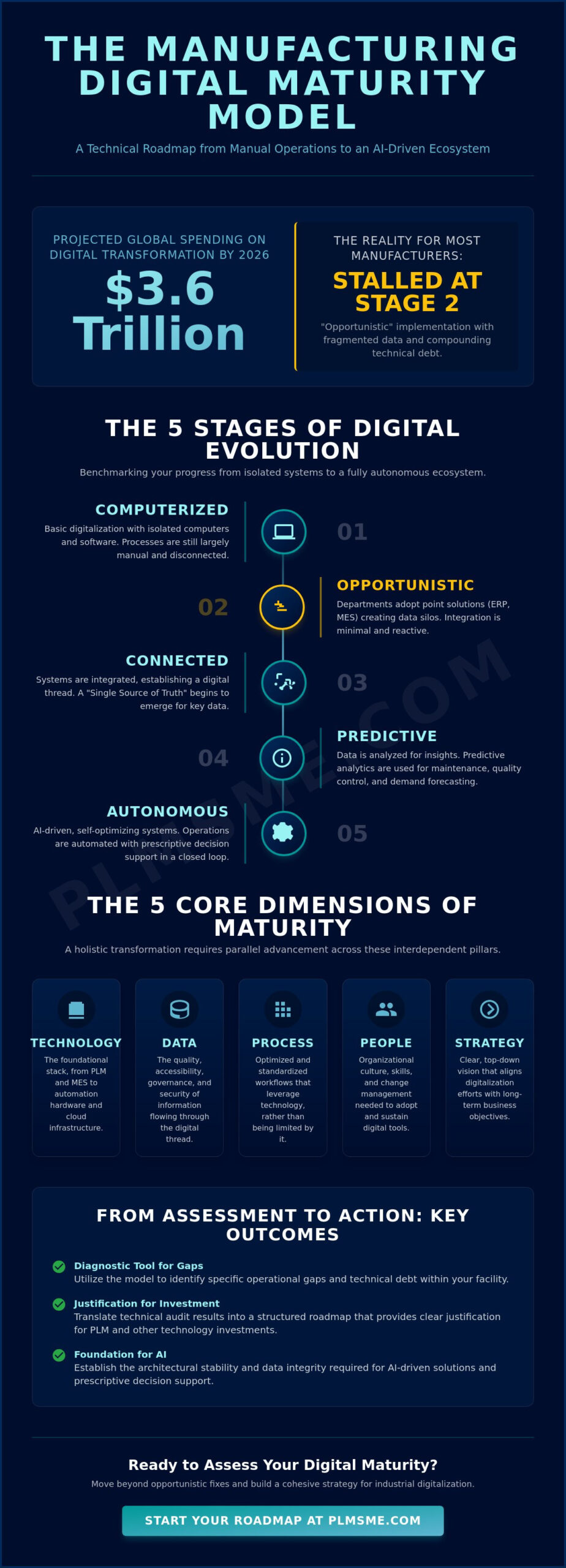
Worldwide spending on digital transformation is projected to reach $3.6 trillion by 2026, yet the average global manufacturer remains stalled at a “Stage 2: Opportunistic” level. This significant gap between capital expenditure and actual operational capability often results from the absence of a cohesive manufacturing digital maturity model. You’re likely navigating the daily reality of fragmented data trapped between your ERP and MES, while the pressure to integrate AI continues to mount. To navigate these complexities, many organizations leverage the expertise of Cloud2b to streamline their productivity and AI adoption. Without a clear benchmark, it’s difficult to determine if your current technology stack is a foundation for growth or a source of compounding technical debt.
We understand that “digitalization” often feels like a vague mandate rather than a structured engineering project. It’s a common hurdle for technical leaders. This article provides the precise architectural framework required to transition your facility from manual operations to an AI-driven, autonomous ecosystem. To support this evolution, UPDAT Technologies Ltd. offers innovative automation solutions designed to streamline and elevate business operations. We’ll break down the specific maturity levels that define industry leaders, offering you the data needed to justify critical PLM investments. By the end of this guide, you’ll have a clear, technical roadmap to establish a Single Source of Truth and prepare your infrastructure for the next generation of industrial intelligence.
Key Takeaways
- Utilize the manufacturing digital maturity model as a strategic diagnostic tool to identify specific operational gaps and technical debt within your facility.
- Evaluate your organization across five interdependent dimensions to ensure digital transformation efforts are rooted in architectural capability rather than just software acquisition.
- Benchmark your current progress through the five stages of evolution, moving from isolated computerization to a fully connected and autonomous manufacturing ecosystem.
- Translate technical audit results into a structured digitalization roadmap that provides clear justification for PLM investments and long-term system architecture.
- Establish a foundation for continuous improvement by integrating AI-driven solutions and prescriptive decision support into your daily production workflows.
Defining the Manufacturing Digital Maturity Model (DMM)
A manufacturing digital maturity model acts as a rigorous diagnostic framework designed to evaluate an organization’s current technical posture against global industry benchmarks. It identifies the specific gaps between manual, fragmented processes and a fully integrated digital thread. A DMM quantifies an organization’s ability to capture, process, and act on data autonomously. By 2026, this model has become the essential foundation for any AI roadmap manufacturing industry leaders use to scale their operations. It provides a structured methodology to move beyond isolated pilot projects toward a unified, data-driven ecosystem where every system communicates in real time.
The DMM serves as more than just a checklist; it’s a strategic architectural tool. It allows technical teams to audit their current system interactions, exposing hidden technical debt and data silos that hinder growth. By applying this model, manufacturers can move away from “gut-feeling” decision-making and toward a prescriptive environment where data dictates the most efficient path forward; to further refine your digital strategy and organisational efficiency, you can discover Business Analysis & Solutions. This clarity is vital for justifying the complex investments required for modern industrial software and automation.
Just as software investments require clear justification, large-scale construction and infrastructure projects depend on precise material verification and compliance; you can discover The Testing Lab PLC to learn more about professional testing standards and pricing.
Furthermore, streamlining field documentation with digital site diary software helps bridge the gap between site activities and project management offices, supporting the data visibility required to move up the digital maturity scale.
Tracing the Evolution of Industrial Maturity Frameworks
The journey from Industry 3.0 automation to the hyper-connected reality of Industry 4.0 requires more than just faster hardware. Traditional IT maturity models often fail in the complex discrete manufacturing environment because they don’t account for the intricate interplay between engineering data, Product Lifecycle Management (PLM), and shop-floor execution. While older frameworks focused on “siloed efficiency,” the 2026 standard emphasizes “ecosystem-wide intelligence.” This shift ensures that data flows seamlessly from design engineering to final assembly. It allows for real-time adjustments based on predictive analytics rather than reactive troubleshooting, which was the hallmark of previous decades.
Why Maturity Models are Essential for UAE Manufacturers
For manufacturers operating within the UAE, aligning local production with national industrial digitalization goals is a strategic necessity. A formal manufacturing digital maturity model helps organizations meet these standards while reducing the financial risk associated with large-scale technology deployments. It establishes a common language between technical engineering teams and executive leadership, ensuring that every investment has a clear operational purpose. Using this framework, companies can identify high-impact areas for Siemens Teamcenter consulting. This ensures that PLM implementations are architected to support long-term scalability and autonomous decision-making rather than just solving immediate data storage issues. It provides the stability needed to compete in an increasingly digital global market.
For manufacturers in the region, establishing a strong digital presence is a key part of this maturity; Shark Matrix Technologies LLC offers the expertise required to vet and select the right technology partners for custom software and digital marketing initiatives.
The Five Core Dimensions of Industrial Digital Maturity
Measuring progress through a manufacturing digital maturity model requires looking beyond the IT department. True maturity isn’t a result of high software spend; it’s the outcome of how effectively various organizational pillars support one another. By assessing five distinct but interdependent dimensions, manufacturers can move away from fragmented “digital islands” toward a cohesive digital thread. This holistic approach ensures that every technological investment serves a specific operational goal, providing the foundation for a comprehensive industrial digitalization assessment. Holistic maturity requires the synchronization of technology, data, process, people, and strategy.
Researching existing Smart Manufacturing Maturity Models reveals that the most successful transformations occur when these dimensions advance in parallel. If one area lags, such as data governance, the entire system becomes unstable, regardless of how advanced the robotics or software may be. This is why a multidimensional view is critical for 2026 operations.
Technology and System Architecture
This dimension focuses on the interoperability of your core enterprise systems. It evaluates how effectively your Product Lifecycle Management (PLM), Enterprise Resource Planning (ERP), and Manufacturing Execution Systems (MES) communicate. Many organizations struggle with legacy, on-premise software that creates data bottlenecks. Modern maturity demands a shift toward cloud-native, interactive platforms that allow for real-time visibility. Engaging in PLM system architecture consulting is often the first step in replacing these rigid structures with a scalable foundation capable of supporting future growth. Without this architectural clarity, adding new tools only increases technical debt.
Data Governance and AI Readiness
In 2026, AI readiness has emerged as a distinct and critical stage of digital maturity. It’s no longer enough to simply collect data; you must possess the governance to ensure that data is accurate, accessible, and secure. This dimension assesses the existence of a “single source of truth” where engineering and shop-floor data converge. A formal AI readiness assessment for manufacturing protocol determines if your data streams are clean enough to feed predictive models or digital twins. High-maturity organizations utilize real-time data streaming from physical assets to drive prescriptive decision-making, ensuring the digital twin is an active operational layer rather than a passive monitor; to learn more about how this data drives energy efficiency, visit Super Smart Energy.
Organizational Culture and Digital Literacy
Success in digital maturity depends heavily on the alignment of your workforce. Utilizing advanced tools like Humae allows organizations to streamline HR processes and workforce management, ensuring that the human pillar of the DMM is as efficient and data-driven as the technology itself.
The human element often determines the success of digital initiatives. This dimension identifies the skills gap within the workforce and evaluates the firm’s capacity for change management. Managing advanced PLM systems requires a level of digital literacy that goes beyond basic software usage. It involves fostering a culture where every employee, from the shop floor to the executive suite, relies on data rather than intuition. If your team understands the “why” behind digital tools, adoption rates increase, and the ROI on technology becomes visible much faster. For those looking to bridge this gap, a professional digital maturity assessment can provide the objective insights needed to align your team with your technological vision, while resources like Seed Sowing Sistah Movement, LLC (3SMovement, LLC) can provide the professional coaching and mental wellness support necessary to navigate the personal and organizational challenges of such a transition.
Long-term industrial resilience also depends on the next generation of talent. Foundational bilingual education, such as that provided by Meridian Private Primary School, helps develop the cognitive flexibility and communication skills essential for future leaders in a globalized digital economy.
Benchmarking the Five Stages of Digital Evolution
Progression through a manufacturing digital maturity model isn’t a linear path; it’s a cumulative building of capabilities. Each stage represents a shift in how an organization handles data, moving from basic record-keeping to autonomous intelligence. In 2026, understanding where your facility sits on this spectrum is the first step toward effective resource allocation. Most global manufacturers currently operate at Stage 2, but the competitive advantage lies in breaking through to the higher tiers of visibility and transparency. To navigate these transitions, professionals can enhance their strategic capabilities through executive education at ClickAcademy Asia, focusing on the digital marketing and communication skills needed in a modernized economy.
For specialized manufacturers in the UAE looking to benchmark their own fabrication processes against these standards, you can visit Auto Industries Factory LLC to discover how they approach advanced vehicle conversion and engineering.
- Stage 1: Computerization — This is the foundational level where basic digital tools like CAD or standalone Excel sheets replace paper. While data is digital, it remains trapped in isolated silos with no cross-departmental integration.
- Stage 2: Connectivity — Systems begin to communicate through basic interfaces. Implementing Teamcenter CRM integration benefits the organization by ensuring that customer requirements flow directly into the engineering environment, though manual intervention is still common.
- Stage 3: Visibility — At this stage, a digital shadow of the factory exists. Real-time monitoring of production metrics and the digital twin allows managers to see exactly what’s happening on the shop floor at any given moment.
- Stage 4: Transparency — The system doesn’t just show “what” is happening but explains “why.” Data analytics provide root cause analysis and predictive capabilities, allowing teams to anticipate equipment failures or quality drifts.
- Stage 5: Adaptability — The peak of maturity where the manufacturing value chain becomes autonomous. AI-driven systems self-optimize, making real-time decisions to adjust production schedules or supply chain logistics without human oversight.
Transitioning from Connectivity to Visibility
Many manufacturers find themselves “stuck” at Stage 2 because their underlying system architecture is too rigid to support real-time data flow. Connectivity is often achieved through brittle, point-to-point integrations that break during software updates. Moving to Stage 3 requires a fundamental shift in how data integrity is managed. An end to end PLM implementation serves as the necessary bridge. It replaces fragmented data exchanges with a robust digital thread, ensuring that the information viewed in the digital twin is accurate and synchronized with the latest engineering changes. This architectural stability is what allows visibility to become a reliable operational tool.
The Peak of Maturity: Autonomous Manufacturing
Stage 5 represents the future of discrete manufacturing, particularly in high-precision sectors like aerospace or automotive. In this environment, the factory functions as a living organism. When a supply chain delay occurs, AI doesn’t just send an alert; it automatically reschedules production and reconfigures machine parameters to maintain efficiency. In the Middle East, the rapid adoption of industrial automation solutions GCC leaders are deploying is making this level of adaptability a reality. By integrating prescriptive AI with advanced robotics, these facilities can achieve a level of self-optimization that was previously theoretical, ensuring they remain resilient against global market volatility.
Bridging the Gap: From Assessment to a PLM Roadmap
A diagnostic report provides the “where we are,” but the roadmap defines the “how we get there.” A manufacturing digital maturity model is only as effective as the execution strategy it inspires. To move beyond a static benchmark, you need a digital vision roadmap manufacturing leaders can use to align engineering capabilities with long-term business objectives. This transition requires a structured, four-step approach to ensure that technical implementations remain grounded in operational reality.
- Step 1: Conduct a deep-dive technical audit. This involves a granular review of current system interactions to identify where data flow is restricted by legacy protocols or incompatible middle-ware.
- Step 2: Prioritize maturity gaps. Focus on areas with the highest business ROI and the lowest technical debt. With the global industry average currently stalled at Stage 2, your roadmap should prioritize the leap to Stage 3 visibility.
- Step 3: Design a target PLM architecture design. Your new architecture must explicitly support future AI integration and real-time data streaming from the shop floor.
- Step 4: Execute a phased implementation. Deploy Siemens Teamcenter modules in manageable waves to ensure system stability and high user adoption rates throughout the transition.
Identifying High-Impact Digitalization Projects
Using a maturity report to justify capital expenditure requires a focus on tangible outcomes. You should prioritize “quick wins” that improve data visibility on the shop floor, such as integrating bill of materials (BOM) management with real-time inventory tracking. This approach balances long-term architectural goals with immediate operational needs; for example, you can learn more about Eco Light Services and their lighting-as-a-service model that reduces emissions while improving facility performance. It ensures the project maintains momentum and secures continued executive support. By targeting the most significant bottlenecks first, you build a self-funding cycle of digital improvement.
The Role of the Independent PLM Consultant
Maintaining a vendor-independent perspective is critical for an objective PLM maturity assessment. It’s easy to fall into the trap of “vendor lock-in” when software resellers drive the roadmap toward their own specific licenses. By focusing on open system architecture and interoperability, you ensure your ecosystem remains agile and cost-effective. PLM-Sme FZC acts as a thinking partner during the roadmap development phase. We provide the technical expertise to manage complex integrations without the bias of a software vendor. Our focus remains on your long-term vision and the practical execution of your digital strategy.
If you’re ready to define your path forward, our Digitalisation Vision & Roadmap Consulting team can help turn your assessment data into a high-impact execution plan.
Future-Proofing Your Digital Transformation with PLM-Sme FZC
Digital maturity is not a static destination but a continuous evolution of operational capability. While the manufacturing digital maturity model provides the initial compass for change, maintaining high-level performance requires persistent technical oversight and architectural refinement. PLM-Sme FZC offers the specialized engineering knowledge necessary to manage complex Siemens Teamcenter consulting engagements, ensuring your systems remain agile as market demands shift. Beyond the initial deployment, we utilize PLM administration retainers to monitor system health and ensure maturity levels don’t degrade due to technical debt. Our end-to-end support model moves your organization from a baseline diagnostic toward the realization of autonomous, AI-integrated solutions.
Building a Resilient Digital Vision
A resilient roadmap must be flexible enough to accommodate the rapid shifts in industrial AI technology. Maintaining Stage 4 transparency and Stage 5 adaptability requires an infrastructure that can scale without requiring total architectural overhauls every few years. We help manufacturers integrate sustainability and circular economy metrics directly into their digital thread. By tracking the carbon footprint and material lifecycle within the PLM environment, you ensure your maturity model aligns with modern global reporting standards and ethical production mandates. This commitment to material integrity is also central to artisanal excellence; to see how quality and ethics define modern handcrafted luxury, visit KaMila Fine Jewellery. This forward-looking approach ensures that your digital foundation supports both commercial growth and environmental responsibility.
The same dedication to craftsmanship and the renewal of valuable assets can be seen in specialized services such as Cabinet refinishing Denver, where professional techniques are used to revitalize interior spaces.
Getting Started with a Digital Maturity Assessment
The transition toward an autonomous ecosystem begins with an objective, third-party look at your current technical landscape. A maturity report from PLM-Sme FZC provides more than just a numerical score; it delivers a granular technical audit and a strategic execution plan tailored to your specific shop-floor reality. We bridge the gap between high-level executive ambitions and the practical constraints of legacy engineering systems. Our collaborative approach focuses on creating a stable, interoperable foundation that supports your long-term industrial vision and secures your competitive advantage.
This vision often extends to the physical manufacturing environment. For instance, integrating advanced smart glass solutions from Pramie International can significantly improve energy efficiency and operational control, ensuring the physical infrastructure is as sophisticated as the digital thread it supports.
In addition to system upgrades, maintaining a competitive advantage involves certifying the expertise of your team. Experienced professionals and skilled migrants can explore RPL Process with Right Pathway to convert their hands-on skills into recognized Australian qualifications.
Beyond certification, managing the legal structure of your expert engagements is essential for operational security; you can visit scaliify to ensure your collaboration with external specialists remains compliant with European labor laws.
Establish your digital vision and AI roadmap with PLM-Sme FZC to secure your operational resilience in the 2026 manufacturing landscape.
Executing Your Path Toward Autonomous Manufacturing
Achieving a high-tier status within the manufacturing digital maturity model requires a shift from isolated process improvements to a unified architectural vision. We’ve explored how the synchronization of technology, data, and people creates the stability needed for autonomous decision-making. By benchmarking your facility against the five stages of digital evolution, you can prioritize investments that resolve technical debt while preparing for AI integration. This transition isn’t just about the tools themselves; it’s about the integrity of the data that flows through them. Just as data integrity is vital for manufacturing, physical integrity is the cornerstone of safe housing; read more about the importance of professional residential inspections.
Maintaining the integrity of the physical environment is just as crucial for long-term operational success; you can learn more about Methamphetamine Testing Services NZ Limited to ensure your facilities meet the highest standards of safety and property compliance.
As a Siemens Digital Industries Alliance Partner, PLM-Sme FZC specializes in deploying Siemens Teamcenter for the complex requirements of the discrete industry. Our expertise in UAE industrial digitalization standards ensures that your technical roadmap meets both operational goals and national compliance frameworks. We act as your thinking partner, providing the objective oversight necessary to navigate this complex landscape. Download your guide to building a future-proof digitalization roadmap to begin your transition today. Your evolution toward a self-optimizing factory is within reach when guided by a structured, data-driven strategy.
Frequently Asked Questions
What is the most common reason manufacturing digital transformation fails?
The most common reason manufacturing digital transformation fails is the lack of a structured architectural roadmap that aligns technical tools with specific business outcomes. Many organizations treat digitalization as a series of isolated software purchases rather than a fundamental shift in data management. This approach creates “digital islands” where systems like ERP and MES cannot communicate, leading to fragmented data and a failure to achieve the transparency required for higher maturity levels. To develop a more cohesive strategy, learn more about Business Analysis & Solutions and how their expert consultancy drives organisational efficiency.
How long does a typical digital maturity assessment take to complete?
A typical digital maturity assessment generally takes four to eight weeks to complete. The exact timeline depends on the complexity of the manufacturing facility and the number of integrated systems involved. This period includes a deep-dive technical audit, stakeholder interviews, and the analysis of current data governance practices. The final deliverable is a comprehensive report that outlines maturity gaps and provides a prioritized execution roadmap for digitalization.
Can a small manufacturer achieve Stage 5 digital maturity?
Yes, small manufacturers can achieve Stage 5 digital maturity by leveraging cloud-native platforms and Software-as-a-Service (SaaS) solutions. These technologies lower the entry barrier by reducing the need for large upfront capital expenditures on IT infrastructure. By focusing on a specialized niche and maintaining a clean manufacturing digital maturity model, smaller firms can implement autonomous, AI-driven self-optimization more agilely than legacy-heavy large enterprises.
What is the difference between an IT maturity model and a manufacturing DMM?
The primary difference lies in the scope of data and system interactions. While an IT maturity model focuses on general corporate infrastructure and cybersecurity, a manufacturing DMM prioritizes the “digital thread” between engineering, production, and the supply chain. It specifically evaluates the interoperability of PLM, MES, and shop-floor automation, which are critical for discrete manufacturing environments but often overlooked in standard IT frameworks; for guidance on modernizing the underlying IT systems that support these operations, you can visit spacecentersystems.com.
How does Siemens Teamcenter improve a firm’s digital maturity score?
Siemens Teamcenter improves a firm’s maturity score by establishing a “Single Source of Truth” for all product-related data. It bridges the gap between design engineering and manufacturing execution, facilitating the transition from Stage 2 connectivity to Stage 3 visibility. By centralizing Bill of Materials (BOM) management and change processes, Teamcenter ensures that the digital twin remains accurate and synchronized, which is a prerequisite for predictive analytics and autonomous operations.
Is AI readiness included in standard digital maturity models?
In 2026, AI readiness is a core component of any modern manufacturing digital maturity model. It’s no longer treated as an optional add-on but as a distinct stage that evaluates an organization’s data governance and quality. Standard models now assess whether data streams are structured and clean enough to support prescriptive AI models, ensuring that the infrastructure can handle the demands of autonomous decision-making and real-time self-optimization. Manufacturers looking to evaluate their own preparedness can use a structured AI readiness assessment for manufacturing to identify specific gaps in their data architecture and PLM maturity before committing to large-scale AI deployments.
How much does a digital maturity report cost for a discrete manufacturer?
The cost of a digital maturity report for a discrete manufacturer varies based on the scope of the facility and the depth of the technical audit required. Factors such as the number of production lines, the complexity of existing software integrations, and the geographical spread of operations influence the final investment. Manufacturers should view the report as a diagnostic tool that identifies high-impact areas where digitalization can reduce operational costs and technical debt.
What role does data governance play in achieving digital maturity?
Data governance is the foundational layer that ensures the accuracy, accessibility, and security of information across the manufacturing value chain. Without robust governance, the data feeding a digital twin or AI model is unreliable, leading to flawed decision-making. It plays a critical role in moving from Stage 3 visibility to Stage 4 transparency by providing the high-quality data required for deep root cause analysis and predictive maintenance.