
How a digital Maturity Assessment Fixes the AI readiness gap
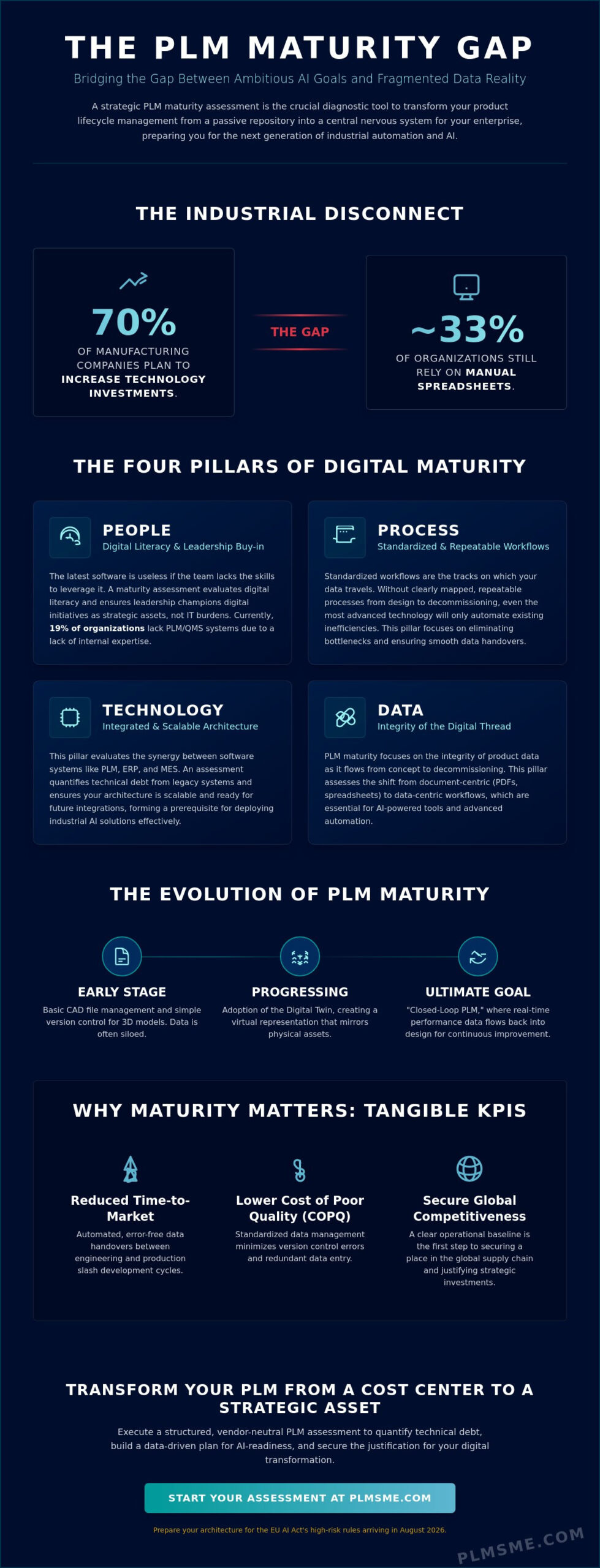
Why do 70% of manufacturing companies plan to increase technology investments this year while nearly one-third of organizations still rely on manual spreadsheets to manage complex product data? In the UAE’s competitive industrial sector, the gap between ambitious AI goals and the reality of fragmented data silos is widening. You’ve likely experienced the frustration of inefficient engineering-to-production handovers or the weight of technical debt from legacy systems that won’t scale. A comprehensive PLM maturity assessment is the only way to bridge this gap, moving beyond a simple software audit to create a strategic diagnostic for your entire operation.
We understand that justifying a major digital overhaul requires more than just a vision; it needs a data-driven plan. This guide shows you how to identify specific improvement targets and build a vendor-neutral roadmap that prepares your architecture for the EU AI Act’s high-risk rules arriving in August 2026. You’ll discover how to transform your PLM from a passive repository into a central nervous system for your enterprise. We’ll outline how to secure the necessary justification for your investment while ensuring your workflows are ready for the next generation of industrial automation and AI integration.
Key Takeaways
- Distinguish between broad digital transformation and specific industrial data management to target hidden operational inefficiencies.
- Evaluate the People and Process pillars to ensure your team’s digital literacy supports your long-term technological vision.
- Execute a structured PLM maturity assessment to quantify technical debt and provide a neutral justification for system upgrades.
- Build a vendor-neutral roadmap that prioritizes PLM-ERP integration as a prerequisite for deploying industrial AI solutions.
- Translate complex audit data into a prioritized list of improvement targets that align with UAE industrial standards and regulations.
Defining the PLM Maturity Assessment in a Modern Industrial Context
Quantifying an organization’s structural capability to govern product data requires more than a software audit. A PLM maturity assessment serves as a comprehensive diagnostic tool, measuring how effectively technical information flows from initial concept to final decommissioning. It moves beyond checking for the presence of a database. Instead, it evaluates the synergy between software architecture, engineering workflows, and human expertise. High-performing organizations treat their Product Lifecycle Management (PLM) system as a living framework rather than a static archive.
Distinguishing between broad digital maturity and specific PLM maturity is vital for industrial clarity. Digital maturity might describe a company’s general shift to cloud infrastructure or modernized IT support. PLM maturity, however, focuses on the integrity of the digital thread. You might possess a sophisticated cloud environment yet still struggle with high technical debt because your engineering change orders rely on disconnected spreadsheets. This distinction ensures that transformation efforts target the specific bottlenecks in the product development cycle rather than generic IT upgrades.
The industrial landscape in 2026 has shifted decisively from document-centric to data-centric workflows. Legacy systems that store “flat” files like PDFs or static spreadsheets can’t support the AI-powered chatbots now appearing in platforms like Teamcenter 2406. Utilizing a structured Maturity Model allows leaders to identify the “Maturity Gap”, which is the distance between current capabilities and the requirements for advanced automation. This gap represents a significant drain on bottom-line revenue. It manifests as redundant data entry, version control errors, and missed market opportunities that can cost UAE manufacturers thousands of Dirhams in lost productivity.
Why Maturity Matters for Discrete Industry Leaders
Maturity scores translate directly into operational KPIs. Organizations with high maturity levels consistently see reduced time-to-market because data handovers between engineering and production are automated and error-free. Standardizing data management also reduces the Cost of Poor Quality (COPQ). For manufacturers in the UAE, achieving high maturity is no longer optional. As the nation pushes for increased industrial competitiveness through digital transformation initiatives, having a clear baseline for your operational readiness is the first step in securing a place in the global supply chain. It provides the objective data needed to justify strategic investments in system architecture. To further capitalize on this competitiveness, EmirAds offers data-driven growth strategies through digital-agency.ae to help UAE-based businesses expand their digital footprint.
The Evolution of Maturity Models
Evaluating the Four Pillars of Digital Maturity
Measuring technical capability requires looking beyond the server room. A comprehensive PLM maturity assessment evaluates four interdependent pillars: People, Process, Technology, and Data. Neglecting any of these leads to expensive “shelfware” that drains budgets without delivering value. If your organization’s pillars aren’t aligned, digital transformation becomes a series of disconnected projects rather than a unified strategy.
Digital literacy is the heartbeat of industrial progress. It’s not enough to have the latest software if your team lacks the skills to leverage it. Leadership buy-in ensures that digital initiatives aren’t seen as IT burdens but as strategic assets. Currently, 19% of organizations aren’t using PLM or QMS systems at all, often due to a lack of internal expertise. Bridging this gap requires a clear understanding of your team’s current capabilities and a plan for targeted upskilling.
Standardized workflows act as the tracks on which your data travels. From initial design to final decommissioning, every step must be mapped and repeatable. Without clear processes, even the most advanced technology will only automate existing inefficiencies. In the UAE, where companies are rapidly scaling, integration between your PLM, ERP, and MES systems is the difference between a siloed department and a unified enterprise. This architectural connectivity allows for real-time visibility across the entire product lifecycle.
The Human Element: Culture and Skill Alignment
Identifying internal champions is essential for driving adoption on the shop floor. In traditional manufacturing environments, resistance to change is a significant hurdle. Transitioning from legacy methods to a Siemens Teamcenter environment requires continuous training, not just a one-time workshop. This human-centric approach ensures that your team feels supported during the transition. To begin aligning your personnel with your long-term digital goals, consider starting with a digitalisation vision and roadmap consulting session to define clear objectives.
Data Integrity as the Foundation of AI
Clean data is the non-negotiable prerequisite for industrial AI. With 70% of manufacturing companies planning to increase technology investments in 2026, the focus has shifted toward AI-powered assistants like those found in Teamcenter 2406. However, the rule of “Garbage In, Garbage Out” remains absolute. If your underlying data is inconsistent, automated decision-making will be flawed. Establishing a Single Source of Truth (SSOT) ensures that every department works from the same verified information. This reliability allows organizations to transition from passive records to active, real-time systems that drive revenue growth. Before deploying any AI solution, conducting a thorough AI readiness assessment for manufacturing ensures your data architecture can support advanced algorithms without producing unreliable outputs.
Analyzing the Cost of Inaction vs. Strategic Assessment
Decision-makers often view a PLM maturity assessment as a non-essential expense or a time-consuming hurdle. This perspective overlooks the cumulative financial impact of maintaining fragmented legacy systems. Technical debt isn’t just a metaphor; it’s the actual cost of supporting inefficient software that can’t integrate with modern ERP or MES platforms. For a large-scale manufacturing plant in the UAE, the daily loss from redundant data entry and manual cross-referencing can reach thousands of Dirhams in lost productivity.
Inaction invites the risk of “Shadow IT.” When official PLM processes are too rigid or immature, employees inevitably find workarounds. They might store critical design files on personal cloud drives or use unmanaged spreadsheets to track change orders. This fragmentation doesn’t just disrupt the digital thread; it creates massive security vulnerabilities and risks the loss of valuable intellectual property. Protecting your assets requires a system that workers actually trust and use.
To mitigate these risks and provide teams with reliable tools, many organizations implement specialized productivity platforms. For companies with international operations, particularly in South America, you can explore Clickup.com licenses with Brazilian tax invoices through Cloud2b to ensure that your project management is both efficient and fiscally compliant.
Comparing the ROI of an assessment-led approach versus a software-first implementation reveals a stark contrast. A software-first strategy often results in high customization costs and low user adoption because the system doesn’t align with the organization’s actual maturity. Conversely, starting with a diagnostic allows you to prioritize high-impact improvements, ensuring that every Dirham spent on implementation delivers measurable value. To ensure your investment is grounded in reality, you might consider a professional digital maturity assessment and report before committing to new licenses.
Identifying Inefficient Workflows and Bottlenecks
Signs of low maturity are often obvious once you look for them. Frequent version control errors and manual re-entry of BOM (Bill of Materials) data are clear indicators that your system is failing. These bottlenecks often persist in specialized areas; for example, integrating SOCWeld to automate welding documentation can remove manual friction that stalls the production line. In this context, operational friction is the resistance encountered when moving data across organizational boundaries, slowing execution and inflating costs. Identifying these friction points is the primary goal of any strategic audit.
Risk Mitigation in Digital Transformation
Strategic assessments significantly reduce the failure rate of digital transformation projects. By identifying gaps in the “People” and “Process” pillars before purchasing software, you avoid the common trap of over-investing in technology your team isn’t ready to use. This foresight ensures compliance with UAE national industrial regulations and standards, which are becoming increasingly stringent regarding data traceability and cybersecurity. Mature governance protocols also act as a shield, protecting your intellectual property from internal mismanagement and external threats.
Executing a Systematic PLM Maturity Assessment
A rigorous PLM maturity assessment requires a structured, five-step methodology to ensure that the resulting strategy is actionable and grounded in operational reality. This isn’t a superficial check-box exercise or a simple software survey. It’s a deep dive into the mechanics of your organization. By following a systematic approach, you transition from reactive troubleshooting to proactive lifecycle management.
- Step 1: Stakeholder Interviews – We engage directly with everyone from executive leadership to shop-floor operators. This step captures the unvarnished reality of daily workflows, revealing where manual workarounds and “Shadow IT” are actually occurring.
- Step 2: System Audit – Our technical specialists evaluate the connectivity between your current PLM, ERP, and MES layers. We look for broken links in the digital thread that cause data duplication and version errors.
- Step 3: Gap Analysis – We compare your current operational state against global industry benchmarks and regional standards. This identifies the specific deficiencies preventing you from reaching higher levels of automation.
- Step 4: Visioning Workshop – We define your desired future state, ensuring that technological goals align with your long-term business objectives and revenue targets.
- Step 5: Roadmap Delivery – You receive a prioritized action plan. This roadmap balances technical necessity with your budget, providing a clear sequence of projects to achieve your vision.
If you’re ready to move beyond generic checklists, our team provides comprehensive digital maturity assessments and reports that define your specific path to industrial excellence.
Benchmark Criteria for UAE Manufacturers
For industrial firms in the Emirates, maturity goals must align with the UAE National Strategy for Industry, known as Operation 300bn. This framework emphasizes the adoption of advanced technologies to increase the industrial sector’s contribution to the GDP. Reaching “Level 5” maturity means your organization has achieved a fully optimized, closed-loop PLM environment. At this stage, real-time data from production and field usage flows back into the design phase, allowing for continuous, automated product improvement. Comparing your performance against regional peers in the discrete industry helps ensure you remain competitive in a rapidly evolving market.
The Role of Independent Consultancy
Vendor-neutral assessments provide an objective roadmap that software providers often can’t offer. While a software vendor might suggest that their latest module is the solution to every problem, an independent consultant focuses on process integrity first. This approach helps you avoid “Vendor Lock-in” by prioritizing flexible system architecture over specific tool sets. We leverage deep Siemens Teamcenter expertise to help you optimize your environment without the bias of trying to sell you additional licenses. This independence ensures that your digital transformation remains cost-effective and tailored to your specific operational needs.
Transforming Assessment Data into a Strategic AI Roadmap
A PLM maturity assessment provides more than a snapshot of current operations; it establishes the foundation for industrial AI integration. In 2026, where AI-powered assistants are becoming standard in platforms like Teamcenter 2406, your maturity score directly determines your “AI Readiness.” Without a structured data environment, advanced algorithms cannot function effectively. We use the data gathered during the audit to design a system architecture that supports predictive maintenance and Manufacturing Operations Management (MOM), moving your facility closer to the vision of an autonomous factory in the UAE. This readiness also extends to how your business is discovered in the digital marketplace; as search engines evolve, BrandLume helps organizations adapt their strategies to dominate local recommendations in an AI-centric 2026.
Prioritizing PLM-ERP integration is often the first critical step toward this future. This connectivity enables automated reporting and real-time visibility, eliminating the manual data reconciliation that currently drains your resources. By aligning these systems—leveraging the capabilities of platforms managed by experts like NaviWorld (Thailand) Co., Ltd.—you create a digital thread that supports complex industrial automation and AI solutions. This transition turns your PLM from a passive record-keeper into an active engine for growth and efficiency. Organizations that have already completed a structured AI readiness assessment for manufacturing consistently report faster ROI from PLM-ERP integration projects because their data governance gaps are identified and resolved before implementation begins.
Building the Digital Vision and Roadmap
Translating assessment findings into a concrete 12 to 36 month plan requires a balance between immediate improvements and long-term stability. We identify “Quick Wins,” such as standardizing engineering change management, to provide immediate relief from operational friction. Simultaneously, we lay the groundwork for end-to-end PLM implementation support that scales with your business. Our approach to digitalisation vision and roadmap consulting ensures that every project in the sequence builds toward a cohesive, high-maturity environment that justifies every Dirham of your investment.
Ongoing Governance and Retainer Support
Digital maturity is a continuous journey rather than a final destination. Industrial environments are dynamic, and your system must evolve alongside changing business needs and new regulations like the EU AI Act. Periodic audits ensure that your processes remain lean and your data stays clean. To mitigate the risk of accumulating new technical debt, many UAE firms utilize a PLM system administration retainer. This ongoing support ensures that your Siemens Teamcenter environment remains optimized, secure, and ready to leverage the latest technological advancements as they emerge.
Securing Your Industrial Future through Digital Precision
Achieving operational excellence requires a shift from reactive data management to a proactive, integrated digital thread. By systematically addressing the four pillars of maturity, your organization can eliminate the hidden costs of technical debt and prepare for the seamless integration of industrial AI. A structured PLM maturity assessment provides the objective evidence needed to justify strategic investments and align your operations with national industrial goals.
When these initiatives are part of a larger capital expenditure, an independent advisory firm like Swiss Alpha Matrix can provide the specialized due diligence and project management necessary for complex financial and investment programmes.
As a Siemens Digital Industries Alliance Partner, we specialize in ensuring your infrastructure meets the requirements of the UAE National Industrial Roadmap. Our team brings deep expertise in Siemens Teamcenter and AI readiness to help you navigate complex digital transitions with confidence. We focus on providing a vendor-neutral path that prioritizes your long-term architectural stability over short-term software fixes.
Don’t let fragmented data silos hinder your growth in an increasingly automated market. Request a Professional Digital Maturity Assessment to begin your journey toward an autonomous, high-performance factory. Your transition to digital leadership starts with a clear, data-driven diagnostic.
Frequently Asked Questions
What is the primary difference between a PLM audit and a maturity assessment?
An audit focuses on compliance and whether a system meets specific technical requirements, while a PLM maturity assessment evaluates the organization’s overall capability to manage product data across people, processes, and technology. Audits are often binary pass or fail checks. Assessments provide a strategic diagnostic that identifies growth opportunities and structural bottlenecks. This holistic approach helps UAE manufacturers understand their current operational baseline relative to global industrial standards.
How long does a typical PLM maturity assessment take for a UAE manufacturer?
A standard engagement typically spans four to six weeks, depending on the complexity of the organization’s system architecture and the number of stakeholders involved. This timeline includes initial interviews, system audits, and the delivery of a prioritized roadmap. For mid-sized discrete industry firms in the Emirates, this duration allows for a thorough investigation without disrupting daily production schedules. Larger enterprises with multiple sites might require a more extended, phased approach.
Can a small discrete industry firm benefit from a formal maturity model?
Yes, smaller firms benefit significantly by identifying the specific technical debt that prevents them from scaling effectively. A formal manufacturing digital maturity model provides a vendor-neutral framework to prioritize investments, ensuring that limited budgets are spent on high-impact improvements. Even without a massive IT department, a small manufacturer can use these insights to standardize workflows and reduce the cost of poor quality. It establishes a clear path toward national industrial competitiveness.
Is a PLM maturity assessment required before a Siemens Teamcenter implementation?
While not strictly mandatory by software providers, conducting an assessment is highly recommended to avoid expensive customization and low user adoption. It ensures that the system architecture is designed around your actual business processes rather than generic templates. By identifying maturity gaps early, you can align the implementation with your team’s digital literacy. This foresight reduces the risk of project failure and ensures the software delivers measurable ROI from day one.
What are the five levels of the manufacturing digital maturity model?
The model generally progresses from Level 1, where processes are ad-hoc and siloed, to Level 5, where data flows in a fully optimized, closed-loop system. Level 2 involves managed data, while Level 3 focuses on defined, standardized workflows. Level 4 introduces integrated systems with real-time visibility across the enterprise. Reaching the highest level allows for automated continuous improvement, where field data informs design iterations, supporting the UAE’s vision for advanced industrial automation. For a detailed breakdown of each stage and its architectural requirements, see our comprehensive guide to the manufacturing digital maturity model in 2026.
How does PLM maturity impact my readiness for Industrial AI?
High maturity is the prerequisite for AI because algorithms require clean, structured, and accessible data to generate reliable insights. If your organization still relies on fragmented spreadsheets or unverified records, any AI implementation will suffer from “Garbage In, Garbage Out” results. A PLM maturity assessment identifies the specific data governance gaps you must bridge before deploying predictive maintenance or AI-powered assistants. It ensures your digital foundation can support advanced machine learning applications.
What data do I need to provide for a professional maturity assessment?
You’ll need to share documentation regarding current engineering workflows, system integration maps, and data governance policies. Access to key stakeholders for interviews is also essential to capture the operational reality on the shop floor. We review your current use of CAD, ERP, and MES systems to identify connectivity gaps. Providing clear examples of recent project delays or version control errors helps our specialists quantify the impact of existing bottlenecks.
How often should a manufacturer re-assess their digital maturity?
We recommend a formal re-assessment every 18 to 24 months to account for technological advancements and internal organizational changes. This frequency aligns with the rapid evolution of industrial software and shifting regulatory requirements in the UAE market. Regular reviews prevent the accumulation of new technical debt and ensure your digitalisation roadmap remains relevant. It allows leadership to adjust strategies based on real-world performance data and emerging AI capabilities.