
AI Readiness Assessment for Manufacturing: A 2026 Digital Maturity Checklist
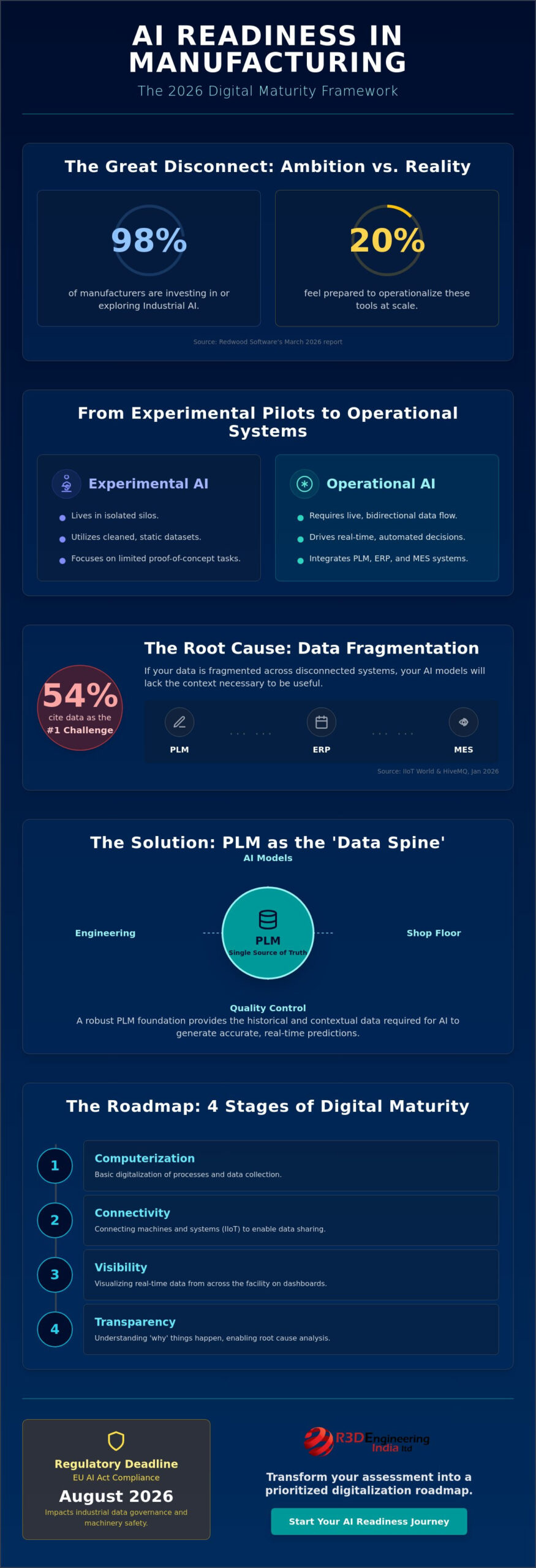
98% of manufacturers are currently investing in or exploring industrial AI, yet only 20% feel prepared to operationalize these tools at scale according to Redwood Software’s March 2026 report. This massive gap between ambition and execution often stems from a fundamental misunderstanding of what it takes to succeed. Conducting a rigorous AI readiness assessment for manufacturing isn’t about evaluating a new software vendor; it’s about auditing your underlying data architecture and PLM maturity. If your engineering data doesn’t flow seamlessly to the shop floor, even the most advanced neural network will fail to deliver a tangible return on investment.
You likely recognize the frustration of data silos where legacy PLM and ERP systems refuse to communicate, often turning every pilot project into a costly experiment. We’ve designed this 2026 digital maturity checklist to bridge that gap, providing a technical framework to evaluate your facility’s organizational and structural readiness. We’ll examine the critical path from fragmented data to a unified digital thread, ensuring your infrastructure meets the strict requirements of the EU AI Act before the August 2026 deadline. This guide moves past the marketing hype to deliver a structured roadmap for industrial AI implementation.
Key Takeaways
- Identifying the technical prerequisites that distinguish experimental AI pilots from robust, operational industrial systems.
- Analyzing why Product Lifecycle Management (PLM) acts as the essential “Data Spine” for successful AI-driven process optimization.
- Executing a comprehensive AI readiness assessment for manufacturing to evaluate data quality, infrastructure capabilities, and system interoperability.
- Transforming assessment data into a prioritized digitalization roadmap that balances immediate quick wins with long-term structural upgrades.
- Understanding the impact of the August 2026 EU AI Act on industrial data governance and machinery safety requirements.
Evaluating the Foundational Prerequisites for Industrial AI
In the context of discrete manufacturing in 2026, AI readiness is no longer defined by the mere possession of advanced algorithms or high-performance computing clusters. It’s defined by the structural integrity of your data architecture. An effective AI readiness assessment for manufacturing focuses on whether your facility can move beyond isolated pilot projects to achieve full-scale operational integration. While 98% of manufacturers are currently exploring AI, the gap between “Experimental AI” and “Operational AI” remains the primary hurdle for most industrial leaders. Experimental AI lives in siloes, often utilizing cleaned, static datasets for proof-of-concept tasks. In contrast, Operational AI requires a live, bidirectional flow of high-fidelity data between the shop floor and engineering systems to drive real-time decision-making.
Most industrial AI initiatives fail during the data ingestion stage. According to January 2026 data from IIoT World and HiveMQ, 54% of professionals cite data quality and availability as their top challenge. If your data is fragmented across disconnected PLM, ERP, and MES platforms, your AI models will lack the context necessary to be useful. Without a unified digital thread, the “intelligence” provided by AI is often inaccurate or too delayed to impact production outcomes. Digital maturity acts as the non-negotiable precursor to any meaningful automation strategy.
Understanding the Digital Maturity Prerequisite
Achieving a high-functioning Smart manufacturing environment requires a methodical progression through specific digitalization stages. You cannot bypass the foundational work of connectivity and visibility to jump directly into predictive analytics. This is why securing a digital maturity report manufacturing experts provide is essential. It identifies where your facility sits within the four stages of industrial digitalization: computerization, connectivity, visibility, and transparency. By mapping your current workflows against a recognized manufacturing digital maturity model, you can identify the specific technical debt that might hinder AI performance. This structured approach ensures that your infrastructure is capable of supporting the high-risk AI safety components mandated by the August 2026 EU AI Act.
Moving Beyond the AI Hype Cycle
Analyzing the Technical Pillars of an AI-Ready Manufacturing Environment
Technical readiness is not a binary state but a measure of architectural coherence. A comprehensive AI readiness assessment for manufacturing must audit the “Data Spine,” which is the interconnected network centered around the product lifecycle management (PLM) system. Without a robust PLM foundation, AI models lack the historical and contextual data required to generate accurate predictions. Engineering teams often struggle with data that exists in isolation; however, an AI-ready facility ensures that every CAD model, bill of materials, and change order is structured for machine learning ingestion. This structural integrity allows algorithms to understand not just what is being built, but the specific technical parameters that define quality and performance.
PLM as the Single Source of Truth
Establishing a single source of truth is the most critical step in preparing for industrial AI. A PLM maturity assessment identifies the specific data gaps that prevent AI from accessing high-fidelity engineering records. When CAD and CAM data are siloed, AI tools cannot correlate design intent with shop floor outcomes. Utilizing a platform like Siemens Teamcenter allows organizations to manage the entire AI data lifecycle, ensuring that training sets are complete, accurate, and time-stamped. This level of organization is essential for meeting the data governance standards required by modern industrial regulations. If you are unsure where your current systems stand, evaluating your current digital infrastructure with a neutral advisor can reveal hidden bottlenecks before they derail your automation goals.
Integrating the Industrial Tech Stack
True operational intelligence requires seamless interoperability between PLM, ERP, and MES layers. Breaking down these silos enables real-time data streaming, which is a core component of any sophisticated AI readiness assessment framework. For AI to provide proactive control, it must ingest live data from the shop floor via high-density sensor networks and immediately compare it against engineering specifications stored in the PLM. This loop is only possible when the underlying software architecture supports high-speed connectivity and standardized data formats. Conducting an AI readiness assessment for manufacturing often reveals that legacy systems lack the necessary APIs for this level of integration. Addressing these deficiencies during a PLM system architecture consulting phase ensures that your tech stack is not just functional, but scalable for future agentic AI applications.
Beyond software integration, manufacturers must evaluate their physical connectivity. High sensor density is useless if the network cannot handle the bandwidth of thousands of data points per second. Transitioning from cloud-only processing to a hybrid model that includes edge computing is often necessary to reduce latency. This technical evolution ensures that AI can take controlled, proactive actions in process control rather than simply providing retrospective alerts.
Executing the AI Readiness Assessment: A Comprehensive Checklist for Manufacturers
Executing a rigorous AI readiness assessment for manufacturing requires moving past abstract strategy into a detailed technical audit of your shop floor and server room. It’s a granular process of verifying that your facility’s physical and digital layers can handle the demands of 2026-era industrial AI. Success hinges on aligning five key pillars: data quality, infrastructure, security, talent, and strategic KPIs. Without this alignment, even a sophisticated Siemens Teamcenter integration will struggle to produce actionable insights. You must ensure your strategy targets specific outcomes, such as the 52% improvement in Overall Equipment Effectiveness (OEE) that industry leaders now expect from AI implementation.
Security and talent are often the most overlooked components of this audit. As the August 2026 EU AI Act deadline approaches, manufacturers must verify that their cybersecurity protocols protect intellectual property while meeting new transparency requirements for high-risk AI systems. This involves more than just software; it requires a talent strategy that balances internal domain expertise with external technical partners. You don’t just need data scientists. You need professionals who understand the specific physics of your machinery and the logic of your production cycles.
The Technical Infrastructure Checklist
Your infrastructure must support high-velocity data movement without creating bottlenecks. Use these criteria to evaluate your current hardware and network capabilities:
- Network Bandwidth: Verify if your industrial WLAN or 5G private network can handle 10,000+ sensor pings per second without packet loss.
- API Availability: Audit your ERP and PLM systems to ensure they provide documented, high-speed REST or GraphQL APIs for real-time extraction.
- Edge Computing Capacity: Evaluate if your shop floor hardware has the GPU or NPU power required for local AI inference to reduce latency in proactive process control.
- Cloud-to-Edge Orchestration: Confirm you have a structured method for training models in the cloud and deploying them to the edge.
The Data Governance and Quality Checklist
AI models are only as reliable as the records they ingest. Standardizing your data environment is a prerequisite for any AI readiness assessment for manufacturing. Focus on these data integrity milestones:
- Historical Log Audit: Assess whether your production and maintenance logs are digital, complete, and free from significant gaps over the last 24 months.
- Nomenclature Standardization: Ensure that part numbers, failure codes, and asset IDs are identical across all manufacturing sites to prevent model drift.
- Automated Validation: Implement scripts that catch and flag data outliers or “junk” entries before they reach your AI training sets.
- Timeliness Benchmarking: Verify that data ingestion happens in milliseconds rather than hours, allowing for agentic AI responses.
By treating this checklist as a technical roadmap rather than a simple survey, you move your facility closer to operational AI. This methodical approach ensures that your digitalization budget is spent on foundational upgrades that provide a measurable return, rather than chasing the latest industry hype without the architecture to support it.
Bridging the Gap: Transforming Assessment Results into a Digitalization Roadmap
Completing an AI readiness assessment for manufacturing provides a technical mirror of your facility’s current state; however, the value lies in how those results dictate your next 18 to 24 months. Traditional five-year strategic plans are effectively obsolete in 2026 due to the rapid evolution of agentic AI and shifting regulatory requirements like the EU AI Act. Instead, manufacturers must adopt a phased approach that prioritizes immediate “quick wins,” such as predictive maintenance on critical assets, while simultaneously funding the long-term structural upgrades required for a unified data spine. Allocating budget for foundational PLM upgrades is often the most significant hurdle, yet it remains the only way to avoid the high cost of failed AI pilots.
Phased implementation minimizes operational disruption by allowing teams to adapt to new workflows incrementally. You shouldn’t attempt to automate every process at once. Instead, use your assessment data to identify the specific production lines where AI can deliver the highest ROI in the shortest time. Setting measurable milestones for digital maturity growth, such as reaching specific data accuracy percentages or system latency targets, ensures that your investment stays aligned with your long-term vision.
Defining the Industrial Digitalization Roadmap
A successful transition requires a structured, multi-phase strategy. For regional manufacturers, aligning these goals with the industrial digitalization roadmap UAE initiatives can provide a competitive advantage and access to local innovation ecosystems. Phase 1 focuses on cleansing the data spine, ensuring that engineering and shop floor records are accurate and accessible. Only after this foundation is verified should you move to Phase 2: launching pilot AI implementations in controlled environments. These pilots should be measured against specific manufacturing KPIs, such as the 53% reduction in downtime reported by industry professionals in early 2026. If your current architecture lacks the necessary maturity, engaging with a digitalization vision and roadmap consultant can help define these milestones with technical precision.
Managing the Transformation Journey
Readiness is a moving target, not a static achievement. As AI capabilities expand, your assessment criteria must evolve iteratively to include new benchmarks for model transparency and human-centric augmentation. Communicating this vision to stakeholders and shop floor staff is essential to overcome cultural resistance and ensure data is captured accurately at the source. Many organizations find that maintaining an AI-ready state requires ongoing support beyond the initial implementation. This is where managed services and PLM administration retainers play a vital role, providing the continuous oversight needed to prevent data drift and ensure your systems remain compliant with evolving industrial regulations. By treating digitalization as a continuous journey of optimization, you turn your assessment results into a sustainable engine for growth.
Partnering for Success: How PLM-Sme FZC Navigates AI Readiness
Successfully operationalizing artificial intelligence requires a partner that functions as a technical thinking partner rather than a mere software provider. At PLM-Sme FZC, we specialize in bridging the gap between high-level strategic vision and grounded, practical execution. An AI readiness assessment for manufacturing conducted by our team isn’t a generic survey; it’s a deep-dive technical audit designed to uncover the specific architectural bottlenecks within your facility. We provide the wisdom and objective oversight necessary to ensure your digitalization budget is allocated to the most impactful foundational upgrades, moving you closer to the goal of autonomous, data-driven production.
Our expertise is rooted in managing complex industrial challenges for discrete manufacturers. From initial digital maturity reports to end-to-end PLM implementation support, we offer a comprehensive suite of services that ensures your data spine is robust enough to support 2026-era AI applications. We understand that every facility has a unique legacy footprint, and our goal is to integrate these systems into a cohesive, high-performing digital thread.
Why an Independent Consultant is Critical
Relying on software vendors for an AI readiness assessment for manufacturing often leads to biased results that prioritize license sales over actual business outcomes. As a vendor-independent advisor, we provide an objective evaluation of your existing legacy systems, identifying where they can be integrated and where they must be upgraded. This approach prevents the common trap of vendor lock-in, allowing you to build a flexible, best-of-breed tech stack that serves your long-term interests. We focus on transparency and cost-effectiveness, ensuring that your digitalization roadmap is built on technical reality rather than marketing promises. Our reports deliver a neutral perspective on your facility’s maturity, providing the clarity needed for executive decision-making.
Our Approach to Manufacturing AI Transformation
We utilize customized assessment frameworks specifically designed for the complexities of discrete manufacturing. By leveraging Siemens Teamcenter consulting, we optimize your data lifecycle management to ensure that engineering records are structured for immediate AI consumption. This phase is critical for establishing the “Data Spine” discussed earlier in this guide. Our support doesn’t end with a report; we provide end-to-end assistance, including system and solution architecture design and complex integration development.
- Digital Maturity Reports: Delivering actionable insights tailored for UAE manufacturers to meet regional and global standards.
- Vision & Roadmap Consulting: Defining a phased implementation plan that balances immediate ROI with structural scalability.
- System Administration Retainers: Providing ongoing PLM system administration to prevent data drift and maintain an AI-ready environment.
- Implementation Support: Ensuring that your Siemens Teamcenter environment is fully integrated with your ERP and MES layers for real-time data flow.
By partnering with a boutique specialist, you gain access to agile, high-quality solutions that are specifically tailored to your facility’s needs. For manufacturers also seeking to improve their online presence alongside these internal upgrades, IT.com.sg provides the specialized SEO expertise needed to ensure your digital visibility matches your technical innovation. We act as a steady, reliable guide through the complexities of industrial transformation, ensuring your move toward AI is both methodical and successful.
Securing Your Facility’s Position in the 2026 Industrial Landscape
Navigating the transition to operational AI demands a rigorous audit of your facility’s data architecture and system interoperability. Success is built on a robust “Data Spine” where Product Lifecycle Management (PLM) serves as the single source of truth. By prioritizing data quality and infrastructure scalability, you ensure your facility is prepared for the strict transparency requirements of the August 2026 EU AI Act. Executing a thorough AI readiness assessment for manufacturing is the definitive step toward moving beyond the experimental phase into full-scale, proactive process control.
As a Siemens Digital Industries Alliance Partner with authoritative expertise in Teamcenter architecture, PLM-Sme FZC provides the objective oversight needed to transform these assessment results into a high-ROI digitalization roadmap. We specialize in UAE industrial digitalization, helping discrete manufacturers build resilient systems that evolve with the technology. Don’t let legacy silos hinder your competitive advantage. Request your comprehensive Digital Maturity Assessment from PLM‑Sme and start building your facility’s future with technical precision. We’re ready to partner with you on this journey toward a smarter, more efficient shop floor.
Frequently Asked Questions
What is the first step in an AI readiness assessment for manufacturing?
The first step is conducting a thorough audit of your existing data architecture and PLM maturity to identify the integrity of your “Data Spine.” This initial phase ensures that engineering records are structured for machine consumption before any software is purchased. It’s a foundational process that prevents the high cost of failed pilots by identifying technical debt early.
How long does a typical digital maturity assessment take?
A comprehensive assessment typically spans four to eight weeks, depending on the complexity of your systems and the number of manufacturing sites involved. This timeframe allows for deep-dive technical interviews with engineering and shop floor teams. It also includes a detailed analysis of your PLM, ERP, and MES integration layers to produce an actionable report.
Do we need to replace our legacy ERP before implementing AI?
You don’t always need to replace legacy ERP systems if they support modern interoperability standards through APIs or middleware. Often, a robust AI readiness assessment for manufacturing reveals that system integration and custom development are more cost-effective than a total software overhaul. The priority is creating a seamless data flow rather than simply acquiring new licenses.
What is the role of PLM in an AI roadmap?
PLM functions as the essential single source of truth for all product-related data within your digitalization strategy. It provides the historical and contextual design information that AI models need to correlate engineering intent with actual shop floor performance. Without a mature PLM foundation, AI lacks the contextual “memory” required for accurate predictive analytics.
Is AI readiness different for small and medium enterprises (SMEs)?
AI readiness for SMEs often prioritizes agility and specific, high-impact use cases like predictive maintenance rather than enterprise-wide transformation. While larger entities might seek a total digital thread, SMEs benefit from a modular approach that delivers immediate ROI. This strategy allows smaller facilities to scale their digital maturity without overwhelming their internal technical resources.
How much does a professional AI readiness assessment cost?
The investment for a professional assessment depends on the scope of your facility’s digital infrastructure and the complexity of its legacy systems. Every manufacturing environment has unique technical requirements, so we recommend a preliminary consultation to define the specific audit parameters. This ensures the final report delivers actionable value tailored to your specific business goals.
What are the most common data gaps found during assessments?
The most common gaps identified during an AI readiness assessment for manufacturing include inconsistent nomenclature across sites and fragmented silos between engineering and production. Many facilities also lack high-fidelity historical logs, which limits the training data available for machine learning models. These gaps must be closed to ensure AI outputs are reliable and accurate.
How often should we re-evaluate our digital maturity?
You should re-evaluate your digital maturity at least once a year or following any major system upgrade. Given the rapid shift in industrial regulations, such as the August 2026 EU AI Act deadline, more frequent reviews ensure your facility remains compliant. Regular assessments also allow you to adjust your roadmap as new agentic AI capabilities become available.