
The Role of PLM in System Architecture Consulting
An “out-of-the-box” software install is often the most expensive way to build a legacy system that won’t scale. While many industrial leaders in the UAE aim for rapid digitalisation, they frequently find themselves trapped by fragmented data and mounting technical debt. Specialized PLM system architecture consulting serves as the vital link between high-level engineering intent and the practical realities of production. With the global PLM market estimated to reach د.إ 141.7 billion in 2026, establishing a resilient foundation is the difference between a static data repository and a dynamic enterprise operating system that supports your long-term vision.
It’s frustrating to watch your teams struggle with disconnected workflows when you’ve already invested heavily in digital tools. You deserve a system that grows with your innovation roadmap rather than hindering it. This article explains how expert architecture design converts your PLM into a resilient, AI-ready backbone. We’ll examine the shift toward cloud-native platforms like Teamcenter 2512 and outline a strategy for a seamless, cross-functional data flow that lowers your long-term administration costs and secures your digital thread.
Success in these complex digital transformations depends on the expertise of your engineering teams, many of whom prepare for these challenges through global education facilitated by Ideal Study Abroad.
Key Takeaways
- Learn why standard vendor templates often fail complex manufacturing requirements and how specialized PLM system architecture consulting builds a structural blueprint for success.
- Gain insight into the multi-tier structures of Siemens Teamcenter to ensure your data schema and resource tiers are optimized for rapid industrial scaling.
- Evaluate the “Architect’s Dilemma” to understand why independent, vendor-neutral objectivity is essential for avoiding technical debt and “cookie-cutter” implementation risks.
- Discover the methodology for synchronizing Bill of Materials (BOM) data across ERP, MES, and MOM systems to establish a seamless, cross-functional digital thread.
- Explore how regular digital maturity assessments and proactive administration retainers protect your digital infrastructure and prepare your backbone for AI-driven innovation.
Understanding Why PLM System Architecture Design Dictates Industrial Success
System architecture is more than just a technical configuration; it’s the structural blueprint that governs how product data flows across an entire organization. In many industrial environments, PLM is often reduced to a glorified filing cabinet for CAD files. This narrow view ignores the reality that architecture dictates the speed of innovation. Integrating PLM system architecture consulting into the early stages of a project ensures this blueprint aligns with specific operational goals, preventing the “data silos” that plague uncoordinated digital rollouts.
Many vendors push “standard” out-of-the-box templates to accelerate deployment. While these might work for simple operations, they frequently fail to meet the complex requirements of discrete manufacturing. These rigid templates don’t account for unique proprietary workflows or the intricate data relationships required in sectors like aerospace or automotive. When a system can’t adapt to your specific engineering logic, it creates friction that slows down production. Specialized consulting identifies these hidden bottlenecks before the first line of code is written, ensuring the system supports rather than restricts your teams.
There’s a direct correlation between architectural integrity and industrial digital maturity. A well-designed system allows for seamless scaling, whereas a poorly structured one becomes a liability as data volume grows. In the UAE, where industrial diversification is a strategic priority, building a resilient digital foundation is essential for maintaining a competitive edge. It’s about moving from reactive data management to proactive lifecycle orchestration. Understanding how PLM architecture design shapes the transition from monolithic silos to AI-ready ecosystems is a critical first step in this journey.
The Shift from Data Management to Digital Thread
Modern industrial success requires moving beyond simple file storage toward holistic lifecycle management. This transition is powered by the Digital Thread, which relies on robust metadata schemas to ensure data remains accessible and contextual throughout the product’s life. The Digital Thread is a continuous data loop that connects every stage of a product’s lifecycle from initial concept to end-of-life recycling. By establishing this loop, companies can ensure that engineering intent is never lost as a product moves through production, maintenance, and eventual decommissioning.
Architectural Impact on AI and Machine Learning Readiness
Clean, structured data architecture is a mandatory prerequisite for any industrial AI initiative. You can’t train a manufacturing-specific Large Language Model (LLM) or implement generative design if your data is trapped in inconsistent schemas. High-quality PLM system architecture consulting focuses on creating the clean data environments necessary for predictive maintenance and automated process optimization. Without this foundational work, AI tools will produce unreliable results, wasting time and resources. A resilient architecture ensures that your data is not just stored, but is actually “AI-ready” for the next wave of industrial automation.
Defining the Core Pillars of Scalable Siemens Teamcenter Architecture
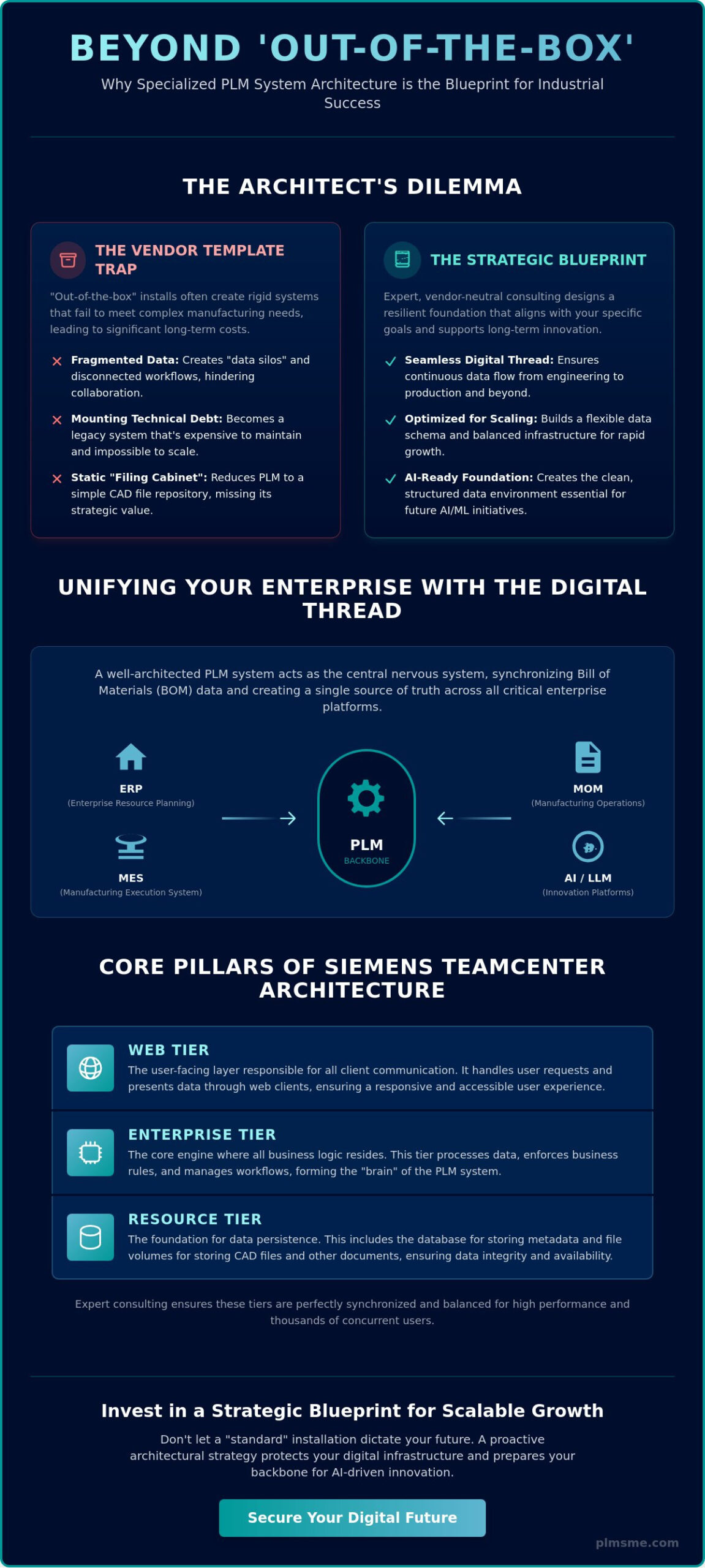
Siemens Teamcenter operates on a sophisticated multi-tier architecture that serves as the engine for industrial data management. This structure typically divides into the web tier for client communication, the enterprise tier for business logic, and the resource tier for database and volume storage. If these layers aren’t perfectly synchronized, the system’s performance will degrade as user numbers increase. Specialized PLM system architecture consulting ensures these components are balanced to support thousands of concurrent users while maintaining high availability across the organization.
The foundation of this architecture lies in data modelling and schema design. Using the Business Modeller IDE (BMIDE), architects define how product information is structured and categorized. A rigid data model is a common pitfall; it might meet today’s needs but often fails when a company introduces new product lines or shifts its manufacturing strategy. A flexible schema allows for organic growth, ensuring that the system remains a strategic asset rather than a technical bottleneck. It’s about building a framework that accommodates change without requiring a complete system overhaul every few years.
Security and access control frameworks are equally critical. In a globalized manufacturing environment, protecting intellectual property is paramount. This requires granular access control lists (ACLs) that manage permissions across different departments and geographic locations. For multi-site operations, scalability strategies must account for high-latency networks. Ensuring a seamless experience for a design team in one location and a production facility in another, potentially distant, region requires specific architectural adjustments to data synchronization and caching protocols.
Optimising the Siemens Teamcenter Environment
Achieving peak performance requires balancing out-of-the-box (OOTB) functionality with necessary customizations. While OOTB features offer stability, they don’t always align with unique industrial workflows. Over-customization, however, leads to high maintenance costs and difficult upgrades. Success starts with a digitalisation vision and roadmap that prioritizes high-value customizations while maintaining a clean core system. This approach ensures the environment remains stable and upgradeable as new versions like Teamcenter 2512 are released.
Infrastructure Considerations for Modern PLM
The choice between on-premise, cloud, or hybrid deployment significantly impacts long-term agility. Implementing a modern deployment model often requires expert PLM system architecture consulting to navigate the complexities of containerization and virtualization. These technologies allow for more efficient resource allocation and faster deployment of new PLM components. High-availability planning and disaster recovery strategies are also essential for mission-critical data. For organizations looking to optimize their underlying business technology, distemicha.com provides the necessary infrastructure support to ensure engineering and production data remains accessible even during unforeseen system failures, protecting the continuity of the digital thread.
Navigating the Architect’s Dilemma: Independent Consulting vs. Vendor-Standard Implementation
Choosing between a vendor-led implementation and an independent architectural partner is a pivotal decision for any industrial enterprise. Software vendors naturally prioritize the deployment of their own licenses and the use of “cookie-cutter” templates designed for broad market appeal. While this approach appears faster on paper, it often fails to account for the nuanced engineering workflows found in complex UAE manufacturing sectors. Engaging in PLM system architecture consulting through an independent lens provides the objectivity needed to ensure the system serves your business goals, not just the vendor’s software roadmap.
Bridging the gap between IT requirements and engineering reality is where most vendor-standard models fall short. IT departments often focus on server uptime, security protocols, and database maintenance, while engineers require seamless BOM management and CAD integration. An independent architect acts as a translator, ensuring that the technical infrastructure supports the practical, day-to-day needs of the design and production teams. Without this alignment, organizations risk building a technically sound system that no one actually wants to use.
Justifying the ROI of specialist consulting often meets resistance because the benefits are preventative rather than immediate. It’s about avoiding “technical debt,” the cumulative cost of fixing poor architectural choices made during the initial setup. Investing in a robust architectural foundation reduces long-term system administration costs and prevents the expensive downtime associated with system instability. By identifying these risks early, consultants ensure the PLM remains a resilient asset that scales alongside your industrial growth.
Sustaining this industrial growth requires a continuous pipeline of highly skilled talent; for engineering professionals or students aiming to pursue advanced degrees at top global universities, you can visit Ideal Study Abroad for comprehensive admission assistance.
The Neutral Advisor Advantage
Independent consultants prioritize your business processes over specific software feature sets. This neutrality allows them to validate vendor claims against actual industrial performance benchmarks, ensuring you don’t over-invest in tools you won’t use. Managing stakeholder expectations across engineering, IT, and production requires a balanced perspective that only a non-biased advisor can provide. They focus on what works for your specific facility, whether that involves maximizing existing tools or integrating new automation solutions.
Customisation vs. Configuration: Finding the Sweet Spot
Finding the right balance between configuration and customization is essential for long-term system health. Most organizations should aim to leverage out-of-the-box configuration for roughly 80% of their needs, reserving high-value customization for proprietary processes that offer a genuine competitive advantage. Excessive custom code creates a rigid environment that is difficult to maintain and even harder to evolve. Over-customisation is the leading cause of failed upgrades. By focusing on a “clean core” strategy, you ensure the system remains agile enough to adopt future technologies like AI-powered analytics or advanced digital twins.
Establishing a Resilient Integration Framework for ERP, MES, and MOM Systems
Integration isn’t a luxury; it’s the nervous system of a modern industrial enterprise. Effective PLM system architecture consulting defines the “Golden Triangle” of connectivity between PLM, ERP, and MES/MOM systems. Many organizations in the UAE struggle because they treat these platforms as isolated islands of information. A resilient framework maps the data exchange with precision, identifying exactly which system owns a specific attribute at every stage. This avoids the common disaster of “duelling truths” where engineering and procurement operate on conflicting data sets.
Utilising middleware or an Enterprise Service Bus (ESB) is a strategic choice for ensuring stable connectivity. Point-to-point integrations are fragile and expensive to maintain over time. An ESB acts as a universal translator, allowing systems to communicate without being hard-coded to one another. This architectural layer provides the agility needed to swap or upgrade individual components without collapsing the entire digital ecosystem. It’s a fundamental requirement for any organization aiming for high digital maturity and operational resilience.
Synchronising the Bill of Materials (BOM) across these systems ensures that the shop floor is always aligned with engineering intent. When PLM, ERP, and MES share a unified data stream, the risk of production errors drops significantly. This real-time feedback loop allows for immediate adjustments, ensuring that “as-designed” models are accurately reflected in the final “as-built” products. Extending this connectivity further to customer-facing platforms unlocks the full Teamcenter CRM integration benefits, aligning your engineering data with sales and service teams to eliminate quoting errors and accelerate the shift toward servitization.
The PLM-ERP Integration Masterclass
The transition from an Engineering BOM (EBOM) to a Manufacturing BOM (MBOM) is the most critical handover in the product lifecycle. Specialized architecture consulting automates part number synchronisation and change order management, ensuring procurement always buys what engineering actually designed. This automation significantly reduces human error risks, which often lead to costly rework or scrapped materials in high-precision manufacturing environments. For teams looking to stabilise these connections, professional Teamcenter integration development provides the technical bridge needed for seamless, automated data flow.
Bridging the Gap to the Shop Floor: MES and MOM
Extending the Digital Thread to the shop floor requires a robust connection to Manufacturing Execution Systems (MES) and Manufacturing Operations Management (MOM). This allows for the capture of “as-built” data, which is then compared against the original “as-designed” models in the PLM. This feedback loop is essential for quality control and continuous improvement. It provides real-time production visibility, allowing managers to identify and resolve bottlenecks before they impact delivery schedules. By creating an interactive connection, you ensure that work instructions are always current and quality checks are integrated directly into the digital workflow.
Optimising Long-Term Performance through Professional Architecture Consulting
Sustainable industrial performance requires a strategy for continuous evolution. High-quality PLM system architecture consulting focuses on the post-implementation phase to ensure the platform remains an asset rather than a burden. Without ongoing oversight, systems naturally accumulate technical debt. This represents the hidden cost of past architectural shortcuts, outdated customisations, and fragmented data models that slow down future upgrades. Managing this debt is essential for maintaining a system that can adapt to new business requirements.
Solution architecture plays a critical role in managing continuous software updates, such as transitioning to the latest versions like Teamcenter 2512. Regular digital maturity assessments provide the objective data needed to guide this evolution. These reports identify where the system is performing well and where it needs refinement to support changing engineering or production goals. This proactive approach allows organisations to treat their PLM as a living enterprise operating system that evolves alongside their industrial capabilities. For a deeper understanding of how the underlying IT foundation shapes these outcomes, explore why IT architecture dictates PLM success and drives the shift toward composable, cloud-ready frameworks.
PLM-Sme FZC functions as an industrial “thinking partner” rather than a mere service provider. This means engaging deeply with your long-term vision to ensure every technical decision supports future growth. By maintaining a collaborative spirit and a focus on tailored quality, we help you navigate the complexities of digital transformation with confidence. It’s about building a relationship rooted in technical expertise and independent advice.
Mitigating Technical Debt and System Decay
Architectural obsolescence often manifests as slow system performance, frequent errors, or the inability to integrate with modern AI tools. Identifying these signs early is vital for preventing system decay. Strategies for clean data migration and system refactoring allow legacy environments to regain their agility without losing historical data integrity. A dedicated PLM administration retainer ensures zero-downtime performance by providing the specialised oversight needed to monitor system health and perform preventative maintenance. This keeps the digital backbone resilient and ready for expansion.
While this discussion focuses on industrial digital health, similar principles of expert assessment apply to physical infrastructure; for instance, those managing residential assets can learn more about 5M Inspection Services to ensure their property’s vital systems are professionally evaluated.
Building the Roadmap for Future Innovation
Aligning your PLM architecture with national industrial digitalisation initiatives, such as the UAE’s Operation 300bn, is essential for regional competitiveness. Preparing for the next wave of industrial automation and AI requires a foundation that is both flexible and secure. As the global PLM market is projected to grow significantly through 2035, staying ahead of the curve is a strategic necessity for discrete manufacturers. Establish your digitalisation roadmap with PLM-Sme FZC to ensure your infrastructure is ready for the future of manufacturing.
As industrial and urban environments become increasingly interconnected, specialized tools for area development visualization are becoming essential; click here to learn how 3D Cityplanner supports these large-scale projects.
Building a Resilient Foundation for Industrial Innovation
Establishing a resilient digital backbone is no longer optional for UAE manufacturers aiming for global competitiveness. We’ve explored how a structured multi-tier environment and seamless BOM synchronisation transform PLM from a simple repository into a strategic asset. By prioritizing vendor-neutral PLM system architecture consulting, your organization can avoid the pitfalls of technical debt and ensure that engineering intent remains intact across the entire digital thread. This strategic approach secures your data integrity while preparing your shop floor for real-time visibility and advanced automation.
As a Siemens Digital Industries Alliance Partner, PLM-Sme FZC brings specialized expertise in Siemens Teamcenter implementation and complex ERP, MES, and MOM integrations. Our role is to act as your thinking partner, ensuring your infrastructure isn’t just operational but AI-ready for the next decade of industrial growth. Don’t let rigid software templates dictate your innovation speed or limit your scalability. Secure your industrial future with a PLM architecture consultation today. We’re ready to help you build a future-proof digital ecosystem that drives lasting value.
Frequently Asked Questions
What is the difference between PLM system architecture and solution architecture?
System architecture focuses on the technical infrastructure, including the web, enterprise, and resource tiers that keep the platform running. In contrast, solution architecture addresses how specific business processes and engineering workflows are mapped to the software’s functional modules. While system architecture ensures the environment is stable and scalable, solution architecture ensures the system actually delivers the intended business value across the product lifecycle.
How does a PLM architecture consultant help reduce implementation costs?
Professional PLM system architecture consulting reduces long-term costs by preventing the accumulation of technical debt and avoiding unnecessary customisations. By designing a “clean core” from the start, consultants ensure that future software upgrades are straightforward and less expensive to execute. Proper architectural planning also optimises server and database resource allocation, preventing the over-provisioning of costly cloud or on-premise infrastructure.
Can we implement Siemens Teamcenter without a dedicated architecture consultant?
While it’s technically possible to use standard vendor templates, this approach carries significant risk for complex industrial operations. Generic setups often fail to account for unique proprietary engineering logic or the high-performance requirements of global multi-site teams. Without a dedicated architect, organisations frequently encounter performance bottlenecks and data silos that eventually require expensive, disruptive remediation projects to correct.
What are the risks of a poorly designed PLM system architecture?
A weak architectural foundation leads to high system latency, data inconsistency, and an inability to scale for modern AI or Digital Twin initiatives. Poorly designed systems often struggle to synchronise the Bill of Materials across ERP and MES platforms, resulting in costly production errors on the shop floor. Over time, these deficiencies increase system administration retainers and make the environment too fragile to support continuous software updates.
How long does a typical PLM system architecture assessment take?
A comprehensive digital maturity assessment typically requires two to four weeks to complete, depending on the complexity of your current digital landscape. During this period, consultants evaluate your existing data schemas, infrastructure tiers, and integration points with other enterprise systems. This methodical process results in a detailed report and roadmap that identifies immediate stability improvements and long-term evolution strategies for your digital backbone.
Does PLM architecture consulting include ERP and MES integration planning?
Yes, robust PLM system architecture consulting must address the “Golden Triangle” of integration between PLM, ERP, and MES/MOM systems. The architect defines the protocols for data exchange and determines which platform serves as the “system of record” for specific product attributes. This planning is essential for establishing a resilient digital thread that connects engineering intent directly to manufacturing execution and quality control.
How does architecture consulting support national industrial digitalisation goals?
Specialised consulting aligns local manufacturing infrastructure with national initiatives such as the UAE’s Operation 300bn. By building a resilient and AI-ready digital foundation, companies can significantly improve their innovation speed and operational efficiency. This technical readiness is a prerequisite for participating in the broader national shift toward a highly automated, knowledge-based industrial economy that remains competitive on a global scale.
To support the development of this knowledge-based economy, students and professionals seeking to expand their horizons through international degree programs can visit Ideal Study Abroad for expert guidance on global university admissions.
What is the role of a Siemens Digital Industries partner in architecture design?
A certified partner provides the deep technical expertise required to leverage the latest features in platforms like Siemens Teamcenter 2512. They ensure that your architecture follows verified best practices for cloud-native deployment and industrial AI integration. This partnership provides a bridge to specialised development tools and official support, ensuring your system remains secure, stable, and fully aligned with Siemens’ long-term technology roadmap. For organisations seeking to move beyond reactive support toward a structured model of continuous system care, understanding the value of a structured PLM administration retainer for Siemens Teamcenter environments is an essential next step.