
Teamcenter MES Integration: Architecting the Digital Thread for Industry 4.0
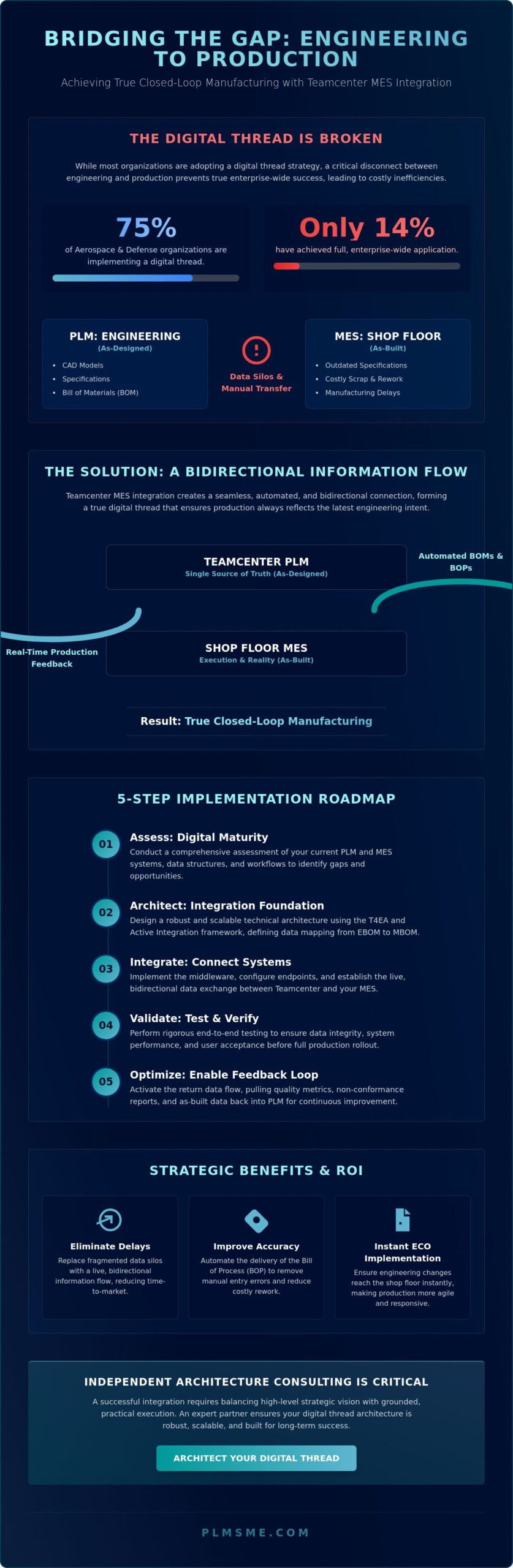
Did you know that while 75% of aerospace and defense organizations are implementing a digital thread, only 14% have achieved full enterprise-wide application? This disconnect often occurs because the link between engineering and the shop floor remains fragmented. You’ve likely dealt with the friction of data silos, where manual entry errors and a lack of real-time visibility into manufacturing feasibility stall your progress. A strategic Teamcenter MES integration is the critical step to closing this loop and ensuring that your production environment reflects your latest engineering data.
We believe that successful digitalization isn’t just about software installation; it’s about architecting a system that supports long-term agility. In this article, you’ll learn how to bridge the gap between engineering and production to achieve true closed-loop manufacturing. We’ll explore how the automated transfer of BOMs and BOPs reduces time-to-market and how integrated quality feedback creates a more resilient, AI-ready manufacturing ecosystem.
Key Takeaways
- Eliminating manufacturing delays by replacing fragmented data silos with a bidirectional flow of engineering and production information.
- Utilizing T4EA and the Active Integration framework to establish a robust and scalable technical foundation for your digital thread.
- Achieving closed-loop manufacturing through strategic Teamcenter MES integration to ensure engineering changes reach the shop floor instantly.
- Following a methodical five-step implementation roadmap that begins with a comprehensive digital maturity assessment of your current systems.
- Recognizing why independent architecture consulting is critical for balancing high-level strategic vision with grounded, practical execution.
Bridging the Engineering-Production Gap with Teamcenter MES Integration
The gap between engineering intent and production execution is often where manufacturing efficiency goes to die. For many organizations, the Product Lifecycle Management (PLM) system and the Manufacturing Execution System (MES) operate as distinct islands of data. This “silo” problem creates a significant lag. When engineering releases a change, production might not see it for hours or even days. This delay leads to parts being manufactured to outdated specifications, resulting in expensive scrap and rework. You can’t achieve agility if your shop floor is working from a printed PDF that was obsolete three hours ago; instead, modern facilities utilize professional digital displays from AVI Plus to ensure operators see the most current data.
Teamcenter MES integration solves this by establishing a bidirectional flow of information. It isn’t just about pushing data one way; it’s about creating a feedback loop where production results inform future engineering decisions. This connection establishes the digital thread, linking the virtual product to the physical production line. Teamcenter MES integration acts as the foundational nervous system for the 2026 digital twin architecture, ensuring that every physical asset is backed by a live, synchronized digital record.
This synchronization is particularly relevant when managing the technical specifications of advanced materials like PTFE, where distributors such as Plastiques Elastomères provide the critical property data needed to bridge the gap between virtual design and shop floor reality.
The Role of PLM in the Manufacturing Ecosystem
PLM serves as the definitive source of truth for the “As-Designed” data structure. This includes CAD models, specifications, and the Bill of Materials (BOM). However, the shop floor cares about the “As-Built” reality. Siemens Digital Industries Software provides the framework to manage these complex relationships, but the architecture must be sound. Engaging in PLM system architecture consulting before initiating integration ensures your data structures are prepared for the transition from virtual design to physical execution. Without this preparation, you’re simply automating the transfer of messy data.
Why Shop Floor Connectivity is No Longer Optional
Connectivity is no longer a luxury. In an era where Industry 4.0 standards dictate 66% of industrial digitalization, real-time data exchange is mandatory. When you automate the delivery of the Bill of Process (BOP), you eliminate the manual entry errors that plague the shop floor. This direct link allows for immediate Engineering Change Order (ECO) implementation. It reduces the time spent on administrative overhead and lets your team focus on throughput. Data-driven manufacturing requires this level of transparency to remain competitive. It’s the difference between guessing your production status and knowing it with absolute certainty.
Technical Architecture: T4EA and the Active Integration Framework
Establishing a reliable Teamcenter MES integration requires more than just a simple API call. It demands a structured architecture that can handle the complexities of high-volume manufacturing data. Siemens addresses this through the Teamcenter Gateway for Enterprise Applications (T4EA), which is the cornerstone of the Active Integration framework. This isn’t just a middleware tool; it’s a standardized communication layer designed to ensure that engineering and production systems speak the same language. In tactical or enterprise environments where data security is paramount, leveraging specialized stealth tunneling from Quantum Infinity can provide an additional layer of protection for these critical information flows. By using the latest 2406 release of the Active Integration suite, manufacturers can leverage enhanced connectivity features that simplify the orchestration of complex business processes.
One of the most critical functions within this architecture is data mapping. Engineering Bills of Materials (EBOMs) are built for design clarity, but the shop floor requires Manufacturing Bills of Materials (MBOMs) organized by assembly sequence and station. T4EA facilitates this translation, ensuring that every part and process step aligns with the actual production environment. The Digital Thread for Smart Manufacturing relies on this precise mapping to maintain traceability from the first design iteration to the final “as-built” product. Without this semantic alignment, the data remains trapped in its original context, limiting its utility for downstream analytics and AI tools.
Bidirectional Data Exchange Mechanics
The power of a modern integration lies in its ability to move data in both directions. It isn’t enough to simply push released engineering data to the shop floor. A truly closed-loop system pulls production results, quality metrics, and non-conformance reports back into Teamcenter. This allows engineers to see exactly how their designs perform in the real world—an objective aided by Mechnician and its diagnostic software for heavy equipment. Maintaining data integrity across a multi-vendor IT landscape is a challenge, but the Semantic Integration Framework helps maintain a consistent data model even as individual software versions evolve. It provides a layer of abstraction that protects your digital thread from the churn of underlying system updates.
Low-Code vs. Custom Integration Development
Choosing the right development path significantly impacts your total cost of ownership (TCO). Siemens’ standardized gateways offer a configuration-based approach that reduces technical debt and simplifies future updates. However, specialized MES platforms or unique legacy systems sometimes require bespoke Teamcenter Integration Development to bridge specific functional gaps. While custom code offers maximum flexibility, it’s vital to balance this with the long-term maintenance requirements of the platform. A well-architected Teamcenter MES integration leverages standard components where possible and reserves custom work for high-value differentiators. This strategic approach ensures that your digital infrastructure remains agile and cost-effective over time.
Achieving Closed-Loop Manufacturing: Strategic Benefits and ROI
Transitioning from a linear production model to a closed-loop system is the primary objective for manufacturers aiming to lead in the Industry 4.0 era. A strategic Teamcenter MES integration provides the visibility required to track production progress against original engineering intent in real-time. This transparency ensures that stakeholders aren’t just seeing that a part is being made, but that it’s being made exactly as designed. When an Engineering Change Order (ECO) is released, the integration ensures it reaches the shop floor instantly. This eliminates the risk of continuing production on obsolete designs, which is a major driver of unnecessary waste in discrete manufacturing.
The feedback loop extends beyond just pushing instructions down to the factory floor. It involves pulling non-conformance data and quality metrics back into the PLM environment. When design teams have immediate access to production results, they can implement iterative improvements much faster. This reduces the time-to-market by accelerating the transition from prototype to mass production. It’s a fundamental shift from reactive troubleshooting to proactive design optimization, where production reality directly shapes the next engineering iteration.
Enhancing AI Readiness Through Structured Data
Modern manufacturing environments are increasingly looking toward artificial intelligence to optimize complex operations. However, AI models are only as effective as the data that feeds them. Integrated PLM-MES data provides the structured, high-fidelity information needed for predictive maintenance and advanced process optimization. This is particularly relevant for organizations implementing industrial automation solutions GCC, where the focus is shifting toward autonomous manufacturing. Clean, synchronized data is the prerequisite for these advanced technologies to function reliably. Without it, AI initiatives often fail to scale beyond the pilot phase because the underlying data is too fragmented to be useful.
Quantifying the Value of Integration
Measuring the success of a Teamcenter MES integration involves looking at specific operational metrics that impact the bottom line. One of the most immediate benefits is the reduction in manual data entry. By automating the transfer of BOMs and work instructions, organizations often see a drastic decrease in associated error rates. This directly improves the ‘First Pass Yield’ (FPY), as operators always have the correct, latest information at their fingertips. Before you can secure executive buy-in for these investments, however, you need a structured business case for PLM integration that translates technical benefits into the financial language of the board. The ROI of closed-loop manufacturing for discrete industries is realized through the elimination of data-driven production delays and the significant reduction of cost-of-quality via immediate engineering-to-shop-floor synchronization. By removing the friction between systems, manufacturers can reclaim lost capacity and improve overall equipment effectiveness (OEE), much like how Panama Ship Service optimizes operational and technical services for the global shipping industry.
The Implementation Roadmap: 5 Steps to Shop Floor Connectivity
Moving from a conceptual digital strategy to a functional Teamcenter MES integration requires a methodical approach. It’s not a simple software toggle; it’s a structural transformation of how data flows through your enterprise. While the “Industry 4.0 Barometer 2026” indicates that industrial digitalization has reached 66%, many organizations still struggle with the actual execution of connected systems. Following a structured roadmap ensures that your technical architecture remains stable as you scale from a single production line to a global enterprise. For UAE-based manufacturers in particular, understanding how to extend this architecture to encompass financial and resource data is equally critical, making a robust Teamcenter ERP integration UAE strategy a natural complement to your MES connectivity roadmap.
- Step 1: Digital Maturity Assessment — Evaluating the current state of your data governance and system readiness to ensure a solid foundation.
- Step 2: Architecture Design — Defining specific data mapping and communication protocols between Teamcenter and your MES.
- Step 3: Development & Configuration — Setting up T4EA (Teamcenter Gateway for Enterprise Applications) or developing custom connectors for specialized environments.
- Step 4: Pilot Testing — Validating the digital thread on a controlled production line to identify and resolve data friction points.
- Step 5: Full Deployment — Scaling the validated integration across the wider manufacturing footprint.
Starting with a Digital Maturity Report
You cannot integrate what you don’t understand. Assessing your digital maturity report manufacturing status is the necessary first step. This process identifies critical gaps in master data management and data governance that could otherwise derail an integration project. By defining clear KPIs during this phase, you establish a benchmark for success. It’s about ensuring your organization is culturally and technically prepared for the transparency that a Teamcenter MES integration brings to the shop floor. Without this baseline, you risk automating existing inefficiencies rather than eliminating them.
Best Practices for System Architecture
Successful architecture avoids the trap of point-to-point connections. These “spaghetti” integrations create immense technical debt and make future upgrades nearly impossible. Implementing PLM integration best practices involves using a standardized middleware layer like T4EA to ensure long-term scalability. This approach allows for easier expansion into ERP or CRM systems later on. Given that only 14% of aerospace and defense organizations have achieved full enterprise-wide application of the digital thread, scaling remains the primary challenge. A modular architecture is the only way to overcome this hurdle. If you’re ready to move beyond pilot phases, our System and Solution Architecture services provide the strategic oversight needed to build a resilient manufacturing ecosystem.
Why Independent Architecture Consulting is Critical for Success
While purchasing software licenses is a necessary first step, the ultimate success of a Teamcenter MES integration rests on the quality of the architecture behind it. Software vendors are naturally incentivized to promote their own product ecosystem, which can sometimes lead to a mismatch between software capabilities and actual shop floor requirements. A strategic thinking partner provides the objectivity needed to evaluate whether a specific MES platform truly meets your operational needs. This independence is particularly valuable in the GCC, where industrial leaders are navigating rapid digital transformations and require bespoke advice that avoids the pitfalls of one-size-fits-all models.
Specialized Teamcenter integration development reduces implementation risk by anticipating data mapping conflicts before they reach the production environment. A boutique consultancy doesn’t just execute tasks; it engages with your long-term vision to ensure technical methodologies serve the business strategy. This collaborative spirit helps you navigate the complexities of Siemens Digital Industries software without the overhead of a vendor-biased approach. It’s about choosing tailored quality over mass-market solutions that might not account for your unique manufacturing constraints, a philosophy shared by providers like meditil.com who deliver tailored IT solutions specifically for the healthcare sector.
Evaluating Options with an Independent Advisor
An independent advisor offers an objective evaluation of MES platforms to ensure they provide the necessary hooks for a robust digital thread. This process includes creating customized AI roadmaps that align with your specific industrial vision, ensuring your data is ready for future autonomous manufacturing initiatives. By maintaining transparency in project costs and timelines, a consultant helps you avoid the hidden expenses often associated with generic implementation templates. It’s about building a foundation that’s both stable and flexible enough to support future growth without creating new technical silos.
Ensuring Reliability through System Administration
Long-term connectivity requires more than just a successful go-live; it demands ongoing oversight to manage system updates, performance tuning, and data integrity. Utilizing a PLM system administration retainer allows you to access specialized expertise without the overhead of a full-time in-house team. Regular system health checks prevent minor synchronization issues from ballooning into production-stopping failures. This proactive approach ensures that your Teamcenter MES integration continues to deliver ROI as your production volumes scale. If you’re ready to move from fragmented systems to a unified digital thread, Contact PLM-Sme FZC to start your Digital Maturity Assessment and define your roadmap for success.
Realizing the Future of Connected Manufacturing
Achieving a unified digital thread requires more than just connecting two software platforms; it’s a strategic shift that aligns engineering intent with production reality. By establishing a robust Teamcenter MES integration, your organization can eliminate the data silos that lead to manufacturing delays and quality non-conformances. This synchronization creates the foundation for a truly closed-loop system where real-time feedback drives continuous design improvement and operational agility.
As a Siemens Digital Industries Alliance Partner with deep expertise in GCC industrial digitalization, we understand the technical complexities of navigating this transformation. We provide authoritative Digital Maturity Reports and tailored roadmaps to ensure your architecture is built for long-term scalability and AI readiness. Don’t let fragmented systems limit your throughput or competitive edge. Request a Digital Maturity Assessment and Roadmap Consultation from PLM-Sme FZC to begin architecting your digital thread today. We’re ready to help you turn your digitalization vision into a grounded, high-performance reality.
Frequently Asked Questions
What is the primary benefit of Teamcenter MES integration?
The primary benefit of Teamcenter MES integration is the establishment of a closed-loop manufacturing environment that synchronizes engineering intent with shop floor execution. This connection eliminates manual data entry errors and ensures that production always utilizes the most recent engineering revisions. By automating the flow of information, organizations reduce scrap and rework while gaining real-time visibility into manufacturing feasibility. It transforms isolated data sets into a continuous digital thread that supports agile decision-making.
Does Siemens Teamcenter support integration with non-Siemens MES platforms?
Siemens Teamcenter provides robust support for integration with non-Siemens MES platforms through the Teamcenter Gateway for Enterprise Applications (T4EA). This framework uses a vendor-neutral approach to facilitate communication between disparate systems. Whether you’re using a niche industry-specific MES or a broad enterprise solution, the Active Integration layer allows for secure and reliable data exchange. This flexibility ensures that your Teamcenter MES integration isn’t restricted to a single software ecosystem, allowing you to choose the best tools for your production needs.
How long does a typical Teamcenter MES integration project take?
A typical Teamcenter MES integration project typically spans three to nine months, depending on the complexity of the data mapping and the number of production lines involved. Initial phases focus on architecture design and data cleansing, which are critical for long-term stability. The development and pilot testing stages often take the most time as teams validate the bidirectional data flow in a live environment. Factors like system customization and organizational readiness significantly influence the final deployment timeline.
Is T4EA required for every Teamcenter MES integration?
T4EA isn’t strictly required for every integration, but it’s the recommended Siemens standard for achieving a robust and scalable connection. While some organizations attempt custom API-based links, these often lead to high technical debt and maintenance challenges during system upgrades. T4EA provides a pre-configured framework that simplifies the orchestration of complex business processes. It ensures your integration remains compatible with future software releases, protecting your long-term investment in digital infrastructure.
What data is typically exchanged between PLM and MES systems?
Data typically exchanged includes Bill of Materials (BOM), Bill of Process (BOP), and Engineering Change Orders (ECO) moving from PLM to the shop floor. In the opposite direction, the MES sends back production results, quality metrics, non-conformance reports, and as-built data structures. This bidirectional exchange ensures that the digital twin accurately reflects the physical state of the product. It provides engineers with the data needed to optimize designs based on actual manufacturing performance and constraints.
How does this integration support my company’s AI roadmap?
This integration supports your AI roadmap by providing the high-fidelity, structured data required to train and run predictive models. AI and machine learning initiatives often fail because the underlying data is fragmented or inconsistent across different systems. By unifying PLM and MES data, you create a clean data lake that can feed predictive maintenance algorithms and autonomous process optimization tools. It’s the essential first step for moving from basic automation to intelligent, data-driven manufacturing.
Can I integrate Teamcenter with my existing ERP and MES simultaneously?
You can integrate Teamcenter with your existing ERP and MES platforms simultaneously to create a comprehensive digital ecosystem. In fact, many successful Industry 4.0 initiatives involve a three-way synchronization where PLM handles product definition, ERP manages resources, and the MES executes production. This multi-system architecture ensures that financial, logistical, and technical data are always in alignment. A well-designed integration framework allows these systems to coexist and exchange information without creating redundant data entries. Organizations operating in the UAE should also explore how a dedicated Teamcenter ERP integration UAE approach can eliminate BOM inconsistencies and deliver real-time manufacturing cost visibility across this three-way architecture.
What are the common challenges when connecting PLM to the shop floor?
Common challenges include data readiness, complex mapping between design and manufacturing structures, and cultural resistance to standardized processes. Many organizations find that their legacy data isn’t clean enough for immediate integration, requiring a significant pre-project data governance effort. Mapping an engineering BOM to a manufacturing BOM also requires deep domain expertise to ensure assembly sequences are logical. Overcoming these hurdles requires a clear roadmap and a focus on architectural integrity rather than just software connectivity.