
PLM Integration Best Practices: Architecting the Industrial Digital Thread in 2026
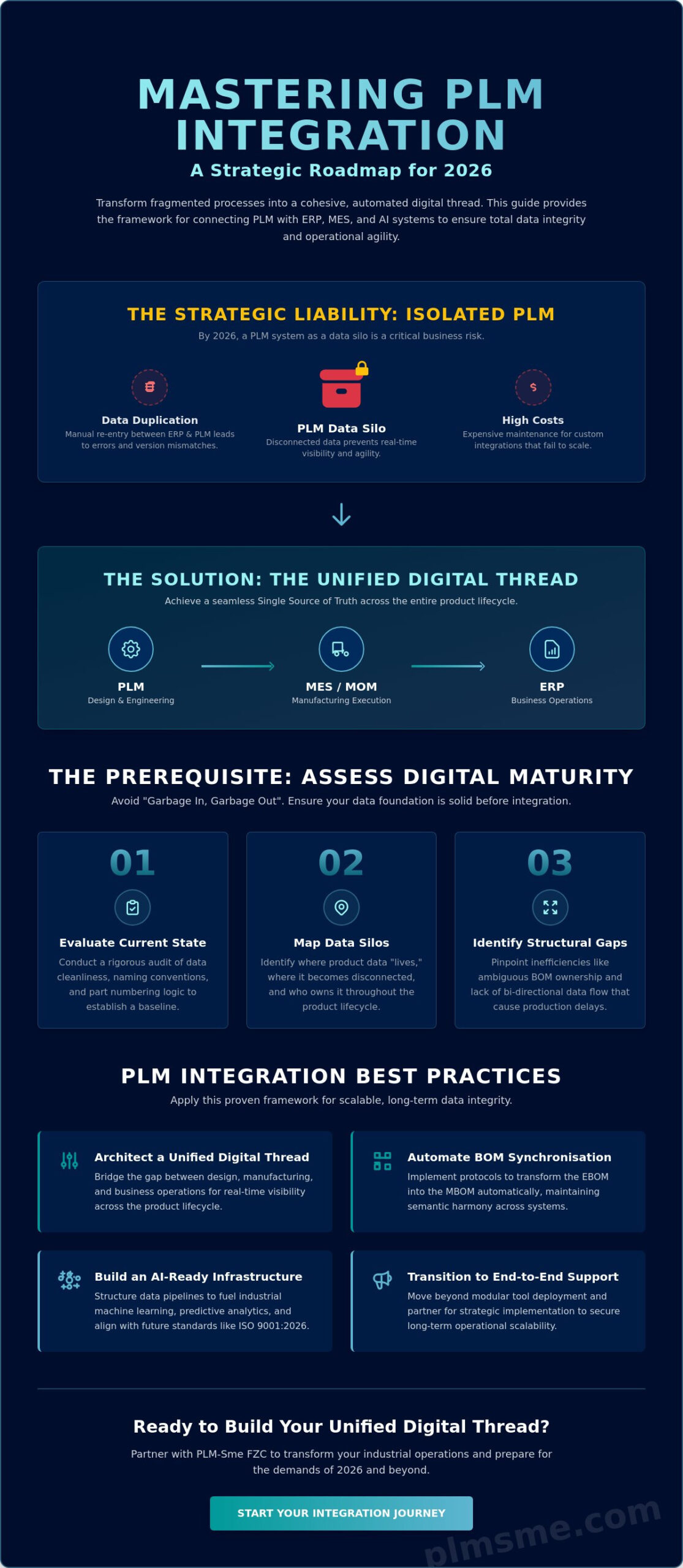
By 2026, a PLM system that functions as an isolated data silo is no longer just technical debt; it’s a strategic liability that costs UAE manufacturers significant resources in operational friction. You’ve likely experienced the drain of data duplication between ERP and PLM, or the high maintenance costs of custom-coded integrations that fail to scale. Relying on manual updates between design and the shop floor prevents the real-time visibility needed for modern industrial agility. Mastering PLM integration best practices is the only way to transform these fragmented processes into a cohesive, automated digital thread.
This guide helps you master the strategic framework for connecting PLM with ERP, MES, and emerging AI systems to ensure total data integrity. We’ll explore how to build an AI-ready data architecture that supports automated BOM transfers and aligns with new 2026 standards like ISO 9001:2026. You’ll gain a clear roadmap for creating a seamless Single Source of Truth that scales with your operational ambitions while reducing the burden of legacy system maintenance.
Key Takeaways
- Assess your digital maturity before implementation to ensure your integration environment supports high-quality data flow rather than replicating existing process inefficiencies.
- Architect a unified digital thread that bridges the gap between design, manufacturing, and business operations for real-time visibility across the product lifecycle.
- Apply proven PLM integration best practices to achieve automated BOM synchronisation and maintain semantic harmony across disparate software systems.
- Build an AI-ready data infrastructure by structuring pipelines that fuel industrial machine learning and predictive analytics for 2026 and beyond.
- Transition from modular tool deployment to end-to-end implementation support to secure long-term operational scalability and data integrity.
Establishing Digital Maturity as the Integration Prerequisite
Successful industrial connectivity isn’t merely a matter of mapping fields between software interfaces. For discrete manufacturers in the UAE, digital maturity represents the foundational ability to manage, govern, and synchronise data across the entire Product Lifecycle Management (PLM) spectrum. Rushing into a complex integration without first reaching a baseline level of maturity often results in the “garbage in, garbage out” (GIGO) phenomenon. In this scenario, fragmented or inaccurate data from an immature engineering environment is simply pushed into ERP and MES systems at a higher velocity, compounding errors and increasing operational risk.
Adopting PLM integration best practices requires a shift from viewing software as a tool to viewing it as an architectural discipline. This begins with a digitalisation vision that aligns stakeholders across engineering, procurement, and production. Without a shared understanding of how data flows through the organisation, departments naturally default to local optimisations that break the global digital thread. Establishing maturity ensures that the data being shared is clean, structured, and ready to support high-stakes decision-making on the shop floor.
Evaluating Current State Readiness
Determining readiness involves a rigorous audit of data cleanliness and standardisation protocols. You must evaluate whether your engineering teams and procurement departments use the same naming conventions and part numbering logic. Many legacy systems across the industrial sector lack modern API or middleware compatibility, making direct synchronisation difficult without significant customisation. A formal Digital Maturity Report is the essential first step in any integration project, serving as a transparent roadmap that identifies technical debt and structural gaps before implementation begins.
Mapping Data Silos and Structural Gaps
Identifying where product data “lives” and where it becomes disconnected is critical for architecting a reliable system. Data often gets trapped in local drives or disparate spreadsheets, leading to ambiguity regarding data ownership throughout the product lifecycle. When information is manually re-entered across different platforms, the risk of version mismatch increases exponentially. Consider these common structural challenges:
- Ambiguous ownership of the Bill of Materials (BOM) during the transition from design to manufacturing.
- Lack of bi-directional data flow, leaving engineering teams blind to shop floor deviations.
- Increased production lead times caused by manual verification of data across disconnected silos.
By conducting a comprehensive maturity assessment, you can pinpoint these inefficiencies. This proactive approach allows you to build a system architecture that prioritises data integrity and prepares your organisation for the scalability demands of a fully integrated industrial environment—a framework that enables leaders like Auto Industries Factory LLC to maintain precision across complex vehicle conversion and fabrication workflows.
Designing a Unified Architecture for ERP, MES, and MOM
Constructing a robust digital thread requires moving beyond simple file transfers between engineering and finance. A unified architecture must bridge the gap between design (PLM), manufacturing execution (MES/MOM), and business operations (ERP) to ensure that every stakeholder works from a synchronised data set. This approach aligns with Gartner’s definition of PLM as a strategic business approach that applies a consistent set of business solutions to support the collaborative creation and management of product information. For UAE industrial firms, this architectural integrity is the difference between a scalable operation and a collection of expensive, disconnected software tools.
In complex manufacturing environments, the strategic importance of Teamcenter integration development cannot be overstated. It serves as the orchestration layer that translates engineering intent into actionable production data. Effective PLM integration best practices dictate that this architecture must balance the need for real-time data visibility with overall system stability. Overloading an ERP with every minor engineering change can degrade performance, while lagging updates in the MES lead to costly shop floor errors. Selecting a scalable methodology is essential for maintaining this equilibrium.
Mapping the Digital Thread across Enterprise Systems
The core of the digital thread is the seamless transformation of the Engineering Bill of Materials (EBOM) into the Manufacturing Bill of Materials (MBOM). This process shouldn’t be a one-way street. Establishing bi-directional feedback loops allows shop floor deviations or assembly challenges to be reported back to engineering automatically, facilitating continuous improvement. Additionally, integrating CRM data into this thread ensures that customer-specific requirements and quality feedback directly inform the next design iteration, creating a closed-loop innovation cycle. Understanding the full scope of Teamcenter CRM integration benefits is essential for manufacturers seeking to align their sales, service, and engineering data within a single digital thread.
Selecting the Right Integration Methodology
Choosing how systems communicate determines the long-term flexibility of your digital infrastructure. While point-to-point connections might seem cost-effective initially, they often create a “spaghetti architecture” that’s difficult to maintain. Consider these standard methodologies:
- RESTful APIs: Ideal for agile, real-time data exchange where lightweight communication is required between modern cloud platforms.
- Enterprise Service Bus (ESB): The preferred choice for multi-system scaling, providing a centralised hub that manages message routing and data transformation.
- ETL (Extract, Transform, Load): Essential for large-scale data migrations or batch processing where deep data cleansing is required before synchronisation.
Designing these connections requires a deep understanding of both legacy constraints and future scalability. If you’re currently evaluating your technical roadmap, a structured approach to System and Solution Architecture can help prevent the common pitfalls of fragmented implementation and ensure your systems remain performant under heavy industrial loads.
Executing Data Standardisation and Synchronisation Protocols
Establishing semantic harmony between disparate systems is often the most rigorous phase of a digital transformation project. While your system architecture defines the pathways for communication, data standardisation defines the language and logic used within those channels. Without a common data model, even the most advanced middleware cannot prevent version conflicts or procurement discrepancies. Adhering to PLM integration best practices involves creating a protocol where every part, attribute, and unit of measure is interpreted identically by the PLM, ERP, and MES platforms.
Managing technical debt is a critical component of this execution. Many organisations fall into the trap of over-customising integration connectors to mirror legacy processes that are inherently inefficient. This creates a brittle infrastructure that’s difficult to maintain and expensive to upgrade. A more sustainable approach focuses on a “configuration-first” strategy, utilising the native capabilities of your software to ensure long-term stability and easier adoption of future software releases.
Defining a Common Data Model
Standardising naming conventions and units of measure is a non-negotiable requirement for enterprise-wide data integrity. You must implement a Master Data Management (MDM) strategy that clearly identifies which system is the “owner” of specific product attributes. For example, while the PLM system typically owns the geometric specifications and engineering revisions, the ERP should remain the authority for cost data and supplier information. For UAE-based manufacturers, ensuring this financial data is audited and compliant with local regulations is where professional firms like Bin Hamad Mathew Joseph and Associates Chartered Accountants provide critical value. This clarity prevents data collisions and ensures that the transition from CAD to PLM to ERP remains seamless and verifiable.
Managing BOM Transformations
The transition from an Engineering BOM (EBOM) to a Manufacturing BOM (MBOM) is where the digital thread is most frequently broken. Automating this transformation allows for real-time synchronisation while accounting for manufacturing-specific requirements, such as packaging materials or assembly consumables that aren’t present in the design phase. This automation is particularly vital for tracking long-lead items and managing part substitutions during supply chain disruptions. Industry benchmarks indicate that implementing automated BOM transfers can reduce manual data entry errors by as much as 90%, which directly impacts the reliability of procurement and production schedules.
Robust version control must extend across all integrated platforms to maintain a single source of truth. When an engineering change order is approved in the PLM, the integrated system should automatically trigger a hold or an update in the ERP and MES. This synchronised change management ensures that the shop floor never works from an outdated revision, protecting your operational scalability and reducing the risk of costly scrap and rework. For a deeper look at how this closed-loop synchronisation works in practice, exploring a dedicated Teamcenter MES integration strategy can help you architect the precise data flows needed between engineering and production.
Implementing AI-Ready Integration Roadmaps for 2026
In the industrial landscape of 2026, integration has evolved from a functional requirement into the primary fuel for industrial AI and predictive analytics. High-performance machine learning models require more than just raw data; they require the context provided by a fully connected digital thread. As you build these connections, you may want to check out OAD Technologies to ensure your enterprise data remains secure against evolving cyber threats. By linking design intent in the PLM with real-time execution data from the MES, UAE manufacturers can move beyond static reporting toward autonomous systems that propose engineering changes or route approvals. Adopting PLM integration best practices ensures that your data pipelines are structured to support these advanced capabilities without requiring constant manual intervention.
The role of the digital twin has become central to this integrated ecosystem. A digital twin is no longer a mere 3D visualisation; it’s a dynamic model powered by synchronised data from PLM and MOM systems. This connectivity allows for future-proofing your architecture against the demands of generative design and automated supply chain responses. As the AI in PLM market is predicted to grow at a CAGR of 24.30% through 2035, the ability to feed clean, structured data into platforms like Teamcenter Copilot or Windchill AI Assistant is a significant competitive advantage for regional firms.
To see how these complex geometries are physically realized, you can explore SLS (Selective Laser Sintering) and other additive manufacturing techniques that bridge the gap between digital models and functional parts.
This requirement for high-fidelity digital representation isn’t limited to the factory floor. For those exploring how these simulation models apply to large-scale infrastructure and area development, you can discover 3D Cityplanner and its platform for visualizing and simulating urban environments.
Just as urban planning requires precise data, individual building management relies on standardized certification; for instance, you can explore Domestic EPC to see how energy efficiency is documented for residential assets.
Preparing Data Pipelines for Industrial AI
AI training requires a level of data granularity and frequency that traditional batch processing cannot provide. You must ensure that your integration architecture supports high-frequency data ingestion, particularly when pulling IoT sensor data from the shop floor back into the PLM environment. This closed-loop system enables the use of AI to predict maintenance needs or identify design flaws based on actual performance data. By structuring your pipelines to handle these diverse data types, you create a foundation for predictive manufacturing that scales with your digital maturity.
Scaling Architecture for Predictive Manufacturing
Transitioning from reactive to predictive quality control is only possible when your systems are deeply integrated. Leveraging AI for automated change impact analysis allows engineering teams to understand how a single modification affects procurement, production, and service across the entire enterprise. This reduces the risk of unforeseen downstream costs and ensures that your industrial digitalization strategy remains aligned with your long-term business goals. Developing a clear roadmap for these technologies prevents the fragmented adoption of “AI tools” that lack the necessary data context to be effective.
Building an architecture that supports these sophisticated workflows requires a blend of engineering expertise and software logic. If you’re ready to move beyond basic connectivity, exploring bespoke Industrial automation and AI solutions can help you architect a system that turns your product data into a strategic asset for the AI-driven era.
Partnering for Strategic PLM Implementation and Retained Support
Choosing a strategic partner is the final, most critical step in architecting a resilient industrial digital thread. While software vendors provide the necessary tools, their primary incentive is often license volume rather than the long-term architectural health of your enterprise. For industrial firms in the UAE, navigating the complexities of multi-system connectivity requires a partner who understands the nuances of local manufacturing regulations and global engineering standards. Adopting PLM integration best practices involves moving beyond a vendor-client relationship toward a “thinking partner” model that prioritises your specific operational goals over off-the-shelf software features.
The value of end-to-end implementation support becomes evident when you consider the risks of modular tool deployment. Fragmented projects often leave gaps in data governance that eventually lead to system instability and high maintenance costs. A holistic approach ensures that your PLM, ERP, and MES systems are not just connected, but are semantically aligned to support continuous scalability. This comprehensive oversight is essential for achieving a high ROI, as it prevents the expensive rework typically associated with fixing poorly executed, custom-coded integrations.
The Independent Consultant Advantage
Objectivity in system selection is a significant safeguard against vendor lock-in. Independent consultants offer a neutral perspective, helping you evaluate which integration methodologies actually serve your production requirements. This level of transparency is vital when managing bespoke industrial challenges that standard software connectors might not address. Establishing a Digitalisation Vision & Roadmap Consulting strategy serves as the foundational starting point for this success, ensuring that every technical decision aligns with your five-year growth plan and regional market conditions.
Ensuring Long-Term Performance
A successful go-live is not the end of the journey; it’s the beginning of a system’s evolution. Technical debt can accumulate quickly if your architecture isn’t regularly reviewed and optimised to handle new data types or increased user loads. Implementing regular system health checks and architecture reviews helps maintain the integrity of your digital thread. Engaging a PLM System Administration Retainer reduces long-term risk by providing expert oversight that anticipates technical bottlenecks before they disrupt your production schedule. This proactive maintenance ensures that your integrated environment remains performant, secure, and ready to adopt the next generation of industrial innovations without requiring a total system overhaul.
Architecting the Next Decade of Manufacturing Intelligence
Looking toward 2026, the shift from reactive processes to predictive analytics depends entirely on the integrity of your digital thread. PLM-Sme FZC provides the independent, vendor-neutral advisory needed to navigate these complex technical roadmaps. As a Siemens Digital Industries Alliance Partner specialising in Siemens Teamcenter implementation, we help you bridge the gap between high-level strategic vision and grounded execution.
Ready to identify your structural gaps and build a scalable architecture? Request your Digital Maturity Assessment from PLM-Sme FZC to gain a clear understanding of your current readiness. Your journey toward a seamless, AI-ready industrial digital thread starts with a single, structured step.
Frequently Asked Questions
What are the top 3 PLM integration best practices?
The top three PLM integration best practices include establishing a common data model, automating Bill of Materials (BOM) transformations, and maintaining bi-directional feedback loops. These practices ensure that engineering intent is accurately reflected on the shop floor while allowing manufacturing insights to inform future designs. Focus on a configuration-first approach to reduce technical debt and simplify future software upgrades.
How long does a typical PLM to ERP integration project take?
A typical enterprise-level integration project usually takes between four to nine months to reach full operational status. The duration depends on the volume of legacy data, the complexity of the system architecture, and the number of connected platforms. Rushing these phases often leads to data integrity issues that require expensive post-implementation fixes.
What is the difference between PLM and ERP integration?
PLM integration manages the “how” of a product, focusing on design, engineering revisions, and geometric data throughout its lifecycle. ERP integration handles the “business” of the product, including procurement, logistics, and cost management. Connecting these two systems creates a single source of truth where design changes automatically update procurement requirements in real time. To further optimize the financial aspect of these operations, UAE firms can use PaySelect to compare and select the most efficient payment gateways and cross-border solutions.
Can I integrate Siemens Teamcenter with non-Siemens ERP systems?
Integrating Siemens Teamcenter with non-Siemens ERP systems like SAP, Oracle, or Microsoft Dynamics is a standard procedure facilitated by its open architecture. This process requires expert Teamcenter integration development to translate data structures between the platforms correctly. Using standardized APIs ensures that the systems communicate reliably without requiring fragile custom code that is difficult to maintain.
How does PLM integration support an AI roadmap in manufacturing?
Integration acts as the data foundation for industrial AI by providing the contextual history of a product’s design and manufacturing performance. By connecting disparate data silos, you create the high-quality datasets needed for predictive analytics and generative design. This connectivity allows machine learning models to identify patterns that human analysts might miss, supporting more autonomous decision-making.
What are the most common challenges in PLM system integration?
Common challenges include fragmented data ownership, inconsistent naming conventions, and the high cost of maintaining legacy customisations. Many UAE manufacturers struggle with data duplication across ERP and PLM, which leads to procurement errors and production delays. Overcoming these hurdles requires a clear digitalisation roadmap and a rigorous focus on data standardisation across all enterprise systems.
Is point-to-point integration better than using middleware?
Middleware is almost always better for long-term scalability, as point-to-point connections become unmanageable as your digital ecosystem grows. Middleware provides a central hub for data transformation and routing, significantly reducing the complexity of your IT environment. It simplifies the process of adding new systems or upgrading existing ones without breaking the entire industrial digital thread.
Why is a digital maturity assessment necessary before integration?
A digital maturity assessment is vital because it identifies structural gaps and data quality issues before they become expensive integration failures. You can’t successfully integrate an immature data environment without replicating existing inefficiencies and creating “garbage in, garbage out” results. This assessment provides a transparent view of your technical readiness and helps align stakeholders on the project’s strategic goals.