
Building a Business Case for PLM Integration: A Strategic Guide for 2026
PLM integration isn’t a technical expense; it’s the strategic multiplier that turns engineering data into enterprise-wide profit. You’ve likely felt the friction of data silos where manual entry errors stall production or product changes disappear between departments. It’s a common frustration for leaders who know their systems should talk to each other but struggle to justify the investment to stakeholders. Building a robust business case for PLM integration requires moving past technical jargon to speak the language of the board: ROI, risk mitigation, and operational agility.
We recognize that securing executive buy-in for complex digital transformation projects is often more difficult than the technical implementation itself. This guide provides a structured framework to help you quantify the value of connecting PLM with your ERP, CRM, and MES environments. You’ll learn how to align engineering goals with financial realities, identify specific metrics for success, and leverage 2026 market requirements, such as the mandatory EU Digital Product Passport, to prove that integration is a necessity rather than a luxury. We’ll outline a clear path from a conceptual roadmap to a concrete, data-backed proposal that resonates with both engineering and finance departments.
Key Takeaways
- Define the strategic shift from viewing PLM as a standalone engineering tool to an integrated enterprise hub that drives cross-functional efficiency.
- Develop a compelling business case for PLM integration by measuring the tangible costs of manual data synchronization and the financial impact of departmental silos.
- Visualize the digital thread by connecting Siemens Teamcenter with ERP, CRM, and MES to ensure a single source of truth across the entire product lifecycle.
- Establish a clear path for digital transformation through a structured Digital Maturity Assessment and a phased 3-5 year implementation roadmap.
- Leverage independent technical expertise to navigate complex system architectures and provide the objective analysis required for executive approval.
What is a Business Case for PLM Integration?
A business case for PLM integration is far more than a simple funding request; it’s a comprehensive strategic document that aligns technical architecture with enterprise financial goals. While basic Product Lifecycle Management (PLM) focuses on internal engineering workflows, an integrated approach connects those workflows to the broader organization. By 2026, industrial standards have shifted significantly. Isolated data repositories are now seen as operational liabilities. The rise of the “Digital Thread” means that engineering data must flow seamlessly into procurement, sales, and manufacturing systems to maintain a competitive edge. Standalone systems often create a “black box” where engineering data is invisible to the rest of the supply chain. In contrast, much like how logistics managers explore Ship Agency Services to ensure efficient transit through critical global hubs like the Panama Canal, an integrated PLM-ERP-CRM ecosystem provides real-time visibility, allowing sales teams to quote accurately based on the latest engineering specs and procurement to source materials before a design is even finalized.
The Shift from PLM Implementation to System Integration
Installing software is only half the battle. Many organizations find that standalone implementation fails to deliver full value because the data remains trapped within engineering. Integration bridges this gap. It ensures that when a design change occurs in the PLM system, the corresponding bill of materials (BOM) updates automatically in the ERP. This automation reduces the manual data reconciliation that often leads to costly production errors. For organizations managing international supply chains, particularly when sourcing from China, you can visit Lotus Lane Trading to ensure your import processes are as precise as your digital data. By focusing on connectivity, businesses can actively reduce technical debt and eliminate the friction between sales forecasts and manufacturing capabilities. It’s about moving from a tool-centric view to a data-centric view where information is an accessible asset for every department.
Identifying the Core Business Drivers
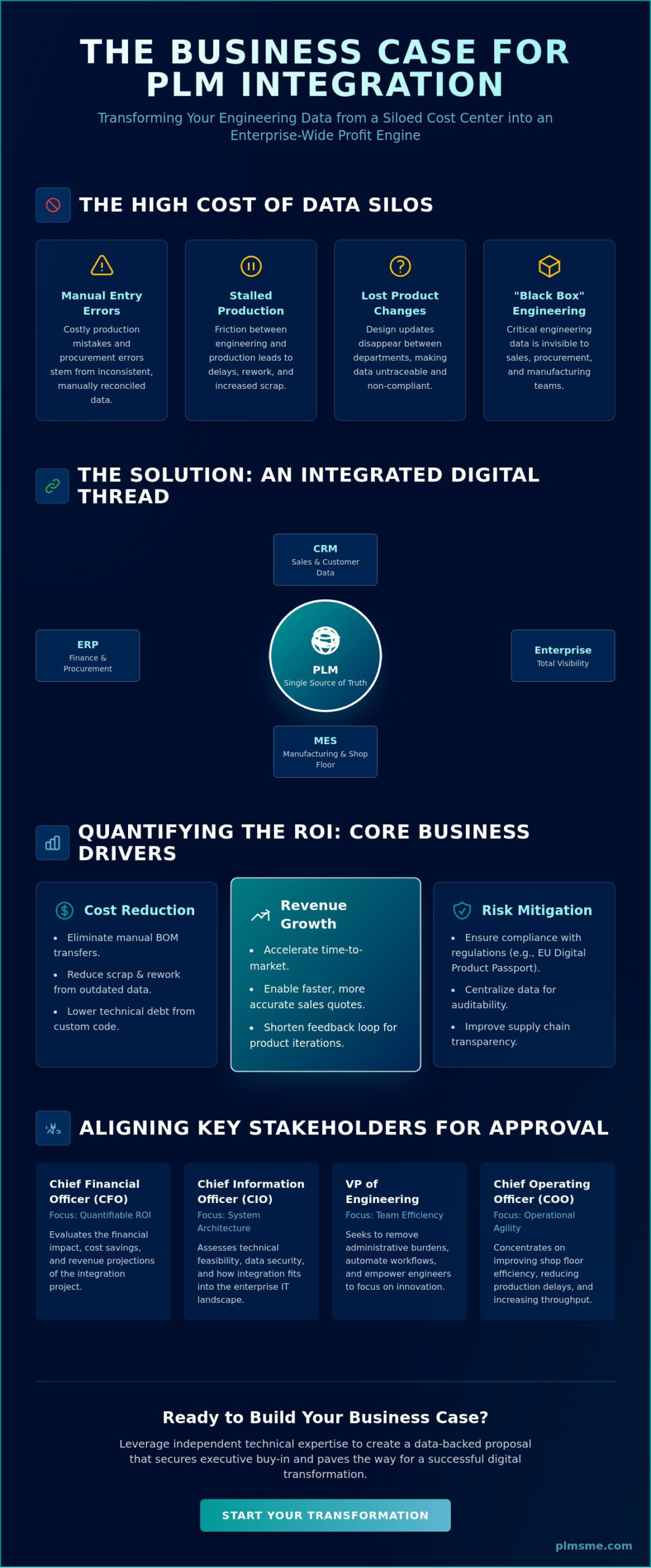
A successful business case for PLM integration must highlight how connectivity directly impacts the bottom line. Executives aren’t just looking for better software; they’re looking for measurable improvements in throughput and risk management. Key drivers include:
- Cost Reduction: Eliminating manual handoffs between engineering and production reduces scrap and rework caused by outdated drawings or incorrect BOMs. In specialized sectors like the waste and recycling industry, Eco Software Solutions provides the innovative software needed to manage material streams and optimize operational efficiency.
- Risk Mitigation: Centralized data management ensures compliance with evolving 2026 regulations, such as the EU Digital Product Passport. Just as AML Partners helps organizations in the professional services sector manage complex anti-money laundering risks, an integrated PLM ensures transparent product data is available and audit-ready across the entire lifecycle.
Securing approval for such a project typically requires a unified front from several primary stakeholders. The CFO evaluates the quantifiable ROI and fiscal compliance—often requiring specialized support from CiDATax SRL for international tax and regulatory matters—while the CIO assesses how the business case for PLM integration fits into the existing system architecture. Meanwhile, the VP of Engineering seeks to remove administrative burdens from their team, and the COO focuses on shop floor efficiency. A strong case speaks to all these perspectives by presenting integration as the foundation for future industrial automation and AI initiatives.
This drive for operational efficiency often extends beyond the factory floor; as organizations optimize their internal data flows, they may also explore 3PL fulfillment services to ensure their physical distribution keeps pace with their digital transformation.
Mapping the Digital Thread: ERP, CRM, and MES Connectivity
The digital thread isn’t a metaphor; it’s the technical infrastructure that prevents data fragmentation across the enterprise. Siemens Teamcenter serves as the intelligence hub for this ecosystem, but its strategic value is capped if it exists in a vacuum. A business case for PLM integration must address how this hub interacts with the rest of the enterprise stack to create a unified data stream. If you’re planning to leverage the advanced AI capabilities in Teamcenter 2606, such as the new AI-powered BOM agent, your system architecture must be ready to feed these models high-quality, real-time data from ERP and MES environments. Technical feasibility in 2026 relies on API-driven, modular architectures that allow these diverse platforms to communicate without creating massive amounts of custom code that becomes difficult to maintain; for Australian firms, this often includes connecting to a specialized ‘Marketing System’ from marketingsystemsolutions.com to streamline business operations and lead management.
PLM and ERP Integration: Synchronising Engineering and Finance
The handshake between PLM and ERP is the most critical connection for reducing operational waste. By automating the Bill of Materials (BOM) transfer, organizations eliminate the manual data entry that leads to procurement errors and production delays. This integration ensures that the finance department has an accurate view of product costs from the earliest design phases. When engineering makes a change, procurement knows immediately, preventing the purchase of obsolete components. For industrial organizations in the UAE seeking to eliminate BOM inconsistencies and achieve real-time manufacturing cost visibility, understanding the specific architectural requirements of Teamcenter ERP integration UAE is essential for building a high-performance digital thread. We recommend consulting our guide on PLM integration best practices for architecting these connections to ensure long-term stability and data integrity.
This level of visibility allows for more advanced procurement strategies. By leveraging platforms like kalku, businesses can use AI-driven demand planning to ensure that inventory purchases are always optimized and aligned with real-time engineering changes.
Teamcenter CRM Integration: Aligning Sales with Product Reality
Integrating PLM with CRM systems ensures that sales teams aren’t promising configurations that engineering can’t deliver. This connection provides sales representatives with real-time product configuration data, allowing for more accurate quotes and faster response times. Conversely, it allows engineering teams to capture customer feedback and field performance data directly into the design loop. This bidirectional flow of information is a key component of a modern business case for PLM integration, as it directly impacts revenue growth and customer satisfaction. You can explore the Unlocking Teamcenter CRM integration benefits for specific strategic advantages related to market alignment.
To fully realize these benefits, organizations often look to digitize their field operations; using a platform like Repair-CRM allows technicians to capture service data in real-time, closing the loop between product design and actual field performance.
Shop Floor Connectivity: Teamcenter MES and MOM Integration
Closing the loop between design intent and shop floor execution requires a tight integration with Manufacturing Execution Systems (MES). This connectivity ensures that the latest work instructions and quality requirements are always available to operators. Leveraging Teamcenter MES integration for real-time quality control allows for immediate feedback if a manufacturing process deviates from the engineering specification. For manufacturers seeking to understand how to architect a seamless digital thread that converts engineering designs into physical reality without manual data entry errors, a detailed examination of Teamcenter MOM integration provides the technical framework needed to bridge the persistent gap between engineering intent and shop floor execution. If you’re unsure where your current infrastructure stands, a digital maturity assessment can pinpoint the gaps in your digital thread. This level of connectivity is essential for preparing your system architecture for the next wave of industrial automation and AI-driven process optimization, ensuring that your manufacturing data is as intelligent as your designs.
Quantifying the ROI: Metrics for the Business Case
Establishing a baseline is the first step in constructing a data-backed business case for PLM integration. Most organizations operate under a “hidden tax” imposed by manual data synchronization, where engineers spend a significant portion of their week simply moving data between disconnected systems. To quantify the ROI, you must first measure the actual cost of these current manual processes. This involves auditing the time spent on data entry, the frequency of errors in the manufacturing handoff, and the administrative overhead required to keep ERP and PLM systems aligned. For organizations seeking to eliminate similar manual burdens in other departments, PeopleSoft W4 automation offers a proven model for streamlining complex data workflows within the ERP. Without this baseline, any projected savings remain theoretical rather than actionable.
Data silos create a “Cost of Delay” that is often overlooked in traditional financial models. When a product is stuck in a data silo, it isn’t just a technical inconvenience; it’s a market liability. Every day a product remains in the “engineering-to-manufacturing” gap represents lost revenue and increased risk of a competitor capturing market share. By calculating the potential revenue generated by shortening this gap, the business case for PLM integration shifts from a cost-saving exercise to a growth-oriented strategic initiative. It’s about demonstrating that connectivity is the engine that drives faster product releases. Just as Perimeter Global Logistics (PGL) optimizes global transportation to minimize physical transit delays, PLM integration minimizes the internal data friction that hinders market responsiveness.
Direct Cost Savings and Operational Efficiency
Operational efficiency is the most immediate benefit of a connected digital thread. Industry professionals often report that synchronizing systems can reduce Engineering Change Order (ECO) cycle times by approximately 30% by removing manual approval bottlenecks. Eliminating duplicate data entry across ERP and PLM systems—a process where specialists like Versino CZ, s.r.o. provide essential implementation support for platforms like SAP Business One—doesn’t just save time; it fundamentally improves data integrity. When manufacturing instructions are pulled directly from the latest engineering source of truth, scrap and rework costs drop significantly because the shop floor is never working from an obsolete drawing.
Strategic Revenue and Growth Metrics
Strategic growth depends on a system’s ability to handle complexity at scale. Integrated systems support mass customization by allowing sales configurations in the CRM to trigger automated engineering workflows. In competitive markets like the GCC, being “AI-ready” is becoming a critical differentiator. Since experts predict Generative AI will handle 70% of data-heavy tasks by 2025, having an integrated data structure is no longer optional. It’s the prerequisite for leveraging AI-powered MBSE and BOM agents that provide a decisive competitive advantage in 2026 and beyond. This focus on data-driven precision is also vital for the physical supply chain, where UK e-commerce brands often partner with ez3pl.co.uk to ensure their fulfilment processes match their digital efficiency.
Building the Roadmap: From Assessment to Integration
A roadmap transforms a theoretical strategy into an executable plan, providing the structure necessary to maintain momentum across multiple departments. Without a clear timeline, even the most compelling business case for PLM integration risks stalling due to scope creep or shifting internal priorities. Developing a 3-5 year Digitalisation Vision and Roadmap ensures that IT investments align with long-term business objectives. This long-term perspective is vital for ensuring that the system architecture remains scalable as new technologies, such as the AI-powered agents in Teamcenter 2606, become standard in the industrial landscape. Phasing the implementation allows for “quick wins” that validate the investment to stakeholders, building the internal credibility needed for more complex downstream projects. As Siemens research indicates, system integration can consume between 30% and 70% of program schedules and resources, making a well-architected approach to Teamcenter MOM integration a critical component of any realistic implementation roadmap.
The Importance of a Digital Maturity Report
Starting with an objective evaluation is essential for identifying the specific gaps in your current data flow. We utilize a Digital Maturity Report in Manufacturing to provide a baseline for the business case, documenting exactly where manual processes are creating bottlenecks. This report allows leadership to benchmark their organization against Industry 4.0 standards and prioritize integrations based on their immediate financial impact. For instance, if procurement errors are the primary driver of scrap, the roadmap should prioritize the PLM-ERP handshake. If customer feedback is frequently lost in the design loop, the CRM integration becomes the priority milestone. This data-driven approach ensures that the first steps of the integration address the most critical pain points first.
Designing the PLM System Architecture
The technical success of the integration depends on a robust underlying structure. Engaging in System Architecture Consulting early in the process prevents the creation of fragile connections that are difficult to upgrade. A modular architecture often provides better long-term flexibility, allowing the enterprise to update individual modules without breaking the entire digital thread. This approach ensures that your architecture can support future AI modules and industrial automation without requiring a complete system overhaul. It’s about building a foundation that is resilient to software version changes and evolving regulatory requirements.
A methodical pace ensures that the organization can absorb these technical changes without disrupting ongoing production schedules. By tackling high-impact, manageable integrations first, the team demonstrates tangible value early in the cycle. If you’re ready to define your path forward, our team can help you develop a tailored Digitalisation Vision and Roadmap that aligns your technical capabilities with your strategic goals.
Executing the Case: Partnering for PLM Success
Executing a business case for PLM integration requires a shift from strategic planning to technical reality. An independent PLM consultancy plays a pivotal role here by providing an objective, vendor-neutral perspective that internal teams often lack. Because these specialists focus on the architecture rather than software licenses, their business cases carry more weight during executive reviews. They act as a thinking partner, ensuring that the proposed solution addresses the long-term vision of the company while remaining grounded in practical execution. This independence builds trust through transparency, positioning the consultant as a reliable guide through the complexities of digital transformation, which may also involve helping teams explore Atlassian Consulting to unify their DevOps workflows with the broader engineering strategy.
Siemens Teamcenter, particularly with the advanced AI and Model-Based Systems Engineering (MBSE) capabilities found in version 2606, is a sophisticated platform that requires specialized Teamcenter Integration Development. Attempting to manage such a complex implementation with generalist IT staff often leads to integration gaps and data integrity issues; to bridge this skills gap and ensure your team is prepared for complex enterprise connections, you can explore Course Enrollment Fees for specialized training in SAP technologies. End-to-End PLM Implementation Support mitigates these risks by providing a steady, deliberate pace for the project, ensuring that each capability is clearly defined before moving to the next. This methodical approach creates a sense of stability and comprehensive oversight, suggesting the project is in total control from the initial roadmap to the final go-live.
Selecting the Right Implementation Partner
Industrial digitalization is not a one-size-fits-all process. When evaluating partners, focus on those with deep experience in System and Solution Architecture who can connect a broad industry goal with a specific technical methodology. A partner who understands the specific nuances of the UAE industrial landscape brings invaluable context to the project, especially regarding regional supply chain dynamics and the push for AI-driven manufacturing. The goal is to move beyond a simple software setup toward strategic digitalisation consulting that prepares the organization for future industrial automation. A boutique specialist offers the agility and tailored quality needed for these complex environments, avoiding the rigid, mass-market solutions of larger firms; this same commitment to quality is found among experts in web design ireland who help businesses create professional, high-converting digital storefronts.
Next Steps for Your Business Case
Presenting the final business case for PLM integration to the board requires a focus on long-term stability. Highlight how a PLM System Administration Retainer protects the organization’s investment by providing ongoing support and proactive maintenance. This demonstrates to stakeholders that the project is a managed, sustainable initiative rather than a one-time expense. Once the board provides approval, the project moves into the technical validation phase where the proposed architecture is stress-tested against real-world manufacturing scenarios. This ensures that the digital thread remains resilient as your product complexity grows.
If you’re ready to secure executive buy-in and begin your digital transformation, the first step is understanding your current baseline. Request a Digital Maturity Assessment from PLM-Sme to receive a detailed report that will form the foundation of your strategic business case.
Securing Your Competitive Edge in a Connected Ecosystem
Moving from siloed data to a unified digital thread is the defining challenge for industrial leaders in 2026. A successful business case for PLM integration doesn’t just ask for software funding; it presents a vision for enterprise-wide efficiency and AI readiness. You’ve seen how quantifying the cost of manual data entry and establishing a phased roadmap transforms engineering data into a strategic asset. This transition ensures that your organization remains agile, reducing the “Cost of Delay” while preparing your infrastructure for the next wave of industrial automation; to ensure your physical communications keep pace with this digital speed, you can check out Linemark for expert guidance on tracking mail and packages.
Achieving this level of connectivity requires more than just technical skill; it demands a partner who understands both the high-level strategic vision and the grounded, practical execution. As a Siemens Digital Industries Alliance Partner, PLM-Sme specializes in Siemens Teamcenter implementations that stand the test of time. We operate as an independent consultancy, providing objective industrial digitalization roadmaps that prioritize your long-term operational health. Our focus is on creating stable, scalable architectures that turn complex digital processes into manageable, high-performance systems.
This commitment to precision and transformative results is a standard that many high-performing individuals apply to their personal lives as well; for those who value expert care in aesthetic medicine, you can visit MG Plastic Surgery to learn more about their specialized body contouring procedures.
Ready to turn your technical challenges into a structured, data-backed solution? Secure your industrial future with a comprehensive Digital Maturity Assessment from PLM-Sme. We’re here to help you navigate the complexities of 2026 and beyond with confidence and technical precision.
Frequently Asked Questions
How long does a typical PLM ERP integration project take?
A typical PLM-ERP integration project usually spans six to twelve months, depending on the complexity of the data mapping and the number of legacy systems involved. While the core technical connection can be established relatively quickly, the validation of data flows and user acceptance testing requires a methodical pace to ensure long-term stability. Phasing the project into smaller milestones can help deliver initial value within the first three to four months.
What is the most common reason for PLM integration failure?
The most common reason for integration failure is a lack of cross-departmental data governance and shared ownership between engineering and manufacturing. When departments don’t agree on a single source of truth for the Bill of Materials, the resulting system often mirrors the same silos it was intended to eliminate. Success depends on aligning these stakeholders early in the process and establishing clear rules for data entry and synchronization.
Can we integrate Siemens Teamcenter with non-Siemens ERP systems?
Siemens Teamcenter features an open architecture designed for seamless integration with a wide variety of non-Siemens ERP systems, including SAP, Oracle, and Microsoft Dynamics. To ensure your broader IT infrastructure is fully optimized for these integrations, you can visit Mytech Partners for strategic consulting. Our Teamcenter Integration Development services utilize industry-standard APIs to build these cross-platform connections, ensuring data remains consistent across your entire enterprise stack. This flexibility allows you to maintain your preferred financial and procurement tools while leveraging Teamcenter as your central product intelligence hub.
How does PLM integration support AI readiness in manufacturing?
Integration supports AI readiness by providing the structured, high-quality data that machine learning models require to deliver accurate insights. Without a connected digital thread, AI tools lack the context needed to optimize production or predict maintenance needs effectively. A robust business case for PLM integration is essential for any firm planning to adopt AI-powered MBSE or BOM agents in 2026, as it ensures the underlying data is clean and accessible. This level of data-driven coordination is also vital for the physical supply chain, where businesses learn more about Pik Pak Logistics to align their fulfillment capabilities with their digital intelligence.
What is the ROI timeframe for a full PLM-ERP-CRM integration?
Most organizations realize a full return on investment for integrated enterprise systems within 18 to 24 months. This timeframe reflects the immediate reduction in scrap and rework costs alongside longer-term gains from faster time-to-market and improved engineering throughput. The specific ROI depends on the baseline costs of manual errors and data reconciliation identified during the initial assessment phase.
Is it better to use an independent consultant or the software vendor for the business case?
Using an independent consultant is generally better for creating a business case because they provide an objective, vendor-neutral analysis focused on your specific operational needs. Unlike software vendors who may prioritize license volume, a boutique specialist acts as a thinking partner to ensure the business case for PLM integration aligns with your long-term strategic vision. This independence builds trust with executive stakeholders and ensures the proposal remains grounded in practical execution.
What data should be included in a digital maturity report?
A digital maturity report should include an audit of your current system architecture, a map of existing data silos, and a detailed analysis of manual data reconciliation costs. It also benchmarks your current capabilities against Industry 4.0 standards to identify the most critical gaps in your digital transformation roadmap. This data provides the objective evidence needed to justify the investment and prioritize which integrations should be tackled first.
How does a PLM administration retainer help with integration maintenance?
A PLM administration retainer provides the proactive oversight needed to manage system updates and prevent technical debt from accumulating over time. As enterprise software evolves, a retainer ensures that your integrations remain stable and secure, avoiding the high costs associated with emergency ad-hoc fixes. It offers a predictable cost model for ongoing support, ensuring that your digital thread remains intact as you upgrade to newer versions like Teamcenter 2606.