
Optimising Teamcenter ERP Integration for UAE Industrial Digitalisation in 2026
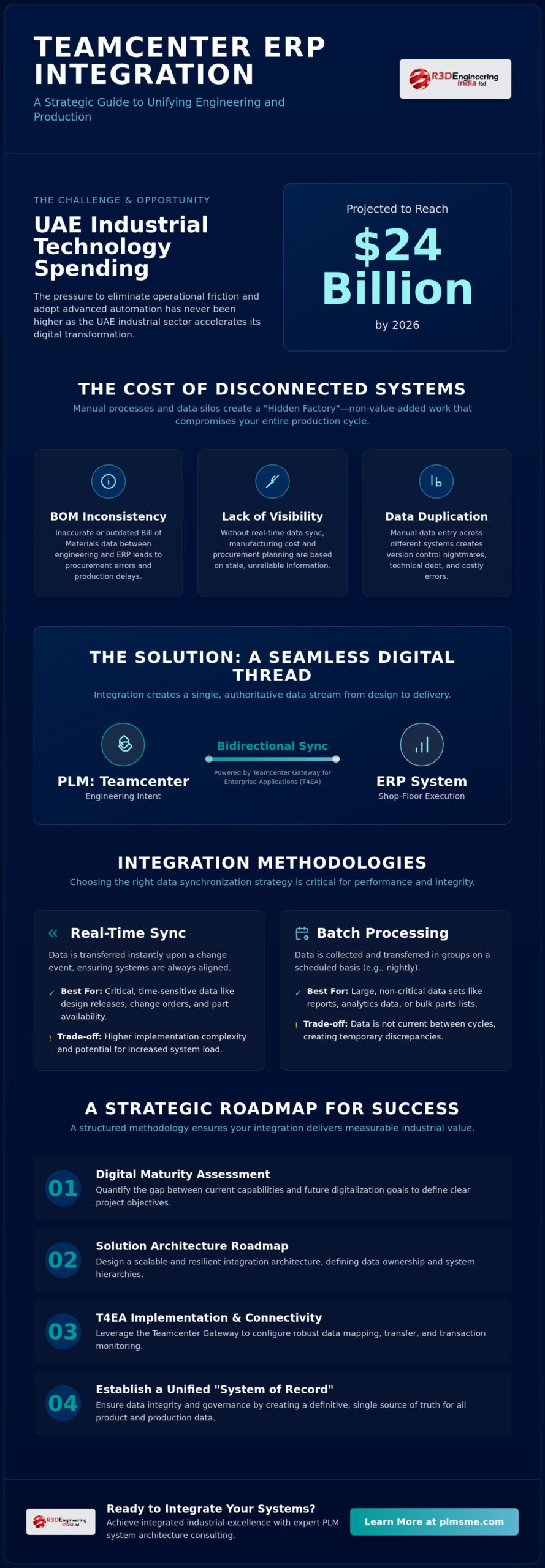
With UAE industrial technology spending projected to reach $24 billion in 2026, the pressure to eliminate operational friction has never been higher. You’ve likely felt the frustration of inconsistent Bill of Materials (BOM) data or the total lack of real-time visibility into manufacturing costs. These silos don’t just slow you down; they compromise the integrity of your entire production cycle. Achieving a high-performance Teamcenter ERP integration UAE is no longer just a software upgrade. It’s a fundamental architectural alignment that bridges the gap between engineering intent and shop-floor execution.
We understand that manual data entry is a liability your facility can’t afford. This article provides a technical analysis of how connecting Siemens Teamcenter with your ERP system creates a seamless digital thread. We’ll explore how the latest features in Teamcenter 2606, including AI-driven analytics and the Teamcenter BOM agent, transform fragmented workflows into a unified data stream. You’ll gain insights into moving beyond basic data exchange toward a structured methodology that ensures your digital transformation roadmap delivers measurable industrial value.
Key Takeaways
- Understand why bidirectional data synchronisation is essential for maintaining a competitive digital thread in the UAE industrial sector through 2026.
- Discover how to leverage the Teamcenter Gateway for Enterprise Applications (T4EA) and Active Workspace to architect robust connectivity between engineering and production.
- Evaluate the technical trade-offs between real-time and batch processing to ensure data integrity and establish a definitive “System of Record” for your facility.
- Learn the strategic phases of a successful Teamcenter ERP integration UAE, beginning with a structured digital maturity assessment and solution architecture roadmap.
Bridging the Engineering-to-Production Gap with Teamcenter ERP Integration
The Business Case for Synchronised Data
Manual Bill of Materials (BOM) reconciliation often creates what industry experts call a “Hidden Factory.” This refers to the vast amount of non-value-added work spent correcting errors, chasing missing data, or re-entering information across engineering and production departments. By integrating Siemens Teamcenter with an ERP, organisations eliminate these redundancies and significantly reduce time-to-market. Production teams can begin planning procurement and tooling during the design phase rather than waiting for a formal release. This level of operational readiness is typically identified as a high-priority objective when conducting a digital maturity report manufacturing, where the focus is on quantifying the gap between current capabilities and future digitalisation goals.
Common Integration Pain Points in Discrete Industry
Successful Teamcenter ERP integration UAE requires resolving deep-seated data ownership conflicts. A frequent challenge is determining which system serves as the “Master” for specific data types. For instance, while engineering owns the geometry, the ERP often demands control over costing and supplier data. Without a clear hierarchy, organisations face data duplication and version control issues. Furthermore, many legacy ERP systems used in the region rely on rigid data formats that don’t naturally align with the flexible, object-oriented structures of Siemens Digital Industries Software solutions. Attempting to force these connections without a robust PLM system architecture consulting approach often leads to technical debt. This results in brittle integrations that break during software updates, ultimately costing more than the initial implementation.
Architecting Connectivity: Technical Approaches to Teamcenter ERP Integration
Architecting a robust connection between engineering and business systems requires more than a simple data bridge. It involves a strategic selection of communication protocols and interface layers that can withstand the rigours of modern manufacturing. In 2026, the industry is shifting rapidly toward API-led connectivity and microservices, allowing for more agile and resilient systems. A well-designed Teamcenter ERP integration UAE ensures that technical data flows into business logic without creating rigid, hard-to-maintain code. This approach also secures the necessary scalability for future Teamcenter MES integration, ensuring the shop floor stays in sync with the engineering office as production volumes grow.
The Role of T4EA in Standardised Integration
Modern Middleware and Low-Code Extensions
For environments where standard gateways fall short, modern middleware and low-code extensions offer a flexible alternative. Leveraging Mendix allows for the creation of custom, user-centric integration portals that present data in a context-sensitive manner. This is particularly effective when using Active Workspace to provide cross-functional data visibility to procurement and production staff who don’t require full PLM access. In complex, multi-system environments, an Enterprise Service Bus (ESB) can manage the orchestration of data across diverse platforms, acting as a traffic controller for the digital thread. While custom development offers tailored quality, it must be balanced against the long-term maintenance benefits of standardised gateways. Decisions made at this stage define the technical debt of the organisation for years to come. It’s essential to evaluate whether a “standard-first” or a “custom-hybrid” approach better serves your long-term roadmap for industrial digitalisation.
By moving data through Active Workspace, teams gain real-time visibility into the status of parts and assemblies without switching between applications. This transparency reduces the likelihood of ordering incorrect components or starting production on an outdated design. Whether you’re using T4EA or a bespoke API-led approach, the goal remains the same: a single, reliable source of truth that powers every stage of the product lifecycle. Extending this principle beyond ERP to your production operations layer requires a dedicated Teamcenter MOM integration strategy that synchronises engineering revisions directly with real-time manufacturing execution.
Evaluating Integration Methodologies: Real-Time vs. Batch Processing
Choosing the right methodology for a Teamcenter ERP integration UAE requires a deep understanding of your facility’s operational rhythm. Real-time synchronisation is often preferred for agile production environments where engineering changes must be reflected on the shop floor immediately. This approach minimises the risk of manufacturing outdated designs, yet it requires a high-performance network infrastructure to prevent system latency. Conversely, batch processing remains a superior choice for high-volume data migrations or nightly synchronisations where data integrity and system stability are the primary concerns. By scheduling transfers during off-peak hours, organisations can ensure that complex data sets are validated before they enter the production environment.
Defining a definitive “System of Record” is a critical step in this evaluation. In a balanced architecture, Siemens Teamcenter typically owns the product geometry and the Engineering Bill of Materials (EBOM). The ERP system takes ownership of costing, inventory levels, and supplier data. Establishing these boundaries early prevents the data ownership conflicts mentioned in previous sections. Before initiating any transfer, data cleansing is mandatory. Integrating “dirty” data—such as duplicate part numbers or inconsistent descriptions—only scales existing inefficiencies. Aligning the frequency of your data exchange with the actual pace of your shop floor ensures that the digital thread remains a supportive tool rather than an administrative burden.
Data Mapping and Transformation Strategies
The transformation of an Engineering BOM (EBOM) into a Manufacturing BOM (MBOM) is where the technical value of integration is realised. This process involves more than just copying lists; it requires mapping engineering attributes to manufacturing realities. For instance, units of measure must be consistent across both platforms to avoid procurement errors. Adhering to PLM integration best practices ensures that part numbers, revision levels, and effectivity dates remain synchronised. When these mappings are automated, the likelihood of human error during manual reconciliation drops to near zero, providing a stable foundation for advanced industrial digitalisation.
Security and Governance in the UAE Context
Operating within the UAE industrial sector necessitates strict adherence to national cybersecurity standards and data sovereignty requirements. A robust Teamcenter ERP integration UAE must account for how sensitive intellectual property is handled as it moves between systems. This includes managing granular user permissions to ensure that only authorised personnel can trigger data transfers or view sensitive costing information. A long-term governance framework is essential for maintaining system stability as software versions evolve. It provides the structured oversight needed to manage technical changes without disrupting the bidirectional flow of information that powers the modern enterprise.
A Strategic Roadmap for Teamcenter ERP Implementation
A successful implementation relies on a methodical progression from high-level strategy to granular technical execution. For many organisations, the complexity of a Teamcenter ERP integration UAE necessitates a phased approach that mitigates risk while delivering incremental value. This roadmap ensures that every stakeholder, from the engineering lead to the production manager, remains aligned with the overarching digitalisation vision. Rather than treating integration as a one-time software installation, we view it as a continuous evolution of your industrial capabilities.
- Phase 1: Discovery and Digital Maturity Assessment. We begin by identifying your current integration readiness, documenting existing data silos, and identifying where manual handovers are causing the most friction.
- Phase 2: Defining System Architecture. This stage involves mapping the bidirectional data flow requirements and selecting the appropriate middleware or gateway protocols discussed in previous sections.
- Phase 3: Pilot Implementation. We focus on a single product line or site to validate the integration logic in a controlled environment, ensuring data integrity before scaling.
- Phase 4: Full-Scale Rollout. Once the pilot is validated, we transition to a factory-wide deployment, supported by comprehensive user training and change management to ensure high adoption rates.
- Phase 5: Continuous Optimisation. Post-deployment, the focus shifts to maintaining system health and refining synchronisation logic through a PLM system administration retainer.
Defining the Integration Vision
Effective integration moves beyond “connecting systems” to fundamentally transforming business processes. To achieve this, you must set clear KPIs for success, such as a measurable reduction in scrap rates or faster Engineering Change Order (ECO) cycles. Establishing these metrics early helps in building a business case for PLM integration that resonates with executive decision-makers. When the vision is clear, the technical hurdles become manageable steps toward a larger goal of operational excellence.
Mitigating Risk During Deployment
Risk management is baked into every stage of our roadmap. We utilise sandbox environments for rigorous testing of data transfers, ensuring that your live production environment remains untouched during the development phase. Developing robust fallback procedures is equally critical to ensure production continuity in the event of a synchronisation error. By identifying potential PLM implementation challenges early in the roadmap, we build a resilient architecture that can handle the unexpected. If you’re ready to secure your facility’s digital future, our team can help you develop a tailored business case for PLM integration that aligns with your 2026 objectives.
Delivering Integrated Industrial Excellence with PLM-Sme FZC
UAE manufacturers require more than just a software vendor; they need a partner capable of navigating the complex intersection of engineering data and business logic. PLM-Sme FZC operates as an independent Siemens Digital Industries partner, providing the objective oversight necessary for high-stakes system alignments. We don’t just implement software; we architect a digital thread that aligns with your facility’s long-term vision. By combining high-level digitalisation vision and roadmap consulting with deep technical expertise, we ensure that your Teamcenter ERP integration UAE is built on a foundation of operational reality. Our role as a “thinking partner” means we engage deeply with your long-term goals, offering bespoke advice that mass-market providers often overlook.
Long-term ROI isn’t achieved through simple connectivity; it’s the result of a scalable solution architecture that grows alongside your production capacity. Our process begins with detailed digital maturity assessments and reports, providing a clear-eyed view of your current capabilities. This data-driven foundation ensures that ERP connectivity isn’t forced onto a broken process, but rather serves as the catalyst for broader industrial excellence. We focus on creating a stable environment where technical specialists and executive decision-makers have access to the same reliable data stream, facilitating faster, more accurate business decisions.
Bespoke Integration Development
Standard, off-the-shelf connectors often fall short in the diverse landscape of the discrete industry. PLM-Sme FZC specialises in crafting bespoke integration solutions that bridge Teamcenter with ERP, CRM, and MES systems, ensuring that data flows exactly where it’s needed. A successful Teamcenter ERP integration UAE hinges on this level of technical precision, particularly when handling unique assembly processes or regional compliance standards. Our focus remains on transparent, cost-effective delivery, avoiding the bloated timelines often associated with generic IT firms. We possess the wisdom to offer tailored quality, ensuring that every custom connector we build is both robust and easily maintainable.
Ongoing Support and Administration
Maintaining a high-performance digital thread requires consistent, methodical oversight. Our PLM system administration retainers are designed to reduce technical debt by ensuring that your integration remains optimised as your software versions and business processes evolve. We provide the end-to-end PLM implementation support needed to manage updates and process changes without disrupting your daily operations. This structured approach creates a sense of stability and comprehensive oversight, allowing you to focus on manufacturing excellence while we manage the complex digital processes behind the scenes. Contact us to start your industrial digitalization roadmap UAE.
Securing Your Industrial Digital Thread for 2026
Achieving operational excellence in the modern manufacturing landscape requires moving beyond fragmented data silos toward a unified architectural vision. We’ve explored how a structured Teamcenter ERP integration UAE eliminates manual reconciliation and establishes a definitive system of record between engineering and production. By selecting the right connectivity methodologies and following a phased implementation roadmap, your facility can gain the real-time visibility needed to remain competitive in the region’s evolving industrial sector.
Success in this transition depends on collaborating with partners who understand both the high-level strategy and the technical nuances of the Siemens ecosystem. As a Siemens Digital Industries Alliance Partner, we specialise in the UAE discrete industry, providing the end-to-end implementation and architecture expertise required for complex digital transformations. Our approach ensures that your digitalisation efforts deliver measurable results rather than technical debt.
Ready to identify the gaps in your current system architecture? Request a Digital Maturity Assessment for Your UAE Operation today. Your journey toward a fully integrated digital thread starts with a clear understanding of your technical readiness.
Frequently Asked Questions
What are the main benefits of Teamcenter ERP integration for UAE manufacturers?
The primary benefits include eliminating manual data entry, ensuring Bill of Materials (BOM) consistency, and gaining real-time visibility into manufacturing costs. These advantages directly support the UAE National AI Strategy 2031 by creating the high-fidelity data environment required for advanced industrial analytics. Manufacturers can significantly reduce time-to-market by synchronising engineering releases with procurement cycles, ensuring production teams work with the latest technical specifications.
How long does a typical Teamcenter ERP integration project take?
A typical project duration ranges from three to nine months depending on the complexity of the data mapping and the current state of your existing datasets. Initial discovery and architecture phases usually take four to six weeks. The implementation and testing phases occupy the remainder of the timeline. Factors like data cleansing requirements and the number of integrated sites significantly influence the final delivery schedule.
Can Teamcenter integrate with any ERP system, including legacy platforms?
Teamcenter can integrate with a wide range of systems, including modern cloud-based platforms and legacy on-premise ERPs. While standard connectors exist for SAP and Oracle, custom Teamcenter ERP integration UAE development allows for connectivity with regional providers like Focus ERP or Odoo; for companies managing Hungarian operations, you can visit Számlázó Programom to ensure your administrative data aligns with local tax regulations. We use API-led connectivity to ensure that even legacy systems can participate in the digital thread without compromising data integrity.
What is the difference between T4EA and custom middleware for integration?
T4EA is the standard Siemens gateway designed for reliable, out-of-the-box connectivity with major enterprise applications like SAP and Microsoft Dynamics. Custom middleware, such as Mendix or an Enterprise Service Bus (ESB), provides the flexibility needed for highly specialised workflows that standard connectors can’t handle. The choice depends on whether your process requires a standardised framework or a bespoke, user-centric interface for cross-functional data visibility.
Is it necessary to have a Digital Maturity Report before starting an integration?
Conducting a digital maturity assessment is essential for identifying technical gaps and establishing an achievable implementation roadmap. It prevents the common mistake of automating inefficient processes or integrating systems that aren’t technically ready for bidirectional data flow. This report serves as the strategic foundation for your investment, ensuring that the selected architecture supports your long-term industrial goals.
How does PLM-ERP integration support AI readiness in manufacturing?
Integration supports AI readiness by providing the clean, structured data sets that machine learning algorithms require to generate actionable insights. Teamcenter 2606 features AI-powered analytics that can improve operational efficiency by 30% when fed with real-time data from both PLM and ERP systems. Without this connectivity, AI tools lack the technical context needed to predict equipment failures or optimise complex supply chain logistics. For enterprises operating at a global scale, Computer Market Research provides the necessary automation to streamline these external partner relationships and channel data.
What is the role of a Siemens Digital Industries partner in the integration process?
A Siemens Digital Industries partner provides the technical expertise and objective oversight needed to manage complex digitalisation projects. We function as a thinking partner, helping you navigate architectural challenges and ensuring the solution aligns with your specific industrial vision. Our role includes end-to-end implementation support, custom development, and long-term system administration to maintain the health of your digital thread.
How do we manage data ownership between PLM and ERP systems?
Data ownership is managed by defining a definitive “System of Record” for every data attribute across the enterprise. Typically, Teamcenter owns the product geometry and Engineering BOM, while the ERP system manages costing, inventory, and supplier information. Establishing these clear boundaries early in the Teamcenter ERP integration UAE project prevents data duplication and ensures that every department works from a single source of truth. Manufacturers seeking to extend this data governance further into production operations should also explore how Teamcenter MOM integration bridges the gap between engineering data ownership and shop floor execution.