
PLM for Industrial Machinery: 2026 Strategic Guide
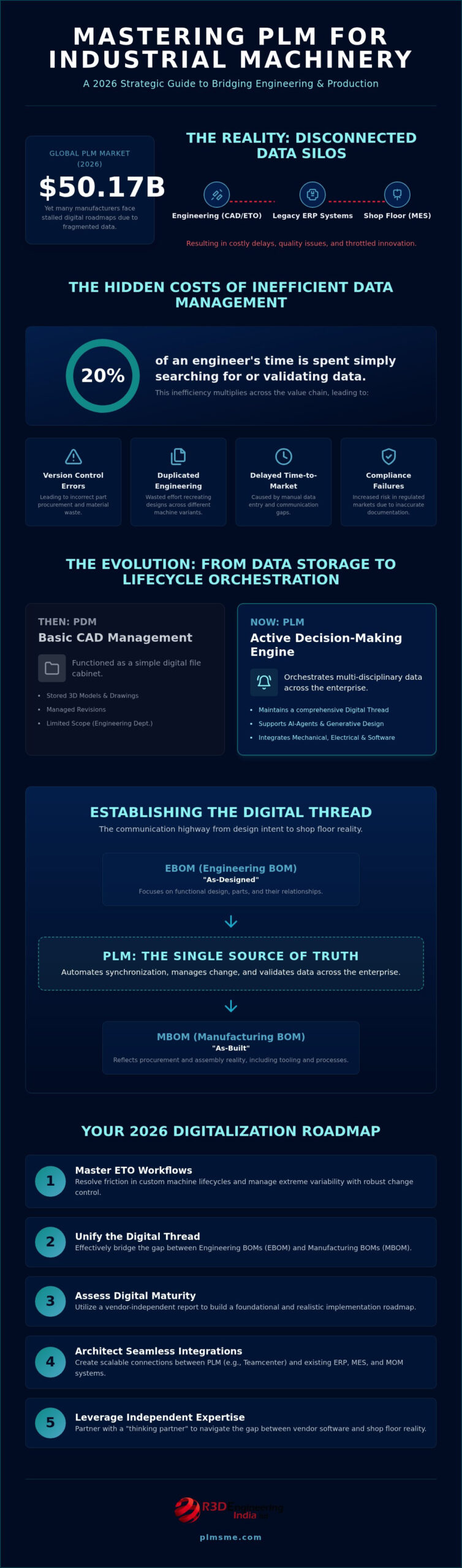
The global PLM market has climbed to $50.17 billion in 2026, yet many manufacturers still find their digital roadmaps stalled by fragmented data silos. Implementing PLM for industrial machinery isn’t just about selecting the latest software like Teamcenter 2606 or Windchill 13. It’s about aligning your entire engineering architecture with shop floor reality. You likely feel the daily friction of inefficient Engineer-to-Order (ETO) workflows and the technical debt of trying to sync legacy ERP systems with modern design tools. It’s a common struggle where engineering innovation is often throttled by disconnected production data.
We understand that achieving a “Single Source of Truth” often feels more like a marketing buzzword than a reachable operational goal. This strategic guide provides the technical clarity you need to master these complexities and eliminate the functional barriers between engineering and production. You’ll learn how to bridge the gap between your design office and the shop floor through seamless MES and ERP integration. We’ll explore the current 2026 technology landscape and provide an actionable digitalization roadmap to ensure your systems work as a unified, high-performance engine.
Key Takeaways
- Understand how to manage the unique lifecycle of custom machines and resolve Engineer-to-Order (ETO) workflow friction.
- Learn to establish a unified digital thread by effectively bridging the gap between Engineering BOMs (EBOM) and Manufacturing BOMs (MBOM).
- Identify the critical role of a vendor-independent digital maturity report in building a successful 2026 roadmap for PLM for industrial machinery.
- Discover how to architect seamless, scalable connections between Siemens Teamcenter and your existing ERP, MES, and MOM systems.
- Gain insights into the strategic advantage of partnering with an independent “thinking partner” to navigate the gap between vendor software and shop floor reality.
Navigating the Complexity of Modern Industrial Machinery Lifecycle Management
Effective What is Product Lifecycle Management (PLM)? serves as the strategic backbone for managing a machine from its initial concept through engineering, production, and long-term field service. In 2026, PLM for industrial machinery has evolved into a dynamic decision-making engine. It’s no longer just about storing 3D models; it’s about maintaining a comprehensive digital thread that supports AI-powered agents and generative design workflows. This transition from simple data storage to active lifecycle orchestration is essential for manufacturers facing increasing global competition and shorter innovation cycles.
Custom machine building and Engineer-to-Order (ETO) workflows introduce extreme variability that traditional management methods can’t handle. Unlike mass production, ETO requires every machine to have a unique configuration, often resulting in thousands of engineering changes during the build phase. Without a robust PLM strategy, these changes remain trapped in emails or local folders. This creates a dangerous disconnect between what was designed and what is actually being assembled on the shop floor, leading to costly delays and quality issues.
The Shift from CAD Management to Lifecycle Orchestration
Modern machines are complex systems of systems. They integrate mechanical structures with intricate electrical layouts and millions of lines of embedded software code. Transitioning from basic Product Data Management (PDM) to full-scale PLM for industrial machinery allows teams to orchestrate these multi-disciplinary data sets in a single environment. This ensures that a software update won’t conflict with a mechanical sensor placement. It also maintains technical documentation accuracy for global compliance, providing a reliable foundation for future service and maintenance.
Identifying the Cost of Inefficient Data Management
The financial drain of fragmented data is often invisible but substantial. Industry professionals frequently report that engineers spend up to 20% of their time simply searching for or validating data. This inefficiency multiplies when outdated Bill of Materials (BOM) versions reach production, causing expensive rework and material waste. These “hidden” costs erode profit margins and slow down your digital roadmap.
- Version control errors leading to incorrect part procurement.
- Duplicated engineering efforts across different machine variants.
- Delayed time-to-market due to manual data entry between disconnected systems.
- Increased risk of compliance failures in regulated markets.
In 2026, the Single Source of Truth is defined as a unified digital environment where every stakeholder accesses real-time, validated product data across the entire enterprise value chain.
Establishing the Digital Thread: How PLM Transforms Machine Building
The digital thread serves as the communication highway that links every phase of the machine building process. In the context of PLM for industrial machinery, this thread ensures that engineering intent remains intact as it moves toward the shop floor. Achieving this requires a rigorous approach to Bill of Materials (BOM) management. The Engineering BOM (EBOM) focuses on the “as-designed” state, while the Manufacturing BOM (MBOM) reflects the “as-built” reality. Discrepancies between these two views are a primary cause of production delays. A structured PLM environment automates the synchronization between EBOM and MBOM, ensuring that procurement and assembly teams always work with the most current data.
Change management is equally critical; when an engineering change occurs, the impact ripples through the entire supply chain. PLM for industrial machinery provides a controlled workflow to evaluate, approve, and implement these changes across the lifecycle. This level of transparency fosters better collaboration between internal departments and external partners. It reduces the risk of miscommunication that often plagues large-scale industrial projects. By centralizing these processes, manufacturers can achieve several key operational benefits:
- Reduced time-to-market through parallel engineering and manufacturing planning.
- Elimination of manual data transcription errors between engineering and production.
- Improved traceability for regulatory compliance and safety standards.
- Enhanced visibility into the impact of design changes on cost and schedule.
Managing Complex Configurations and Variants
Industrial manufacturers increasingly rely on modular designs to satisfy diverse customer requirements without reinventing the wheel. PLM enables sophisticated variant management, allowing engineers to manage a platform of modules rather than individual custom machines. This approach improves the reuse of existing designs, which can significantly reduce development time. By automating the transition from a high-level design to a production-ready configuration, companies can handle more complex orders with fewer resources. To ensure your digital framework supports this level of modularity, you might consider how system architecture consulting can identify and resolve potential integration bottlenecks.
Closing the Loop with Service and Maintenance Data
The machine’s lifecycle doesn’t end at the factory gate. Integrating service requirements into the early design phase ensures that components are accessible for maintenance and overhaul. By maintaining a digital twin, manufacturers have a living record of the machine’s “as-maintained” state. This data is invaluable for predictive maintenance strategies. It allows service teams to anticipate failures before they occur, shifting from a reactive to a proactive service model. This closed-loop feedback provides engineering teams with real-world performance data, which informs the next generation of machine designs.
Evaluating Digital Maturity: The Foundation of a Successful PLM Strategy
Many industrial firms rush into software procurement before understanding their internal readiness. Success in PLM for industrial machinery depends on establishing a clear baseline of current capabilities. Without this, organizations often automate inefficient processes rather than optimizing them. A digital maturity report manufacturing provides the necessary diagnostic to identify where your digital thread is broken. It assesses your culture, technical infrastructure, and process consistency to ensure you aren’t building a digital roadmap on a shaky foundation.
In 2026, benchmarking must account for AI-readiness and Industry 4.0 standards. This involves evaluating if your engineering data is sufficiently structured for generative agents to assist in complex BOM management or automated quality analysis. Identifying “low hanging fruit,” such as digitizing manual engineering change approvals or centralizing legacy CAD files, allows for early wins that build organizational momentum and prove ROI to stakeholders before moving to more complex integrations.
The Components of an Industrial Digitalization Assessment
A comprehensive assessment begins with a deep dive into data quality and migration readiness. Legacy systems often contain decades of unstructured data that cannot be simply “lifted and shifted” into a modern PLM environment. We analyze existing workflows to find operational bottlenecks that cause friction between engineering and the shop floor. This includes mapping your current system landscape to ensure your ERP, CRM, and MES are documented for future integration. By evaluating technical debt early, you can avoid the high costs of fixing data issues during the implementation phase of PLM for industrial machinery.
Defining the Digitalization Vision and AI Roadmap
Your digitalization vision should align with core business drivers like reducing custom machine lead times or increasing aftermarket service revenue. Executing Your Industrial Digitalization Roadmap requires a phased approach that minimizes daily operational disruption. This allows your team to adapt to new tools while maintaining production schedules. It’s essential to move at a pace that matches your organizational maturity, ensuring that each new capability is fully absorbed before moving to the next stage. A vendor-neutral maturity assessment prevents you from over-investing in complex software features that your organization isn’t yet ready to utilize, saving significant capital and preventing costly software missteps.
Architecting Seamless Integrations Across ERP, MES, and MOM Systems
A successful digital roadmap depends on more than software deployment; it requires a robust structural framework. Integrating PLM for industrial machinery into an existing enterprise ecosystem is often where the most significant technical challenges arise. While the maturity assessment discussed previously identifies readiness, PLM system architecture consulting provides the actual blueprint for execution. It ensures your PLM environment serves as a scalable foundation rather than a bottlenecked repository that hinders growth.
Connecting Siemens Teamcenter to your ERP system allows for the automated transfer of validated engineering data. For industrial machinery firms, this link ensures that procurement and finance teams work with approved releases, preventing the purchase of obsolete components. Bridging the gap between virtual design and the physical shop floor requires a tight loop with Manufacturing Execution Systems (MES) and Manufacturing Operations Management (MOM). When these systems communicate effectively, the “as-built” record remains synchronized with engineering intent, maintaining total data integrity across the value chain.
Teamcenter Integration Strategies for Industrial Machinery
Industrial leaders are increasingly recognizing the Teamcenter CRM integration benefits when deploying PLM for industrial machinery. By linking customer requirements directly to engineering projects, manufacturers can better track custom requests in ETO scenarios. Synchronizing engineering data with MES allows for real-time production feedback, which is vital when managing complex data migrations for system upgrades. Ensuring that legacy data is properly mapped prevents the corruption of your digital thread during enterprise-wide system consolidations.
Reducing Technical Debt with Managed PLM Administration
Technical debt often accumulates when systems are left unmanaged post-implementation. A PLM system administration retainer provides the proactive monitoring necessary to keep the environment optimized. This includes regular updates to accommodate new machine variants or modular designs. As your portfolio grows, your PLM must scale without degrading performance. Managed support ensures your infrastructure remains resilient, allowing teams to focus on innovation rather than troubleshooting backend connectivity issues.
To secure the future of your digital thread, consider our specialized System and Solution Architecture services to build a resilient and integrated environment.
Executing Your Industrial Digitalization Roadmap with Independent Expertise
Moving from a high-level vision to a functional production environment is the most critical phase of your digital transformation. In 2026, successfully deploying PLM for industrial machinery requires a partner that understands the friction between engineering intent and shop floor reality. While software vendors often focus on license volume, an independent consultant prioritizes architectural integrity and process alignment. This objective perspective ensures that your technology stack serves your specific business goals rather than forcing your workflows to adapt to rigid software limitations.
The end-to-end implementation lifecycle involves more than just technical installation. It encompasses data cleansing, user adoption strategies, and the creation of a building a strategic industrial digitalization roadmap that aligns with national industrial objectives. By managing this transition methodically, you ensure that the digital thread remains unbroken from the first design iteration to the final machine delivery. This structured approach prevents the common pitfalls that lead to stalled projects and unrealized ROI.
Choosing a Thinking Partner Over a Software Vendor
Boutique specialists act as a “thinking partner,” engaging deeply with your long-term vision to offer bespoke advice. This is particularly valuable when pursuing Siemens Teamcenter consulting. Instead of a one-size-fits-all setup, an independent expert tailors the environment to handle complex machinery configurations and modular variants. This approach also addresses long-term sustainability. By utilizing a system administration retainer, you can manage technical debt proactively, ensuring your PLM environment evolves alongside your growing machine portfolio without performance degradation.
Future-Proofing with Industrial Automation and AI
The roadmap for 2026 must account for the rapid integration of industrial automation solutions GCC. As machines become increasingly software-defined, your PLM system must be ready to manage the convergence of hardware, electronics, and software data. Preparing this data foundation is a prerequisite for AI-driven design tools and predictive maintenance agents. Without structured, high-quality data, these advanced technologies cannot deliver their promised value. A professionally architected PLM roadmap provides the stable, scalable foundation required to turn these technological trends into tangible competitive advantages. This strategic alignment ensures that every digital investment contributes directly to reduced lead times and increased operational efficiency.
Driving Industrial Excellence through Strategic Digital Alignment
Navigating the complexities of PLM for industrial machinery requires a shift from viewing software as a tool to treating it as a strategic architectural asset. Success in 2026 depends on an accurate assessment of your digital maturity and the seamless integration of engineering data with your shop floor execution systems. Establishing this digital thread ensures that your machinery configurations remain accurate, modular, and ready for future AI-driven advancements.
As a Siemens Digital Industries Alliance Partner, we provide the objective, technical oversight needed to bridge the gap between high-level vision and practical shop floor reality. Our specialized digital maturity reports and tailored Siemens Teamcenter architecture ensure your roadmap is both scalable and cost-effective. We’re here to help you eliminate technical debt and accelerate your path toward a unified single source of truth.
Book your Digital Maturity Assessment with PLM-Sme today to begin architecting a more resilient and integrated manufacturing future. Your journey toward industrial digitalization is a long-term evolution, and with the right strategy, your organization is well-positioned to lead in the competitive global market.
Frequently Asked Questions
What is the primary difference between PDM and PLM for machinery?
PDM focuses strictly on managing engineering files and CAD data within the design department. In contrast, PLM for industrial machinery expands this scope to manage the entire machine lifecycle, including manufacturing, procurement, and service. While PDM acts as a repository for engineering documents, PLM serves as an enterprise-wide orchestration engine. It connects diverse stakeholders through a unified digital thread, ensuring that data created in engineering informs every subsequent decision on the shop floor.
How long does a typical Siemens Teamcenter implementation take for machine builders?
A typical end-to-end implementation for industrial machine builders generally ranges from six to twelve months. This duration depends on the complexity of your existing data and specific integration requirements. The timeline includes critical phases for system architecture design, data migration, and structured user training. While smaller deployments might move faster, complex industrial projects often require detailed configuration to support specific Engineer-to-Order workflows and multi-system synchronization across the entire manufacturing enterprise.
Why is a digital maturity assessment necessary before buying PLM software?
An assessment identifies existing process gaps and technical debt that could cause a software deployment to fail. Purchasing software without understanding your digital maturity often leads to automating inefficient manual processes. This diagnostic phase ensures your organization is culturally and technically ready for the transition. It helps prioritize high-impact areas, preventing you from over-investing in complex features that your current infrastructure and team cannot yet support effectively.
Can PLM be integrated with our existing ERP and MES systems?
Yes, modern PLM systems are designed to function as the central nervous system of a manufacturing enterprise. Integration with ERP ensures that engineering releases automatically update procurement and inventory records. Connecting to an MES allows for real-time feedback from the shop floor back to the design team. These interactive connections are essential for maintaining data integrity. They ensure the as-built machine matches the as-designed specifications without manual data reentry.
What are the benefits of an independent PLM consultant versus a software vendor?
Independent consultants provide objective, vendor-neutral advice focused on your specific operational goals rather than software license sales. They act as a thinking partner to bridge the gap between technical software capabilities and shop floor reality. Unlike vendors who are naturally biased toward their own ecosystems, an independent expert can architect a solution that integrates multiple third-party systems. This ensures long-term scalability and a more tailored implementation of PLM for industrial machinery.
How does PLM support Engineer-to-Order (ETO) manufacturing?
PLM manages the extreme variability of Engineer-to-Order manufacturing by providing robust configuration and variant management tools. It allows engineers to reuse modular designs while tracking thousands of unique engineering changes for custom orders. By centralizing the change management process, PLM ensures that every stakeholder has visibility into the specific configuration of a custom build. This reduces the errors and long lead times typically associated with manual data handling and fragmented communication.
What is the role of a digital twin in the industrial machinery lifecycle?
A digital twin provides a virtual representation of the physical machine that persists throughout its operational life. During the design phase, it allows for the simulation and validation of mechanical and software components. Once the machine is in the field, the digital twin tracks real-world performance data. This enables predictive maintenance strategies and provides engineering teams with valuable feedback to improve future designs, effectively closing the loop between field service and engineering.
How does a PLM administration retainer help reduce technical debt?
A PLM system administration retainer provides proactive monitoring and regular updates to prevent system performance from degrading over time. Technical debt often accumulates when configurations are left unmanaged after the initial implementation. Dedicated support ensures that your solution architecture remains optimized for new machine variants and modular designs. This ongoing oversight allows your internal team to focus on core innovation while external experts handle the complex backend maintenance and system health.