
Critical PLM Implementation Success Factors: A Guide to Strategic Digital Transformation
While 70% of global manufacturers are projected to implement integrated PLM strategies by 2026, a staggering number of these initiatives fail to bridge the gap between engineering requirements and executive ROI. You’ve likely experienced the friction of legacy projects that promise digital harmony but deliver siloed data and mounting technical debt. It’s a common challenge for leaders who need their systems to function as a cohesive “nervous system” rather than a passive repository.
Mastering the critical PLM implementation success factors isn’t about simply selecting a software vendor. It’s about aligning your organizational pillars with a robust, vendor-independent architecture that scales with your business. This guide provides the strategic roadmap you need to ensure your investment delivers measurable returns and seamless integration across ERP and MES layers. We’ll explore how to build a future-proof digital thread that maintains compliance with the EU AI Act while turning your PLM into a genuine engine for sustained industrial innovation.
Key Takeaways
- Redefine project success by prioritizing digital continuity and long-term industrial scalability over the simple milestone of a system go-live.
- Secure sustained executive support by effectively translating technical PLM capabilities into measurable business outcomes and strategic ROI.
- Master the technical PLM implementation success factors by adopting a scalable solution architecture and enforcing strict data migration standards.
- Implement a methodical five-step roadmap that starts with a digital maturity assessment to align your IT capabilities with engineering requirements.
- Leverage independent, vendor-neutral expertise to bridge the gap between software features and the practical realities of your shop floor operations.
The Foundation of PLM Implementation Success Factors
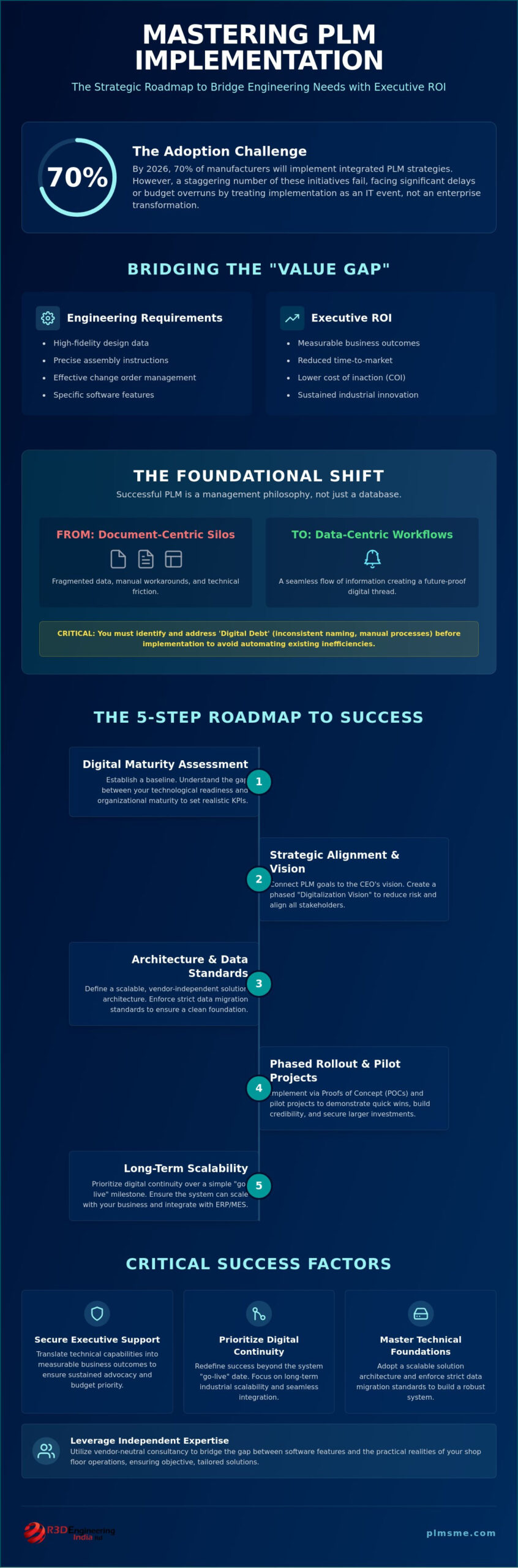
Success in Product Lifecycle Management (PLM) is often misidentified as the moment the system goes live. In reality, a successful launch is just the beginning of digital continuity. Industry data suggests that 70% of PLM projects face significant delays or budget overruns because organizations treat them as isolated IT events rather than enterprise-wide transformations. To avoid these pitfalls, you must prioritize the foundational PLM implementation success factors that align your technical capabilities with your business goals.
Setting realistic KPIs requires a clear understanding of your starting point. Utilizing a digital maturity report manufacturing context provides the baseline data needed to distinguish between technological readiness and organizational maturity. A company might have the latest CAD tools but lack the standardized processes to manage change orders effectively. Without this insight, implementations often stall as they encounter hidden operational bottlenecks that software alone cannot fix.
The ‘Management Concept’ Shift
Modern PLM isn’t just a database; it’s a management philosophy. You’re moving from document-centric silos to data-centric workflows where information flows seamlessly across the product lifecycle. Your digital maturity dictates your implementation speed. If you don’t identify ‘Digital Debt’, such as fragmented data, inconsistent naming conventions, or manual workarounds, before the first software installation, you’ll simply automate existing inefficiencies. Addressing this debt early ensures the platform supports growth rather than compounding technical friction. It’s about preparing the soil before you plant the technology.
Success Factor #1: Strategic Alignment
Your PLM goals must connect directly to your broader industrial digitalization roadmap. Engineering needs high-fidelity design data, while manufacturing requires precise assembly instructions and the supply chain needs real-time visibility into material requirements. If these departments aren’t aligned, the system becomes a source of conflict rather than a single source of truth. PLM Success is the intersection of process, people, and platform. Achieving this alignment is one of the most critical PLM implementation success factors, ensuring that every stakeholder sees the tangible value of the new digital thread. Without a unified vision, even the most sophisticated software will fail to deliver measurable ROI.
Securing Executive Buy-in: The Critical Success Factor
Executive advocacy remains the most significant predictor of long-term PLM viability. Without it, projects often lose momentum as soon as the first technical hurdle appears or when competing priorities emerge. The disconnect usually stems from a “Value Gap” where technical teams focus on specific software features while leadership prioritizes bottom-line metrics. To bridge this, you must translate technical capabilities into high-level business outcomes. This alignment is one of the most vital PLM implementation success factors, as it ensures the project remains a priority during budget cycles.
Building a robust business case often requires shifting the focus from simple Return on Investment (ROI) to the “Cost of Inaction” (COI). What does it cost the organization to maintain fragmented data silos? How much revenue is lost due to delayed product launches or compliance failures? Engaging a Siemens Teamcenter consulting partner can help validate these claims by providing empirical data from similar industrial environments. This external validation provides the objectivity needed to convince skeptical stakeholders that the investment is grounded in practical reality.
How to Get Executive Buy-in for PLM
Securing leadership support requires a structured approach that mirrors the company’s strategic goals. First, you must link the PLM roadmap directly to the CEO’s 2026 strategic vision, whether that involves sustainability targets or market expansion. Second, present a phased “Digitalization Vision” rather than a massive, single-stage overhaul. This reduces the perceived risk and allows for budgetary flexibility. Third, implement pilot projects or Proofs of Concept (POCs) to demonstrate immediate efficiency gains. These quick wins build the internal credibility necessary for larger investments and prove that the team can deliver on its promises.
Addressing the ROI Objection
Executives often view PLM as a significant capital expenditure with distant benefits. To counter this, provide concrete projections on time-to-market reduction and scrap rate improvements. For instance, manufacturers that integrate PLM with ERP systems have shown the ability to reduce time-to-market by 20% to 35%. Beyond immediate savings, position PLM as the indispensable foundation for future AI and automation initiatives. Developing deep PLM and BOM management skills within the organization ensures that these technical pillars are ready for the next wave of industrial evolution. Ultimately, active executive buy-in transforms PLM from a recurring IT cost into a high-leverage strategic asset that drives competitive advantage.
If you’re unsure where your organization stands, starting with a digital maturity assessment can provide the objective evidence needed to begin these executive conversations.
Structural and Technical Success Factors
Building a robust digital thread requires more than just functional software; it demands a resilient technical framework. A scalable PLM system architecture consulting approach ensures your platform grows alongside your production volume without collapsing under technical debt. For complex discrete manufacturing, Siemens Teamcenter remains the industry benchmark because it handles the intricate relationships between multi-domain BOMs and configuration management. However, even the most powerful tool fails if the underlying data is flawed. The ‘Clean Data In, Clean Data Out’ rule is a non-negotiable part of PLM implementation success factors. Mastering data migration involves scrubbing legacy records and standardizing attributes before they ever touch the new production environment.
Interoperability determines whether your PLM remains an isolated island or becomes a bridge to the rest of the enterprise. Successful implementations facilitate a seamless flow between PLM, ERP, and Manufacturing Operations Management (MOM) layers. When these systems speak the same language, you eliminate the manual data re-entry that often leads to costly errors on the shop floor. This technical cohesion is what allows a manufacturer to move from reactive troubleshooting to proactive lifecycle management.
Integration Strategy: Breaking the Silos
Successful integration isn’t about connecting every system at once; it’s about strategic data exchange. Utilizing Teamcenter CRM integration benefits allows engineering data to inform sales and service teams, closing the loop on customer feedback and field performance. To maintain agility, you should avoid the trap of hard-coded customizations. Relying on standard API usage ensures bidirectional data flow between engineering and the shop floor while keeping the system upgrade-ready. This strategy reduces the long-term burden on IT teams and ensures that a software update doesn’t break your entire production pipeline.
AI Readiness and Future-Proofing
Future-proofing is no longer optional. Your architecture must be ready to support the advanced industrial automation solutions GCC manufacturers are increasingly adopting to meet regional digitalization targets. A well-structured data environment serves as the prerequisite for a high-fidelity Digital Twin, which mirrors physical assets in a virtual space for real-time monitoring and simulation. By organizing your data structure today, you prepare your enterprise for AI-driven generative design and predictive maintenance. These technical PLM implementation success factors transform your repository into an active intelligence asset, capable of detecting bottlenecks before they impact your delivery schedules.
The 5-Step Roadmap to PLM Implementation Success
Execution requires a structured sequence that moves from high-level vision to grounded, practical deployment. While the technical pillars are essential, the sequence in which you address them is one of the most vital PLM implementation success factors. A methodical roadmap prevents the common trap of over-engineering the system before the organization is ready to use it. This five-step framework ensures that each phase builds upon a verified foundation of data and process alignment.
- Phase 1: Digital Maturity Assessment and KPI Definition. Establish a baseline of your current capabilities and define what success looks like in measurable terms, such as reduced engineering change cycle times.
- Phase 2: Business Process Re-engineering (BPR). Optimize your workflows before applying technology. Automating an inefficient process only accelerates the generation of errors.
- Phase 3: Solution Architecture and Pilot (POC) Development. Design the technical blueprint and validate it through a Proof of Concept. This phase ensures the system can handle your specific multi-domain BOM requirements.
- Phase 4: Phased Rollout. Deploy the system in manageable increments. This approach allows you to refine the configuration based on real-world feedback without disrupting the entire production line.
- Phase 5: Continuous Improvement. Transition to long-term stability through a PLM administration retainer. This ensures the system evolves with your business and remains compliant with changing regulations.
Executing the Industrial Digitalization Roadmap
A “Big Bang” approach often fails in the UAE manufacturing sector because it underestimates the complexity of local supply chain integrations and shop floor realities. It’s more effective to align your implementation phases with a broader industrial digitalization roadmap UAE context. To maintain internal governance, you should establish a Center of Excellence (CoE). This dedicated team acts as a bridge between IT and engineering, ensuring that the system’s evolution stays aligned with the original strategic intent and doesn’t drift into unnecessary customization.
Training and Cultural Change Management
Technology only delivers value when it’s embraced by the people using it. Developing role-specific training modules for Teamcenter users is essential to ensure that engineers, shop floor managers, and procurement officers understand how the system benefits their specific daily tasks. Effective change management also relies on active feedback loops that allow you to refine system usability post-launch. User adoption is the ultimate metric of PLM success. By treating your staff as “thinking partners” in the digital journey, you reduce resistance and accelerate the time it takes to reach full operational efficiency.
To begin structuring your own journey, consider our Digitalisation Vision & Roadmap Consulting to ensure your implementation phases are both realistic and scalable.
The Role of Independent Consultancy in Ensuring Success
The final piece of the puzzle in PLM implementation success factors is the quality of the guidance you receive. Software vendors are inherently incentivized to prioritize license sales, which can sometimes lead to a “one-size-fits-all” approach that ignores specific operational nuances. In contrast, independent consultancy offers a neutral perspective that prioritizes your requirements over software quotas. This objectivity is essential for bridging the gap between the broad capabilities of Siemens Digital Industries and the granular realities of your specific shop floor. A consultant acts as a translator, ensuring the technical platform serves the business process rather than the other way around.
PLM-Sme FZC functions as a strategic thinking partner, securing your investment through comprehensive System and Solution Architecture. We ensure that your digital thread isn’t just a technical achievement but a scalable business asset. By providing End-to-End PLM Implementation Support, we navigate the complexities of deployment while maintaining a steady focus on your long-term industrial vision. This independent oversight prevents the common project drift that often leads to budget overruns and functional gaps.
Leveraging Specialized Expertise
Navigating the technical landscape of modern PLM requires more than general IT knowledge. It demands deep Teamcenter Integration Development skills to ensure your engineering data flows correctly into ERP and MES environments. Expert oversight is particularly critical during complex data migration scenarios, where legacy errors can easily jeopardize a new system’s integrity. By utilizing a PLM System Administration Retainer, you can proactively reduce technical debt and ensure your platform remains optimized as your production needs evolve. This ongoing support transforms your PLM from a static repository into an agile component of your industrial automation strategy.
Conclusion: Your Path to a Digital Future
The first step toward a successful transformation is understanding your current standing. Contact PLM-Sme FZC for a Digital Maturity Assessment to define your roadmap and secure the long-term scalability of your industrial operations.
Future-Proofing Your Industrial Digitalization Strategy
Mastering PLM implementation success factors requires moving beyond the software layer to focus on organizational readiness and architectural integrity. The evidence shows how executive advocacy and a structured five-step roadmap can mitigate the high failure rates associated with legacy projects. By prioritizing digital continuity and clean data migration, your enterprise builds the resilience needed for long-term scalability. This strategic shift ensures that your technical pillars support engineering requirements while delivering the ROI stakeholders demand.
As a Siemens Digital Industries Alliance Partner, PLM-Sme FZC specializes in Siemens Teamcenter Architecture and complex ERP, MES, and MOM integrations. We function as your independent thinking partner, providing the objective oversight necessary to navigate technical debt and multifaceted integration hurdles. It’s time to transform your PLM investment into a measurable engine for sustained innovation and industrial growth. We’re ready to help you bridge the gap between high-level vision and grounded, technical execution.
Book Your Digital Maturity Assessment with PLM-Sme FZC to secure your roadmap and ensure your digital transformation delivers deep industrial value. Your journey toward a more connected, efficient future begins with a single, strategic step.
Frequently Asked Questions
What are the most common reasons for PLM implementation failure?
Project failures usually stem from a lack of strategic alignment between IT capabilities and engineering requirements. When organizations treat PLM as a simple software installation rather than a comprehensive business transformation, they often encounter massive user resistance. Incomplete legacy data migration and the absence of sustained executive advocacy are also frequent culprits that stall momentum early in the project lifecycle.
How long does a typical Siemens Teamcenter implementation take?
Implementation timelines vary significantly based on your chosen deployment model and organizational complexity. Cloud-native solutions typically reach a go-live state within 3 to 6 months. Traditional on-premise projects for large manufacturers often require 12 to 18 months to achieve full operational capacity. These durations are heavily influenced by the volume of CAD data and the depth of required system integrations.
Is a Digital Maturity Assessment necessary before choosing a PLM system?
Conducting a Digital Maturity Assessment is essential for defining your baseline and setting realistic KPIs. It identifies “Digital Debt” and process gaps before you commit to a specific technical architecture. This assessment ensures your chosen platform aligns with your actual organizational readiness rather than just your aspirational goals, preventing you from over-engineering the system too early.
How do I calculate the ROI of a PLM implementation for my board?
Focus on measurable metrics such as time-to-market reduction, which can range from 20% to 35% for integrated systems. You should also quantify savings from reduced scrap rates and lower compliance costs, which can represent 10% to 15% of revenue in regulated sectors. Presenting the “Cost of Inaction” helps the board view PLM as a strategic asset rather than a recurring IT cost.
Can PLM be integrated with my existing ERP and MES systems?
Modern PLM systems are designed for deep interoperability with existing ERP and MES layers. Successful PLM implementation success factors include establishing bidirectional data flows that connect engineering intent directly with shop floor execution. This integration eliminates manual data re-entry and ensures that manufacturing teams always work from the latest approved design revisions, reducing costly production errors.
What is the difference between an independent PLM consultant and a software vendor?
Software vendors are primarily focused on license sales and platform-specific features. An independent consultant acts as a neutral advisor, prioritizing your unique business processes and a vendor-independent architecture. This objectivity helps you bridge the gap between high-level software capabilities and the practical technical requirements of your specific industrial operations without being tied to a single vendor’s sales targets.
How does PLM support my company’s AI and automation roadmap?
PLM provides the structured data thread necessary for training AI models and driving generative design. It serves as the foundation for the Digital Twin, enabling real-time monitoring and predictive maintenance. Without the organized data lifecycle managed by PLM, advanced industrial automation solutions lack the high-fidelity information needed to function effectively and provide actionable insights for decision-makers.
What is a PLM system administration retainer and why do I need one?
A PLM system administration retainer provides continuous technical oversight and proactive system optimization. It ensures your environment stays updated, secure, and aligned with evolving engineering workflows without the overhead of maintaining a full-time internal team. This ongoing support is vital for maintaining peak system performance and preventing the accumulation of technical debt as your business scales over time.