
Busting 5 Common Myths About PLM Implementation Challenges in Manufacturing
Most manufacturers treat Product Lifecycle Management as a simple software installation, yet the reality is that a tool alone cannot fix a broken process. While the global PLM market is projected to reach 52.4 billion dollars by 2026, many organizations still struggle to realize a tangible return on their investment. You’ve likely dealt with the common PLM implementation challenges manufacturing leaders face, such as data silos between ERP and CAD systems or engineering teams that are hesitant to abandon their legacy workflows. It’s frustrating to invest heavily in technology only to find your data more fragmented than it was before the rollout.
This article moves beyond surface-level excuses to expose the architectural and strategic hurdles that actually derail these projects. We’ll show you why a roadmap-first approach is essential for navigating complex integrations with existing ERP and MES environments. By the end, you’ll have a clear framework for overcoming implementation pitfalls and a strategy for achieving true digital maturity. We’re breaking down five persistent myths to help you transform your PLM from a costly burden into a streamlined engine for industrial innovation.
Key Takeaways
- Architecting a comprehensive digital thread rather than treating PLM as a standalone software installation to prevent high failure rates.
- Differentiating between Engineering-to-Order (ETO) and Configure-to-Order (CTO) requirements to tailor your PLM strategy to specific manufacturing environments.
- Overcoming the primary PLM implementation challenges manufacturing firms face by addressing the deep-seated data silos between PLM, ERP, and MES systems.
- Evaluating the strategic benefits of independent consulting to ensure an objective, solution-focused architecture that avoids vendor-specific bias.
- Securing measurable ROI by replacing high-risk “Big Bang” rollouts with a phased approach aligned to a verified digital maturity roadmap.
Myth 1: PLM Implementation is Primarily a Software Installation Project
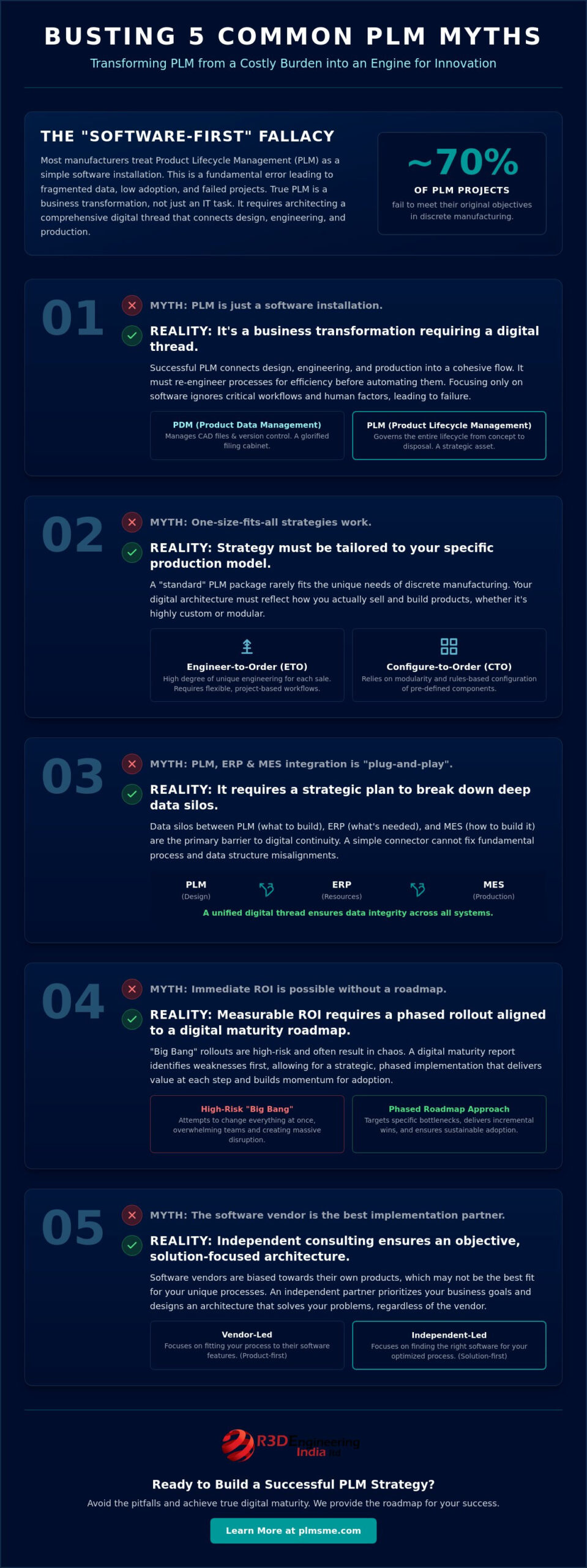
Many manufacturers mistakenly categorize Product Lifecycle Management as an IT line item. This perspective is a fundamental error that compromises the entire project from the start. Treating PLM like a simple tool upgrade or a server migration leads to staggering failure rates. Industry data often suggests that nearly 70% of PLM projects in discrete manufacturing fail to meet their original objectives because they lack a strategic foundation. When you focus solely on the “go-live” date of a software package, you ignore the intricate human and process-driven PLM implementation challenges manufacturing teams face daily. PLM is a business transformation, not a software installation.
The Reality of Digital Transformation
Successful PLM isn’t about storing files; it’s about architecting a digital thread. This thread connects design, engineering, and production into a single, cohesive narrative that flows across the entire organization. Before you configure a single field in a database, you must re-evaluate how data moves through your departments. Software should automate optimized workflows, not digitize inefficient ones. It’s also vital to distinguish between Product Data Management (PDM) and true PLM. While PDM handles CAD files and version control, PLM governs the entire lifecycle from initial concept to end-of-life disposal. Without this broader vision, your system remains a glorified filing cabinet rather than a strategic asset.
This broader vision should also encompass health and safety compliance as an integral part of the product’s journey. For manufacturers looking to digitalize these processes, Be-Safe Technologies Ltd offers specialized EHS platforms that ensure safety and regulatory standards are maintained across the entire digital thread.
- Process Re-engineering: Evaluating current bottlenecks ensures the software supports a lean, agile workflow.
- Cross-Departmental Alignment: Ensuring that procurement and manufacturing can access the same data as engineering.
- Digital Continuity: Maintaining a single source of truth that survives system updates and organizational changes.
The Cost of the “Software-First” Mentality
Rushing into a purchase without a clear vision creates immediate technical debt. You’ll likely find that “out-of-the-box” features don’t align with your specific shop floor realities, leading to expensive, messy customizations. This mismatch is a primary driver of scope creep and budget overruns. To avoid this, starting with a digital maturity report manufacturing leaders can rely on is critical. It identifies where your processes are weak before you commit to a specific software architecture. Without this roadmap, you’re essentially building a high-tech house on a crumbling foundation. The long-term financial impact of poor initial architecture often exceeds the cost of the software itself through lost productivity and constant system rework. Real success requires a solution-focused approach that prioritizes your business goals over the vendor’s feature list. Manufacturers seeking a comprehensive framework should explore how an end to end PLM implementation bridges the gap between engineering intent and production execution across the full product lifecycle.
Myth 2: One-Size-Fits-All PLM Strategies Work for Every Manufacturer
A common misconception in the industrial sector is that a successful PLM strategy can be copied and pasted from one manufacturer to another. This logic ignores the fundamental differences between discrete and process manufacturing. While a process manufacturer deals with recipes and formulas, a discrete manufacturer manages complex assemblies with thousands of individual parts. Gartner’s definition of PLM emphasizes its role as a business strategy, which implies it must align with your specific production model. A “standard” implementation package rarely survives the first week of a real-world deployment because it fails to account for these architectural nuances.
Tailoring PLM to Discrete Manufacturing
In discrete manufacturing, the transition from an Engineering Bill of Materials (EBOM) to a Manufacturing Bill of Materials (MBOM) is a critical junction. If your PLM isn’t configured to handle this handoff seamlessly, you risk production errors and costly rework. This requires custom data schemas that reflect your specific industrial equipment and assembly sequences. These bespoke configurations naturally impact the PLM implementation cost manufacturing executives must budget for. It’s often more cost-effective to invest in tailored architecture early than to fix a generic system later. If you’re looking for a starting point, conducting a digital maturity assessment can reveal the specific architectural gaps in your current workflow.
The Importance of Industry-Specific Extensions
Myth 3: PLM-ERP-MES Integration is a Simple “Plug-and-Play” Task
Software vendors often market integration as a standard feature, but this perspective ignores the fundamental “Siloed Data” trap. In reality, PLM and ERP systems speak entirely different languages. PLM is built around the “What”—the engineering intent, geometric data, and configuration logic. Conversely, ERP is focused on the “How many”—inventory levels, procurement schedules, and financial transactions. Simply installing middleware doesn’t bridge this semantic gap. Without a logic-based mapping of how data should flow, middleware merely acts as a faster way to move incorrect information between departments. These technical PLM implementation challenges manufacturing firms encounter often stem from a lack of clear data ownership.
Relying on generic connectors usually leads to a maintenance nightmare. A PLM implementation case study from Purdue University illustrates that even in highly regulated environments, the complexity of data continuity requires more than just a software link. It demands a deep understanding of the product lifecycle. This is why PLM system architecture consulting is essential. It provides the blueprint for how Teamcenter integration development can bridge the gap between your virtual designs and the physical realities of the shop floor, ensuring that engineering changes don’t get lost in translation before they reach production.
The PLM-ERP-MES-MOM Connectivity Stack
To achieve a seamless digital thread, you must define the specific roles of each system in your stack. PLM defines the product, ERP manages the resources, and the MES/MOM layer handles the actual execution. Synchronizing this data in real-time is particularly difficult in high-volume manufacturing where even a five-minute delay in data propagation can lead to significant waste. MOM integration serves as the critical bridge between digital design and operational execution. This connectivity ensures that the person on the assembly line is always working from the latest engineering revision, rather than a stale printout from an disconnected ERP module.
Avoiding the Integration “Spaghetti” Architecture
Many organizations fall into the trap of point-to-point integrations. While connecting two systems directly might seem faster, it creates a “spaghetti” architecture that is impossible to upgrade or scale. Every time you update your ERP, your PLM connection breaks. A more robust approach involves a centralized hub or service bus that maintains data integrity even during complex system migrations. You can further extend this value by exploring Teamcenter CRM integration benefits, which allow you to connect customer requirements directly to the engineering workflow. This architecture doesn’t just move data; it creates a responsive ecosystem where every department operates from a single source of truth.
Myth 4: You Can Achieve Immediate ROI Without a Digital Maturity Roadmap
Expectations for instant financial returns often lead manufacturers into the “Big Bang” implementation trap. This high-risk strategy attempts to roll out every PLM module simultaneously across all departments. Instead of rapid gains, organizations usually encounter system paralysis and massive user resistance. True Return on Investment (ROI) isn’t a byproduct of the software itself; it’s a result of how well the system aligns with your current operational capabilities. If your foundation is weak, the software only accelerates your existing inefficiencies. Addressing the PLM implementation challenges manufacturing companies face requires acknowledging that digital maturity is the strongest predictor of project success.
A structured industrial digitalization roadmap UAE manufacturers can follow provides the necessary milestones to gauge progress. It transforms PLM from a perceived sunk cost into a long-term value driver. By setting realistic performance targets rather than chasing overnight miracles, leadership can maintain project momentum and secure ongoing funding based on incremental, verified wins.
The Prerequisite: Digital Maturity Assessments
Before selecting a tool, you must understand your starting point. A comprehensive digital maturity report identifies the “low-hanging fruit”, those specific areas where automated lifecycle management can provide immediate relief from manual document control. While PLM focuses on industrial product data, other sectors use specialized tools for similar efficiency gains; you can learn more about GoBuid to see how digital site documentation replaces manual reporting in construction. It also evaluates your readiness for advanced technologies like AI and industrial automation. If your data isn’t clean or your processes aren’t documented, even the most advanced AI features will fail to deliver insights. Moving from a paper-based or spreadsheet-reliant environment to a centralized PLM requires a clear understanding of these internal gaps.
Phased Implementation for Sustainable Gains
Sustainable success usually follows a 3-5 year roadmap rather than a frantic 6-month sprint. This deliberate pace allows your team to balance technical configuration with essential organizational change management. You can’t expect engineering teams to adopt radical new workflows overnight without training and proof of value. Measuring success must move beyond the “go-live” date. Instead, focus on KPIs like user adoption rates, data accuracy, and the reduction of engineering change order cycle times. This methodical approach ensures that the system scales alongside your business growth, providing a stable platform for future innovation. For a detailed walkthrough of each deployment stage, the strategic guide to end to end PLM implementation outlines how manufacturers can structure each phase to maximize adoption and minimize disruption.
To identify your specific hurdles and start building a realistic path forward, you can develop a strategic digitalization roadmap to align your technology with your business vision.
Myth 5: The Software Vendor is Always the Best Implementation Partner
Manufacturers often default to software vendors for their rollout, assuming the product creator is naturally the best choice for integration. This assumption overlooks the fundamental conflict between a product-centric focus and a solution-centric focus. A vendor’s primary objective is typically the deployment of specific features and the expansion of license usage. In contrast, independent Siemens Teamcenter consulting provides an objective layer of oversight. It ensures that the system architecture serves your business goals rather than just the software’s capabilities. These PLM implementation challenges manufacturing firms face require a partner who isn’t afraid to challenge the vendor’s “standard” configuration if it doesn’t fit your shop floor reality.
Post-implementation support is another area where the vendor model often falls short. Once the initial project is complete, the vendor’s focus shifts to the next sale. This leaves your internal team to manage complex updates and system tuning alone. A dedicated PLM administration retainer bridges this gap by providing ongoing technical expertise. It ensures long-term system health and allows for continuous optimization as your manufacturing processes evolve. Relying on a partner who understands the local industrial landscape ensures that your system remains agile and responsive to regional operational shifts.
The Strategic Advantage of Independent Consultancy
An independent consultant acts as a “thinking partner” rather than a transactional service provider. This relationship allows for deep engagement with your long-term vision. When navigating the specific requirements of Teamcenter implementation Dubai, local expertise becomes a significant asset. Understanding the regional industrial landscape, from local supply chain nuances to specific regulatory standards, allows for a more tailored and resilient system design. Independent advisors can objectively evaluate third-party integrations and custom development needs without the pressure to upsell additional proprietary modules. They prioritize the integrity of your digital thread over the vendor’s quarterly sales targets.
Future-Proofing with AI and Automation
The modern manufacturing environment is rapidly moving toward higher levels of autonomy. Preparing your PLM environment for industrial automation solutions GCC requires an architecture that can handle real-time data from the shop floor. An independent partner helps you build an AI roadmap that isn’t just about buzzwords; it’s about practical data readiness. This ensures your PLM system becomes a foundation for industrial digitalization rather than a legacy bottleneck. By focusing on scalability and open integration standards, you create a system that can adapt to the next generation of industrial AI and robotic automation.
Ready to assess your readiness? Contact PLM-Sme for a Digital Maturity Assessment to begin your journey toward a robust, future-proof industrial architecture.
Securing Your Digital Thread for Long-Term Resilience
Successful digitalization begins when you stop treating PLM as a tool and start treating it as the backbone of your industrial strategy. Moving beyond the “software-first” trap to architect a true digital thread prevents the data fragmentation that stalls most projects. By aligning your systems with a verified maturity roadmap and ensuring deep connectivity across your ERP and MES layers, you transform fragmented data into a strategic asset. Overcoming the persistent PLM implementation challenges manufacturing leaders face is a journey that demands objective expertise and a clear vision for the future.
As a Siemens Digital Industries Alliance Partner specialized in Siemens Teamcenter Architecture, we offer the technical wisdom needed to bridge the gap between design and execution. Our expertise in PLM-ERP-MES-MOM integration ensures your systems don’t just coexist; they thrive in a unified, high-performance ecosystem. It’s time to replace the high-risk guesswork of uncoordinated rollouts with a methodical, results-oriented strategy tailored to your specific operational needs.
Request Your Digital Maturity Assessment & Roadmap Consulting to build a foundation that scales with your ambition and secures your place in the future of manufacturing.
Frequently Asked Questions
What are the most common PLM implementation challenges in manufacturing?
The most frequent PLM implementation challenges manufacturing firms encounter include fragmented data across legacy systems and a lack of alignment between engineering and production workflows. Many projects fail because they prioritize software configuration over business process re-engineering. Success requires addressing these cultural and architectural hurdles with a clear digitalization vision before the rollout begins.
How long does a typical Siemens Teamcenter implementation take?
A standard Siemens Teamcenter implementation generally spans six to eighteen months. The exact timeline depends on the complexity of your product data and the depth of integration required with ERP or MES systems. Adopting a phased roadmap rather than a “big bang” approach often yields more predictable results and faster user adoption across the organization.
Is PLM only for large-scale manufacturing enterprises?
PLM is increasingly essential for small and medium-sized enterprises (SMEs) as product complexity grows. With the SME segment expected to see a 9.3% CAGR through 2034, cloud-based solutions have made these tools more accessible. It’s no longer just for global giants; any manufacturer managing complex configurations or strict regulatory requirements benefits from a centralized digital thread. This same dedication to quality and traceability can be seen in other sectors; for instance, you can discover CBD Health Collection to see how they maintain high standards for their health and wellness offerings for both people and pets.
What is the difference between PLM and ERP integration?
PLM manages the product’s intellectual property and design intent, while ERP handles the transactional execution and resource planning. Integration bridges the gap between the “What” (engineering) and the “How many” (procurement and finance). This ensures that manufacturing teams always work from the latest revision, reducing scrap and rework caused by disconnected data silos.
How does a Digital Maturity Report help reduce implementation risks?
A Digital Maturity Report provides a comprehensive audit of your current technical capabilities and process readiness. It identifies hidden bottlenecks and technical debt that could derail your project later. By establishing this baseline, you can set realistic performance milestones and ensure your system architecture is built on a stable, well-documented foundation.
Can PLM be implemented in phases to manage costs?
Phasing your implementation is the most effective way to manage both costs and organizational change. By starting with high-impact areas like document management or change control, you can secure quick wins and demonstrate ROI early. This modular strategy allows for budget flexibility and ensures that each phase is fully optimized before moving to the next complex integration.
What role does AI play in modern PLM implementation strategies?
AI enhances modern PLM by automating data classification, providing predictive analytics for maintenance, and supporting generative design. It helps manufacturers process vast amounts of lifecycle data to identify trends that human analysis might miss. Integrating AI into your implementation strategy ensures your architecture is prepared for the next wave of industrial automation and smart manufacturing.
Why should we choose an independent consultant over a direct software vendor?
Independent consultants provide an objective, solution-focused perspective that direct vendors often lack. While a vendor focuses on license sales and product features, a consultant prioritizes your specific business outcomes and system architecture. This independence allows for unbiased advice on integrations and long-term system health through dedicated administration retainers.