
Strategic Siemens PLM Solutions for UAE Digital Manufacturing in 2026
If your digital manufacturing strategy is built on software licenses rather than robust system architecture, are you actually innovating or just accumulating technical debt? You’ve likely seen how the rush to adopt Industry 4.0 can lead to fragmented systems and high implementation costs that don’t deliver the promised ROI; to ensure your industrial investments are backed by sound commercial logic, you can find out more about conducting a strategic business feasibility study. Many manufacturers across the Emirates struggle to bridge the gap between high-level engineering vision and the practical realities of the shop floor. It’s a common frustration when legacy ERP systems refuse to sync with new digital twins.
This lack of cohesion often extends beyond the shop floor into broader enterprise planning. Specialized consultancies like Propriety Group help manufacturers bridge these gaps by implementing EPM and CRM software that aligns forecasting and performance with the overall digital strategy.
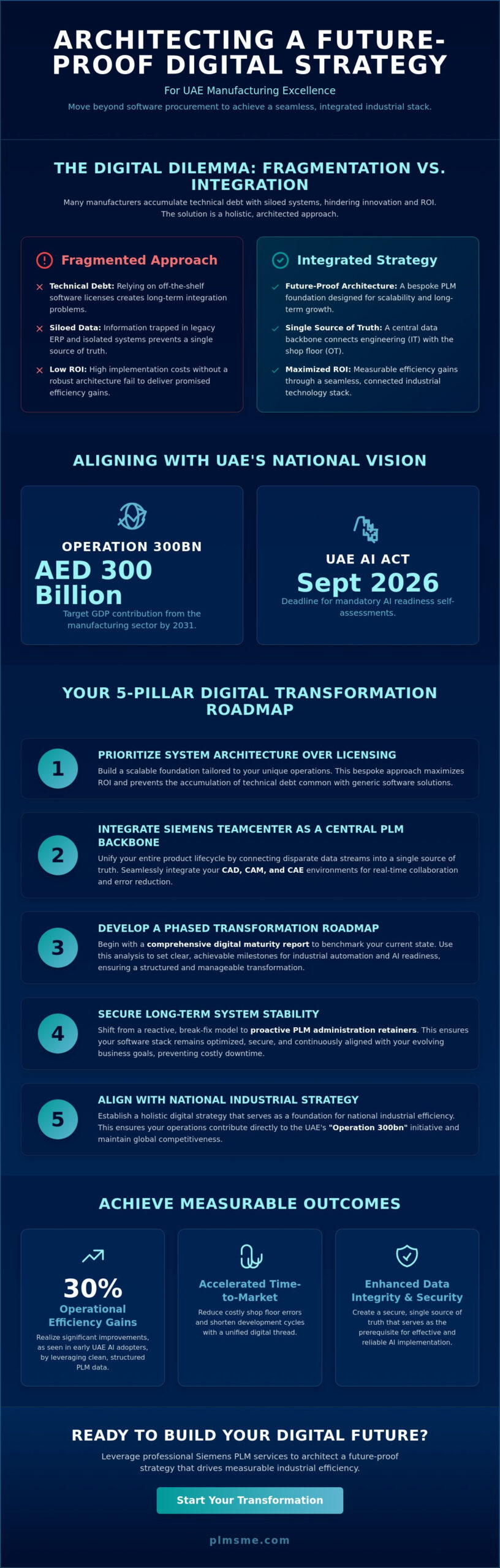
This article shows you how to leverage specialized Siemens PLM services UAE to architect a future-proof digital strategy that drives measurable industrial efficiency. We’ll explore how to align your operations with the UAE’s “Operation 300bn” goals and ensure your data is ready for the mandatory September 2026 AI Act assessments. By focusing on a structured digitalisation roadmap and expert system administration, you can move beyond software procurement to achieve a seamless, integrated industrial stack that supports long-term growth; this level of technical synergy is what allows companies like Apevie Simulators to develop world-class, high-performance simulation hardware.
Key Takeaways
- Align your manufacturing operations with the UAE’s “Operation 300bn” initiative by establishing a holistic digital strategy that serves as a foundation for national industrial efficiency.
- Utilize professional Siemens PLM services UAE to integrate Teamcenter as your central data backbone, ensuring seamless connectivity across CAD, CAM, and CAE environments.
- Prioritize bespoke system architecture over off-the-shelf software licensing to maximize your return on investment and prevent the accumulation of costly technical debt.
- Develop a phased transformation roadmap starting with a comprehensive digital maturity report to set clear milestones for AI readiness and industrial automation.
- Secure long-term system stability and performance by shifting from reactive fixes to proactive PLM administration retainers that keep your software stack optimized and secure.
Navigating the UAE Industrial Digitalisation Landscape in 2026
The UAE industrial sector is undergoing a profound transformation. It’s no longer just about manufacturing products; it’s about manufacturing them smarter. The national “Operation 300bn” initiative sets a clear target to increase the manufacturing sector’s contribution to GDP to AED 300 billion by 2031. To reach this, local firms must move beyond simple automation. For entrepreneurs looking to capitalize on these opportunities, Sarsan Corporate Services provides the essential guidance needed to establish a business presence in the UAE. A true digital manufacturing strategy then acts as a holistic framework, ensuring every part of the business works in sync to drive industrial efficiency. With industrial exports reaching AED 262 billion in 2025, the pressure to maintain global competitiveness has never been higher.
Transitioning from siloed engineering departments to a unified digital thread is the primary challenge for regional manufacturers. Many organizations find their data trapped in isolated pockets, which hinders the speed of innovation. By implementing a robust Product Lifecycle Management (PLM) system, companies can create a single source of truth that spans from initial design to final disposal. This connectivity is essential for any firm aiming to leverage Siemens PLM services UAE to modernize their operations. In 2026, this shift is no longer a luxury; it’s a requirement for survival.
The Strategic Shift Toward Industrial AI
2026 marks a critical juncture for AI adoption. With the UAE AI Act requiring mandatory self-assessments by September 2026, industrial entities must evaluate their AI readiness immediately. Moving beyond basic automation means adopting predictive manufacturing models that anticipate equipment failures before they occur; for those in the food processing sector, you can read more about how professional-grade culinary machinery is evolving to meet these new standards. However, AI is only as good as the data it consumes. High-quality data integrity within your PLM system is the prerequisite for effective AI training. Without a clean, structured data set, even the most advanced AI solutions will fail to deliver the 30% operational efficiency gains seen in early UAE adopters.
Bridging the Gap Between IT and OT
Successful digitalisation requires aligning information technology (IT) with operational technology (OT) on the shop floor. This isn’t just a technical hurdle; it’s a cultural one. Leaders must overcome internal resistance by establishing a clear Digitalisation Vision that scales alongside national growth. Utilizing specialized Siemens PLM services UAE helps bridge this gap, ensuring that software insights translate directly into tangible improvements in production speed. Starting this journey often requires a comprehensive digital maturity report to identify current gaps. It’s about creating a manageable, structured path that connects engineering intelligence with shop floor execution.
Integrating Siemens Teamcenter as the Strategic PLM Backbone
Siemens Teamcenter serves as the foundational layer for companies navigating complex product development. It isn’t just a document repository; it’s a multi-disciplinary platform that synchronizes mechanical, electronic, and software data into a single, coherent stream. For UAE-based OEMs and industrial SMEs, this level of coordination is vital to meet the rigorous standards of the UAE’s Digital Economy Strategy. By leveraging Siemens PLM services UAE, local firms can unify their CAD, CAM, and CAE environments, reducing the friction often found between design and production.
The platform’s strength lies in its ability to manage the entire product development lifecycle within a unified digital thread. This is particularly relevant for the UAE’s growing aerospace and defense sectors, where data complexity is high. For manufacturers in these fields, integrating high-precision analytical tools is essential, and you can learn more about Electron Optics Instruments, LLC to see how SEM technology supports rigorous quality standards. Teamcenter allows teams to collaborate on a single source of truth, ensuring that engineering changes in the design office are instantly visible to the manufacturing planners. This real-time visibility prevents costly errors on the shop floor and accelerates the time-to-market for new industrial solutions.
While the digital thread optimizes the manufacturing process, the choice of physical materials remains paramount for industrial longevity. For companies seeking high-performance, EU-sourced composite solutions for their facilities, you can learn more about Green Plank.
End-to-End PLM Implementation Support
Successful implementation requires more than just installing software. It demands a robust system architecture designed for long-term scalability. Expert Siemens PLM services UAE focus on managing data migration from legacy systems without causing production downtime. This transition involves:
- Mapping existing engineering workflows to Teamcenter modules.
- Cleaning and validating legacy data to ensure integrity.
- Customizing the user interface to match specific industrial requirements.
A well-architected system ensures that as your business grows, your digital backbone remains stable and performant. For organizations managing large-scale industrial sites, incorporating enterprise drone mapping services into your data strategy ensures that your digital models are continuously updated with high-precision aerial intelligence.
Seamless Integration with ERP, MES, and MOM
To achieve true industrial efficiency, your PLM system shouldn’t operate in a vacuum. It must communicate fluently with your Enterprise Resource Planning (ERP) and Manufacturing Execution Systems (MES). Establishing these interactive connections creates a closed-loop manufacturing environment where data flows bidirectionally. This synchronization ensures that production schedules are always based on the latest engineering revisions. Many firms also find significant value in Teamcenter CRM integration, which bridges the gap between customer requirements and product design.
By connecting PLM with Manufacturing Operations Management (MOM), you gain total visibility into the shop floor. This connectivity allows for real-time tracking of production quality and resource utilization. For firms sourcing parts internationally, ensuring compliance through audits by The Inspection Company can further strengthen the digital thread. If you’re looking to optimize your industrial software stack, exploring customized solution architecture can provide the clarity needed to align your IT and OT goals effectively.
Prioritising System Architecture Over Software Licensing
Purchasing a software license is often the easiest part of a digital transformation journey. The real challenge lies in ensuring that the software actually solves your specific operational problems. Many manufacturers in the Emirates fall into the trap of “out-of-the-box” thinking, assuming that standard configurations will suffice for complex industrial environments. This approach frequently leads to system fragmentation. Without a tailored blueprint, even the most advanced tools become expensive digital silos that fail to communicate with the rest of your industrial stack. Your ultimate ROI depends entirely on the strength of your solution architecture, not the number of seats you’ve purchased. To ensure your physical facility designs are just as well-integrated, you can check out CRAYDL for specialised BIM and VDC expertise.
Beyond digital modeling, ensuring your physical structures adhere to all local building codes is essential for avoiding operational delays. If you are dealing with complex permitting or need to resolve building violations, PMPC Architects provides the architectural design and compliance support necessary for residential and commercial projects.
Adopting a strategic approach means viewing your digital ecosystem as a cohesive unit. When you engage with professional Siemens PLM services UAE, the focus shifts from mere procurement to high-level system design. This ensures that every module, from requirements management to manufacturing planning, is aligned with your long-term business goals. Utilizing PLM system architecture consulting allows you to build a foundation that is both resilient and adaptable. It’s about creating a system that works for your engineers today while remaining flexible enough to incorporate future AI and automation modules as your company scales within the UAE’s industrial landscape.
Reducing Technical Debt in Digital Systems
Technical debt often accumulates when companies prioritize speed over structural integrity during initial setups. In the context of industrial PLM architecture, technical debt is the operational friction and future financial cost caused by implementing rigid, non-scalable system designs to solve immediate, short-term needs. Eliminating this debt requires a thorough audit of legacy workflows. By designing for interoperability between different software vendors, you ensure that your Siemens environment can exchange data seamlessly with existing ERP or MES tools; for instance, to see how these challenges impact wider enterprise resource planning, you can visit Kagool to explore their guide on SAP implementation failure reasons. This proactive architectural cleanup prevents the “spaghetti code” effect that often cripples mature digital systems.
The Boutique Specialist Advantage
Independent consultancies provide a level of objectivity that software vendors simply cannot match. While a vendor is naturally incentivized to sell more licenses, a boutique specialist acts as a “thinking partner” focused on the quality of the execution. This independence is crucial for national manufacturers who require bespoke solutions rather than mass-market templates. By using agile implementation methodologies, these specialists can deliver faster time-to-value, breaking down complex projects into manageable sprints. This ensures that your Siemens PLM services UAE are delivered with precision, transparency, and a deep understanding of local market conditions. This preference for specialized, boutique support often extends to the personal sphere; for instance, SCN Travel specializes in designing bespoke and authentic journeys for travellers seeking meaningful experiences beyond the industrial landscape.
Formulating a Phased Digital Transformation Roadmap
Attempting to digitise an entire factory floor at once often leads to operational paralysis and wasted capital. A successful industrial evolution depends on a structured sequence of improvements rather than a single, massive overhaul. By adopting a phased approach, manufacturers can validate each stage of their investment before committing to the next; for those looking to maintain precise financial oversight during these transitions, CTC Tax & Accounting provides the expert advisory needed to manage owner’s equity and long-term fiscal health. This methodical progression ensures that the Siemens PLM services UAE you deploy are perfectly calibrated to your specific production environment. A well-defined Digitalisation Vision acts as a strategic compass; it guides your organization through the transition from manual processes to a fully automated, data-driven enterprise.
This focus on strategic planning and high-quality execution also defines the UAE’s premium real estate sector; for those seeking excellence in their residential investments, you can learn more about Modelux Developments.
Phased deployment typically begins with pilot projects designed to solve immediate, high-priority bottlenecks. These small-scale successes build internal confidence and provide concrete performance metrics that justify full-scale enterprise integration. Throughout this journey, continuous assessment is vital. As market conditions in the Emirates shift, your roadmap must remain flexible enough to incorporate new industrial performance data. This ensures that your digital strategy doesn’t become a rigid document but remains a living framework for sustained industrial efficiency. For those also managing the complexities of enterprise-scale retail data, Ommni offers a robust solution to maintain operational agility beyond the factory floor.
For those operating in the highly regulated healthcare manufacturing space, this efficiency is paramount. To see how these standards translate to high-quality medical supplies, you can explore Drug-Eluting Stents and other advanced solutions from IMT Medical Devices.
Step 1: Digital Maturity Assessment
The first step in any roadmap is understanding your starting point. This requires a comprehensive digital maturity report to evaluate your current data infrastructure and AI readiness. We identify exactly where data is currently leaking and where manual handovers are slowing down the product lifecycle. By benchmarking your operations against regional and global industrial standards, you gain a clear view of your competitive standing. This audit provides the baseline data needed to move forward with confidence, ensuring you don’t build advanced systems on a shaky foundation.
Step 2: Designing the AI Readiness Roadmap
Once the foundation is understood, the focus shifts to future-proofing. Designing an AI readiness roadmap involves selecting high-impact use cases where industrial automation can deliver the highest returns. This stage requires aligning your PLM strategy with upcoming industrial automation solutions in the GCC. We plan for the necessary hardware-software synergy, ensuring your physical assets are equipped with the sensors and connectivity required for AI-driven analytics. For discrete manufacturers specifically, following a structured PLM roadmap for discrete manufacturing ensures your technology adoption is sequenced correctly to avoid the data silos and scaling failures that derail many transformation initiatives. If you’re ready to define your path forward, you can schedule a Digitalisation Vision & Roadmap Consulting session to begin architecting your future-proof industrial stack.
By following this structured path, you ensure that every dirham spent on Siemens PLM services UAE contributes directly to a more agile, efficient manufacturing operation. It’s about moving with intention, using data to drive decisions, and scaling your digital capabilities in line with your business growth and national industrial goals. For firms looking to ensure their financial reporting and compliance are as robust as their digital systems, you can discover Bin Hamad Mathew Joseph and Associates Chartered Accountants.
Optimising Long-Term Performance via PLM Administration Retainers
Go-live is a milestone, not the finish line. In the high-stakes UAE manufacturing sector, system downtime translates directly to lost revenue and disrupted supply chains. A complex PLM environment requires constant vigilance to prevent performance degradation and data drift. Utilizing professional Siemens PLM services UAE through a structured retainer ensures that your software stack remains as agile as your production line. These services go beyond basic troubleshooting; they provide the specialized Teamcenter integration development needed to adapt your systems as your business requirements evolve over time. To ensure your physical production facilities across the region are equally robust and well-maintained with expert iron and aluminum fabrication, you can find out more about the services of مصنع الشرق الصناعي.
Ensuring that the entire facility is managed professionally is a cornerstone of operational stability; The CFS Group offers tailored facilities management solutions that allow businesses to focus on their core industrial goals while their infrastructure is kept running efficiently.
Maintaining a Digital Twin is a continuous process. If the digital representation of your product drifts from the physical reality on the shop floor, the value of your entire PLM investment evaporates. Managed services provide the oversight necessary to keep these two worlds in sync. This ongoing administration ensures that every engineering change and production update is reflected accurately, preserving the integrity of your digital thread. It’s about ensuring that the data you use for decision-making remains reliable and actionable throughout the product’s life. For manufacturers who also need to maintain the physical condition of their shop floor, check out The Solution for specialized restoration services.
Retainer-Based Administration vs. In-House Management
Building an internal team of senior PLM architects is a significant financial burden. It involves high recruitment costs and the ongoing overhead of full-time salaries. A PLM System Administration Retainer offers a more cost-effective alternative. You gain immediate access to a pool of seasoned experts without the long-term liabilities of permanent hires. This model ensures maximum system uptime and rapid response for mission-critical applications. When your team needs custom development for a new industrial workflow, the expertise is already on hand to execute without delay, ensuring your operations never lose momentum. This focus on accessing specialized expertise while maximizing value is a principle that translates well to personal life; for those seeking high-quality diamond engagement rings, you can discover LC Rings.
Future-Proofing Your Industrial Investment
Industrial software moves fast. Siemens regularly releases major updates, such as the recent Teamcenter 2512 and 2406 versions, which introduce advanced AI features like Teamcenter Copilot. Staying ahead of these release cycles is essential for maintaining a competitive edge in the GCC. A scalable support model grows with your manufacturing capacity, ensuring your infrastructure doesn’t become a bottleneck. By partnering with a specialist that deeply understands the industrial software ecosystem, you secure the long-term stability required to meet the UAE’s “Operation 300bn” targets. This proactive approach transforms your PLM system from a static tool into a dynamic engine for continuous industrial innovation; for those seeking high-quality manufacturing partners in the commercial food sector, you can discover STEELTRACK KITCHEN EQUIPMENT IND LLC to see how local excellence in stainless-steel fabrication supports these national goals.
Securing Your Industrial Competitive Edge in the Emirates
Building a resilient manufacturing operation in the Emirates requires a fundamental shift in perspective. It’s not enough to simply acquire software; you must architect a system that bridges the gap between engineering design and shop-floor execution. By prioritizing solution architecture over mere licensing, your organization can eliminate technical debt and ensure long-term ROI. A phased digitalisation roadmap, supported by professional Siemens PLM services UAE, provides the structure needed to meet national industrial goals while maintaining operational agility. To find out more about navigating the complex public affairs and government relations landscape involved in these national initiatives, strategic consulting remains a vital resource.
To further bolster this agility, many organizations are also investing in their broader web infrastructure and digital platforms. For those seeking specialized expertise in custom software engineering and digital marketing in Dubai, Shark Matrix Technologies LLC offers comprehensive solutions to help industrial firms maintain a modern, high-performance digital presence.
Complementing these digital efforts, high-quality visual production is key for effective corporate communication and technical demonstrations. For firms looking to invest in the right production tools, United Broadcast & Media Solutions (UBMS) offers a detailed guide to professional equipment for Dubai-based studios and media teams.
To ensure your corporate identity matches the quality of your technical output, you can check out Omedia Paris for sophisticated branding and strategy that resonates with high-end global audiences.
Furthermore, to ensure these digital assets translate into measurable growth, you can check out EmirAds for data-driven marketing strategies tailored to the UAE’s competitive industrial landscape.
For industrial firms aiming to develop digital communication systems that are specifically optimized for revenue generation, learn more about The Palm Group and their performance-driven approach.
In addition to revenue-focused systems, ensuring your organization has a resilient enterprise-grade communication backbone is critical for operational continuity; stratelegy.com provides the UCaaS and CCaaS infrastructure necessary for large-scale industrial coordination.
For manufacturers looking to benchmark their administrative systems against global standards for high-performance office technology, discover UIQ for specialized hardware solutions.
We function as an independent consultancy focused on your specific business outcomes. As a Siemens Digital Industries Alliance Partner and specialists in Teamcenter system architecture, we design bespoke environments that grow with your manufacturing capacity. Whether you’re navigating the 2026 AI Act requirements or integrating legacy ERP systems, a structured approach is the only way to secure system stability and performance. For organizations that prioritize quality in every facet of their operation, including their corporate hospitality, Mikah Coffee UAE provides the authentic Italian coffee experience that matches the excellence of the UAE’s industrial sector.
Take the first step toward a more efficient, future-proof operation today. Book a Digital Maturity Assessment for Your Manufacturing Operation to identify your current gaps and define a clear path forward. Your journey toward industrial transformation starts with a single, data-driven decision.
Frequently Asked Questions
What is the first step in creating a digital manufacturing strategy in the UAE?
The first step is conducting a comprehensive digital maturity assessment to establish a clear baseline of your current operational capabilities. This evaluation identifies existing data silos and technical debt that could hinder your long-term transformation goals. It ensures your digitalisation vision aligns with the UAE’s “Operation 300bn” targets, providing a structured starting point for any industrial investment; additionally, if you are at the initial stage of setting up your entity, you can explore Free Zone Company Formation with Fast Zone Business to ensure your corporate structure is as robust as your digital roadmap.
How does Siemens Teamcenter integrate with existing ERP systems?
Siemens Teamcenter integrates with existing ERP systems through bidirectional data connectors that synchronize engineering intelligence with business resource planning. This connection ensures that Bill of Materials (BOM) changes in the design phase are instantly reflected in procurement and production schedules. Utilizing professional Siemens PLM services UAE helps manufacturers develop these custom integrations to maintain a single source of truth across the software stack; for organizations that require physical validation of these designs, VPrint3D Limited provides integrated rapid prototyping and product development solutions that streamline the transition from digital models to physical parts.
What are the benefits of a digital maturity assessment for manufacturers?
A digital maturity assessment provides a clear, actionable roadmap by uncovering specific inefficiencies in your current product lifecycle. It evaluates your readiness for advanced technologies such as industrial automation and AI analytics. This report prevents costly implementation failures by ensuring your digital strategy is built on a stable, well-understood foundation of data and processes.
Why should a company choose an independent PLM consultant over a software vendor?
Choosing an independent consultant ensures you receive objective architectural advice focused on your return on investment rather than software license volume. An independent partner acts as a “thinking partner,” prioritizing the structural integrity and interoperability of your system. This approach allows for a bespoke solution that addresses the unique technical challenges of your specific manufacturing environment. To explore how to select the right technology advisors for large-scale projects, you can discover Cordless Consultants Limited.
How does PLM support the implementation of industrial AI?
PLM provides the high-quality, structured data foundation necessary for training effective industrial AI models. Without the data integrity maintained by a robust PLM system, predictive maintenance and efficiency tools cannot reach their full potential. This preparation is critical for UAE firms needing to complete mandatory self-assessments under the 2026 UAE AI Act.
What is included in a PLM system administration retainer?
A PLM system administration retainer includes ongoing system health checks, software updates, security patching, and on-demand integration development. It ensures your digital environment remains performant and secure without the overhead of a full-time in-house team. This proactive support model prevents the performance degradation that often occurs in complex, unmanaged industrial systems.
Can Siemens PLM solutions be customised for small to medium-sized manufacturers?
Yes, Siemens PLM services UAE can be tailored to the specific budget and operational needs of small to medium-sized manufacturers. By focusing on essential modules and scalable cloud-based deployments, SMEs can access powerful engineering tools previously reserved for large OEMs. This flexibility allows smaller firms to participate effectively in the “Make it in the Emirates” campaign; to complement this growth, Phoenix Design helps SMEs transform their branding to become true market leaders.
How long does a typical end-to-end PLM implementation take?
The timeline for a PLM implementation depends on the complexity of your data and the scope of the required integrations. A phased approach is typically recommended, starting with a pilot project to validate the system architecture within a few months. Full enterprise integration then progresses through clearly defined milestones, ensuring each stage delivers measurable value before scaling further. For firms in discrete manufacturing sectors, referencing a detailed PLM roadmap for discrete manufacturing can provide realistic benchmarks and sequencing guidance to keep your implementation on track.