
Building a Compelling Business Case for Siemens Teamcenter in 2026
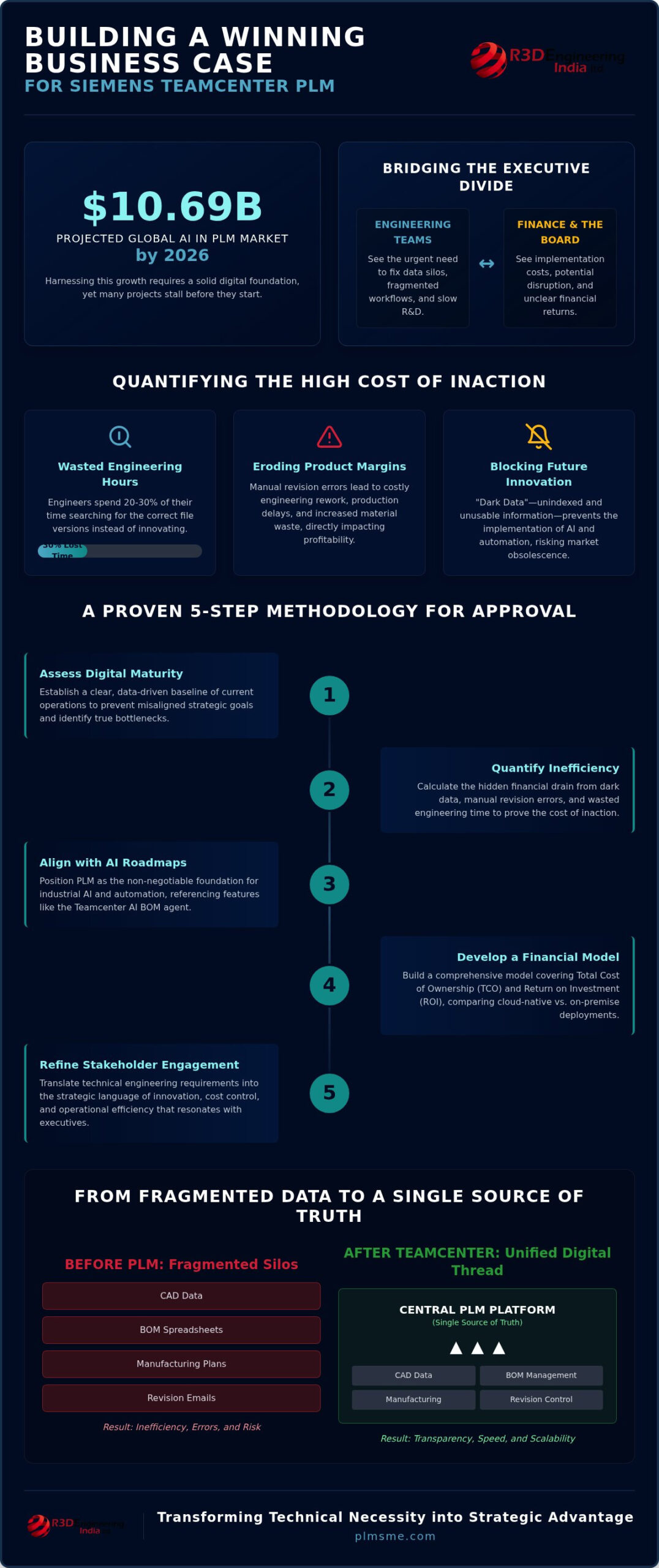
The global AI in Product Lifecycle Management market is projected to reach 10.69 billion dollars in 2026, yet many engineering leaders still find themselves stalled by a skeptical board. You’ve likely seen how legacy data silos and fragmented workflows are actively hindering your R&D speed. While the need for a unified digital thread is clear to technical teams, the perceived friction of implementation costs often creates a divide between engineering and finance. Building a business case for Teamcenter requires moving past vague promises of better collaboration and into the realm of quantifiable, strategic value.
This article provides a structured methodology to align Siemens Teamcenter with your specific industrial digitalization goals. You’ll learn to quantify the ROI of advancements like the Teamcenter AI BOM agent and the Copilot features found in the latest 2606 release. We’ll outline how to transform soft benefits into hard data that resonates with executive decision-makers. Our preview of the process covers everything from initial digital maturity assessments to architecting a roadmap that ensures your system architecture supports the traceability requirements of the EU AI Act. You’ll gain the tools needed to secure approval and bridge the gap between technical necessity and financial performance.
Key Takeaways
- Establish a clear baseline by conducting a digital maturity assessment to prevent your PLM investment from stalling due to misaligned strategic goals.
- Calculate the hidden financial drain of industrial inefficiency, specifically focusing on how dark data and manual revision errors erode product margins.
- Learn the essential steps for building a business case for Teamcenter that positions PLM as the necessary foundation for industrial AI and automation.
- Develop a comprehensive financial model that accounts for the total cost of ownership while comparing the impact of cloud-native versus on-premise deployments.
- Refine your stakeholder engagement strategy by translating technical engineering requirements into the strategic language of innovation, cost control, and operational efficiency.
Assessing Digital Maturity Before the Teamcenter Investment
Many organizations rush into software procurement without first understanding their current operational baseline. A business case built on shaky assumptions often collapses under executive scrutiny because it fails to address the root causes of inefficiency. To avoid this, you need a clear, data-driven starting point. An objective maturity score provides the transparency required to justify a significant digital transformation. Neutral advisors play a critical role here, offering an independent perspective that ensures the assessment isn’t merely a sales pitch for a specific tool.
Effective Product Lifecycle Management (PLM) isn’t just about purchasing a software license; it’s about shifting your organizational culture toward total data transparency. Without this shift, the platform becomes little more than an expensive digital filing cabinet. Building a business case for Teamcenter requires you to identify the specific gaps in your current workflow that prevent you from reaching long-term strategic goals. These gaps often involve the absence of a “Digital Thread” connecting design to manufacturing, a challenge that Siemens Teamcenter is uniquely engineered to solve through its integrated architecture.
Utilizing a Digital Maturity Report for Manufacturing
A formal digital maturity report manufacturing professionals rely on serves as a vital diagnostic tool. It uncovers exactly where siloed CAD data creates bottlenecks and where manual revision controls are failing your R&D teams. By benchmarking your current processes against 2026 industrial standards, you can pinpoint high-impact use cases that offer the fastest return. This ensures your investment targets areas where the ROI is most immediate, such as reducing engineering rework or accelerating time-to-market for complex assemblies. It’s about moving from fragmented data silos to a unified “Single Source of Truth.”
Establishing a Digitalization Vision and Roadmap
Your roadmap acts as the North Star for every technical decision your team makes. It’s a fundamental mistake to select software before you’ve defined your long-term KPIs. Technical debt often stems from tactical software use that doesn’t scale as the business grows. In contrast, a strategic industrial digitalization roadmap UAE manufacturers follow ensures that every implemented module serves a broader corporate vision. This alignment makes it much easier to justify costs to the CFO. You aren’t just buying software; you’re building a digital foundation for the next decade of production.
Identifying these digital gaps early allows you to position Teamcenter as the primary bridge to your future state. Whether your priority is AI-driven BOM management or a seamless connection between engineering and the shop floor, the maturity assessment provides the evidence. By the time you present your case, the transition from current inefficiencies to future capabilities is backed by hard data rather than intuition. This structured approach is the most reliable way of building a business case for Teamcenter that wins executive approval.
Quantifying Industrial Inefficiency: The Cost of Inaction
Building a business case for Teamcenter requires a cold, hard look at the financial drain caused by maintaining the status quo. Many organizations ignore the cost of “Dark Data,” which consists of vast amounts of information collected during the design process that remains unindexed and unusable. When engineers spend 20% to 30% of their time simply searching for the correct file version, your R&D velocity drops. This inefficiency directly erodes product margins. Engineering rework, often triggered by manual revision errors, creates a ripple effect that delays production and increases material waste.
Fragmented data does more than just slow down current projects; it actively blocks your future. The global AI in PLM market is projected to reach 10.69 billion dollars in 2026, but AI agents cannot function without a clean, structured data foundation. In a rapidly digitalizing national landscape, failing to consolidate your digital thread creates a risk of market obsolescence. You can’t automate what you haven’t first standardized. Understanding the business value of PLM starts with recognizing that inaction is, in itself, a high-cost strategic choice.
Identifying Technical Debt in Legacy PLM Systems
Technical debt in the PLM lifecycle describes the compounding operational costs and architectural limitations incurred by delaying necessary system upgrades in favor of short-term patches. Legacy, on-premise PDM solutions often require expensive custom maintenance just to keep them compatible with modern CAD versions. Beyond the maintenance burden, these aging systems pose significant security risks. Unmanaged intellectual property stored in disparate folders is vulnerable to data breaches and internal leaks. Transitioning to a modern architecture reduces this liability while freeing up IT resources for more strategic initiatives.
Measuring the Productivity Gap in Engineering Workflows
The productivity gap is most visible in the friction between departments. When engineering data is trapped in a silo, separate from ERP and CRM systems, the entire supply chain suffers. Poor supplier communication regarding design changes leads to increased lead times and procurement errors. By quantifying the Teamcenter CRM integration benefits, you can demonstrate how a unified view of customer requirements reduces design cycles and improves delivery accuracy. This integration ensures that the “voice of the customer” is directly linked to the technical configuration.
If you’re unsure where your specific inefficiencies lie, a professional digital maturity assessment can provide the hard data needed to validate these costs. This evidence is essential for building a business case for Teamcenter that moves beyond theory and into actual balance sheet impact. Documenting these losses makes the investment transition from a “technical upgrade” to a “financial necessity.”
Aligning Teamcenter Capabilities with Strategic AI Roadmaps
Building a business case for Teamcenter in 2026 demands a shift from seeing PLM as a storage tool to viewing it as the primary engine for industrial AI. With the release of Teamcenter 2606, features like the AI BOM agent and Copilot have moved from experimental to essential. These tools don’t just organize data; they actively assist in complex decision-making. However, these AI capabilities are entirely dependent on a robust digital thread. If your engineering data doesn’t flow seamlessly into manufacturing execution systems (MES), your AI initiatives will remain siloed. By integrating PLM with Manufacturing Operations Management (MOM), you create a feedback loop where real-time shop floor intelligence informs future design cycles.
In the regional context, aligning with industrial automation solutions GCC trends is vital for long-term viability. Modern business cases must prioritize AI-readiness to stay competitive in a landscape where automation is the standard, not the exception. Executives are no longer looking for incremental improvements. They want a platform that supports the rapid adoption of predictive analytics and autonomous design verification. Demonstrating how Teamcenter facilitates this transition is the most effective way to secure high-level buy-in.
Architecting for AI and Advanced Analytics
Meaningful AI implementation requires clean, structured data. Teamcenter acts as the primary validator for this information, ensuring that the datasets used to train models are accurate and version-controlled. It feeds the digital twins that allow your team to simulate production before a single part is made. This architecture also supports generative design, where AI suggests optimal geometries based on constraints stored within the PLM system. Future-proofing your setup means ensuring that your data schema is robust enough to handle these automated workflows without constant manual intervention.
The Value of PLM System Architecture Consulting
Achieving this level of integration isn’t a matter of simple software installation. Professional PLM system architecture consulting is necessary to ensure your environment scales alongside your AI ambitions. A consultant helps design the interactive connections between PLM, ERP, and MES, preventing the creation of new data islands. Long-term performance is then maintained through specialized system administration retainers, ensuring the digital thread remains unbroken as your digitalization vision evolves. This expert oversight is a cornerstone in building a business case for Teamcenter that promises sustainable, long-term ROI rather than a one-time technical fix.
Financial Modeling for PLM: Calculating ROI and TCO
Building a business case for Teamcenter involves more than just tallying subscription fees. To present a viable financial model to the board, you must account for the Total Cost of Ownership (TCO). This includes the obvious software costs, but also the resources required for data migration, user training, and ongoing system maintenance. A common mistake is focusing solely on the initial purchase price while ignoring the long-term operational expenses associated with legacy system upkeep. This comprehensive view of spending is vital when building a business case for Teamcenter that seeks to survive a CFO’s audit.
Quantifying ROI through “Time-to-Value” metrics allows you to demonstrate how quickly the system pays for itself. In 2026, the shift toward SaaS models like Teamcenter X has changed the financial landscape for many manufacturers. Teamcenter X utilizes a cloud-native architecture to eliminate the need for significant on-site hardware investments, effectively reducing upfront CAPEX in favor of a scalable operational expense model. This transition often results in a faster path to profitability compared to traditional on-premise deployments that require heavy infrastructure management.
Direct vs. Indirect ROI in Teamcenter Implementation
Direct ROI is the easiest to measure and often serves as the cornerstone of the financial case. You should focus on tangible reductions in scrap and rework caused by revision errors. If your engineering team currently spends 15% of their time on rework, reducing that to 5% through better version control provides a clear dollar value. Indirect ROI is more qualitative but equally important. It includes faster innovation cycles and improved employee retention. Engineers stay longer at companies that provide modern, efficient tools rather than forcing them to navigate fragmented data silos.
Accounting for Implementation and Integration Costs
Successful budgeting must include the costs of data migration and the integration of CAD, CAM, and CAE extensions. These are technical necessities that often lead to project delays if underfunded. Investing in expert Siemens Teamcenter consulting helps you avoid these common pitfalls by ensuring the initial architecture is sound. A well-architected system minimizes the need for expensive custom fixes later in the lifecycle.
Long-term cost stability is further achieved through professional oversight. A PLM system administration retainer ensures that your system remains optimized as your data volume grows. This proactive approach prevents performance degradation and reduces the burden on your internal IT staff. If you need assistance in developing a data-driven ROI model for your organization, our team can provide a digital maturity assessment to validate your financial assumptions before you present to the board.
Navigating the Stakeholder Approval Process
Securing executive approval for a PLM transformation requires more than just a list of technical requirements. It demands a nuanced understanding of different departmental priorities. When building a business case for Teamcenter, you must present a unified vision that speaks to the specific pressures faced by each member of the board. A phased implementation plan is often the most effective way to manage these expectations, as it allows for quick wins that demonstrate value within the first six months of the project. This incremental approach builds the internal trust necessary to tackle more complex integrations later in the roadmap.
Stakeholders typically fall into three primary categories, each requiring a tailored message:
- The CTO (Innovation): Focus on how the platform acts as the foundation for the AI capabilities and digital twin models required for 2026 industrial standards.
- The CFO (Cost): Emphasize the TCO stability and the transition from CAPEX to OPEX through cloud-native solutions like Teamcenter X.
- The COO (Efficiency): Highlight the measurable reduction in engineering rework and the elimination of dark data silos that slow down production cycles.
Leveraging the expertise of a Siemens Digital Industries Alliance Partner provides the technical credibility needed to reassure the board. This partnership signals that your plan is backed by proven methodologies and a deep understanding of end-to-end PLM architecture. It moves the conversation from if the system will work to how it will be optimized for your specific environment. Working with a specialized boutique like PLM-Sme FZC ensures that your strategy remains agile and focused on your long-term vision.
Addressing Common Executive Objections
Executives often worry about the risks associated with large-scale software deployments. You can mitigate these concerns by presenting a clear risk-management strategy that includes specialized implementation support and an ongoing system administration retainer. Proving your organization’s digital maturity readiness is another critical step. The board needs to know that the internal culture and data infrastructure are prepared for the transition. Positioning an independent consultant as a neutral advisor helps ensure the ROI projections are objective and not influenced by vendor-specific sales targets.
Finalizing the Business Case Document
Your final document should open with an executive summary that distills a ten-year digitalization vision into a ten-minute briefing. It’s vital to lead with the results of a Digital Maturity Assessment as your opening argument. This data-driven baseline provides the necessary justification for every subsequent financial and technical request. It transforms the project from a discretionary IT expense into a strategic industrial necessity. By the time you reach the final proposal, the transition to a unified digital thread should feel like the only logical path forward for the organization.
If you’re ready to validate your roadmap and secure the support of your leadership team, the first step is a formal evaluation of your current environment. Book a Digital Maturity Assessment with PLM-Sme FZC to ensure your strategy for building a business case for Teamcenter is built on a foundation of technical reality and strategic foresight.
Securing Your Competitive Advantage Through Digital Integration
Successfully building a business case for Teamcenter in 2026 requires moving beyond software features to focus on strategic industrial alignment. You’ve seen how a data-driven maturity assessment provides the baseline needed to justify investment and how quantifying the hidden costs of dark data can sway financial stakeholders. By positioning PLM as the essential digital thread for AI and automation, you transform a technical upgrade into a board-level necessity. It’s about ensuring your infrastructure is ready for the next decade of discrete manufacturing.
As a Siemens Digital Industries Alliance Partner, PLM-Sme FZC brings specialized expertise in complex ERP-PLM-MES integrations and discrete industry digital roadmaps. We function as a dedicated thinking partner to help you architect a scalable system that delivers long-term ROI. Don’t let legacy silos or fragmented workflows hold back your R&D velocity any longer. Your path to a unified digital thread starts with a clear understanding of your current state. Start your digitalization journey with a professional Maturity Assessment with PLM-Sme FZC today and take the first step toward a more resilient, AI-ready enterprise.
Frequently Asked Questions
What are the main components of a business case for Teamcenter?
The core components include a digital maturity assessment, a clear digitalization vision, a detailed Total Cost of Ownership (TCO) model, and a risk mitigation strategy. You must demonstrate how the platform acts as a digital thread connecting R&D to production. Building a business case for Teamcenter also requires a phased implementation plan that identifies short-term wins to maintain stakeholder confidence throughout the multi-year transformation process.
How do I calculate the ROI of a Siemens Teamcenter implementation?
ROI calculation involves measuring direct savings from reduced engineering rework, lower scrap rates, and decreased IT infrastructure costs. You should also quantify indirect benefits like accelerated time-to-market and improved product quality. By analyzing the current productivity gap, such as the time engineers spend searching for dark data, you can project significant labor savings. These data points transform technical improvements into tangible financial gains for the balance sheet.
Is Teamcenter X (Cloud) more cost-effective than on-premise PLM?
Teamcenter X is often more cost-effective for organizations looking to reduce upfront CAPEX and internal IT overhead. It follows a SaaS model that includes infrastructure management and automatic updates, which lowers the long-term maintenance burden. While on-premise solutions offer maximum control, they require significant hardware investments and specialized staff. For many manufacturers, the cloud-native approach provides a more predictable cost structure and faster deployment cycles.
How does a Digital Maturity Report help in getting board approval?
A Digital Maturity Report serves as an objective baseline that validates your current operational inefficiencies with hard data. It removes the guesswork from the proposal by highlighting specific digital gaps that hinder growth. When you present this report to the board, it frames the software investment as a strategic necessity rather than a discretionary technical upgrade. This transparency builds the trust required for high-stakes executive approval.
What is the typical timeframe for seeing ROI from a PLM system?
Most organizations begin to see measurable ROI within 12 to 18 months, particularly in areas like revision control and engineering productivity. However, the full strategic value of a unified digital thread often matures over 24 to 36 months as integrations with ERP and MES systems go live. A phased implementation strategy ensures that initial quick wins provide value early in the lifecycle, helping to sustain long-term project funding.
Why should I use an independent PLM consultant instead of a vendor?
Independent consultants provide a neutral perspective that focuses on your specific business outcomes rather than software sales targets. They act as a thinking partner to ensure the system architecture is optimized for your unique environment. This objectivity is crucial when building a business case for Teamcenter, as it ensures your ROI projections are realistic and that the implementation roadmap addresses your actual digital maturity level and long-term organizational goals.
How does Teamcenter integrate with existing ERP and MES systems?
Teamcenter utilizes standardized gateways and robust APIs to create a seamless flow of data between engineering, resource planning, and the shop floor. This integration ensures that the Bill of Materials remains consistent across all platforms, reducing procurement errors and production delays. By establishing this digital thread, your organization can leverage real-time manufacturing data to inform future design cycles and predictive maintenance models, creating a closed-loop engineering environment.
What are the hidden costs of PLM implementation I should include in my case?
Hidden costs often include extensive data migration, user training, and the development of custom integrations with legacy CAD tools. You must also budget for ongoing system administration and potential performance tuning as your data volume grows. Failing to account for these elements can lead to project delays and budget overruns. Including a specialized retainer for system oversight ensures that the platform remains optimized without straining your internal IT resources or causing technical friction.