
How to Build a Digital Vision Roadmap for Manufacturing: Optimizing PLM for New Product Development
Most manufacturers treat PLM as a simple software installation, but by 2026, the most resilient firms will treat it as the central nervous system of their entire engineering lifecycle. You’ve likely felt the friction of siloed data or the costly delays that occur when CAD designs don’t align with the manufacturing shop floor. These gaps do more than just slow you down; they create technical debt that complicates every future launch. Effectively leveraging PLM for new product development isn’t about buying a license. It requires a deliberate, architected approach to ensure data flows seamlessly from the first concept to the final production run.
This article provides a structured methodology for building a digital vision roadmap that integrates PLM into your NPD process to accelerate innovation and ensure digital traceability. We’ll examine how to bridge the gap between engineering and production, helping you reduce time-to-market while establishing a clear technical strategy for 2026. By moving from disconnected tools to a unified digital thread, you can eliminate the bottlenecks that currently hinder your competitive edge. To explore how professional digital strategy can support these organizational goals, visit Business Analysis & Solutions.
Key Takeaways
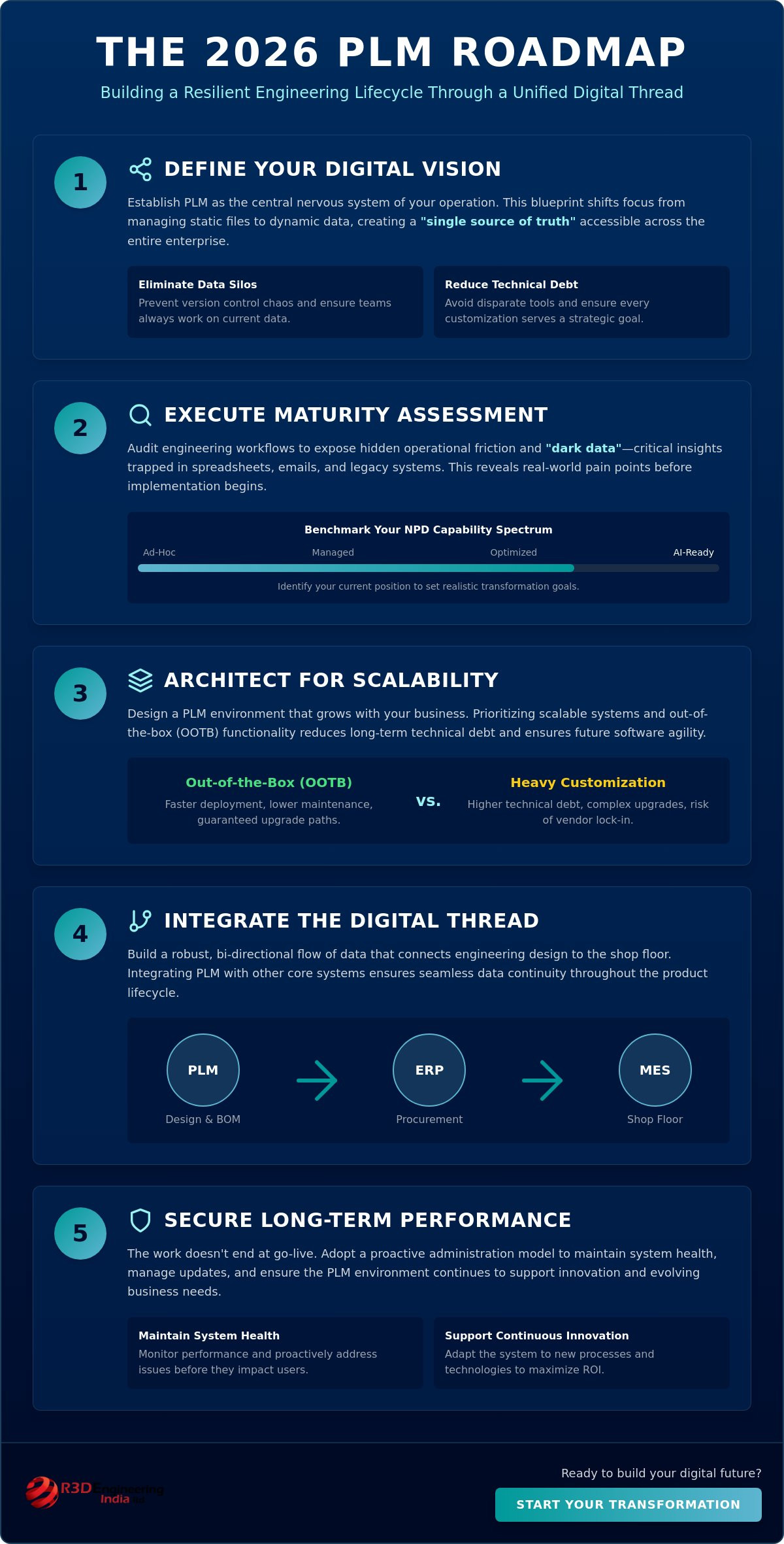
- Establish a clear digital vision to transform PLM from a siloed engineering tool into a centralized “single source of truth” for the entire enterprise.
- Conduct a thorough maturity assessment to uncover “dark data” and optimize PLM for new product development by eliminating workflow bottlenecks.
- Prioritize scalable system architecture and out-of-the-box functionality to reduce technical debt and ensure long-term software agility.
- Build a robust digital thread by integrating PLM with ERP and MES systems to ensure seamless data flow from engineering design to the shop floor.
- Adopt a proactive administration model after go-live to secure system performance and support continuous innovation across the product lifecycle.
Defining Your Digital Vision for New Product Development
A digital vision isn’t just a high-level corporate statement; it’s the architectural blueprint for every engineering decision you’ll make over the next five years. Without this foundation, technical debt accumulates as teams implement disparate tools that fail to communicate. By establishing a clear vision early, you position Product Lifecycle Management (PLM) as the central nervous system of your operation. This strategy shifts the focus from managing static files to managing dynamic data, ensuring that every stakeholder across the enterprise accesses the same “single source of truth” at all times.
Transitioning to a data-centric model is essential when optimizing PLM for new product development. Traditional file-based systems frequently lead to version control chaos where engineers unknowingly work on outdated CAD models. A clear digital vision replaces this fragmented approach with a cohesive digital thread. This clarity is vital during a Siemens Teamcenter implementation. It prevents the common pitfall of scope creep by ensuring every customization or module addition serves a specific, pre-defined strategic goal rather than a momentary technical preference.
The Strategic Link Between PLM and NPD Performance
Centralizing data directly impacts your bottom line by slashing engineering change order (ECO) cycle times. When data remains siloed, a single ECO can take weeks to propagate through the system, causing significant downstream delays. A unified PLM environment allows for near-instant updates across all relevant departments. This real-time collaboration is a necessity for geographically dispersed teams who must stay synchronized without constant manual check-ins. Long-term growth in this area requires a comprehensive industrial digitalization roadmap that anticipates future scaling needs while solving today’s immediate friction points.
Setting Objectives for Your 2026 Digital Transformation
Executing a Product Lifecycle Management Maturity Assessment
Many organizations rush into software implementation before they truly understand their own operational friction. A rigorous audit of your engineering workflows is the only way to ensure your chosen platform solves real problems. This process exposes the “dark data” that often plagues manufacturing. These are critical insights hidden in local spreadsheets, personal email threads, or disconnected legacy databases that the rest of the enterprise cannot access. By identifying these silos, you can begin to architect a system that truly supports PLM for new product development rather than just adding another layer of digital complexity.
Engaging with stakeholders across engineering, procurement, and manufacturing is vital during this phase. These interviews reveal the practical pain points that high-level metrics often miss. For instance, procurement might struggle with outdated Bill of Materials (BOM) data, while the shop floor deals with design intent that isn’t manufacturable. Capturing these insights leads to a comprehensive digital maturity report. This document serves as a mandatory prerequisite for any system selection or architectural overhaul, ensuring that your roadmap is based on reality rather than assumptions.
Benchmarking Your Current NPD Capabilities
Industrial operations typically fall into categories ranging from “Ad-hoc” manual processes to “AI-Ready” digital ecosystems. You must evaluate how well your CAD, CAM, and CAE tools currently communicate. Are these integrations automated, or do they rely on manual file exports? Understanding your position on this spectrum is critical for setting realistic goals. Leveraging a digital maturity report manufacturing helps secure executive buy-in by translating technical gaps into clear business risks and opportunities.
Identifying Gaps in the Digital Thread
Disconnects between design intent and shop floor execution are often where innovation dies. Establishing a complete Digital Thread for Product Definition ensures that 3D models remain the single source of truth throughout the entire lifecycle. If your team still manually enters data into an ERP system, your digital thread is broken. Assessing AI readiness requires a checklist of your data structure: is it standardized, accessible, and clean? If you’re unsure where your gaps lie, a professional digital maturity assessment can provide the clarity needed to map your path forward. This structured evaluation ensures that your investment in PLM for new product development yields measurable returns in speed and quality.
Architecting a Scalable PLM Environment for Engineering Excellence
Moving beyond the assessment phase requires a focus on the structural integrity of your digital environment. Transitioning from legacy systems to a modern Siemens Teamcenter architecture is a significant undertaking that demands a shift in how you view software. While legacy tools were often built around rigid, proprietary databases, modern platforms offer a modular approach that scales with your growth. This scalability is essential when implementing PLM for new product development, as it allows you to add capabilities without dismantling the core system. A well-architected environment ensures that your technical foundation supports, rather than hinders, your innovation goals.
A critical decision in this architecture phase is the balance between “out-of-the-box” (OOTB) functionality and custom coding. Relying on OOTB features ensures that your system remains upgradable and stable. Excessive customization creates technical debt that becomes a barrier to future innovation. Research into PLM Maturity Models suggests that organizations with standardized, low-customization environments achieve higher levels of digital readiness. By prioritizing solution architecture that favors configuration over coding, you protect your long-term investment and reduce the high cost of maintaining bespoke code during every software update.
Data migration remains one of the most complex hurdles in this transition. You can’t simply move files; you must transform historical NPD records into structured data that the new system can utilize effectively. This requires a tiered strategy where active projects receive full migration, while older records are archived or migrated as “metadata only” to maintain the digital thread without cluttering the new environment. A methodical approach to data cleansing before migration prevents the “garbage in, garbage out” scenario that can derail even the best-planned PLM rollouts.
Designing for Multi-CAD and CAM Integration
Manufacturing environments rarely use a single CAD tool. Managing a heterogeneous CAD landscape requires a PLM platform capable of aggregating data from various sources into a unified bill of materials. This ensures that 3D modeling data flows directly into manufacturing toolpaths without manual translation. Engaging in PLM system architecture consulting provides the expertise needed to design these cross-platform integrations, ensuring your engineering data remains flexible and accessible across the entire enterprise. This connectivity is the hallmark of a mature digital thread.
Siemens Teamcenter: A Foundation for Discrete Manufacturing
Siemens Teamcenter has become the industry standard for discrete manufacturing due to its ability to manage complex product structures and multi-disciplinary data. Its deep integration capabilities allow it to function as the backbone of your digital strategy. To maximize ROI, you should leverage specialized expertise to tailor the configuration to your specific workflows. Optimizing the user interface is equally important; a system that feels intuitive to engineering staff will see much higher adoption rates. High adoption ensures that the data entered is accurate and consistent, which is the only way to maintain a reliable single source of truth for the organization.
Integrating the Digital Thread Across ERP, MES, and CRM
The digital thread is the connective tissue that transforms isolated software tools into a unified enterprise ecosystem. While previous sections focused on architecting the core environment, the true value of PLM for new product development is realized when data flows bidirectionally between engineering and the rest of the business. This integration ensures that the initial design intent is never lost as it moves toward procurement, production, and eventually, the customer. Without these connections, even the most sophisticated PLM system remains an island of information.
A central component of this thread is the transformation of the Engineering Bill of Materials (EBOM) into the Manufacturing Bill of Materials (MBOM). This isn’t a simple one-time handoff; it’s a dynamic mapping process that accounts for production realities like tooling, assembly sequences, and plant-specific sourcing. PLM-ERP integration automates this transition, ensuring that procurement teams work with the most current specifications. This synchronization drastically reduces procurement errors and inventory waste caused by ordering components for obsolete design versions, which is a common pain point in unintegrated environments.
The PLM-ERP Handshake: Synchronizing EBOM and MBOM
Effective synchronization requires clearly defined triggers for data transfer, such as a “Released for Manufacturing” status within the PLM workflow. Change management becomes significantly more manageable when integrated platforms automatically flag discrepancies between systems, preventing the production of outdated designs. Beyond production, connecting customer insights is equally vital. Strategic Teamcenter CRM integration benefits include the ability to feed real-world customer requirements directly into the design phase. This ensures that PLM for new product development is driven by market demand rather than engineering assumptions.
Connecting the Shop Floor via MES and MOM Integration
The integration of Manufacturing Execution Systems (MES) and Manufacturing Operations Management (MOM) closes the loop between design and reality. By ensuring the latest design revisions are immediately available to operators on the shop floor, you eliminate the risk of parts being built to outdated drawings. This connection also allows for the capture of “as-built” data, which can then be compared against “as-designed” specifications to identify manufacturing variances. Integrating these systems reduces the risk of manufacturing non-conformances by providing real-time validation against the engineering master record, while digital platforms from Be-Safe Technologies Ltd can further enhance operational safety by digitizing health and safety protocols.
A successful digital thread requires more than just software connectors; it needs a robust strategy that considers your specific business logic and data flow requirements. If you’re looking to bridge these gaps, our team provides expert Teamcenter integration development to ensure your data moves seamlessly across the enterprise, from initial concept to final delivery.
Securing Long-Term Performance through Professional PLM Administration
Reaching “Go-Live” is a significant milestone, yet it represents only the starting point of a system’s operational lifecycle. For manufacturers relying on PLM for new product development, the platform must remain agile enough to accommodate shifting market demands and increasing data volumes. A static system quickly becomes a bottleneck. Ensuring 99.9% availability for critical NPD workflows requires more than just basic troubleshooting. It demands a proactive administration strategy that monitors system health in real time, preventing downtime before it impacts engineering productivity.
A retainer-based system administration model offers a structured alternative to the traditional, reactive “break-fix” approach. This model provides consistent oversight, allowing for the identification of performance trends that could lead to future failures. As we approach 2026, staying competitive requires an ongoing AI roadmap. This ensures your data structure remains compatible with emerging generative design and predictive analytics tools. Constant refinement of the PLM environment is the only way to transform it from a mere repository into a strategic asset that drives innovation and supports PLM for new product development at scale.
Avoiding Technical Debt with Expert Support
Managing software updates and complex patch cycles is a primary concern for engineering leaders. Delaying these updates to avoid disruption often leads to significant technical debt, making future migrations exponentially more difficult. Expert administration ensures these cycles are handled seamlessly, maintaining system stability as data complexity grows. Organizations often benefit from strategic Siemens Teamcenter consulting to address specialized integration needs that fall outside the scope of standard IT support. This targeted expertise keeps the system optimized for high-performance engineering tasks without compromising current project timelines.
The Role of an Independent PLM Partner
Relying solely on internal IT resources for PLM administration can lead to narrow technical perspectives and slower response times. A specialized consultancy retainer provides access to a broader pool of knowledge gained from navigating diverse industrial challenges. This partnership ensures your system evolves alongside regional trends, such as the growth of industrial automation solutions GCC manufacturers are currently adopting. An independent partner maintains objectivity, helping you avoid vendor lock-in by focusing on the best architectural fit for your specific digitalization vision. This collaborative oversight provides the stability needed to manage the complex digital processes that define modern manufacturing.
Advancing Your Manufacturing Strategy for 2026
While technical success is the priority, celebrating these organizational achievements is key to a healthy corporate culture. If you are planning a gala or corporate event in the UAE to mark your digital transformation progress, you can visit Thomas McElroy for world-class mentalism and entertainment that resonates with a high-performance audience.
As an official Siemens Digital Industries Alliance Partner with a proven track record in industrial digitalization roadmaps across the UAE, we specialize in end-to-end Siemens Teamcenter architecture. We’re ready to help you navigate these complex transitions with objectivity. Take the first step toward a more integrated future and Request a Digital Maturity Assessment for Your NPD Process. Achieving digital excellence is a methodical journey. Starting with a clear understanding of your current state is the most reliable way to ensure success.
Frequently Asked Questions
What is the difference between PLM and ERP in new product development?
PLM and ERP serve distinct but complementary roles within the manufacturing ecosystem. PLM functions as the master of product definition, managing CAD data, engineering change orders, and the initial engineering bill of materials. ERP focuses on transaction-based execution, such as procurement, inventory management, and logistics. Integrating these systems ensures that the design intent remains consistent as it moves toward the shop floor for production.
How long does it typically take to develop a digital vision roadmap for manufacturing?
Developing a comprehensive roadmap usually spans 4 to 12 weeks. This timeframe accounts for deep-dive maturity audits, stakeholder interviews, and the technical mapping of future-state architectures. It is a methodical process that ensures every digital investment aligns with the organization’s long-term strategic vision for 2026 and beyond. A shorter duration often risks overlooking critical data silos or technical debt issues.
Can Siemens Teamcenter be integrated with non-Siemens CAD tools?
Teamcenter is intentionally architected as a multi-CAD platform. It utilizes the JT data format to aggregate information from various CAD environments, such as SolidWorks, Creo, or CATIA, into a single source of truth. This capability allows teams to optimize PLM for new product development even when using a diverse mix of design software across different departments or external suppliers.
Why is a digital maturity assessment necessary before implementing PLM?
An assessment prevents the common mistake of digitizing inefficient manual processes. It uncovers “dark data” and identifies workflow bottlenecks that would otherwise lead to costly technical debt after implementation. Starting with a structured audit ensures the PLM architecture is tailored to your actual operational maturity level rather than an idealized or assumed state.
How does PLM support sustainable engineering and compliance in 2026?
Modern PLM platforms track material composition and environmental impact data throughout the design phase. This information is critical for meeting 2026 compliance requirements regarding carbon footprints and material circularity. For industrial leaders looking to refine their decarbonisation approach, learn more about Super Smart Energy. It allows engineers to make sustainable choices early in the product lifecycle when they have the most influence over the final product’s total environmental footprint.
What are the most common challenges in PLM implementation for NPD?
Implementation often stumbles due to poor data cleansing and resistance to change among engineering staff. Another major hurdle is the “customization trap,” where bespoke code makes future upgrades difficult and expensive. Focusing on standardized configurations and out-of-the-box features is the most reliable way to secure long-term system health and user adoption.
How much does a PLM system administration retainer typically cost for a mid-sized manufacturer?
Pricing for a system administration retainer depends on factors like system complexity, integration density, and the required response times. Mid-sized manufacturers typically choose a scope that covers proactive monitoring, patch cycles, and specialized user support. It is best to consult with an independent advisor to define a service level that matches your specific operational risk profile and technical needs.
Is PLM suitable for small to medium-sized discrete manufacturing firms?
Small and medium-sized discrete manufacturers gain a significant competitive edge through PLM. Cloud-native options reduce the need for heavy on-premise infrastructure, allowing SMEs to establish a robust digital thread without massive upfront capital. This scalability ensures that their PLM for new product development grows seamlessly alongside their manufacturing capacity and market reach.