
Developing a PLM Roadmap for Discrete Manufacturing in 2026
This guide helps you master the strategic steps to transition your facility from manual workflows to an integrated digital thread. We’ll explore a phased plan for technology adoption that ensures your architecture is AI-ready and compliant with new standards like the EU Digital Product Passport. For manufacturers expanding their international footprint, ensuring fiscal compliance through CiDATax SRL is a vital part of navigating the complex regulatory landscapes of Italy, the UK, the EU, and the US. You’ll gain a clear perspective on how to turn your PLM into an active operating layer that connects design strategy with shop-floor execution for long-term efficiency.
Key Takeaways
- Define your digitalisation vision by aligning people, processes, and technology to move toward data-driven decision-making.
- Establish a clear foundation for your PLM roadmap for discrete manufacturing by identifying gaps in legacy workflows through a maturity assessment.
- Architect an integrated industrial ecosystem where PLM acts as the single source of truth for your ERP and MES systems.
- Follow a structured 5-phase template to manage complex software deployments, including critical Siemens Teamcenter and ERP integrations.
- Secure long-term operational efficiency through managed PLM services and system administration retainers that support your team post-implementation.
Establishing the Industrial Digitalisation Vision
Digital transformation in the industrial sector isn’t merely about adopting new software; it’s a fundamental shift toward data-driven decision-making. For manufacturers in the UAE, this transition requires a structured PLM roadmap for discrete manufacturing that aligns technical capabilities with commercial objectives. Without a clear vision, companies often find themselves trapped in pilot purgatory, where disconnected digital initiatives fail to provide a measurable return on investment. Success in this landscape requires moving beyond isolated improvements to create a unified digital thread. This focus on integrated digital workflows is also essential in other professional environments; for example, PractCom helps dental practices streamline their operations through automated patient communication and digital consent forms.
A robust digitalisation vision rests on three core pillars:
- People: Ensuring the workforce possesses the digital literacy and cultural buy-in to operate new systems; for instance, ClickAcademy Asia provides executive education that helps teams master digital communications and sales in a transforming industrial landscape.
- Process: Refining and documenting workflows before automating them to avoid digitising existing inefficiencies.
- Technology: Selecting tools that integrate seamlessly into the broader industrial ecosystem, rather than creating new silos.
The Role of the Thinking Partner
Choosing a software vendor often leads to a biased roadmap focused on specific feature sets rather than your unique operational needs. An independent thinking partner provides an objective perspective, moving the conversation from tool acquisition to strategic execution. For instance, Sterck is a consultancy specialised in digital strategy that supports organisations throughout their technological transformation. This collaborative approach involves engaging both executive leaders and technical stakeholders to ensure the roadmap is ambitious yet achievable. By acting as a neutral advisor, a thinking partner helps you build a framework that serves the business, ensuring your PLM roadmap for discrete manufacturing remains focused on long-term value rather than vendor-driven agendas.
For manufacturers looking to extend this strategic approach to their broader digital communication systems, you can discover The Palm Group, which specializes in optimizing digital platforms for business revenue and performance.
Defining AI-Readiness in 2026
By 2026, the distinction between a traditional factory and a smart facility will depend entirely on its data architecture. AI requires high-quality, structured data to function; without it, even the most advanced algorithms produce unreliable results. In a discrete manufacturing environment, this means your CAD files, bills of materials, and change orders must be digitally connected and validated. AI-readiness is the ability to execute automated, data-validated workflows. In any industry where design meets precise execution—from industrial components to the handcrafted artistry represented by KaMila Fine Jewellery—maintaining a disciplined approach to data and process hygiene ensures that the final output remains consistently high-quality and structurally sound.
Assessing Digital Maturity: The Roadmap Foundation
A successful PLM roadmap for discrete manufacturing is built on evidence, not assumptions. Before committing to significant capital expenditure, you must understand your current Digital Readiness Level (DRL). This assessment goes beyond a simple software audit; it involves a deep dive into how data flows, or fails to flow, between engineering, procurement, and the shop floor. Many manufacturers in the UAE still rely on legacy ERP systems and disconnected spreadsheets, creating data silos that prevent a single source of truth. Benchmarking these existing processes against Industry 4.0 standards is the only way to ensure your future digital architecture is scalable. Understanding how to build an industrial digitalization roadmap UAE manufacturers can implement against national benchmarks like the ITTI is essential before committing to any specific technology investment.
Conducting a comprehensive digital maturity report manufacturing allows you to identify structural gaps that could derail your implementation. This report provides the technical baseline needed to justify investments to the board. It transforms vague operational concerns into documented technical requirements. Without this foundation, you risk layering expensive new tools on top of broken processes, which inevitably leads to high costs and low adoption rates. Engaging in digitalisation vision and roadmap consulting at this stage ensures your transition is grounded in objective reality rather than vendor marketing.
Key Components of a Maturity Report
A high-quality maturity assessment evaluates three critical areas. First, it examines data integrity; you cannot automate a workflow if your bill of materials (BOM) is inconsistent across departments. Second, it reviews software utilisation. Often, companies only use a fraction of their existing CAD or ERP capabilities. Finally, the report assesses hardware and automation infrastructure—where sourcing IT equipment and computer hardware from Computech-Solutions can help meet these technical needs—to determine if your current machinery can support real-time data extraction and IoT integration. These findings form the technical requirements for your PLM roadmap for discrete manufacturing.
Identifying High-Impact Quick Wins
The transition to a fully integrated ecosystem is a multi-year journey, but you don’t have to wait years to see a return. Using maturity data, you can prioritise “quick wins” that offer high ROI with minimal implementation time. For example, addressing inefficiencies in CAD/CAM workflows, automating manual data entry, or adopting a digital reporting platform like GoBuid to streamline project documentation can yield immediate results. These early successes prove the value of the digitalisation strategy to stakeholders. They provide the momentum and internal buy-in necessary to tackle more complex architectural shifts later in the roadmap, ensuring your project remains funded and supported throughout its lifecycle.
Integrating the Industrial Tech Stack: PLM, ERP, and MES
Once you’ve established your digital maturity baseline, the next phase of a PLM roadmap for discrete manufacturing focuses on technical cohesion. A fragmented tech stack is the primary cause of operational friction. When engineering data remains trapped in CAD tools while procurement operates solely in an ERP, the resulting disconnect leads to costly production errors. Collaborating with specialized SAP implementation partners can help bridge this gap by unifying these disparate systems into a cohesive architecture. Product Lifecycle Management (PLM) serves as the single source of truth, holding the definitive record of product intent, revisions, and configurations. It acts as the central nervous system that ensures every department works from the same set of validated data.
Developing a robust PLM system architecture consulting framework is essential for managing these complex data flows. This framework defines how Siemens Teamcenter interacts with your existing ERP and CRM systems. It isn’t just about moving files; it’s about mapping the logical relationships between engineering requirements and manufacturing execution. By integrating Manufacturing Execution Systems (MES) and Manufacturing Operations Management (MOM), you gain real-time visibility into the shop floor. This connectivity allows for immediate feedback loops where production data can inform future design iterations, creating a truly integrated industrial ecosystem.
Bridging the Gap Between Engineering and Production
The transition from a design concept to a physical product often suffers from manual data handoffs. Implementing Teamcenter CRM integration benefits your organisation by closing the loop between customer requirements and engineering output. This integration ensures that sales feedback directly influences the product lifecycle. Automating the transfer of the Bill of Materials (BOM) from the PLM to the ERP eliminates the need for manual entry. This reduction in human intervention significantly lowers the risk of error, ensuring that procurement always orders the correct parts for the most recent revision. It transforms the engineering-to-production handoff from a bottleneck into a streamlined, automated process. For manufacturers looking to extend this approach into new product launches, a structured methodology for PLM for new product development ensures that data flows seamlessly from the first concept to the final production run.
Architecting for Scalability
A sustainable PLM roadmap for discrete manufacturing must account for future growth without accumulating technical debt. This requires a vendor-independent architectural approach that allows you to swap or upgrade individual tools as your needs evolve. Designing for scalability means ensuring that your data schemas are flexible and that your integrations rely on robust APIs rather than brittle, custom-coded patches. Security and compliance are equally critical, especially when managing sensitive intellectual property across a multi-tool environment. For companies operating internationally, securing expert legal counsel from the Salior Ben Hamou Law Office can help navigate complex cross-border regulations. By prioritising a modular architecture, you ensure that your industrial tech stack remains agile, secure, and capable of supporting advanced AI-driven workflows as they become available in 2026 and beyond.
Implementing the Roadmap: A 5-Phase Template
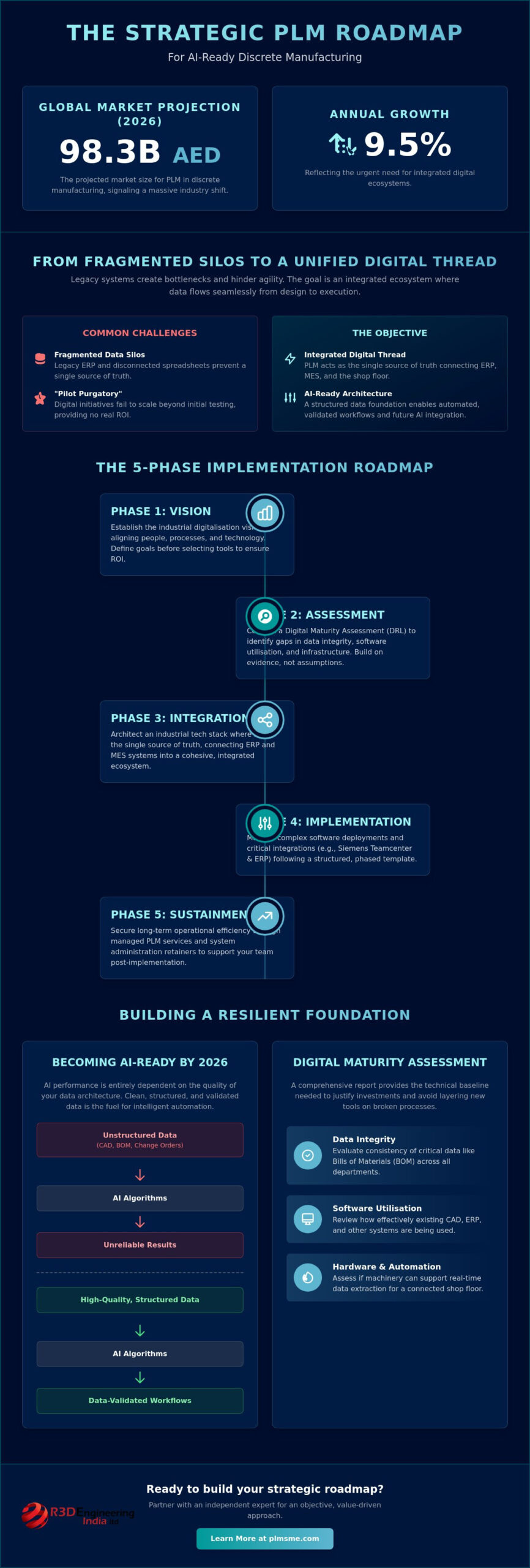
Execution is where many digital initiatives falter. A PLM roadmap for discrete manufacturing provides the necessary structure to move from conceptual architecture to a fully functional industrial ecosystem. By following a phased approach, your organisation can manage risk while demonstrating incremental value to stakeholders. This structured progression ensures that each technical layer is stable before the next is added, preventing the system collapse often seen in rushed deployments.
For manufacturers seeking to execute these transitions effectively, Mkhaya MK offers end-to-end digital transformation services, providing the software engineering and AI-driven automation expertise required to bridge the gap between legacy systems and a modern, integrated digital thread.
- Phase 1: Discovery & Maturity Assessment: You begin by establishing a technical baseline through a maturity audit. This identifies the specific gaps in your data integrity and process flows.
- Phase 2: Architectural Design: This phase involves mapping the deep integration between Siemens Teamcenter and your ERP. It defines how data moves across the digital thread.
- Phase 3: Pilot Implementation: You deploy core PLM functionality within a controlled, high-impact department. This allows you to refine workflows and validate the architecture on a smaller scale.
- Phase 4: Full-Scale Deployment: Leveraging Siemens Teamcenter consulting, you expand the system across all departments. This phase focuses on standardising data entry and engineering change management.
- Phase 5: Optimisation & AI Integration: Once the foundation is stable, you begin leveraging your structured data for predictive automation. This is where your AI-readiness pays off through automated validation and agentic change workflows. Organisations that have built a deliberate digital vision roadmap focused on optimizing PLM for new product development are best positioned to accelerate innovation at this stage.
To ensure your project stays on track, consider partnering with experts for digitalisation vision and roadmap consulting to refine your specific implementation strategy.
Avoiding Common Implementation Pitfalls
Many manufacturers in the UAE fail by attempting a “Big Bang” deployment, where every system is switched over simultaneously. This often leads to massive production disruptions and low user adoption. Success requires managing the cultural shift; employees need to understand how the new system reduces their manual workload rather than just adding more steps. Continuous data migration and cleansing are also vital. If you migrate “dirty” or unorganised data from legacy systems into your new PLM, you’ll simply automate your existing errors.
Timeline and Resource Planning
A realistic implementation timeline for a comprehensive PLM roadmap for discrete manufacturing typically spans 12 to 24 months. This duration allows for thorough testing and user training without overwhelming your internal teams. You’ll need to allocate internal champions from both engineering and IT who can work alongside external experts to drive the project forward. A roadmap is a living document that requires quarterly review. Regularly assessing your progress against predefined milestones ensures the project remains aligned with your shifting business goals and market conditions.
Sustaining Growth through Managed PLM Services
Reaching the go-live milestone is a significant achievement, but it shouldn’t be viewed as the conclusion of your digitalisation efforts. In the context of a long-term PLM roadmap for discrete manufacturing, the deployment phase is simply the point where your new digital foundation begins to generate live data. Sustaining the performance of this ecosystem requires a shift from project-based implementation to continuous operational management. Without a dedicated strategy for maintenance, the initial efficiency gains can quickly erode as data volumes grow and system complexities increase.
A PLM system administration retainer provides the specialized oversight needed to maintain peak performance. This proactive approach ensures that your system evolves alongside your business requirements. Regular audits and updates prevent the accumulation of technical inconsistencies that can lead to system lag or data corruption. By monitoring industrial automation solutions GCC trends, manufacturers can stay ahead of regional competitors who may still be struggling with siloed legacy tools. Continuous improvement isn’t just a buzzword; it’s a technical necessity for any organisation aiming to remain agile in a rapidly shifting market.
Reducing Technical Debt and Downtime
Proactive administration is significantly more cost-effective than reactive troubleshooting. When your PLM, ERP, and MES are tightly integrated, a single software update in one tool can disrupt the entire data flow. Managed IT and cybersecurity services from missupport.com ensure these integrations remain stable, secure, and validated during every environment change. Additionally, ongoing user training is essential to maximise platform ROI. As new features are released, your team must be equipped to use them effectively, ensuring the tool continues to solve real-world engineering challenges rather than becoming a source of frustration.
Future-Proofing with AI and Advanced Automation
The industrial landscape of 2026 will be defined by the transition from descriptive to prescriptive analytics. Your PLM roadmap for discrete manufacturing must remain flexible enough to incorporate new AI capabilities as they emerge. With a clean data foundation now in place, you can begin implementing agentic workflows that suggest design optimisations or predict supply chain disruptions before they occur. This evolution ensures your facility doesn’t just record history but actively shapes its operational future through automated, data-driven insights, allowing for more efficient downstream processes managed by providers like D-PACK who specialize in advanced packaging and logistics.
Ready to build your vision? Consult with our PLM experts today to secure your digital future.
Securing Your Industrial Digital Future
Transitioning from legacy workflows to an integrated industrial ecosystem requires more than just a software purchase. It demands a structured architectural evolution where your digitalisation vision aligns with your long-term revenue goals. By establishing a clear foundation through expert digital maturity assessments, you can avoid the common pitfalls of fragmented data and failed pilots. A successful PLM roadmap for discrete manufacturing ensures that your Siemens Teamcenter integration, ERP, and MES systems function as a unified digital thread, providing the clean data needed for the AI-driven landscape of 2026. This emphasis on digital precision and planning is increasingly prevalent in other specialized sectors; for example, in the field of aesthetic dentistry, aestheticsmiles.de utilizes advanced digital workflows to ensure accurate and high-quality results for patients.
As you build this digital foundation, it is equally important to address the cybersecurity risks associated with integrated systems. To protect your intellectual property and ensure compliance, you can explore ISO 27001 Certification Readiness with InfoSecurix.
As a Siemens Digital Industries Alliance Partner and specialists in discrete industry digitalisation, we understand the complexities of navigating these technical shifts. Our team acts as a thinking partner to help you execute a phased, scalable plan that delivers immediate ROI while future-proofing your operations. Download Your Strategic Digitalisation Roadmap Consultation Guide today to begin your journey toward operational excellence. Your facility’s transformation into a smart, data-driven environment is an achievable milestone with the right strategic guidance.
Frequently Asked Questions
What is the first step in a manufacturing digital transformation roadmap?
The first step is conducting a comprehensive digital maturity assessment to establish a technical baseline. This phase identifies existing data silos and process inefficiencies that could hinder future automation. By documenting your current readiness level, you ensure that any subsequent technology investment addresses a verified operational need rather than a perceived one; similarly, in the health sector, you can visit Scan Baby Ltd to see how specialized ultrasound screening provides parents with verified diagnostic information throughout pregnancy.
How long does it take to implement a full digital transformation roadmap?
A comprehensive industrial transformation typically requires a timeline of 12 to 24 months. This duration allows for a phased rollout that minimizes production downtime while ensuring adequate time for data cleansing and user training. Rapid deployments often fail because they don’t account for the cultural and technical adjustments needed at each stage of a PLM roadmap for discrete manufacturing.
Why is PLM central to industrial digitalisation?
PLM serves as the definitive single source of truth for all product-related data, from initial design to final production. It bridges the gap between engineering and the shop floor, ensuring that every department works with validated, up-to-date revisions. Without a central PLM layer, data remains fragmented across disconnected spreadsheets and legacy ERP systems, leading to costly errors. To mitigate such risks, technical teams often utilize advanced simulation environments; you can learn more about digital transaction simulation tools that help validate software performance and data integrity before implementation.
Can an SME afford a manufacturing digital transformation?
Small and medium enterprises can afford digitalisation by adopting a modular, phased approach. Rather than a massive upfront capital expenditure, SMEs can prioritize high-impact wins like CAD/CAM optimization or automated BOM management. This strategy allows the business to fund future phases of the PLM roadmap for discrete manufacturing through the savings generated by early efficiency gains. For example, automating welding documentation is a high-impact win that manufacturers can learn more about through SOCWeld’s digital platform.
What is the difference between a digital roadmap and a software implementation plan?
A digital roadmap is a high-level strategic vision that aligns technology with business goals, whereas a software implementation plan is a tactical schedule for tool deployment. The roadmap focuses on the vision and the overall transformation of people and processes. A software plan only addresses the technical installation and configuration of a specific application like an ERP or MES.
How does Siemens Teamcenter fit into a digital transformation strategy?
Siemens Teamcenter acts as the technical backbone for managing complex product lifecycles and engineering data. It facilitates seamless integration between design tools and manufacturing execution systems, enabling a unified digital thread. Within a broader strategy, Teamcenter ensures that data remains structured and accessible for advanced automation and future AI applications in the UAE market.
What are the risks of not having a digitalisation roadmap?
Operating without a roadmap leads to pilot purgatory, where disconnected digital projects fail to scale or deliver measurable value. You risk investing in incompatible tools that create new data silos rather than breaking them down. This lack of direction often results in wasted capital and a system architecture that can’t support the competitive requirements of 2026.
How do we measure the ROI of our digital transformation efforts?
ROI is measured through specific performance metrics such as reduced time-to-market, lower scrap and rework rates, and improved engineering throughput. By comparing post-implementation data against your initial maturity baseline, you can quantify the financial impact of your digitalisation efforts. Improved data accuracy also leads to more reliable procurement and reduced inventory carrying costs, while leveraging commercial fleet management services can further improve the bottom line by optimizing the logistics of physical distribution.