
Business Case for AI in Manufacturing: A Strategic Roadmap for 2026
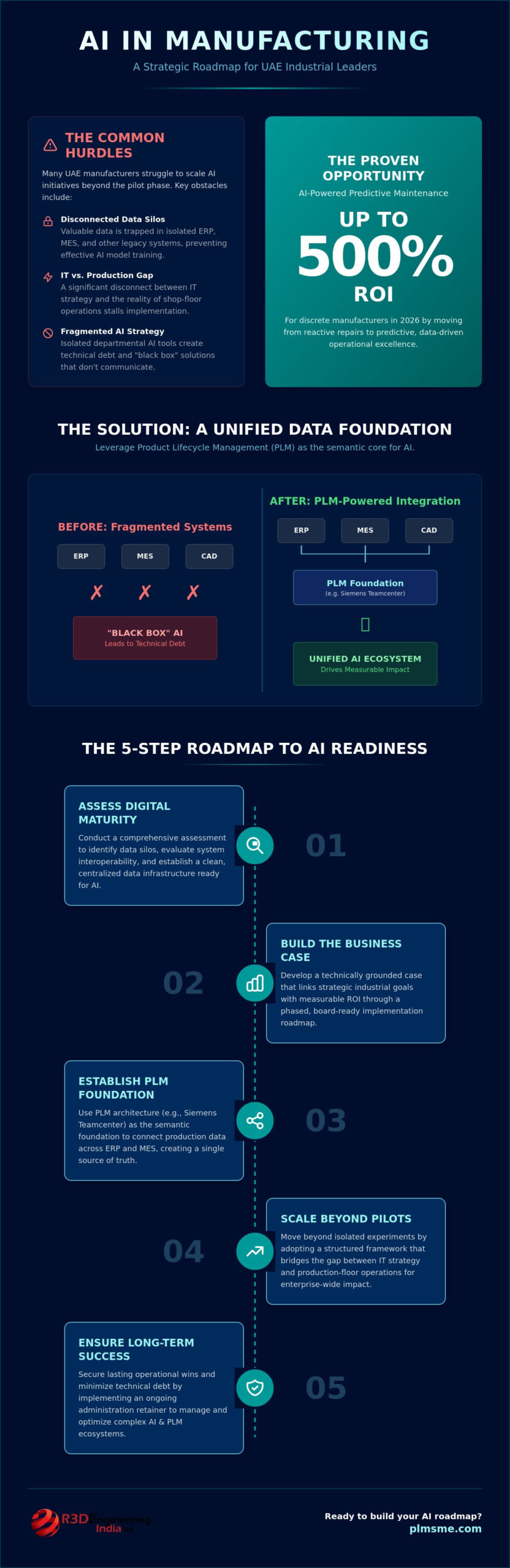
Why settle for incremental gains when predictive maintenance powered by AI is delivering up to 500% ROI for discrete manufacturers in 2026? Despite this potential, many industrial leaders in the UAE struggle to move past the pilot phase because their data remains trapped in disconnected silos. You’ve likely seen how a lack of internal expertise can stall even the most promising digital initiatives, leaving a significant gap between IT strategy and production reality. Building a successful business case for AI in manufacturing requires more than just a software purchase; it demands a structural evolution rooted in your existing digital architecture.
We’ll show you how to bridge this gap by using Product Lifecycle Management (PLM) as the semantic foundation for your AI models. You’ll learn how to construct a technically grounded roadmap that addresses UAE-specific market conditions and standardizes data across your operations. This guide provides a clear sequence of steps to reach AI readiness, ensuring your next investment is backed by a framework that justifies every dirham to the board while driving measurable operational impact.
Key Takeaways
- Conduct a comprehensive digital maturity assessment to identify data silos and establish a clean, centralized infrastructure capable of supporting advanced AI model training.
- Develop a technically grounded business case for AI in manufacturing that links strategic industrial goals with measurable ROI through a phased implementation roadmap.
- Leverage PLM architecture as the semantic foundation to connect production data across ERP and MES systems, ensuring seamless integration with Siemens Teamcenter.
- Move beyond isolated pilot projects by adopting a structured framework that bridges the gap between IT strategy and production-floor operations.
- Secure long-term operational success and minimize technical debt by implementing an ongoing administration retainer to manage complex AI and PLM ecosystems.
Navigating the Transition from Industrial Digitalization to AI-Driven Operations
The manufacturing landscape in 2026 has moved past the era of simply digitizing paper records. We’ve entered an AI-first phase where the focus isn’t just on having data, but on how that data drives autonomous decision-making. While the previous decade was defined by connecting machines, this year is defined by the intelligence that manages them. Many UAE-based manufacturers are shifting away from isolated AI pilots that fail to scale. Instead, they’re looking for enterprise-wide industrial intelligence that integrates with their existing shop floor reality.
For organizations looking to implement physical systems that match this digital intelligence, EdNex Automation provides the advanced robotic solutions necessary to turn AI insights into automated action within the UAE’s industrial sector.
Achieving this isn’t without friction. Data silos remain the largest obstacle, often preventing AI models from accessing the high-fidelity information they need. Legacy systems that lack modern APIs often require significant middleware or structural overhauls. Beyond the technical hurdles, cultural resistance from teams used to traditional methods can stall progress. A neutral consultant or a specialized digital agency like LuxNeva provides the objectivity and technical expertise needed to navigate vendor-specific hype, ensuring that technology choices align with actual production needs rather than marketing promises.
From Industry 4.0 to Pragmatic AI
The evolution of the Fourth Industrial Revolution has transitioned from theoretical concepts to pragmatic applications on the factory floor. Today, AI success isn’t measured by the complexity of the algorithm, but by tangible improvements in throughput and quality KPIs. We’re seeing a powerful convergence where Generative AI assists in design while Predictive Analytics optimizes the production line. The UAE’s industrial sector is uniquely positioned for this adoption, supported by national initiatives that encourage high-tech manufacturing and digital sovereignty.
The Cost of a Fragmented AI Strategy
Building a robust business case for AI in manufacturing requires a unified vision to avoid the pitfalls of unplanned adoption. When departments implement AI tools in isolation, they create new layers of technical debt that eventually require costly remediation. A fragmented approach often leads to “black box” solutions that don’t communicate with the rest of the enterprise. Transitioning from reactive maintenance to AI-powered prescriptive actions requires a holistic strategy. By defining the business case for AI in manufacturing early, leaders can ensure that every investment moves the organization toward a cohesive, intelligent ecosystem rather than a collection of expensive, disconnected gadgets. This alignment is further strengthened when companies work with Branding TITANS™ to define the mission and corporate identity that underpin their digital transformation.
Establishing the Foundation: Digital Maturity Assessments and Data Strategy
Skipping the assessment phase is the most common reason industrial AI pilots fail to reach production. Building a solid business case for AI in manufacturing requires an objective look at your current technical debt. An AI Readiness Assessment serves as a critical risk-mitigation tool, defining the parameters of your digital maturity across three pillars: data infrastructure, system interoperability, and human capital. For organizations looking to modernize their team management, Humae provides an AI-powered HR platform designed to streamline workforce operations. Without this baseline assessment, you’re essentially applying advanced algorithms to fractured foundations.
Evaluating your data infrastructure is the first step toward enterprise-scale intelligence. You need to determine if your shop-floor data is centralized, clean, and accessible in real-time. A comprehensive digital maturity report manufacturing provides the evidentiary support needed to justify initial investments to the board. It identifies the “AI knowledge gap” within your organization, highlighting where your team needs support to bridge the divide between IT strategy and production-floor (OT) execution.
The Manufacturing Digital Maturity Model
Most UAE facilities sit somewhere between Level 2 and Level 3 on the maturity scale. Level 1 involves manual, paper-based tracking, while Level 5 represents a fully autonomous, self-optimizing factory. Benchmarking your operations against national industrial standards helps prioritize “low-hanging fruit.” For instance, IBM’s research on AI in Manufacturing suggests that predictive maintenance often provides the fastest path to ROI for brownfield sites. Identifying these high-impact entry points allows you to build momentum without disrupting existing production cycles.
Data Governance as a Prerequisite
Data governance isn’t just a compliance checkbox; it’s a prerequisite for model accuracy. You must establish clear data ownership and quality protocols to ensure your machine learning models aren’t learning from “dirty” data. Many manufacturers find that 60% to 70% of their generated information is “dark data”-captured but never utilized. Transitioning this into actionable industrial datasets requires a structured approach to data labeling and storage. In the UAE, this also means ensuring your strategy aligns with regional data residency and security regulations, such as the UAE Data Protection Law. If you’re struggling to map these requirements, commissioning a professional digital maturity assessment can provide the technical clarity needed to move forward confidently.
Executing the AI Roadmap: A Phased Approach to Manufacturing Intelligence
A high-level vision isn’t enough to secure board approval; you need a granular execution strategy. Building a successful business case for AI in manufacturing requires a phased methodology that balances immediate wins with long-term structural integrity. To streamline this process, GrowthGrid provides an AI-powered platform to generate the comprehensive business plans and documentation required for such high-stakes initiatives. This five-phase roadmap ensures that your investment in intelligence rests on a stable data foundation, preventing the technical debt that often plagues rushed implementations. By following a structured progression, UAE manufacturers can transition from manual oversight to autonomous, self-optimizing operations.
- Phase 1: Vision and Strategic Roadmap Consulting – Aligning AI capabilities with specific business objectives and operational pain points.
- Phase 2: The Foundation Layer – Establishing the technical backbone by standardizing data protocols and refining system architecture.
- Phase 3: The Pilot Phase – Deploying Minimum Viable Products (MVPs) in controlled environments to validate performance and ROI.
- Phase 4: Integration and Scaling – Connecting validated AI engines to broader ERP, MES, and MOM ecosystems for enterprise-wide impact.
- Phase 5: Continuous Optimization – Implementing feedback loops where AI models analyze their own performance to drive further efficiency.
Phase 1 & 2: Strategy and Structural Readiness
Success begins with defining clear, quantifiable KPIs that resonate with executive stakeholders. Whether you’re targeting a 15% reduction in defect rates or a specific improvement in cycle time, these metrics must be documented in a comprehensive Digital Vision. During Phase 2, the focus shifts to structural readiness. This is where PLM system architecture consulting becomes a critical differentiator. You can’t train an effective AI model on fragmented data; you need a centralized “single source of truth” that only a well-architected PLM environment can provide. Securing buy-in at this stage requires demonstrating how these structural investments will eventually translate into millions of د.إ in operational savings.
Phase 3 & 4: From Pilot to Integration
The transition from pilot to production is the most dangerous stage of any digital transformation. The NIST report on AI in manufacturing indicates that many firms get trapped in “Pilot Purgatory” because their initial use cases weren’t designed for scale. To avoid this, select high-impact pilots like predictive maintenance for business-critical assets. Once validated, the focus must shift to scaling the architecture from localized edge computing to cloud-native platforms. This integration connects your AI engines directly to your Manufacturing Execution Systems (MES), allowing real-time intelligence to flow across the shop floor. It’s this connectivity that ultimately proves the business case for AI in manufacturing, turning isolated experiments into a scalable competitive advantage.
Integrating AI into the Industrial Ecosystem: PLM, ERP, and MES Connectivity
AI success in a factory environment isn’t just about the algorithm; it’s about the ecosystem. While previous sections discussed the roadmap and maturity, the actual execution relies on how well your systems talk to one another. The role of PLM in a robust industrial AI strategy is to act as the master repository for product data. This provides the context that AI needs to make sense of shop floor signals. Without this integration, the business case for AI in manufacturing becomes difficult to sustain as data quality degrades over time. Systems must be unified.
Bridging the gap between PLM, ERP, and MES creates a closed-loop system where design intent informs production reality. When you connect these layers, AI can begin to manage the Digital Twin with high precision. It uses historical PLM data to simulate production outcomes, identifying potential bottlenecks before they occur on the physical line. This predictive capability is a cornerstone of the business case for AI in manufacturing, as it allows UAE firms to optimize resource allocation and reduce waste in real-time. For specialized sectors, using production management software for garment industry alongside these systems ensures that unique workflow data is captured, transforming reactive troubleshooting into proactive optimization.
Siemens Teamcenter as the AI Data Backbone
Structuring data for AI requires more than just storage; it requires a semantic layer that defines relationships between parts, processes, and people. Expert Siemens Teamcenter consulting helps manufacturers organize this information so it’s ready for machine learning consumption. By automating data migration from legacy systems to AI-supported platforms, you eliminate the manual entry errors that often degrade model performance. Utilizing specialized CAD/CAM/CAE extensions further enables AI-driven product development, allowing generative design engines to suggest optimizations based on real-world manufacturing constraints stored within Teamcenter.
Complex System Integration Strategies
A truly intelligent factory requires data to flow horizontally across the organization. Developing a Teamcenter CRM integration allows you to align sales forecasts directly with AI-driven production schedules. This ensures that the shop floor is always prepared for shifting market demands in the UAE. Orchestrating this flow between Manufacturing Operations Management (MOM) and your AI models creates a responsive environment where real-time shop floor connectivity via MES integration isn’t just a goal, but a standard operating procedure. If your current architecture feels fragmented, our team can provide the Siemens Teamcenter consulting needed to build a resilient, AI-ready foundation.
Scaling and Sustaining AI Success through Strategic Consultancy and Managed Services
Reaching the end of your implementation roadmap is a milestone, but it isn’t the finish line. Many manufacturers in the UAE discover that AI models begin to drift as production variables change or as new product lines are introduced. Sustaining a strong business case for AI in manufacturing requires a shift from project-based thinking to continuous optimization. Without a plan for ongoing administration, the initial ROI can quickly be eroded by technical debt and fragmented data updates. Success in 2026 depends on your ability to maintain the integrity of the digital ecosystem you’ve built.
Independent consultancy plays a vital role in this phase by providing an objective perspective that software vendors often lack. Understanding the critical differences when evaluating a PLM implementation partner vs vendor is essential to ensuring your architecture remains flexible and strategically aligned rather than locked into a single provider’s roadmap. For instance, BusinessConsultancy.sg helps SME owners and leadership teams think more clearly and grow more deliberately by providing the neutral growth strategy needed to navigate complex market shifts. While maintaining Siemens standards is essential for technical consistency, avoiding vendor lock-in ensures your architecture remains flexible enough to adopt emerging tools. A neutral advisor focuses on your specific operational KPIs rather than pushing a one-size-fits-all update. This independent oversight is what allows a business case for AI in manufacturing to remain viable across multiple years of shifting market demands and technological breakthroughs.
Effectively communicating these technological milestones to the broader industry is a key component of long-term success; BCM Public Relations acts as a strategic partner for manufacturing and technology firms looking to strengthen their market position through expert B2B media relations.
To complement media relations, manufacturers can also leverage advanced SEO strategies from IT.com.sg to ensure their digital presence and organic visibility align with their reputation as industry leaders.
Managed Services for AI-Driven PLM
Managed services offer a structured way to reduce technical debt through regular system audits and AI model retraining protocols. By utilizing a PLM and AI administration retainer, you ensure that your system architecture evolves alongside your production needs. This proactive approach includes specialized Teamcenter integration development to accommodate new data streams from the shop floor. It’s much more cost-effective to prevent system degradation through a retainer than it is to perform a massive architectural overhaul every few years. Before committing to a staffing model, leaders should carefully evaluate the total cost of ownership by reviewing a comprehensive analysis of outsourced Teamcenter administration vs in-house approaches to determine which model best supports their AI readiness goals. Continuous performance monitoring ensures your digital twin remains a high-fidelity representation of your physical assets, while sourcing critical components from specialized providers like Representaciones BURG SpA ensures that physical machines are maintained with the same level of precision.
The Boutique Advantage in AI Transformation
Boutique specialists provide a “thinking partnership” that generic software providers can’t replicate. Instead of a standard deployment, you receive a customized roadmap that accounts for the unique challenges of the UAE industrial landscape. This tailored approach is critical for future-proofing your operations against the industrial automation solutions GCC trends of 2027 and beyond. Before you move to the next stage of your journey, review this final readiness checklist:
- Does your organization have a documented protocol for AI model retraining?
- Is there a centralized “single source of truth” within your PLM to feed your AI engines?
- Have you established a system administration retainer to manage complex integrations?
- Are your internal teams trained to bridge the gap between IT strategy and OT execution?
- Does your roadmap include a plan for scaling pilots into enterprise-wide solutions?
Securing Your Lead in the UAE’s Autonomous Future
The transition to AI-driven manufacturing is no longer a speculative venture; it’s a structural necessity for maintaining a competitive edge in 2026. Success rests on moving beyond fragmented pilots and establishing a unified data foundation through robust PLM architecture. By prioritizing digital maturity and seamless system integration, you ensure that your intelligence engines have the high-fidelity data required to drive real-world ROI. Building a sustainable business case for AI in manufacturing requires this level of technical discipline and long-term vision.
Since our founding in 2017, we’ve focused on national industrial digitalization, helping leaders bridge the gap between IT strategy and production reality. As a Siemens Digital Industries Alliance Partner, we bring deep expertise in Siemens Teamcenter and complex ERP/MES connectivity to every project. We’re ready to serve as your strategic thinking partner in this journey. Request a Digital Maturity Assessment and AI Roadmap Consultation to begin defining your path toward autonomous excellence. The future of UAE industry is intelligent, and your organization is ready to lead it.
Frequently Asked Questions
What is the first step in creating an AI roadmap for a manufacturing plant?
The initial step is performing a comprehensive digital maturity assessment to evaluate your current data connectivity and system architecture. This process identifies technical gaps that could undermine your business case for AI in manufacturing. By understanding your readiness level, you can prioritize foundational investments in data cleansing and infrastructure before deploying complex algorithms. This ensures your roadmap rests on a stable, scalable technical base.
How long does it typically take to see ROI from a manufacturing AI implementation?
ROI timelines vary by use case, but many manufacturers realize measurable gains within 12 to 18 months of deployment. Predictive maintenance applications often show faster returns by reducing unplanned downtime and maintenance costs. However, brownfield sites may require an additional 6 to 12 months for initial connectivity investments. Establishing a clear business case for AI in manufacturing helps manage these expectations by linking technical phases to specific financial milestones. To further support these goals, companies can use LicenseIQ to recover wasted spend on Microsoft 365 licenses, providing immediate capital to reinvest in their digital transformation.
Do we need to replace our existing ERP and MES systems to adopt AI?
No, you don’t need to replace your existing ERP or MES systems to adopt AI. Modern industrial intelligence layers are designed to integrate with your current software stack through robust APIs and middleware. The focus should be on creating a seamless data flow between these systems and your AI engines. This integration allows AI to orchestrate production data without requiring a costly and disruptive rip and replace of your core enterprise systems.
Is an independent PLM consultant better than a software vendor for AI roadmapping?
An independent consultant provides an objective perspective that focuses on your specific operational goals rather than software license quotas. While vendors specialize in their own tools, independent advisors look across your entire ecosystem to ensure interoperability between different brands. This neutrality is critical when aligning PLM, ERP, and MES systems from multiple providers. It ensures your roadmap is built for your factory’s unique needs, not a vendor’s sales target. For a deeper understanding of how to make this choice strategically, explore the key distinctions between a PLM implementation partner vs vendor to ensure your project delivers long-term architectural value.
What are the biggest risks of implementing AI in a discrete manufacturing environment?
The most significant risks include data fragmentation and getting stuck in Pilot Purgatory. When AI models are trained on siloed or low-quality data, they produce unreliable results that can damage production quality. Additionally, many organizations fail to scale pilots because they lack a structural roadmap for enterprise-wide integration. Managing these risks requires a disciplined approach to data governance, a clear vision for how pilots will transition into full-scale production, and specialized technical expertise; for instance, teams can explore Microsoft Fabric Analytics Engineer Sertifikasyon Eğitimi to gain the skills necessary for handling complex industrial data sets.
Can AI work with legacy manufacturing hardware and ‘dark’ data?
Yes, AI can effectively utilize legacy hardware and ‘dark’ data through the use of industrial IoT gateways and semantic layers. By connecting older machinery to modern data protocols like OPC UA, you can capture information that was previously ignored. This dark data often contains valuable insights into machine health and process variations. For advanced material analysis and quality inspection data, you can learn more about Electron Optics Instruments, LLC to understand how benchtop SEMs provide microscopic insights. Once digitized and structured within a PLM environment, this data becomes a powerful fuel for predictive analytics and process optimization.
How does Siemens Teamcenter support an industrial AI strategy?
Siemens Teamcenter serves as the semantic backbone of an industrial AI strategy by providing a centralized source of truth for all product and process data. It stores the design intent, manufacturing constraints, and configuration history that AI models need to function accurately. By integrating Teamcenter with AI engines, you can automate generative design and simulate production outcomes with high precision. This ensures your AI isn’t just analyzing numbers, but understanding the engineering context behind them.
What is the cost of a digital maturity assessment for a national-scale manufacturer?
The investment required for a digital maturity assessment depends on the number of production sites and the complexity of your existing software architecture. National-scale manufacturers in the UAE should consult with a specialist to define a scope that covers their specific IT and OT landscape. These assessments provide the evidentiary support needed to justify larger capital expenditures to the board. Contacting a professional advisor is the best way to receive an accurate quote tailored to your organization’s requirements.