
Analyzing PLM Implementation Cost for Manufacturing: A Strategic 2026 Guide
With manufacturers projected to spend 5.8 billion dollars on PLM software in 2026, why do so many digital transformation projects still stall due to unforeseen budget overruns? Calculating the true PLM implementation cost manufacturing leaders face requires looking far beyond the initial software quote. You’ve likely experienced the frustration of high license fees that don’t immediately translate to ROI, or the fear that data migration complexities will drain your resources. It’s a common challenge in an era where architectural maturity determines your success more than the tool itself.
This guide provides a transparent breakdown of the variables, hidden fees, and architectural decisions that define your total cost of ownership. You’ll learn how to distinguish between essential service costs and avoidable overhead while building a roadmap to minimize implementation risks. We’ll examine the structural choices that prevent vendor lock-in and provide the technical data you need to justify this strategic investment to your board. By focusing on a structured solution, you can transform a complex financial hurdle into a predictable, value-driven deployment.
Key Takeaways
- Define the full scope of investment beyond software licenses, including infrastructure and specialized professional services.
- Identify and mitigate high-risk budget overruns by prioritizing legacy data cleaning and streamlining complex system integrations.
- Analyze the correlation between project duration and the total PLM implementation cost manufacturing firms incur when using specialized consultants.
- Utilize digital maturity assessments to create a phased roadmap that spreads capital expenditure across multiple fiscal years.
- Gain insights into vendor-independent solution architecture to avoid long-term lock-in and ensure a scalable digital foundation.
Defining the Scope of PLM Implementation Cost in Manufacturing
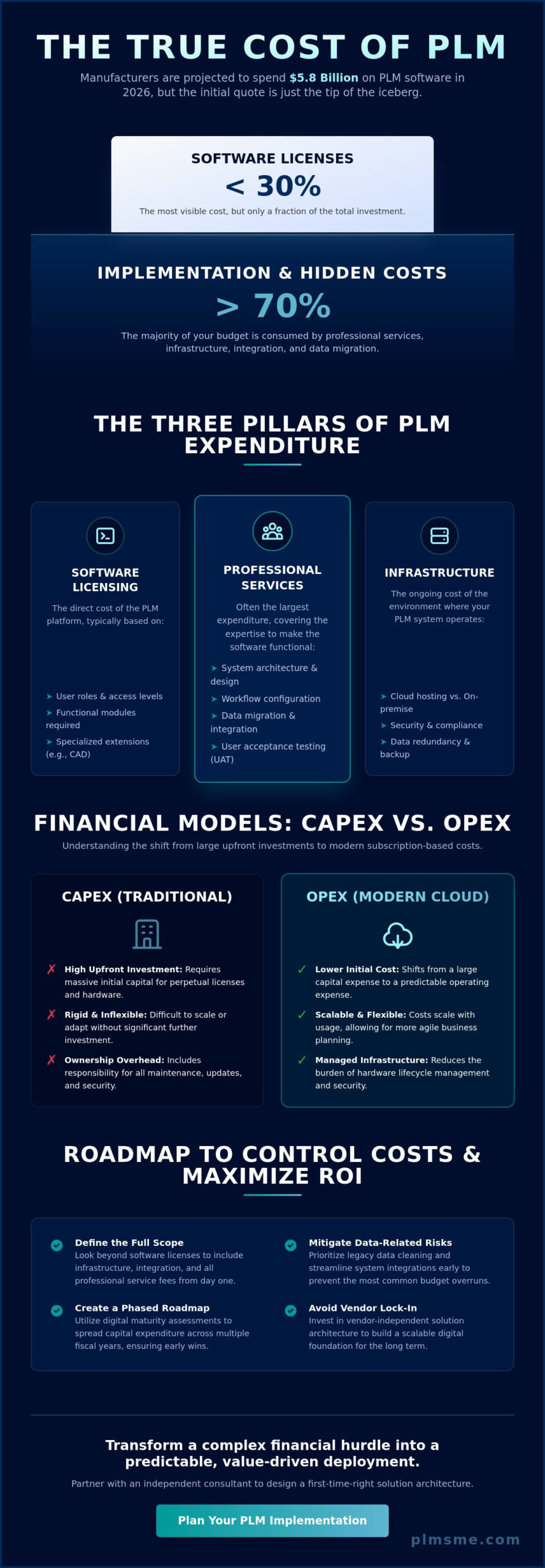
Many executives start their digital transformation journey by asking for a software quote, only to find that the initial price tag is just the tip of the iceberg. Industry benchmarks indicate that software licensing typically represents less than 30% of the total PLM implementation cost manufacturing firms actually pay. The majority of the budget is consumed by the technical heavy lifting required to make the software functional within a specific industrial environment. This discrepancy explains why engineering teams on platforms like Reddit often express frustration with high entry prices and hidden professional service fees that weren’t clearly outlined during the initial sales cycle.
Distinguishing between capital expenditure (CapEx) and operational expenditure (OpEx) is critical for modern financial planning. Traditional deployments relied on a CapEx model, requiring massive upfront investments in perpetual licenses and hardware. In 2026, the industry has largely pivoted toward OpEx-driven cloud subscriptions. While this shift reduces the initial cash outlay, it necessitates a long-term commitment to subscription management and cloud infrastructure. Adopting product lifecycle management (PLM) through an OpEx model ensures that costs scale with usage, but it also demands a more disciplined approach to architectural planning to avoid subscription creep and escalating maintenance fees.
Analyzing the Three Pillars of PLM Expenditure
A realistic budget must account for three foundational pillars that support a successful rollout. Software licensing remains the most visible cost, usually structured around user roles, functional modules, and specialized extensions. To optimize these recurring expenses, organizations can use LicenseIQ to discover and recover wasted spend on Microsoft 365 licenses. Professional services constitute the second, and often largest, pillar. These services cover everything from initial system architecture to the granular configuration of engineering workflows and user acceptance testing. The third pillar is infrastructure. Whether you choose cloud hosting or maintain on-premise servers, you’ll face ongoing costs for security, data redundancy, and hardware lifecycle management that aren’t included in the software-only price.
While this pillar focuses on digital assets, physical infrastructure compliance is equally vital for manufacturing leaders. Just as digital architecture must be sound, physical site expansions require specialized oversight; for instance, ML Traffic Engineers Australia provides the expertise needed to ensure car park designs meet strict regulatory standards, preventing the “surprise” costs that often arise from non-compliance.
Understanding How Manufacturing Complexity Influences Pricing
Not all implementations are priced equally because the underlying engineering data varies significantly between sectors. Discrete manufacturing environments, such as aerospace or medical device production, require extensive CAD, CAM, and CAE extensions to manage complex multi-component assemblies. These extensions carry their own licensing fees and specific configuration requirements. Process manufacturing, which deals with formulas and chemical recipes, requires a different architectural logic altogether. The number of integration points between these engineering tools and your core PLM system directly impacts the total project spend. PLM implementation cost is a strategic investment in digital continuity.
Calculating Professional Service Fees and Implementation Timelines
Professional fees are often the most variable component of the total PLM implementation cost manufacturing organizations must manage. While software license prices are relatively static, service fees fluctuate based on the depth of technical expertise required to configure the system. A robust business case for PLM must account for the reality that project duration is the primary driver of total spend. Every month a project extends beyond its initial scope increases the burn rate for specialized consultants, particularly in high-demand industrial hubs like the UAE where Siemens Teamcenter consulting expertise is at a premium.
Consultancy vs. Vendor-Led Implementation
Choosing between a vendor-led team and an independent consultancy significantly impacts both the quality of the architecture and the final bill. Vendor-led implementations often prioritize standard out-of-the-box features that might not align with specific engineering workflows, leading to expensive customizations later in the lifecycle. Engaging in PLM system architecture consulting helps organizations avoid this technical debt by designing a solution that fits the business requirements first. While hiring a Siemens Digital Industries Alliance Partner involves a specific daily rate, the cost-benefit analysis usually favors this route. These partners provide a higher level of localized technical knowledge that ensures a first-time-right deployment, ultimately reducing the long-term cost of ownership.
Standard Implementation Timelines
Establishing a realistic roadmap is essential for budget predictability. A typical enterprise rollout follows a structured progression that determines the cash flow requirements for the project:
- Phase 1: Discovery and digital maturity assessment (4–8 weeks). This phase identifies current process gaps and defines the digitalization vision before any software is configured.
- Phase 2: Architecture design and pilot environment (12–20 weeks). This involves building a representative model to test core functionalities and system integrations in a controlled setting.
- Phase 3: Full-scale deployment and data migration (6+ months). The final stage focuses on moving legacy data and scaling the system across the entire manufacturing enterprise.
Don’t overlook the human element when calculating these timelines. Budgeting for stakeholder training and organizational change management is just as vital as the technical configuration. If the engineering team doesn’t adopt the system, the financial investment fails to deliver its promised value. To ensure your roadmap is technically sound and financially realistic, consider starting with a professional digital maturity assessment to define your baseline before committing to a full-scale rollout.
Analyzing Hidden Costs: Integration and Data Migration
Hidden expenses often emerge in the technical gaps between software modules. While license fees are visible from day one, legacy data cleaning frequently becomes the primary catalyst for budget overruns. Managing the total PLM implementation cost manufacturing teams encounter requires a deep dive into the technical debt hidden within legacy systems. If you migrate inconsistent or “dirty” data into a new environment, you aren’t solving a problem; you’re simply automating chaos at a high price point. Verifying the integrity of decades of engineering history is a labor-intensive process that must be accounted for before the first migration script is ever written. Understanding the full scope of PLM implementation challenges manufacturing organizations commonly face can help teams anticipate these hidden costs before they derail the project.
Custom integration development for ERP, CRM, and MES systems adds another layer of financial complexity. These connections are necessary for creating a single source of truth, yet they require specialized architecture to maintain. The cost of inaction, represented by fragmented data silos and manual entry errors, often exceeds the price of the integration itself. As user adoption spreads from engineering to procurement and the shop floor, infrastructure scaling costs also rise. Planning for this growth ensures that your system remains performant as the data volume increases across the enterprise.
Managing the Integration Multiplier
Connecting disparate business systems involves more than just mapping fields. Understanding how Teamcenter CRM integration impacts the initial budget is essential for aligning engineering data with customer-facing requirements. Organizations must also budget for MES and MOM connectivity to bridge the gap between design and the actual shop floor. Choosing between middleware and direct API integration involves significant trade-offs. While direct APIs might offer lower latency, middleware often provides a more scalable and cost-effective approach for long-term maintenance in complex environments.
Assessing Data Migration Complexity Levels
The financial resources required for migration depend heavily on the maturity of your existing data structures. We typically categorize these into three distinct levels:
- Level 1: Simple CAD file migration. This involves moving basic geometry and metadata into a managed environment with minimal historical context.
- Level 2: Complex BOM structures. At this level, you’re migrating multi-level Bill of Materials and historical revision data that must remain linked and searchable.
- Level 3: Cross-platform migration. This is the most expensive tier, requiring the extraction of data from legacy PDM systems and re-mapping it to a modern PLM schema.
Budgeting for these levels correctly prevents the “surprise” costs that often derail projects in their final stages. By treating data migration as a core architectural pillar rather than an afterthought, you protect your investment and ensure the system delivers immediate operational value.
This level of financial foresight is essential for any major project, including bespoke home improvements. For those looking to manage the costs of high-quality interior design, you can discover Bowkirk Kitchens & Bedrooms to see how their custom installation services are made more accessible through specialized finance plans.
Optimizing ROI: Strategies to Control Implementation Spend
Controlling the PLM implementation cost manufacturing organizations encounter requires a shift from reactive spending to proactive architectural planning. Instead of attempting a “big bang” rollout that strains both capital and culture, successful leaders adopt a phased approach. This strategy allows you to spread capital expenditure across multiple fiscal years while delivering immediate value in high-impact areas. By demonstrating early wins, you build the internal momentum necessary to justify continued investment to the board. Standardizing out-of-the-box (OOTB) workflows is another critical tactic; every hour spent on custom coding today creates a recurring maintenance cost for tomorrow.
The Role of Digital Maturity
A comprehensive digital maturity report serves as your primary cost-saving roadmap. It identifies redundant software licenses and manual processes that can be eliminated before the new system goes live. This assessment also helps in identifying “AI-ready” data structures. Since industry analysts predict that AI-enhanced PLM systems will cut design iteration cycles by 30-40%, ensuring your data is structured correctly from the start is a critical future-proofing step. You don’t want to pay for a modern system only to feed it legacy data that prevents you from leveraging these massive efficiency gains.
Smart Budgeting for 2026
Precision in budgeting involves more than just listing known expenses. We recommend allocating a 20% contingency fund specifically for unforeseen integration challenges that often surface during the pilot phase. For organizations utilizing Siemens Teamcenter, negotiating multi-year agreements can stabilize your OpEx and provide better long-term predictability. When calculating ROI, look beyond the first year. A successful deployment typically shows its true value over a 3-year to 5-year horizon as engineering cycle times decrease and product quality improves. These long-term gains far outweigh the initial implementation hurdles if the architecture is sound.
System degradation is a silent budget killer. Without ongoing oversight, configurations can drift and user adoption may stall. Investing in a PLM administration retainer ensures that your architecture remains optimized and aligned with evolving business goals. This proactive maintenance prevents the need for expensive “rescue” projects later. To begin your journey with a clear financial and technical strategy, you can request a tailored digital maturity assessment to define your path forward.
Partnering with PLM-Sme FZC for Cost-Effective Digital Transformation
Successfully navigating the PLM implementation cost manufacturing leaders face requires a partner that prioritizes architectural integrity over software sales. As an independent consultancy, PLM-Sme FZC operates as a neutral advisor, ensuring that your digitalization roadmap reflects your specific operational requirements rather than a vendor’s quarterly quota. Our approach centers on the belief that a first-time-right deployment is the most effective way to control long-term expenses. By focusing on vendor-independent solution architecture, we help you build a scalable foundation that avoids the technical debt often associated with rigid, proprietary setups.
Our engagement model transitions seamlessly from high-level strategic planning to grounded, practical execution. We don’t just deliver a configured system; we provide a continuous partnership that spans the entire digital lifecycle. This includes moving from the intensive implementation phase into a structured PLM system administration retainer. This model ensures that your system remains optimized as your business evolves, preventing the performance degradation that typically leads to expensive rescue projects or system overhauls. PLM-Sme FZC balances technical depth with cost-efficiency by providing boutique, high-skill expertise tailored to specific industrial challenges.
Executing Our End-to-End Implementation Methodology
Our methodology is designed to be thorough and methodical, mirroring the structured nature of the engineering projects we support. We begin with comprehensive digital maturity assessments to establish a clear baseline of your current capabilities. From there, we move into system and solution architecture, where we define the data structures and workflows required for digital continuity. Our technical specialists provide specialized Teamcenter integration development, connecting your PLM environment to ERP and MES systems with precision. This end-to-end support ensures that every integration point is optimized for performance and data integrity from day one.
Case Study: Strategic Implementation for UAE Manufacturers
Regional context matters when deploying complex industrial software. In a recent Teamcenter implementation case study, we demonstrated how architectural precision directly impacts the bottom line. By conducting a rigorous discovery phase and prioritizing out-of-the-box functionality where appropriate, we achieved a 30% reduction in deployment time for a UAE-based manufacturer. This accelerated timeline didn’t just save on consultancy fees; it allowed the client to realize ROI months ahead of schedule.
Looking toward 2026, the integration of PLM with broader industrial automation solutions is becoming a requirement for staying competitive. We help you build a future-proof roadmap that accounts for AI-driven design and shop-floor automation, ensuring your PLM system acts as the central hub for all product data. Partnering with a specialist like PLM-Sme FZC, who understands both the strategic vision and the technical minutiae of Siemens Teamcenter consulting for industrial digitalization, ensures your digital transformation remains predictable, manageable, and, most importantly, profitable.
Securing Your Digital Future with Architectural Precision
Managing the PLM implementation cost manufacturing leaders face requires more than a simple budget allocation; it demands a strategic commitment to architectural clarity. We’ve explored how identifying hidden migration risks and prioritizing out-of-the-box workflows can prevent the common pitfalls of budget overruns. By shifting from a reactive spending model to a phased, maturity-led roadmap, you ensure that every dollar invested strengthens your digital thread and provides a measurable return. It’s about building a foundation that supports long-term agility rather than just installing software.
As a Siemens Digital Industries Alliance Partner, PLM-Sme FZC specializes in Siemens Teamcenter architecture and complex ERP/MES integrations. We function as your thinking partner, providing the objective guidance needed to navigate technical complexities without vendor bias. Our focus remains on delivering a first-time-right deployment that scales with your long-term vision. Transitioning to a high-performance digital environment is a significant milestone, and having the right technical oversight makes that journey predictable and manageable.
Take the first step toward a transparent and optimized deployment. Request a Digital Maturity Assessment and Implementation Roadmap today to define your path to industrial excellence.
Frequently Asked Questions
How much does a Siemens Teamcenter implementation typically cost?
The total investment for a Siemens Teamcenter implementation depends on the number of user licenses, the complexity of your product data, and the depth of required integrations. While software costs are fixed, professional service fees for architecture and configuration often represent a significant portion of the budget. It’s best to base your financial planning on a detailed digitalization roadmap that accounts for your specific engineering workflows rather than relying on generic industry averages.
What are the main drivers of PLM implementation cost in manufacturing?
The primary drivers of PLM implementation cost manufacturing projects include the volume of concurrent users, the complexity of CAD/CAM integrations, and the scope of legacy data migration. System architecture design and the necessity for custom ERP or MES connectivity also impact the final bill. Additionally, the level of organizational change management and stakeholder training required to ensure high adoption rates will influence the total professional service hours billed by your implementation partner.
Is it cheaper to use a cloud-based PLM or on-premise?
Cloud-based PLM deployments typically offer lower upfront costs by shifting the investment from capital expenditure to an operational expenditure model. This approach eliminates the need for server hardware and internal IT maintenance while providing better scalability. On-premise solutions require a higher initial investment in infrastructure and security, which may only be cost-effective for large enterprises with established data centers and specific regulatory requirements that demand local data hosting. For manufacturers managing these complex international tax and regulatory landscapes, CiDATax SRL provides specialized advisory services to ensure compliance across Italy, the UK, the European Union, and the United States.
How long does it take to see ROI from a PLM implementation?
Most manufacturers begin to realize a measurable return on investment within 12 to 24 months of a successful deployment. Initial gains usually manifest as a reduction in engineering cycle times and a decrease in costly production errors. Long-term value is achieved through improved data continuity and faster time-to-market. Organizations that utilize a phased implementation approach often see faster returns by addressing high-impact process bottlenecks early in the project lifecycle.
What are the hidden costs of data migration in PLM projects?
Hidden costs in data migration frequently arise from the need for legacy data cleaning and the reconstruction of complex Bill of Materials structures. If historical files contain metadata inconsistencies or broken links, specialized scripts and manual intervention are required to ensure data integrity in the new environment. These technical challenges can lead to budget overruns if a thorough digital maturity assessment wasn’t conducted to audit the source data before the migration began.
Can small manufacturing firms afford a full PLM implementation?
Small firms can manage a full implementation by adopting a phased rollout and focusing on essential out-of-the-box functionalities. Cloud-based solutions are particularly beneficial for smaller teams as they reduce the barrier to entry regarding infrastructure costs. By starting with core data management and expanding as the business grows, smaller manufacturers can control their PLM implementation cost manufacturing budget while still gaining the competitive advantages of digital continuity.
How does digital maturity affect the cost of PLM deployment?
High digital maturity significantly lowers implementation costs because existing processes are already documented and data structures are standardized. When an organization has a clear digitalization vision, consultants spend less time on discovery and process mapping. Conversely, low digital maturity requires more extensive foundational work in system architecture and change management. This increases the professional service fees needed to transform manual or fragmented processes into a functional, automated PLM environment.