
Building a Business Case for PLM: 2026 Strategic Framework
Most digital transformation initiatives fail not because of technical limitations, but because they’re pitched as IT upgrades rather than strategic financial assets. When you’re building a business case for PLM, the biggest hurdle isn’t the software’s capability. It’s the skepticism of a board that’s seen previous digital projects vanish into a black hole of unfulfilled promises. You likely feel the daily friction of disconnected data silos causing time-to-market delays, yet quantifying the “soft” benefits of collaboration remains a persistent challenge. It’s difficult to align engineering priorities with financial realities when the ROI isn’t immediately visible.
This article delivers the 2026 strategic framework required to bridge that communication gap and secure investment. We’ll master a methodology for building a defensible financial model that translates technical milestones into the hard metrics your CFO demands. You’ll learn how to address executive skepticism by shifting the focus from tool selection to a foundation of digital maturity. We’ll also outline a clear roadmap for integrating AI and industrial automation, ensuring your infrastructure is ready for the EU Digital Product Passport mandates arriving in 2026. This approach moves beyond vendor hype to provide a structured, results-oriented path for industrial digitalization.
Key Takeaways
- Shift the conversation from potential ROI to the Cost of Inaction (COI) by identifying the hidden financial drain caused by manual data management and spreadsheet reliance.
- Master a structured methodology for building a business case for PLM that translates “soft” collaboration benefits into audited financial metrics like Time-to-Market (TTM) reduction.
- Learn why an independent digitalisation vision is superior to vendor-led promises, providing a more realistic and risk-adjusted roadmap for your digital transformation.
- Utilise a five-step maturity framework that begins with a digital maturity assessment to align engineering priorities with a clear strategy for AI and industrial automation.
- Protect the long-term value of your investment through end-to-end implementation support and professional system administration to reduce technical debt and secure ROI.
Defining the Cost of Inaction in Industrial Digitalization
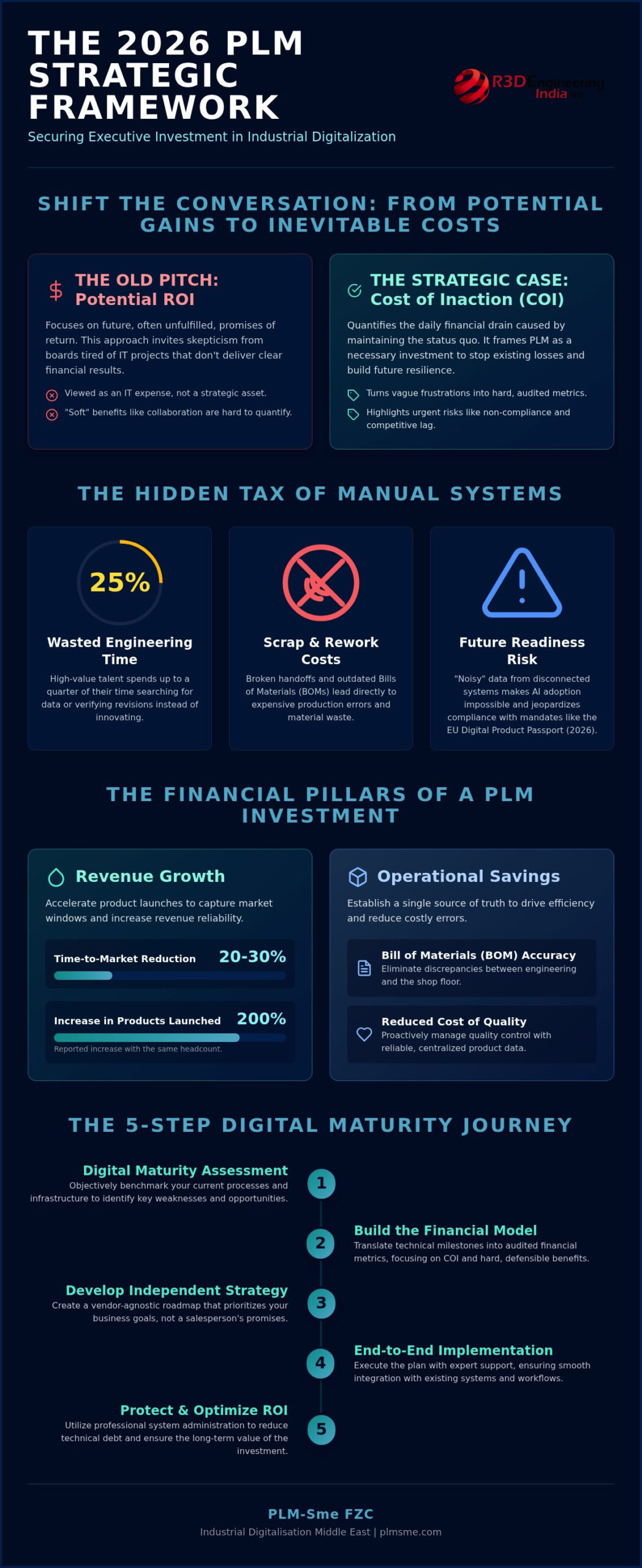
When building a business case for PLM, most leaders focus exclusively on the potential return on investment. However, a more compelling baseline for the board is the Cost of Inaction (COI). This metric quantifies the silent tax your organization pays by maintaining the status quo. In a manufacturing environment, COI manifests as the cumulative financial drain from manual data entry, fragmented communication, and a reliance on disconnected spreadsheets that act as data graveyards. These legacy habits don’t just slow you down; they actively erode your competitive edge in an increasingly automated market.
The foundation of Product Lifecycle Management (PLM) is the creation of a single source of truth. Without it, fragmented data throttles your time-to-market and heightens compliance risks. This is particularly critical as the EU Digital Product Passport (DPP) registry becomes operational on July 20, 2026, requiring granular material tracking that manual systems cannot sustain. Utilizing a digital maturity report manufacturing assessment is the first step in uncovering these hidden costs. It provides an objective look at where your current infrastructure fails to support your long-term vision.
Identifying Inefficiency in Legacy Workflows
Operational waste often hides in plain sight. Engineers frequently spend up to 25% of their time simply searching for data or verifying design revisions, which is a direct drain on high-value talent. When handoffs between engineering and the shop floor are “broken,” the result is a surge in scrap and rework costs. These errors usually stem from outdated Bills of Materials (BOMs) that don’t reflect real-time changes. By building a business case for PLM, you can quantify these losses, turning vague frustrations into hard numbers that demand executive attention.
The Risk of Falling Behind the AI Curve
The global PLM software market is predicted to reach $50.17 billion in 2026, driven largely by the integration of generative AI. For manufacturers in the UAE, staying competitive means moving beyond basic automation toward intelligent decision-making. AI readiness is the ability of a system to provide clean, structured data for machine learning algorithms. Without a structured PLM foundation, your data remains too “noisy” for AI to process effectively. Delaying industrial digitalization doesn’t just keep you in the past; it ensures that your future AI initiatives will lack the necessary data integrity to succeed.
Quantifying Hard Benefits: The Financial Pillars of PLM
Securing board approval requires shifting from abstract “collaboration” to audited financial pillars. When building a business case for PLM, the objective is to demonstrate how technical improvements directly impact the income statement. This involves reclaiming engineering time for high-value innovation and establishing direct cost savings through supply chain visibility. By treating PLM as a financial asset rather than an IT expense, you align engineering priorities with the company’s long-term fiscal goals.
Revenue Growth through Faster Time-to-Market
In discrete manufacturing, a 20% to 30% reduction in Time-to-Market (TTM) often determines whether a product captures a seasonal window or faces obsolescence. According to industry data from Centric PLM, some organizations report a 200% increase in the number of styles or products launched with the same headcount. This acceleration isn’t just about speed; it’s about revenue reliability. Integrating industrial automation solutions GCC allows regional manufacturers to respond to market shifts faster than competitors relying on manual workflows. Hitting these windows reliably ensures that your investment pays for itself through increased market share and reduced opportunity costs.
Operational Savings and BOM Accuracy
Accuracy is a financial imperative. Reducing the “Cost of Quality” starts with a single source of truth for all product data. One of the major Teamcenter CRM integration benefits is the elimination of discrepancies between customer orders and manufacturing specifications. This prevents the scrap and rework costs associated with outdated Bills of Materials (BOM) that don’t reflect real-time changes. Consolidating legacy systems also reduces IT overhead, as managing a unified platform is significantly more cost-effective than supporting a patchwork of disconnected software tools.
Ultimately, building a business case for PLM is about proving that digital maturity is a prerequisite for financial resilience. Implementing these changes requires a structured approach to ensure the projected savings are actually realized. Exploring industrial automation and AI solutions can provide the necessary technical foundation to support these hard financial metrics and secure the long-term success of your digitalization efforts.
Independent Strategy vs. Vendor Sales: Choosing the Right Path
Success in building a business case for PLM depends heavily on the objectivity of your underlying data. Many organizations fall into the trap of “Vendor-Calculator Optimism,” where ROI projections are based on idealized software performance rather than specific operational realities. While vendors provide valuable tools, their primary objective is license acquisition. This often leads to over-licensing and a focus on generic features rather than the unique technical requirements of your facility. An independent strategy prioritizes a risk-adjusted ROI, ensuring that every projected saving is grounded in practical execution.
Adopting a vendor-neutral approach to system architecture allows you to design a solution that integrates seamlessly with existing ERP and MES layers. This objective perspective is essential when aligning your investment with a broader industrial digitalization roadmap UAE. By focusing on the strategic goal rather than the software brand, you build a more resilient case that withstands executive scrutiny. As defined by IBM, Product Lifecycle Management is about managing the entire journey of a product; this requires a strategy that spans beyond the capabilities of a single software license.
The Role of a Thinking Partner
A “thinking partner” differentiates between a simple software implementation and a true strategic transformation. Objective assessments help prevent the common pitfall of under-utilization, where expensive modules are purchased but never deployed. For companies utilizing Siemens ecosystems, engaging in Siemens Teamcenter consulting from a neutral standpoint ensures the configuration matches your specific workflows. This collaborative guidance focuses on long-term vision, ensuring the architecture remains agile as your business scales.
Risk Mitigation and Change Management
Digital transformation programs face a staggering 66% failure rate, often due to a lack of cultural alignment. To counter this, your business case must include change management as a dedicated, funded line item. It isn’t enough to secure board approval for the purchase; you must also secure the budget for adoption. Executives need to understand that the real ROI of building a business case for PLM is realized only when the workforce fully integrates the new system into their daily routines. Realistic planning accounts for the learning curve, ensuring the project doesn’t stall after the initial launch.
Mapping the Digital Maturity Journey: A 5-Step Process
Successful industrial digitalization isn’t achieved through a single procurement cycle. It requires a disciplined, five-step methodology that aligns technical capabilities with corporate strategy. When building a business case for PLM, you must move beyond feature lists to demonstrate a clear path toward operational excellence. This process ensures that the investment is both defensible and scalable for the challenges of 2026 and beyond.
- Step 1: Conduct a comprehensive digital maturity assessment to identify existing data silos and process bottlenecks.
- Step 2: Define a clear digitalization vision and AI roadmap that prioritizes long-term growth over short-term fixes.
- Step 3: Quantify the financial gap between current manual processes and the optimized future state.
- Step 4: Design a scalable PLM system architecture consulting framework that integrates with existing ERP and MES layers.
- Step 5: Present a risk-adjusted investment plan to the board, highlighting both immediate “quick wins” and long-term strategic value.
Establishing the Baseline
A credible business case starts with objective data. Using maturity models to benchmark your facility against national manufacturing standards provides the board with a neutral perspective on your competitive standing. This involves gathering baseline metrics from engineering, finance, and operations to calculate the actual cost of current inefficiencies. Identifying “quick wins,” such as reducing Engineering Change Order (ECO) cycle times, helps build the internal momentum needed for large-scale transformation. To begin this process, organizations can leverage professional digital maturity assessments to uncover the specific technical debt hindering their progress.
Architecture and Integration Planning
The technical foundation of your business case must account for the entire digital thread. This means planning for seamless ERP, MES, and CRM connectivity from day one. AI readiness is a critical driver here; it’s estimated that AI-enhanced functionality will account for 12% of total PLM software spending in 2026. Without clean, structured data provided by a robust PLM system, advanced machine learning initiatives will fail to deliver value. PLM system architecture dictates the long-term cost of ownership. By ensuring your architecture is scalable, you protect the investment against future technical debt and ensure the system can support the rapid growth of industrial automation.
Protecting the Investment: Implementation and Beyond
Securing executive approval is a significant milestone, but the long-term success of the initiative depends on what happens after the software is installed. Building a business case for PLM must account for the reality that implementation is a continuous process of refinement and integration. Many projects stall because they underestimate the complexity of connecting the digital thread across the entire enterprise. Protecting your investment requires a commitment to end-to-end execution that ensures the system remains a strategic asset rather than a technical burden.
Ensuring End-to-End Execution
Generic, “off-the-shelf” solutions rarely accommodate the intricate workflows of discrete manufacturing. Specialized Teamcenter integration development is necessary to bridge the gap between high-level engineering vision and the practical realities of the shop floor. A common oversight in many business cases is the failure to budget for the deep integration of ERP, MES, and CRM systems. These connections are the nervous system of industrial digitalization. Without them, data remains trapped in functional silos, negating the very efficiency the board expects to see. True ROI is realized only when data flows seamlessly from the initial concept through to the final customer delivery.
The Strategic Value of Retained Support
Technical debt is the silent killer of digital transformation. It accumulates when systems are poorly maintained or when configurations become outdated as the business evolves. A PLM administration retainer shifts the focus from reactive troubleshooting to proactive system optimization. This ongoing support protects the integrity of your single source of truth, ensuring that data remains clean and accessible for future AI applications. It’s about maintaining the stability of the digital environment so your team can focus on innovation rather than system maintenance. Professional administration ensures that the system evolves alongside your business requirements, preventing the performance degradation that often follows unmanaged deployments.
Measuring success requires more than just tracking the initial launch. Post-implementation audits and consistent KPI tracking are essential to prove that the financial pillars established in your business case are being met. This iterative approach allows for the adjustment of the roadmap based on real-world performance data. It provides the board with the transparency they need to justify continued investment in digital initiatives. If you’re ready to move beyond software selection and secure a sustainable future for your facility, develop your industrial digitalization roadmap with PLM-Sme today.
Securing Your Competitive Edge in 2026
Building a business case for PLM is more than a financial exercise; it’s a strategic commitment to the future of your manufacturing operations. By quantifying the Cost of Inaction and moving beyond vendor-led ROI calculators, you create a defensible model that resonates with executive leadership. Success requires a structured approach that starts with an objective baseline and extends through professional implementation and ongoing system administration. This ensures your investment is protected against technical debt while remaining agile enough to support future AI growth.
As a Siemens Digital Industries Alliance Partner, PLM-Sme provides the independent consultancy needed to navigate these complex transformations. We specialize in discrete manufacturing, ensuring your system architecture is optimized for long-term industrial digitalization. Don’t let fragmented data silos continue to drain your resources or delay your time-to-market. Secure your Digital Maturity Assessment today to define your roadmap and turn engineering vision into shop-floor reality. Your transition to a data-driven enterprise is a manageable journey, and the right strategic framework makes all the difference.
Frequently Asked Questions
How do you build a business case for PLM without baseline data?
You begin by conducting a comprehensive digital maturity assessment to identify process bottlenecks and data silos. If internal metrics are unavailable, you can utilize industry benchmarks from organizations like Aberdeen or Tech-Clarity to estimate typical waste in manual workflows. This allows you to establish a “Cost of Inaction” baseline. By building a business case for PLM on these estimates, you provide the board with a logical starting point for quantifying potential efficiency gains.
What is the typical ROI period for a Siemens Teamcenter implementation?
Most industrial organizations realize a full return on investment within 18 to 24 months. This timeline depends on the speed of adoption and the complexity of your system architecture. Early gains often come from a 20% to 30% reduction in time-to-market and decreased Engineering Change Order (ECO) cycle times. A phased implementation approach helps demonstrate value quickly, securing continued support from stakeholders as the project scales toward more complex automation goals.
How much does a PLM implementation cost for a mid-sized manufacturer?
Implementation costs for mid-sized manufacturers vary significantly based on the number of users and the depth of system integrations required. Industry data suggests that service fees for enterprise-level deployments can range from $25,000 to over $400,000. These figures typically cover system architecture, data migration, and specialized Teamcenter integration development. It’s essential to factor in long-term support through a PLM administration retainer to protect the initial investment and manage ongoing technical debt effectively.
Should we use a vendor ROI calculator for our board presentation?
Vendor calculators are useful for understanding potential software capabilities, but they should not be the sole basis for your presentation. They often rely on idealized scenarios that ignore the specific risks of your facility. An independent strategy provides a more realistic, risk-adjusted ROI model. Executives usually prefer an objective assessment that accounts for change management costs and technical integration challenges rather than a generic model provided by a software vendor.
How does PLM integration with ERP affect the business case?
Integrating PLM with your ERP system is a critical driver for financial ROI. It ensures that the shop floor always operates with the most current Bill of Materials (BOM), which directly reduces scrap and rework costs. This connectivity eliminates the manual data entry errors that often occur when engineering and manufacturing systems remain disconnected. By including these operational savings, you strengthen the business case by proving that the digital thread delivers measurable bottom-line results.
What happens if we choose to delay our PLM investment?
Delaying the investment increases your Cost of Inaction and leaves your organization vulnerable to more agile competitors. You also face significant compliance risks, particularly with the 2026 rollout of the EU Digital Product Passport (DPP) registry. Without a structured data foundation, your facility will struggle to provide the granular material tracking required for international trade. Postponing digitalization also makes future AI integration more expensive as your technical debt continues to accumulate over time.
Can a digital maturity assessment help secure board approval?
A digital maturity assessment is one of the most effective tools for securing executive buy-in. It provides an objective, data-driven report that highlights exactly where your current processes are failing. This transparency builds trust with the board by showing that your request is based on technical reality rather than marketing hype. It also establishes a clear baseline for measuring the success of the project through post-implementation audits and specific KPI tracking.
How does an AI roadmap influence the PLM business case?
An AI roadmap demonstrates that your digitalization strategy is future-proof. Because machine learning algorithms require clean, structured data to function, building a business case for PLM becomes a prerequisite for any advanced automation initiative. Highlighting AI readiness shows the board that the PLM system is the necessary infrastructure for next-generation manufacturing. This approach shifts the conversation from a simple IT upgrade to a strategic investment in long-term technological leadership.