
The Strategic Guide to PLM Administration Retainers for Industrial Excellence
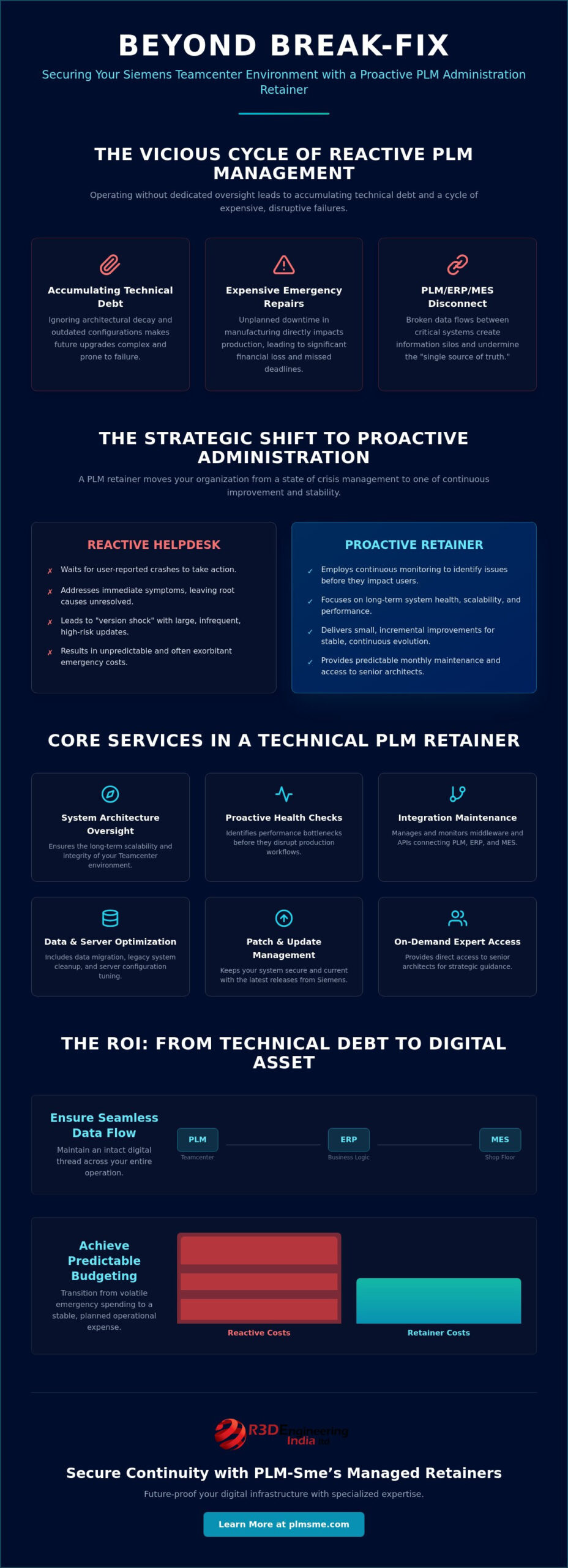
The true cost of a Siemens Teamcenter environment isn’t the initial license fee; it’s the hidden price of a reactive “break-fix” mentality that ignores accumulating technical debt. Operating without a dedicated PLM administration retainer often leads to a cycle of expensive emergency repairs and complex integration failures between your PLM, ERP, and MES layers. You likely recognize that system stability is the foundation of industrial excellence, yet finding the internal expertise to maintain that stability while driving innovation remains a persistent challenge.
This guide explores how a structured PLM administration retainer secures your Siemens Teamcenter environment and ensures continuous system performance. You’ll discover how to transition from unpredictable emergency costs to a model that provides on-demand access to senior architects and a future-proofed digital infrastructure. We’ll examine the strategic shift from simple support to a partnership that eliminates technical debt and prepares your operations for the complexities of modern industrial automation. By the end of this article, you’ll understand how to achieve predictable monthly maintenance while leveraging specialized expertise to keep your digital threads intact.
Key Takeaways
- Distinguish between reactive helpdesk support and a proactive PLM administration retainer focused on long-term system architecture and stability.
- Learn how consistent oversight prevents “Architecture Decay” and reduces the technical debt that frequently leads to failed software upgrades.
- Gain strategies for maintaining complex integrations between Siemens Teamcenter, ERP, and MES to ensure seamless data flow across your digital thread.
- Quantify the financial impact of unplanned PLM downtime in high-volume manufacturing environments to justify a structured maintenance model.
- Identify the optimal agreement structure for your organization by comparing capacity-based hourly blocks against access-based advisory frameworks.
Defining the PLM Administration Retainer for Industrial Digitalization
A PLM administration retainer represents a fundamental shift from reactive troubleshooting to a structured, lifecycle-based management model. Instead of treating system maintenance as an occasional necessity, this strategic agreement secures continuous expert oversight for Siemens Teamcenter environments. It ensures that the digital thread remains intact and performant, preventing the gradual degradation of system architecture that often occurs in high-pressure industrial settings. By engaging in a dedicated retainer, organizations move beyond the limitations of internal IT generalists who may lack the deep, specialized knowledge required for complex PLM ecosystems.
There is a critical distinction between a standard helpdesk and a proactive retainer. Traditional support models are designed to address immediate failures, often leaving the underlying root causes untouched. In contrast, a PLM administration retainer focuses on the long-term health and scalability of the environment. This service model directly supports the benchmarks established in a digital maturity report manufacturing, where system reliability and architectural integrity are viewed as core drivers of operational success. Choosing an independent consultancy for this role provides an objective perspective that software vendors often lack, as the focus remains on optimizing your specific configuration rather than pushing additional license sales.
Managed Services vs. Traditional Support
Proactive monitoring is the cornerstone of effective managed services. While traditional support waits for a user-reported crash, a retainer model employs regular system health checks to identify performance bottlenecks before they disrupt the production line. This approach facilitates the continuous delivery of small-scale configuration updates, which prevents the “version shock” typically associated with massive, infrequent system overhauls. These incremental improvements align perfectly with an industrial digitalization roadmap UAE, allowing manufacturers to scale their digital capabilities at a manageable and predictable pace.
The Siemens Teamcenter Context
Managing a Teamcenter environment requires specialized technical literacy that spans both the Active Workspace and the traditional Rich Client. A robust retainer model accounts for these differences, providing the expertise needed to manage complex CAD, CAM, and CAE extensions within a recurring service framework. Leveraging the skills of a Siemens Digital Industries Alliance Partner ensures that your administration team stays current with the latest patch releases and best practices. This level of specialized support is essential for maintaining the high-availability requirements of modern engineering and manufacturing teams who cannot afford even minor disruptions to their PLM workflows. Effective Teamcenter system administration is now a strategic necessity for securing your digital thread and ensuring your infrastructure can handle the demands of the latest platform releases.
Core Services Included in a Technical PLM Retainer
A technical PLM administration retainer provides far more than basic user management or password resets. It offers a structured framework for continuous oversight of system and solution architecture, ensuring your Siemens Teamcenter environment remains scalable as your product data grows. Instead of waiting for a major system overhaul to address performance bottlenecks, a retainer allows for the ongoing optimization of server configurations and data models. This proactive approach includes dedicated support for data migration and the periodic cleanup of legacy systems, which effectively prevents the “digital rot” that often hampers engineering productivity.
Specialized integration development is another vital component of a comprehensive service model. Modern industrial environments rely on the seamless flow of information between Teamcenter and other business-critical systems like CRM or Manufacturing Operations Management (MOM). A structured retainer provides the technical bandwidth and expertise needed to develop, test, and maintain these custom connections. It ensures that your integrations don’t just work at launch but continue to perform as each connected system evolves through its own update cycles.
Maintaining Integration Integrity
Configuration and Patch Management
Stability and security demand a disciplined approach to software maintenance. A PLM administration retainer ensures that Siemens Teamcenter security patches and minor version updates are systematically tested and deployed to minimize production risks. Managing changes within the Business Modeler IDE (BMIDE) requires precision to ensure that new business rules or attributes don’t disrupt existing workflows. Every configuration change is thoroughly documented, which is a critical step in preventing the accumulation of technical debt. A well-designed Teamcenter solution architecture ensures that these configuration changes align with your long-term scalability goals and reduce the risk of costly re-implementations. If you want to secure this level of technical continuity, a professional PLM System Administration Retainer provides the expert oversight necessary for long-term excellence.
The ROI of Proactive Maintenance: Reducing Technical Debt
Quantifying the financial impact of unplanned downtime is essential for understanding the value of a managed service model. In high-volume discrete manufacturing, a PLM system failure doesn’t just frustrate engineering teams; it halts the entire production release cycle. When CAD data becomes inaccessible or release workflows stall, the cost per hour can escalate rapidly due to idle labor and missed delivery milestones. A PLM administration retainer mitigates these risks by shifting the focus from emergency recovery to continuous availability and performance tuning. For manufacturers in the medical sector, where timely delivery of supplies is vital, you can check out IMT Medical Devices for high-quality equipment and global export services.
Regular administration prevents the “Architecture Decay” that frequently leads to catastrophic upgrade failures. Over time, systems that aren’t actively managed tend to accumulate undocumented workarounds and data inconsistencies that complicate future migrations. Strategic PLM architecture design plays a decisive role here, as it dictates whether your system remains a scalable asset or becomes a technical liability. By maintaining architectural integrity through a retainer, organizations ensure that their long-term Total Cost of Ownership (TCO) remains manageable rather than ballooning during every major version jump.
Eliminating the Upgrade Crisis
Monthly, incremental updates delivered through a retainer are significantly more cost-effective than the traditional “big bang” upgrade every five years. This approach utilizes “Clean Core” strategies, ensuring that customizations are handled in a way that doesn’t break during standard Siemens Teamcenter updates. Technical debt in PLM is the cumulative cost of shortcuts taken during initial implementation. Addressing these shortcuts through recurring maintenance ensures your infrastructure remains agile and ready for the integration of industrial AI tools, transitioning your environment from a legacy burden to a future-proofed digital foundation. Organizations that invest in proactive Teamcenter system administration are far better positioned to manage Active Workspace updates and BMIDE deployments without disrupting engineering velocity.
Security and Compliance Readiness
Industrial software environments face increasing pressure from sophisticated cyber threats and evolving regulatory requirements. A proactive administration model includes dedicated vulnerability management, ensuring that patches are applied before they can be exploited. This level of oversight is vital for maintaining data sovereignty and complying with national industrial standards. It also prepares your system for the specific industrial automation solutions GCC security requirements, where digital infrastructure must be both robust and locally compliant to support regional manufacturing growth.
How to Structure Your PLM Administration Retainer
Choosing the right commercial model is equally vital. A Capacity-Based model provides a fixed block of hours each month, offering predictability for routine maintenance tasks. Conversely, an Access-Based model focuses on advisory services and high-level architecture oversight, which is often preferred by organizations with stable systems that require senior-level guidance on-demand. Establishing clear boundaries for “Maintenance” versus “New Project Work” is essential to prevent scope creep within the PLM administration retainer framework. Maintenance covers recurring tasks like log file rotation, license monitoring, and security patching, while project work involves implementing entirely new modules or redesigning complex workflows.
By setting these boundaries early, both the client and the consultant maintain a shared understanding of how resources are being utilized. Reporting cycles should also be formalized, providing regular updates on system health and progress toward digital maturity goals. This structured approach ensures that the agreement remains a tool for progress rather than just a safety net for failures.
Defining the Scope of Work (SOW)
A well-defined Scope of Work (SOW) categorizes tasks into L1/L2 user support, proactive system monitoring, and high-level solution architecture. It’s often beneficial to include “Innovation Hours” within the agreement. These hours allow for AI roadmap development and automation testing without the administrative overhead of a separate contract. This ensures the agreement covers Siemens Teamcenter consulting for future-state planning, keeping your digitalization strategy on track and adaptable to new technological shifts. Understanding the principles behind a robust Teamcenter solution architecture is essential when scoping these innovation hours, as it ensures that new capabilities are built on a structurally sound and future-proof foundation.
Governance and Performance Tracking
Performance tracking relies on Key Performance Indicators (KPIs) such as system uptime, ticket volume trends, and patch latency. Patch latency measures the time between a vendor’s security release and its implementation in your environment; a lower number indicates a more secure, proactive stance. Quarterly business reviews (QBRs) then bridge the gap between technical metrics and executive goals, ensuring the service evolves alongside your business. A retainer should be evaluated by the absence of critical issues, not just the volume of tickets closed. To start defining a structure that fits your unique operational needs, explore our managed digitalization services.
Securing Continuity with PLM-Sme’s Managed Retainers
Leveraging the status of PLM-Sme FZC as a Siemens Digital Industries Alliance Partner provides your organization with expert-level administration that transcends basic maintenance. Our end-to-end approach integrates digital maturity assessments with recurring system architecture support, ensuring every hour of your PLM administration retainer drives your digitalization forward. We emphasize transparency in reporting and cost-effective delivery, allowing discrete industry leaders to maintain a clear view of their system’s health and evolution without the overhead of a full-time internal specialist team.
Maintaining a vendor-independent, objective advisory role is central to how PLM-Sme FZC operates. This independence allows us to focus on reducing technical debt through architectural improvements that prioritize your long-term success over software license quotas. We identify hidden inefficiencies within your Siemens Teamcenter environment that generic support desks often overlook, ensuring it remains a performant and lean foundation for your engineering workflows. By focusing on the structural integrity of your data, we help you avoid the common pitfalls of unmanaged system growth.
The PLM-Sme FZC Advantage
Our boutique specialist agility allows us to provide enterprise-grade Siemens expertise with a personal, responsive touch. We act as a thinking partner, integrating AI readiness into your monthly maintenance cycles to prepare your infrastructure for future technological shifts. Our team possesses a deep track record in managing complex ERP, MES, and MOM integrations, ensuring that data consistency is maintained across your entire digital thread. We don’t just fix issues; we look ahead to identify how new Siemens updates or industrial trends can be leveraged to your advantage.
Next Steps for Your Digital Transformation
Moving from project-based consulting to a stable PLM administration retainer provides the continuity needed for sustained industrial excellence. We recommend starting with a comprehensive system audit to define your initial retainer scope and identify immediate areas for optimization. This structured transition ensures your digital infrastructure is robust, secure, and ready for growth. You can Enquire about a tailored PLM Administration Retainer from PLM-Sme FZC to begin securing your operational future with a partner who understands the high stakes of industrial manufacturing.
Future-Proofing Your Industrial Digital Infrastructure
Shifting from a reactive maintenance model to a proactive, architecture-driven approach is essential for long-term industrial excellence. By prioritizing system stability and integration integrity, organizations can effectively eliminate the “Architecture Decay” that often stalls digital transformation. A well-structured PLM administration retainer provides more than just technical support; it’s a strategic partnership that secures your digital thread and reduces the hidden costs of technical debt. This model ensures your Siemens Teamcenter environment remains scalable and ready for the next wave of industrial automation.
As a Siemens Digital Industries Alliance Partner, PLM-Sme FZC brings specialized expertise in Teamcenter architecture and complex ERP, MES, and MOM integrations. Our objective, vendor-independent advisory focuses on your specific operational needs, providing the agility and foresight required to maintain a performant digital ecosystem. You can Secure your system stability with a PLM Administration Retainer and transform your PLM environment into a reliable foundation for continuous innovation. We look forward to helping you navigate the complexities of your digitalization journey with confidence and clarity.
Frequently Asked Questions
What is typically included in a PLM administration retainer?
A standard agreement covers proactive system health monitoring, license management, security patching, and BMIDE configuration updates. It also includes solution architecture oversight to ensure that small changes don’t compromise long-term scalability. This structured approach moves beyond simple troubleshooting to provide a comprehensive management framework for Siemens Teamcenter environments.
How does a retainer reduce long-term PLM implementation costs?
Proactive maintenance prevents the “Architecture Decay” that often leads to expensive, failed upgrades or complete system re-implementations. By addressing technical debt incrementally, organizations avoid the massive capital expenditure required for “big bang” overhauls every few years. This shifts the financial burden from unpredictable emergency repairs to a manageable, recurring operational expense.
Can I include Teamcenter integration development in a monthly retainer?
Yes, specialized integration development for ERP, MES, and CRM systems can be incorporated into the monthly scope. This ensures that the connections between Teamcenter and your broader enterprise stack remain performant as individual software components evolve. It allows for continuous synchronization checks and API updates without the need for separate project contracts.
What is the difference between an SLA and a retainer agreement?
A Service Level Agreement (SLA) defines performance standards, such as response and resolution times, while a retainer agreement establishes the commercial framework and scope of work. The SLA is a quality benchmark within the retainer. While the retainer secures the expert’s availability, the SLA ensures that the expert meets specific technical expectations during their engagement.
How do you handle unused hours in a capacity-based PLM retainer?
Policies for unused hours vary but often include a rollover provision or a reallocation to strategic tasks like documentation and roadmap planning. This ensures that the client receives full value from the PLM administration retainer even during months with low ticket volume. We prioritize using that time to strengthen the system architecture rather than letting the hours expire.
Why should I use an independent consultant for PLM administration instead of the software vendor?
Independent consultants offer an objective, vendor-neutral perspective that focuses on your specific operational efficiency rather than software license sales. They often provide more agile, boutique service levels compared to the standardized, high-volume support models of large vendors. This independence is critical for identifying the most cost-effective solutions for complex, multi-vendor integrations.
Is a retainer suitable for small to mid-sized manufacturing firms?
A PLM administration retainer is often more beneficial for SMBs because it provides access to senior-level architects without the cost of a full-time internal hire. It allows smaller firms to maintain enterprise-grade Siemens Teamcenter environments with a predictable monthly budget. This specialized support ensures that smaller teams can compete on technical maturity without overextending their internal IT resources.
How does a PLM retainer support my industrial AI roadmap?
Continuous administration ensures that your data models remain clean, structured, and ready for AI ingestion. A retainer allows for the ongoing testing of AI-assisted design and search capabilities within your production environment. By maintaining a high level of digital maturity, you create the necessary foundation for advanced automation and predictive analytics.