
Justifying PLM Investment to the CFO: A Strategic Financial Framework for 2026
What if the tool your finance team dismisses as an engineering luxury is actually the most critical safeguard for your company’s 2026 profit margins? For many leaders, justifying PLM investment to the CFO feels like an uphill battle against the perception that Product Lifecycle Management is just a shiny toy for technical teams. It’s difficult to quantify the value of better collaboration when the person holding the budget is focused on immediate, hard-dollar ROI. You’re likely feeling the pressure to show how a technical solution translates into enterprise value while navigating an increasingly complex economic climate.
This article provides a structured framework to help you reframe PLM from a technical overhead into a strategic financial control mechanism. You’ll learn how to connect PLM capabilities to specific financial KPIs, such as protecting margins against rising material costs and ensuring compliance with mandatory EU Digital Product Passport regulations. We’ll outline how to build a business case that secures executive buy-in by focusing on risk mitigation and accelerated growth. By the end, you’ll have a clear path toward a digital maturity assessment that provides the objective data your CFO demands.
Key Takeaways
- Reframe PLM as the central “Financial Source of Truth” to shift the executive perception from a technical expense to a vital margin protection tool.
- Identify and quantify the “Cost of Chaos” by measuring how data silos lead to scrap, rework, and direct erosion of EBITDA.
- Apply a three-lens ROI model when justifying PLM investment to CFO leaders, focusing on revenue growth and risk mitigation rather than just engineering efficiency.
- Construct a compelling five-step business case that aligns your digital transformation roadmap with the organization’s 2026 strategic financial objectives.
- Utilize digital maturity assessments to establish an objective baseline for all financial claims and accelerate the project’s time-to-value.
Reframing PLM: From Engineering Overhead to Financial Control Mechanism
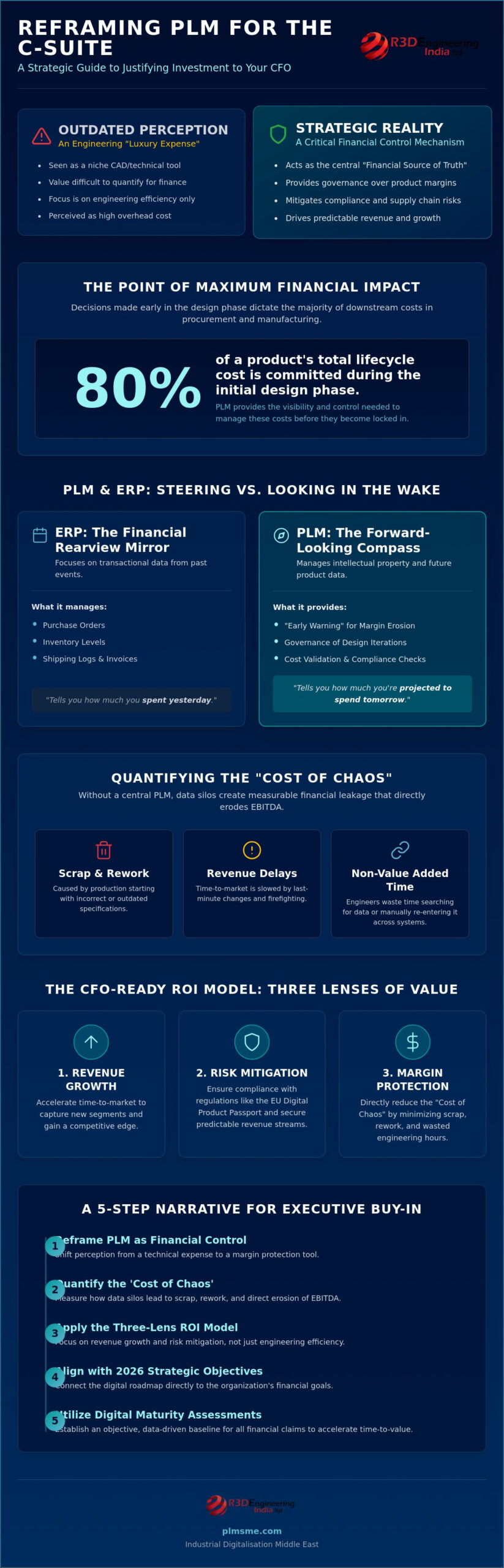
CFOs traditionally categorize Product Lifecycle Management software as a technical overhead, often grouping it with high-end workstations or specialized CAD tools. This perception stems from a historical focus on engineering efficiency rather than enterprise value. However, in the 2026 economic environment, this view is a strategic liability. Modern Product Lifecycle Management (PLM) systems serve as the financial source of truth for product costs long before a single component reaches the factory floor. When justifying PLM investment to CFO leaders, the conversation must shift from “faster design” to “governed margins.”
Industry data consistently shows that roughly 80% of a product’s total cost is committed during the initial design phase. While the actual spend occurs later in procurement and manufacturing, the decisions that dictate those costs are made early in the development cycle. Without a robust PLM framework, these costs are essentially unmonitored. A “metered” PLM process ensures that every design choice is validated against cost targets, material availability, and regulatory requirements, transforming product development from a black box into a transparent financial pipeline.
Addressing the “Open Tap” Problem in Product Development
Uncontrolled product development operates like an open tap, where orphaned data and unmanaged revisions lead to significant budget creep. When engineers work in silos, they often specify components that haven’t been vetted for price or long-term availability. This lack of oversight forces manufacturing teams to scramble, leading to expensive last-minute changes or “firefighting” during production. By centralizing product data, you close the gap between design intent and financial reality. It’s about moving away from a culture of “design at any cost” toward a disciplined environment where every revision is tracked and every component choice is a calculated financial decision.
Moving Beyond ERP: Why Finance Needs PLM Data
A common misconception in the C-suite is that an Enterprise Resource Planning (ERP) system can manage the entire product lifecycle. ERP is designed for transactional data; it handles purchase orders, inventory levels, and shipping logs. It doesn’t, however, manage the intellectual property or the complex iterations that occur before a product is ready for production. Justifying PLM investment to CFO stakeholders requires demonstrating that PLM provides the “early warning” for margin erosion. While ERP tells you how much you spent yesterday, PLM tells you how much you’re projected to spend tomorrow. Relying on ERP alone for product governance is like trying to steer a ship by looking at the wake it leaves behind. You need the forward-looking visibility that only a dedicated PLM architecture provides.
Quantifying the ‘Cost of Chaos’: Identifying Hidden Margin Erosion
When justifying PLM investment to CFO executives, you must address the “Cost of Chaos” as a measurable financial leakage. This isn’t a vague technical friction; it’s the measurable gap between your planned product margins and the actual EBITDA realized at the end of the quarter. Poor data management leads to direct hits in the form of scrap, rework, and warranty claims. According to CIMdata PLM research, companies without centralized product data often spend significant portions of their budget on Non-Value Added (NVA) activities. These are tasks like searching for correct revisions or manually re-entering data into multiple systems, which provide zero value to the end customer.
Reducing NVA time doesn’t just lower operational costs. It accelerates Time-to-Market (TTM). In 2026, being first to market with a compliant product is the difference between capturing a new segment and fighting for leftovers. Accurate PLM data ensures that production starts with the right specifications every time, preventing the revenue delays that occur when errors are caught too late in the cycle. This level of precision is exactly what’s required for justifying PLM investment to CFO leaders who prioritize predictable revenue streams.
Calculating the Financial Leakage of Rework
Inventory Carry Costs and Part Reuse
PLM serves as a primary defense against part proliferation. When engineers can’t easily find existing components, they create new ones. This adds unnecessary complexity to the warehouse and increases inventory carry costs. Reusing a single part structure instead of creating a new one can save thousands in administrative overhead and tooling costs. By consolidating parts, you also improve purchasing power and allow for vendor consolidation, which directly lowers the Cost of Goods Sold (COGS). Understanding your current baseline is the first step, which is why a digital maturity assessment is essential for mapping these leaks before they impact your bottom line.
Calculating the Real ROI: Moving Beyond Engineering Efficiency
To secure executive approval, you must present a case that speaks the language of Net Present Value (NPV) and Internal Rate of Return (IRR). CFOs don’t invest in software to make engineers happy; they invest to drive enterprise value. A robust framework for justifying PLM investment to CFO leaders relies on a “Three-Lens” ROI model. This model categorizes returns into cost reduction, revenue growth, and risk mitigation. By moving beyond simple “time savings,” you translate technical capabilities into hard currency that appears on the balance sheet.
A comprehensive business case requires a granular breakdown of the Total Cost of Ownership (TCO). This calculation must go beyond the monthly subscription fees, which typically range from $80 to $150 per user in the current market. You must account for implementation, data migration, and ongoing system administration retainers. In the 2026 manufacturing sector, Teamcenter implementation ROI benchmarks show that companies utilizing modern “Active Workspace” workflows often see a return on investment within 18 to 24 months. This is achieved by converting soft benefits, like “better collaboration,” into measurable reductions in engineering change cycle times and project hour allocations.
Hard Savings vs. Strategic Value
Direct cost savings are easiest to quantify, such as the consolidation of legacy IT silos into a single platform. However, the strategic value of AI readiness is becoming the dominant factor in 2026. PLM provides the structured data foundation required for industrial AI and machine learning applications. Without this foundation, AI investments will fail due to poor data quality. You should also emphasize “Revenue Pull-forward.” If a PLM-driven process accelerates time-to-market by just three months, you capture three additional months of market share and revenue. Engaging with specialized Siemens Teamcenter consulting can significantly shorten this implementation window, accelerating your path to positive cash flow.
The Risk Argument: The Cost of Doing Nothing
Risk mitigation is often the most persuasive lens for a CFO. Product recalls and compliance failures are catastrophic to EBITDA. With the EU Digital Product Passport (DPP) regulations becoming mandatory for batteries in February 2027 and textiles in January 2027, the window for manual data management is closing. Companies that haven’t digitized their product record by late 2026 face the real risk of being barred from European markets. In high-growth regions like the UAE, digital laggards are quickly losing their competitive edge to agile, tech-enabled firms. Position PLM as a necessary insurance policy that protects your company’s intellectual property and ensures long-term market access.
Constructing the CFO-Ready Business Case: A 5-Step Narrative
Securing executive approval for a digital transformation project requires more than a list of features. It demands a narrative that moves logically from corporate risk to measurable reward. When justifying PLM investment to CFO stakeholders, your proposal should follow a structured five-step progression that mirrors the company’s capital allocation process. This approach ensures that the investment is viewed as a strategic necessity rather than a discretionary technical upgrade.
- Step 1: Aligning with 2026 Strategic Financial Goals. Start by connecting the PLM vision to the organization’s high-level objectives, such as margin protection in volatile markets or meeting the 2027 EU Digital Product Passport deadlines.
- Step 2: Presenting the Digital Maturity Gap. Use objective data to highlight the delta between your current operational state and the digital maturity required to remain competitive. This identifies exactly where “The Cost of Chaos” is eroding profits.
- Step 3: Detailing the Phased Roadmap. Outline a deployment strategy that breaks the project into manageable stages. This reduces upfront risk and allows the organization to realize value incrementally rather than waiting for a “big bang” release.
- Step 4: Showing Clarity of Spend. Provide a transparent Total Cost of Ownership (TCO) that includes software, end-to-end PLM implementation, and long-term administration retainers to ensure no hidden costs emerge later.
- Step 5: Defining Success Metrics. Establish the specific financial KPIs that the finance team will track, such as reductions in scrap rates, warranty claims, or engineering change cycle times.
Translating Technical Milestones into Financial Gates
A “Pilot-to-Scale” approach is essential for minimizing capital expenditure risk. By structuring the project around financial gates, you provide the CFO with control over the investment at every critical juncture. A Financial Gate is a project milestone tied to a measurable ROI. This ensures that each phase of the implementation must prove its value before the next tranche of funding is released. This methodology builds trust through transparency and demonstrates a commitment to fiscal responsibility.
The “One Slide” Summary for Executives
Executives don’t have the time to digest fifty-page technical specifications. Your business case needs a high-level “Executive Dashboard” view that summarizes the strategic benefits on a single slide. Highlight how a professional PLM system architecture reduces technical debt by replacing fragmented legacy tools with a unified digital thread. Emphasize that your strategy is built on objective, vendor-independent advice focused solely on your company’s long-term vision. To begin defining this narrative for your organization, consider starting with Digitalisation Vision & Roadmap Consulting to establish a baseline for your business case.
Accelerating Time-to-Value with Digital Maturity Assessments
CFOs prioritize certainty over technical potential. When justifying PLM investment to CFO leaders, a Digital Maturity Assessment serves as an essential risk-mitigation tool. It replaces speculative benefits with an empirical audit of your existing processes. By quantifying the current state of data fragmentation and process inefficiency, you provide the finance team with a reliable starting point for all subsequent ROI calculations. This objective approach positions the project as a structured business improvement rather than a discretionary technical expenditure.
A comprehensive assessment uncovers the hidden friction points that erode EBITDA, such as:
- Inconsistent data handovers between engineering and manufacturing teams.
- Lack of visibility into material compliance for upcoming 2027 EU Digital Product Passport deadlines.
- Redundant software costs caused by overlapping legacy systems.
- High rates of non-value-added time spent on manual data entry and revision searching.
Establishing the Baseline for Digital Transformation
A professional digital maturity report identifies the specific gaps in your current architecture that prevent you from reaching your financial targets. It maps your current capabilities against industry standards, allowing you to link an industrial digitalization roadmap directly to corporate CAPEX planning. This level of visibility is vital for the finance team. It reduces the “Anxiety of the Unknown” by showing exactly where capital will be deployed and which specific inefficiencies will be eliminated first. Instead of a vague promise of digital transformation, you present a surgical plan for margin recovery and long-term stability.
Securing the Future: PLM as the Foundation for AI
Looking toward the 2026 economic landscape, the conversation around justifying PLM investment to CFO stakeholders must include AI readiness. Artificial intelligence requires structured, high-quality data to deliver actionable insights. Without the digital thread established by PLM, AI applications in the factory remain disconnected and underperform. A strategic AI roadmap for manufacturing relies on the single source of truth that only a robust PLM system can provide. By investing in the foundation now, you ensure that future automation and AI initiatives don’t require expensive, retrospective data cleaning projects that drain resources.
PLM-Sme FZC functions as your independent thinking partner throughout this process. We provide the technical expertise and objective oversight needed to build a business case that survives rigorous financial scrutiny. Our assessments ensure your roadmap is tailored to your specific industrial challenges, avoiding the pitfalls of one-size-fits-all software deployments. To secure the baseline data your CFO requires for approval, you can start your justification with a professional Digital Maturity Assessment today.
Securing Your Competitive Advantage in the 2026 Industrial Landscape
The transition from fragmented product management to a unified digital thread is no longer a technical choice; it’s a financial necessity. By justifying PLM investment to CFO leaders through the lens of risk mitigation and margin protection, you transform a software purchase into a strategic pillar of enterprise value. You’ve seen how quantifying the cost of chaos and aligning implementation with financial gates provides the transparency that executive teams demand. This structured approach ensures that product data becomes a governed asset that fuels AI readiness and maintains compliance in a shifting regulatory environment.
As a Siemens Digital Industries Alliance Partner, we specialize in Siemens Teamcenter implementation and maintain deep expertise in UAE industrial digitalization. We function as a collaborative thinking partner to help you navigate complex technical transitions with clarity and precision. Establishing an objective baseline is the most effective way to build trust with your finance team and accelerate your time-to-value. Request a Digital Maturity Assessment to build your business case and take the first step toward a more resilient, data-driven future. Your path to sustainable growth begins with a clear vision and a roadmap grounded in financial reality.
Frequently Asked Questions
How is PLM different from ERP for a CFO?
ERP systems focus on transactional data, managing what has already happened in terms of inventory, orders, and logistics. PLM manages the intellectual property and product definitions that dictate what will happen. While ERP handles the cost of goods sold (COGS) once production begins, PLM governs the design decisions that commit the vast majority of those costs. Justifying PLM investment to CFO leaders requires clarifying that PLM provides the forward-looking visibility that ERP lacks.
What is the typical payback period for a Siemens Teamcenter investment?
Most organizations achieve a full return on investment within 18 to 24 months when utilizing modern Active Workspace workflows. This timeline is typically driven by measurable reductions in engineering change cycle times and the elimination of scrap caused by data errors. By establishing a single source of truth, companies can significantly lower their non-value-added time, leading to a faster path toward positive cash flow and improved project profitability.
Can we implement PLM in phases to manage cash flow?
Yes, a phased “Pilot-to-Scale” approach is the standard methodology for managing capital expenditure and reducing upfront risk. This allows the organization to fund the project through financial gates, where each subsequent phase is only released after the previous milestone demonstrates tangible value. This structured progression ensures that the investment remains aligned with the company’s liquidity while proving ROI at every critical juncture of the implementation.
What are the biggest hidden costs in a PLM implementation?
Data migration and user training are the most frequently underestimated expenses in a standard PLM budget. Beyond software subscription fees, organizations must account for the time required to clean legacy data and the ongoing need for system administration retainers. Ensuring the platform remains optimized as the business scales requires a dedicated support structure that many firms fail to include in their initial Total Cost of Ownership calculations.
How does PLM impact the company’s bottom line (EBITDA)?
PLM directly improves EBITDA by reducing the “Cost of Chaos,” which includes scrap, rework, and warranty claims. By ensuring data accuracy from the start, companies avoid the margin erosion that occurs when design errors reach the manufacturing floor or the end customer. Additionally, PLM accelerates time-to-market, allowing the business to capture revenue sooner and gain a competitive edge that translates into higher top-line growth and improved operating margins.
Why do we need a consultant instead of going directly to the software vendor?
A neutral consultant provides objective, vendor-independent advice that focuses on your specific business goals rather than software sales targets. This independence is crucial when justifying PLM investment to CFO stakeholders, as it ensures the solution architecture is tailored to your actual digital maturity. We act as a thinking partner to ensure the implementation delivers high-level strategic vision alongside the grounded, practical execution required for long-term success.
What happens if we delay our PLM investment until 2027?
Delaying until 2027 creates a significant regulatory risk due to the EU Digital Product Passport (DPP) deadlines. With mandatory requirements for batteries starting in February 2027 and textiles in January 2027, companies without a digital thread in place by late 2026 may face market access restrictions. This delay also hinders your ability to build the data foundation required for AI-driven growth and industrial automation initiatives in the competitive GCC market.
How does PLM support our ESG and sustainability reporting goals?
PLM provides the structured data foundation required to track material composition, carbon footprints, and repairability metrics across the entire product lifecycle. This granular visibility is essential for accurate ESG reporting and meeting circular economy regulations that demand transparency from design to disposal. By capturing this data at the source, your organization can provide the verified reports that investors and regulators now require for sustainable business operations.