
Teamcenter MOM Integration: Architecting the Digital Thread for Manufacturing Excellence
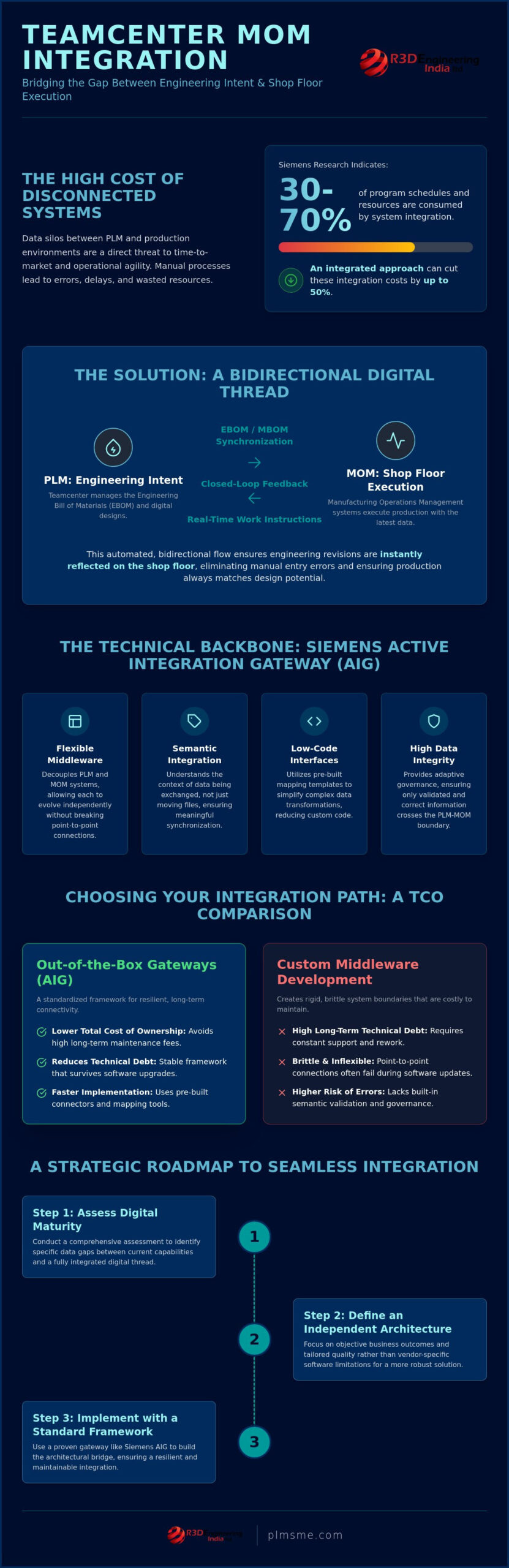
Siemens research indicates that system integration can consume between 30% and 70% of program schedules and resources. Even with the release of Teamcenter 2606, many manufacturers struggle to bridge the persistent gap between engineering intent and shop floor execution. Achieving a robust Teamcenter MOM integration isn’t merely a software configuration task. It’s the fundamental architectural bridge required to convert digital designs into physical reality without the friction of manual data entry or version errors.
You likely recognize that data silos between your PLM and production environments are more than just a technical nuisance; they’re a direct threat to your time-to-market and operational agility. This article provides a technical analysis of how to architect a seamless digital thread using the Siemens Active Integration Gateway. We’ll explore the strategic methodologies for synchronizing engineering revisions with real-time manufacturing operations, ensuring your production performance finally matches your design potential.
Key Takeaways
- Establishing a bidirectional digital thread ensures engineering revisions are instantly visible on the shop floor, so you don’t have to worry about manual data entry errors.
- Using the Siemens Active Integration Gateway (AIG) provides a standard framework for semantic connectivity without creating rigid, brittle system boundaries.
- Comparing the total cost of ownership for out-of-the-box gateways versus custom middleware is essential to avoid long-term technical debt and high maintenance costs.
- A successful Teamcenter MOM integration starts with a digital maturity assessment to identify specific data gaps within your production environment.
- Adopting an independent architectural approach allows you to focus on objective business outcomes and tailored quality rather than vendor-specific software limitations.
Understanding Teamcenter MOM Integration in the Modern Digital Thread
Teamcenter MOM integration represents the bidirectional exchange of product data between Product Lifecycle Management (PLM) and Manufacturing Operations Management (MOM). It isn’t just a simple data synchronization; it’s a strategic architectural bridge. By automating the flow of information between these two critical environments, businesses can reduce the time spent on manual data entry and minimize the risk of costly production errors. It’s the foundation of a truly responsive manufacturing environment.
The digital thread ensures that engineering revisions are instantly reflected on the shop floor. For many discrete manufacturers, the process still relies on manual file transfers or paper based instructions. These methods are slow and prone to version control issues. Automated synchronization removes these bottlenecks, ensuring that the shop floor always works with the latest engineering intent. It’s about moving from a state of reactive troubleshooting to proactive execution.
Data from Siemens suggests that system integration can consume between 30% and 70% of program schedules. However, an integrated approach can cut these costs by 50%. By implementing a robust Teamcenter MOM integration, manufacturers significantly reduce non-conformance costs. When production delays are minimized and scrap rates drop because the correct revision was used, the return on investment becomes clear. It’s a fundamental shift in how manufacturing quality is managed.
The Core Components of MOM Integration
Successful integration focuses on the alignment of the Engineering Bill of Materials (EBOM) with the Manufacturing Bill of Materials (MBOM). This alignment ensures that the physical product matches the digital design. Work instructions are delivered directly to the shop floor through Active Workspace, providing operators with real-time guidance. A closed-loop feedback system then feeds manufacturing performance data back into the PLM environment. This allows engineers to see how their designs perform in real-world conditions and make data-driven improvements for future iterations.
Why UAE Manufacturers are Prioritising Integration in 2026
Industrial digitalization has become a core competitive advantage within the UAE national market. By July 2026, aligning with global Industry 4.0 standards is no longer optional for those seeking to remain relevant. Many organizations are moving away from legacy systems to improve their operational agility. Conducting a digital maturity report for manufacturing is often the first step in identifying the gaps between current capabilities and a fully integrated digital thread. This strategic roadmap helps businesses transition from fragmented silos to a unified, high-performance manufacturing ecosystem.
Technical Architecture: The Role of Active Integration Gateway (AIG)
The Siemens Active Integration Gateway (AIG) serves as the technical backbone for a resilient Teamcenter MOM integration. It functions as a flexible middleware layer that decouples the PLM system from the production floor, allowing each to evolve independently. By adhering to Digital Thread for Manufacturing standards, AIG ensures that data remains consistent across the entire product lifecycle. This architecture moves away from brittle, point-to-point connections that often fail during software upgrades. It provides a stable environment where data governance is baked into the connection itself, rather than being an afterthought.
AIG facilitates semantic integration, meaning it understands the context of the data being exchanged rather than just moving raw files. This is achieved through low-code interfaces that simplify complex data transformations. Instead of writing thousands of lines of custom code, architects use pre-built mapping templates to define how engineering attributes map to manufacturing parameters. Maintaining a clean Teamcenter MOM integration requires this level of semantic awareness to prevent data corruption. This approach maintains high data integrity and provides adaptive governance, ensuring only validated information crosses the PLM-MOM boundary. It’s a cleaner way to manage the inherent complexity of modern industrial software.
T4EA and the Semantic Integration Framework
T4EA (Teamcenter Gateway for Enterprise Applications) acts as the primary translator within the AIG suite. It converts Teamcenter objects into formats that manufacturing systems can ingest. This is vital for managing change processes effectively. When an engineering change notice is released, T4EA triggers automated workflows that update manufacturing plans in real time. It’s a robust connectivity engine that supports future software releases, including the latest Teamcenter 2606 updates, without requiring a complete rebuild of the integration logic. This future-proofing is a key advantage for long-term digital strategies.
Optimising Data Flow for Shop Floor Connectivity
Achieving real-time synchronization of work orders and resource management data requires a high-availability integration layer. This ensures that if one system experiences downtime, the data queue remains intact and synchronization resumes automatically once connectivity is restored. Integrating PLM with Teamcenter MES integration allows for granular control over production events. This level of connectivity is essential for tracking as-built configurations against as-designed specifications accurately. If you’re struggling to map these complex data flows, our specialists in System and Solution Architecture can help design a framework tailored to your specific production environment.
Comparative Analysis: OOTB Gateways vs. Custom Integration Development
Choosing the right architecture for Teamcenter MOM integration requires a careful balance between immediate deployment speed and long term maintenance costs. While bespoke middleware often appears cost effective during the initial development phase, the total cost of ownership (TCO) typically favors standardized solutions like Siemens AIG. Custom scripts lack the institutional support of a global software vendor; they require dedicated internal resources to manage every patch, update, or system migration. This internal burden often outweighs the initial savings of avoiding licensing fees.
Technical debt is a significant risk when using custom coded integration scripts. As systems like Teamcenter evolve, bespoke connections often break, leading to production downtime. The latest Teamcenter 2606 release, for example, introduces updates that might not be compatible with older, custom written middleware. Vendor supported gateways provide a layer of abstraction that protects your production data flow from these underlying software changes. This ensures that your digital thread remains intact even as your software stack matures.
Scalability is another critical factor. By July 2026, the volume of data moving across the manufacturing floor will likely increase due to AI driven operations and advanced sensor networks. Standard gateways are engineered to handle these high data volumes and complex transformations. Bespoke solutions might struggle to maintain performance without constant, expensive refactoring. Standardized gateways often win the long term battle because they offer a clear upgrade path and predictable support cycles.
When to Choose Siemens Active Integration
Standardized workflows are ideal for Siemens Active Integration. If your requirements align with 80% of the gateway’s native capabilities, the remaining 20% can usually be handled through configuration rather than coding. This is the preferred route for firms looking to build a business case for PLM integration based on rapid deployment and reduced risk. It ensures tight alignment with the broader Siemens Digital Industries ecosystem and simplifies future software migrations.
The Case for Bespoke Integration Development
There are instances where bespoke integration development is unavoidable. Legacy MOM systems often lack standard API connectors, making an out of the box solution impossible without significant workarounds. Highly specialized manufacturing processes might also require unique data mappings that fall outside standard templates. In these cases, leveraging an independent consultant helps architect a hybrid approach. This strategy combines the stability of standardized gateways with targeted, custom extensions for specific legacy requirements, ensuring tailored quality without sacrificing system reliability.
Strategic Roadmap: Implementing Teamcenter MOM Integration
Executing a successful Teamcenter MOM integration requires more than technical installation; it demands a structured, phased approach that aligns engineering capabilities with manufacturing realities. A methodical rollout prevents the common “big bang” failures that often occur when organizations attempt to synchronize complex data silos without adequate preparation. This roadmap provides a clear trajectory from initial assessment to sustained operational excellence.
Step 1: Begin by conducting a digital maturity report for manufacturing. This assessment identifies existing integration gaps and determines if your current data structures can support a bidirectional thread. Step 2: Define a clear “Digital Vision” that outlines the technical requirements for your PLM-MOM bridge. This includes identifying which specific attributes must flow between systems to provide the most value. Step 3: Select the appropriate architecture, whether utilizing the Siemens Active Integration Gateway (AIG), T4EA, or a hybrid custom solution for legacy systems. Step 4: Pilot the integration on a single production line. This allows you to validate data accuracy and refine mapping logic in a controlled environment before scaling. Step 5: Move to full-scale deployment, supported by ongoing PLM system architecture consulting to ensure the framework adapts as your production needs evolve.
Avoiding Common Pitfalls in MOM Integration
Many manufacturers underestimate the complexity of data cleaning before migration. Attempting to integrate “dirty” data only accelerates the spread of errors across the shop floor. Another frequent oversight is ignoring the human element. Training shop floor staff on new digital workflows is essential for adoption; even the most sophisticated Teamcenter MOM integration will fail if operators don’t trust the digital work instructions. Adhering to PLM integration best practices during the design phase ensures that these organizational and technical hurdles are addressed early in the project lifecycle.
Measuring Success: KPIs for Integrated Manufacturing
Quantifying the impact of your integration is vital for long-term support. Key performance indicators should include a measurable reduction in engineering change order (ECO) cycle time, as automated synchronization eliminates manual processing delays. You should also see a marked improvement in first-pass yield (FPY) because operators are always working from the most recent, accurate engineering revisions. The return on investment for MOM integration is fundamentally defined by the cumulative cost savings achieved through a sustained reduction in scrap rates and material waste. If you’re ready to define your own path toward manufacturing excellence, our team provides expert End-to-End PLM Implementation Support to guide your transition.
The PLM-Sme Approach to Teamcenter MOM Integration
Partnering with an independent consultancy provides an objective perspective that vendor-led projects often lack. While software vendors naturally focus on license quotas and their own product ecosystem, we prioritize the long-term health of your industrial architecture. Our approach to Teamcenter MOM integration centers on creating a neutral, high-performance environment where data flows seamlessly without being tied to a single vendor’s rigid constraints. This independence allows us to offer bespoke advice that truly aligns with your specific operational requirements.
We focus on providing end-to-end PLM implementation support, moving beyond basic configuration to deliver specialized integration development. Our team acts as a thinking partner, engaging deeply with your engineering and manufacturing stakeholders to ensure the digital thread is functional on the shop floor. By utilizing our digital maturity assessments, we help organizations build a data foundation that supports a 10-year AI roadmap. With the July 2026 release of Teamcenter 2606 emphasizing AI-powered workflows and Copilot features, having a clean, integrated data stream is a prerequisite for competitive survival.
Ongoing performance is maintained through our PLM system administration retainer. We don’t believe in “set it and forget it” implementations. Manufacturing environments are dynamic; your integration layer must adapt to new product lines, updated software versions, and shifting production goals. Our retainer services provide the continuous oversight and technical refinement necessary to prevent technical debt from accumulating as your digital ecosystem matures. It’s a steady, reliable way to manage the inherent complexity of modern industrial software.
Bridging the Gap Between Vision and Execution
We collaborate closely with your teams to align IT architecture with manufacturing goals. Our specialized Teamcenter integration development is tailored to your unique industrial needs, ensuring that your Siemens Teamcenter consulting leads to tangible shop floor results. We focus on converting high-level strategic vision into grounded, practical execution that operators can rely on every day.
Secure Your Digital Future
Ready to architect your digital thread and eliminate the friction between design and delivery? Contact PLM-Sme for a strategic assessment to identify your current maturity level and integration gaps. You can also explore our industrial automation solutions in the GCC to see how we’re helping regional manufacturers navigate the complexities of Industry 4.0. Positioning your business for AI readiness starts with an integrated data foundation that connects every stage of the product lifecycle.
Securing Your Digital Thread for Future Scalability
Establishing a resilient digital thread requires moving beyond fragmented data silos toward a unified, bidirectional information flow. By leveraging the Siemens Active Integration Gateway, your organization ensures that engineering intent translates directly into shop floor performance with semantic precision. A successful Teamcenter MOM integration isn’t just a software configuration; it’s a strategic architectural foundation that supports long term agility and AI readiness. This structure allows your production environment to adapt as technology evolves, protecting your investment from technical debt.
PLM-Sme functions as a Siemens Digital Industries Alliance Partner with deep expertise in complex Teamcenter system architecture. We provide the independent objectivity required to develop industrial roadmaps that actually work in practice. Our team’s ready to help you bridge the gap between design and delivery with tailored, high quality solutions. You can take the first step toward transforming your production performance today.
Book a Strategic Digital Maturity Assessment
Frequently Asked Questions
What is the difference between MES and MOM in the context of Teamcenter?
Manufacturing Operations Management (MOM) is the comprehensive architectural framework that includes various components like quality management, planning, and execution. Manufacturing Execution Systems (MES) represent the specific sub-layer focused on the real-time delivery and tracking of work on the shop floor. Within a Teamcenter MOM integration, the MOM suite provides the overarching digital thread that connects engineering intent to these granular execution tasks.
How long does a typical Teamcenter MOM integration project take?
A typical project duration ranges from four to twelve months, depending on the complexity of your existing data and the number of production lines involved. The initial pilot phase usually lasts eight to twelve weeks to validate data mappings and connectivity. Following a successful pilot, a phased rollout ensures that staff can adapt to new digital workflows without disrupting ongoing production schedules.
Can Teamcenter integrate with non-Siemens MOM or MES systems?
Yes, Teamcenter utilizes the Active Integration Gateway (AIG) and T4EA to connect with third party MOM or MES platforms. These tools use standardized API connectors and XML based data exchange to facilitate communication with non-Siemens systems. This capability is vital for manufacturers who maintain a heterogeneous software landscape but still require a unified digital thread between PLM and production.
What are the hardware requirements for Siemens Active Integration Gateway?
How does MOM integration support the creation of a Digital Twin?
Integration supports the Digital Twin by providing the real-time “as-built” data needed to mirror the “as-designed” digital model. This bidirectional flow allows the digital twin to reflect actual manufacturing performance, enabling predictive maintenance and virtual commissioning. It creates a continuous loop where shop floor data informs future engineering cycles, ensuring the digital representation stays synchronized with physical reality.
What is the role of T4EA in Teamcenter MOM integration?
T4EA acts as the semantic translator that maps Teamcenter objects to specific manufacturing parameters used by shop floor systems. It automates the transfer of Bills of Materials (BOM) and engineering change notices across the PLM-MOM boundary. By ensuring that engineering data is correctly interpreted by manufacturing software, T4EA reduces the risk of version errors and manual data entry mistakes.
Is a digital maturity assessment necessary before starting an integration project?
A digital maturity assessment is a prerequisite for identifying technical gaps and ensuring the project supports your long term vision. It prevents organizations from automating inefficient processes and helps define a realistic roadmap for implementation. Starting without this assessment often leads to project delays and unforeseen technical hurdles that can significantly increase the total cost of ownership.
How do I calculate the ROI of Teamcenter MOM integration for my facility?
ROI is calculated by measuring the reduction in scrap rates, engineering change cycle times, and manual labor costs. Siemens data suggests that an integrated approach can cut integration related costs by 50% compared to fragmented systems. You should also account for the cumulative savings from improved first pass yield and reduced non-conformance costs when evaluating the financial impact of a Teamcenter MOM integration.