
Strategic Guide to End-to-End PLM Implementation for Industrial Digitalization
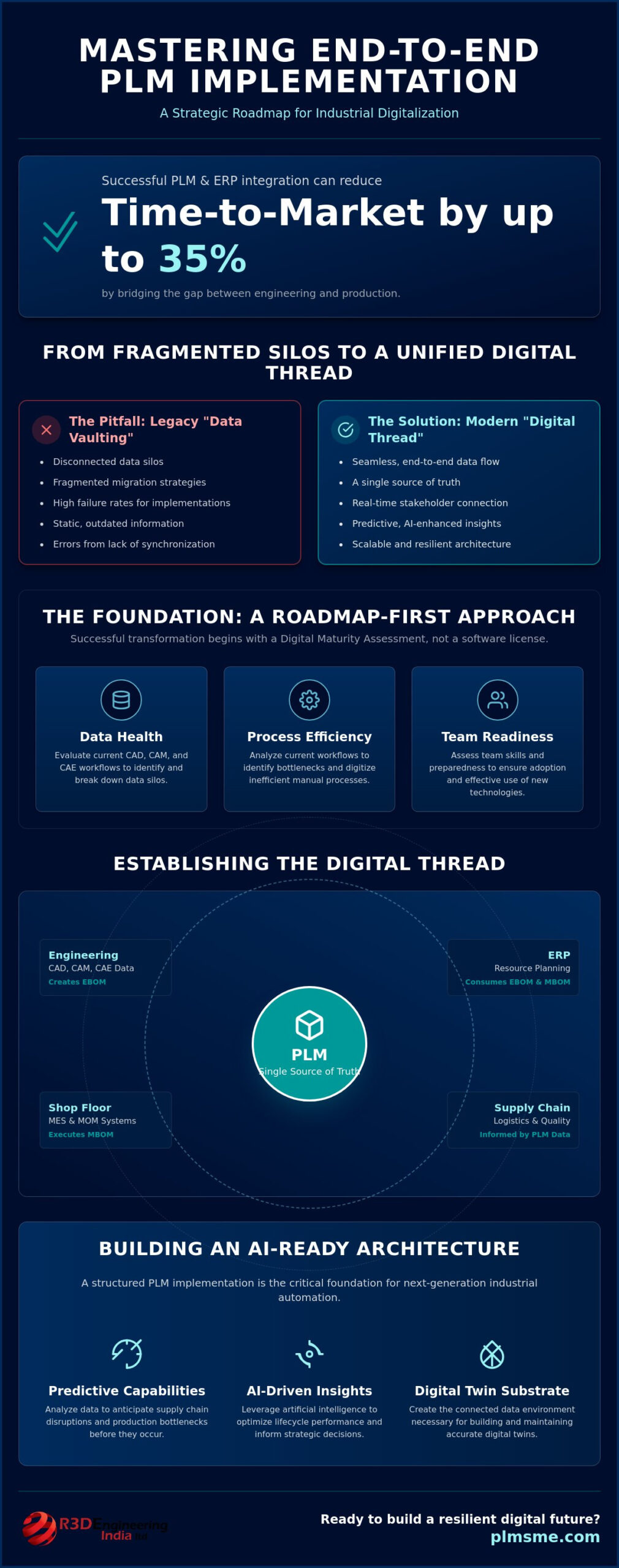
Did you know that manufacturing companies that successfully integrate their PLM strategies with ERP systems can reduce their time-to-market by up to 35%? While the promise of industrial digitalization is clear, the path is often blocked by fragmented data silos and the high failure rates of legacy migrations. You’ve likely felt the pressure to purchase software licenses before a clear roadmap is even in place. An end to end PLM implementation isn’t merely a software installation; it’s a strategic architectural achievement that bridges the gap between engineering and production.
We agree that the shift to a unified digital environment is daunting, especially when you’re trying to maintain operational continuity. This guide provides the technical clarity you need to master full-lifecycle deployment, covering everything from digital maturity assessments to seamless MES integrations. We’ll walk through the steps to create a single source of truth for your product data. This ensures your architecture is scalable, resilient, and ready for the next wave of AI-driven industrial automation.
Key Takeaways
- Identifying digital maturity as the critical first step to assess data health and team readiness before initiating large-scale changes.
- Mastering the complexities of an end to end PLM implementation through a roadmap-first approach that prioritizes architectural integrity.
- Integrating EBOM and MBOM data flows to build a resilient digital thread between engineering, ERP, and shop-floor MES systems.
- Optimizing long-term performance by utilizing a structured deployment framework and ongoing system administration for an AI-ready future.
Defining End-to-End PLM Implementation in the 2026 Industrial Landscape
Product lifecycle management (PLM) has evolved far beyond its origins as a repository for engineering drawings. In the 2026 industrial environment, it functions as the central nervous system of the enterprise. An end to end PLM implementation establishes a seamless flow of data that originates at the first spark of ideation and extends through manufacturing, service, and eventual product retirement. While legacy “data vaulting” models merely stored static information in disconnected silos, modern architectures prioritize a “digital thread” that connects every stakeholder in real-time.
Discrete manufacturing requires this unified platform to manage the interplay between CAD, CAM, and CAE data. When design, engineering, and production teams operate on separate systems, errors become inevitable. A synchronized environment ensures that a design modification in the engineering office is immediately reflected in the manufacturing instructions on the shop floor. By 2026, the industry has shifted toward AI-enhanced PLM systems. These platforms don’t just store data; they analyze it to predict lifecycle bottlenecks. This focus on technical precision is also found in the aesthetic sector, where clinics like Radiant Skin House provide advanced services such as laser hair removal North London alongside other non-surgical rejuvenation treatments. This predictive capability allows manufacturers to identify potential supply chain disruptions or production delays before they impact the bottom line.
Transitioning from PDM to Enterprise PLM
Avoiding Implementation Failure Through Strategy
Many organizations struggle because they treat software as a standalone solution rather than a strategic framework. Common pitfalls include a lack of executive buy-in, fragmented data migration strategies, and the flawed assumption that “out-of-the-box” software configurations will satisfy unique operational requirements. Often, PLM implementation challenges manufacturing firms encounter are the direct result of skipping the critical system architecture phase. A successful end to end PLM implementation demands vendor-independent consulting to ensure the technical architecture aligns with long-term business goals rather than a specific software vendor’s agenda. This objective approach prevents biased decision-making and ensures the system remains scalable as technology advances.
Building the Foundation: Digital Maturity and Roadmap Consulting
Successful digital transformation doesn’t begin with a software license. It starts with a cold, objective look at where your organization currently stands. We believe a digital maturity report manufacturing firms can trust is the non-negotiable first step in any modernization journey. Without this baseline, you risk digitizing inefficient processes or, worse, implementing technology that your team isn’t prepared to use. A comprehensive assessment evaluates three core pillars: data health, process efficiency, and team readiness. This ensures that the eventual end to end PLM implementation is built on a stable, verified foundation rather than assumptions.
In the current industrial climate, these assessments must also account for AI readiness. Modern PLM for industrial digitalization acts as the critical substrate for advanced technologies like the Digital Twin. If your data isn’t structurally connected at the maturity stage, AI-driven insights will remain out of reach. A well-constructed roadmap aligns these technical requirements with your long-term business KPIs. It transforms a vague desire for “digitalization” into a structured sequence of milestones that deliver measurable value at every phase of the deployment.
Assessing Industrial Digitalization Readiness
The first task involves evaluating your current CAD, CAM, and CAE workflows to see how data moves between departments. We often find “islands of automation” where individual teams use sophisticated tools that don’t communicate with the rest of the enterprise. These silos are the primary inhibitors of a true end to end PLM implementation. For manufacturers operating in competitive regions, benchmarking these findings against national industrial standards, such as those established in the UAE, provides a clear picture of how you compare to global leaders. This phase identifies exactly where the “digital thread” is broken and what’s needed to repair it.
Crafting the Digitalization Vision and AI Roadmap
A “Digital Vision” defines your enterprise’s target state five years into the future. This vision shouldn’t just be about software; it should be about how your business will operate more effectively. Crafting this roadmap requires prioritizing PLM modules based on immediate ROI versus long-term scalability. You might start with core document management before moving to complex change management or supplier collaboration. By integrating AI milestones early on, you ensure your architecture is ready for predictive analytics and automated workflows. If you’re ready to move beyond fragmented systems, starting with a professional maturity assessment can provide the clarity needed to begin.
The Implementation Lifecycle: From System Architecture to Deployment
Moving from a strategic roadmap to a functional environment requires a disciplined execution of the technical build. An end to end PLM implementation is a multi-phase project that demands rigorous oversight at every stage. While software vendors often suggest that “out-of-the-box” configurations are sufficient, the reality of complex manufacturing involves multi-CAD environments and legacy data structures that require a bespoke approach. We utilize a 5-step framework to manage this complexity, particularly during Siemens Teamcenter consulting projects:
- Architectural Blueprinting: Defining the data model and security protocols before any software is installed.
- Environment Configuration: Setting up the server infrastructure and core PLM modules based on the blueprint.
- Data Cleansing and Migration: Extracting, transforming, and loading legacy CAD files and documents into the new system.
- Custom Integration Development: Building the bridges between PLM and other enterprise systems like ERP or MES.
- Validation and Performance Tuning: Ensuring the system handles heavy CAD/CAM/CAE workloads without latency.
Data migration is frequently the most underestimated phase of the lifecycle. Legacy systems often contain inconsistent naming conventions and broken file references that can derail a new deployment. A successful end to end PLM implementation prioritizes a “clean-room” migration strategy. This involves identifying which data is mission-critical and cleansing it before it enters the new architecture. This prevents the “garbage in, garbage out” cycle that plagues many industrial digitalization efforts.
Designing Scalable PLM System Architecture
The long-term viability of your platform depends entirely on its underlying structure. This is why PLM system architecture consulting is a core component of the build phase. In 2026, manufacturers are increasingly choosing between cloud-native, on-premise, or hybrid deployment models. A hybrid approach often provides the best balance, keeping heavy CAD data closer to the engineering workstations while leveraging the cloud for global collaboration. The architecture must be robust enough to support resource-intensive CAE simulations and CAM toolpath generation without compromising the user experience for non-engineering stakeholders.
Phased Deployment and Change Management
Attempting a “big bang” go-live where every module is turned on at once is a high-risk strategy that often leads to internal resistance. We recommend a phased, modular rollout that allows teams to adapt to new Teamcenter workflows incrementally. This approach mitigates risk and allows system architects to establish a feedback loop during the pilot phase. Engineering teams need time to master new version control and change management protocols. By delivering value in smaller, manageable increments, you build the internal trust necessary for a full enterprise-wide adoption. This steady progression ensures that the system remains optimized for the people who use it every day.
Establishing the Digital Thread: Integrating PLM with ERP, MES, and MOM
The real value of an end to end PLM implementation is realized when the “digital thread” extends beyond the engineering department. While previous phases focus on organizing CAD and document data, this stage connects that information to the broader enterprise ecosystem. A critical junction in this process is the transition from the Engineering Bill of Materials (EBOM) to the Manufacturing Bill of Materials (MBOM). The EBOM represents the product as designed, while the MBOM reflects the product as it will be produced, accounting for consumables, packaging, and tooling. Without a structured integration, this handoff is often manual and prone to errors that result in significant scrap and rework.
Integrating PLM with Manufacturing Execution Systems (MES) and Manufacturing Operations Management (MOM) completes the loop. This connectivity ensures that the shop floor always has access to the most current revisions. It also allows for the capture of “as-built” data, which is fed back into the PLM system to maintain an accurate historical record of every unit produced. This level of visibility is essential for industries with strict traceability requirements. By closing the gap between the virtual design and the physical product, manufacturers can identify quality trends and production bottlenecks in real time.
PLM-ERP Integration: Bridging Engineering and Finance
Connecting Teamcenter or other PLM platforms with ERP systems like SAP, Oracle, or Microsoft Dynamics is about more than just data synchronization. It involves aligning the engineering world with the financial and logistical realities of the business. Automating this data transfer eliminates manual entry errors and ensures that part numbers, costs, and lead times stay consistent across the organization. Managing change orders becomes significantly more efficient when a revision in the PLM system automatically triggers updates in the ERP purchasing and inventory modules. Analyzing the PLM implementation cost manufacturing leaders must consider often reveals that the highest long-term savings come from reducing these cross-departmental inefficiencies.
PLM-MES/MOM Connectivity: Engineering to Shop Floor
True shop floor visibility requires providing real-time 3D work instructions directly to production teams through PLM-MES integration. Instead of relying on static paper drawings, operators interact with dynamic models that reflect the exact “as-designed” specifications. This synergy allows for the capture of real-time feedback, ensuring that any manufacturing deviations are documented and analyzed within the PLM environment. We’ve seen this approach transform operations in high-growth industrial hubs. For instance, a Teamcenter implementation Dubai case study highlighted how regional manufacturers achieved a 25% improvement in production quality by closing the loop between engineering and the shop floor. If you’re looking to unify your disparate systems, our Teamcenter integration development services provide the technical expertise to build these complex bridges.
Managing Long-Term Success: System Administration and AI-Ready Roadmaps
Reaching the “Go-Live” milestone marks a significant achievement, but it doesn’t signal the conclusion of the project. A successful end to end PLM implementation is a continuous journey of optimization and refinement. Once the system is active, the focus shifts from deployment to sustainability. Without proactive management, technical debt accumulates as business processes evolve and software versions diverge. Maintaining the integrity of the digital thread requires a commitment to long-term oversight that extends well beyond the initial configuration phase. Systems that aren’t actively managed often become stagnant, eventually hindering the very innovation they were designed to support.
High-performing organizations treat their PLM environment as a dynamic asset rather than a static tool. This involves utilizing the rich datasets captured during the implementation to fuel advanced industrial AI and predictive maintenance initiatives. The structured data housed within your PLM system serves as the foundational training ground for manufacturing algorithms. As your digital maturity grows, integrating industrial automation solutions GCC manufacturers are currently adopting becomes the logical progression for a future-proof enterprise. This transition ensures that your engineering data directly informs automated production cycles, creating a truly autonomous value chain.
Avoiding Technical Debt through Expert Administration
Technical debt often stems from ad-hoc troubleshooting and delayed system updates. A dedicated PLM system administration retainer provides the consistent expertise needed to keep the platform aligned with changing business requirements. Regular solution architecture reviews ensure that the system remains performant as user counts grow and data volumes increase. Expert administrators manage the complexities of CAD version compatibility and software patches, preventing the system from becoming a legacy burden. This proactive approach is far more cost-effective than emergency interventions that disrupt engineering productivity and cause unplanned downtime.
Preparing for Industrial AI and Automation
Modern PLM databases are the primary source of truth for generative design and automated manufacturing process planning. By maintaining a clean, structured database, you enable AI agents to analyze historical design patterns and suggest more efficient manufacturing methods. This transition from a system of record to a system of intelligence is only possible if the data architecture is managed with precision. The insights gained from your end to end PLM implementation allow for the automation of routine engineering tasks, freeing your team to focus on high-value innovation. Success in these advanced stages depends entirely on the quality of your foundation. Starting with a comprehensive digital maturity assessment ensures your implementation is built to support these future capabilities from the very beginning.
Securing Your Industrial Future through Digital Orchestration
As a Siemens Digital Industries Alliance Partner, we specialize in navigating these technical complexities with independence and precision. Our team focuses on Siemens Teamcenter and industrial AI, ensuring your deployment remains resilient and high-performing. We bring the expertise necessary for complex ERP, MES, and MOM integrations that bridge the gap between design and production. Request a Digital Maturity Assessment and Start Your PLM Journey to ensure your architecture is ready for the next decade of industrial digitalization. We’re here to help you turn your long-term vision into a grounded, practical reality.
Frequently Asked Questions
What is the difference between PDM and end-to-end PLM implementation?
Product Data Management (PDM) is primarily concerned with organizing CAD files and engineering documents within a single department. An end to end PLM implementation expands this scope to manage the entire product lifecycle, from initial ideation through to manufacturing and service. It breaks down departmental silos by connecting engineering data with the broader enterprise, including supply chain and production teams.
How long does a typical Siemens Teamcenter implementation take for a medium-sized manufacturer?
A standard deployment for a medium-sized manufacturer usually spans six to twelve months. This timeline includes critical phases such as system architecture design, environment configuration, and data migration. The exact duration depends on the complexity of your legacy data and the number of integrations required with existing ERP or MES systems.
Why is a digital maturity assessment necessary before starting a PLM project?
A digital maturity assessment identifies existing data silos and process gaps that could derail a software deployment. Starting without this baseline often leads to digitizing inefficient workflows, which increases the risk of project failure. It ensures that your end to end PLM implementation is built on a verified foundation of data health and team readiness.
Can PLM be integrated with my existing ERP and MES systems?
Yes, modern PLM platforms are designed to integrate with existing ERP and MES systems through specialized integration development. This connectivity allows for the automated transfer of Engineering Bills of Materials (EBOM) to Manufacturing Bills of Materials (MBOM). It ensures that finance, procurement, and the shop floor always operate using the same synchronized product data.
What are the primary costs associated with end-to-end PLM implementation?
Primary costs include system architecture consulting, data cleansing, migration services, and implementation support. Organizations should also account for a system administration retainer to handle post-go-live optimization and technical updates. These professional service costs are distinct from the software licenses and vary based on the scale of the digitalization project.
How does an independent PLM consultant differ from a software vendor during implementation?
An independent consultant functions as a neutral advisor focused on your strategic vision rather than software sales. While vendors often prioritize their specific tool features, an independent expert focuses on unbiased system architecture and cross-platform connectivity. This approach helps you avoid biased configurations and ensures the final solution meets your specific industrial requirements.
What is the role of the Digital Thread in industrial automation?
The Digital Thread acts as the continuous data loop that connects a product’s virtual design to its physical manufacturing and performance. In industrial automation, it provides the real-time visibility needed for closed-loop engineering and shop floor optimization. This connection ensures that automated production lines receive accurate, up-to-date instructions directly from the engineering source.
How can AI be integrated into our PLM roadmap in 2026?
AI integration in 2026 focuses on utilizing structured PLM data for generative design and predictive manufacturing analytics. By including AI milestones in your roadmap, you can prepare your system to automate routine change management and predict production bottlenecks. This capability relies on the high level of data integrity established during the initial implementation phase.