
Teamcenter Implementation Dubai: A Strategic Case Study for UAE Industry
Treating a Siemens Teamcenter implementation Dubai project as a mere software installation is the primary reason why industrial digitalisation initiatives stall before they deliver value. For discrete manufacturers in the UAE, the real challenge isn’t just deploying a tool; it’s re-engineering the flow of data between engineering, the shop floor, and the boardroom. You’ve likely experienced the friction caused by fragmented data and the high cost of PLM deployments that fail to integrate with your existing ERP or CAD systems. Lack of internal expertise for complex solution architecture often leaves teams struggling to bridge these gaps.
We understand that building a reliable digital thread requires a sophisticated architectural strategy that addresses specific local requirements, from data sovereignty under the PDPL to mandatory emissions reporting under Federal Decree-Law No. 11 by the May 30, 2026, deadline. This case study demonstrates how a structured approach creates a single source of truth for your product data. You’ll discover how to achieve seamless integration across your enterprise and establish a future-proof AI roadmap. We’ll examine the technical methodologies that turn complex industrial challenges into manageable, scalable operational excellence.
Key Takeaways
- Learn why successful PLM requires a bespoke solution architecture that prioritizes the alignment of people and processes over generic, out-of-the-box templates.
- Understand the critical phases of a Teamcenter implementation Dubai, moving from technical discovery and roadmap alignment to the development of custom industrial workflows.
- Discover the technical methodologies for closing the “integration gap” between PLM, ERP, and MES systems to ensure a seamless digital thread from design to the shop floor.
- Explore how ongoing PLM administration and AI-driven roadmaps provide the continuous performance monitoring necessary to sustain long-term digital maturity.
Defining the Strategic Necessity of Teamcenter Implementation
A successful Teamcenter implementation Dubai project isn’t defined by the installation of software packages. It’s the deliberate alignment of people, processes, and technology within a unified digital thread. For many discrete manufacturers, the journey begins with a hard look at how data moves through the organisation. Transitioning from fragmented CAD data stored in isolated folders to a comprehensive Product Lifecycle Management (PLM) ecosystem is a fundamental shift in business logic. This transition ensures that every stakeholder, from design to delivery, works from the same set of validated information.
UAE-based manufacturers are increasingly prioritising this transition to meet national industrial excellence standards. As the region pushes for higher local production value, the ability to manage complex product data becomes a competitive necessity. Without a central repository, engineering changes often fail to reach the shop floor in real time, leading to costly rework and missed deadlines. Establishing a clear link between a digital maturity report manufacturing and the actual implementation ensures that the technical architecture supports long-term business goals rather than just solving immediate storage problems.
The Role of PLM in Industrial Digitalisation
PLM acts as the connective tissue of a modern factory. It breaks down the data silos that traditionally exist between engineering, procurement, and production. This integration is vital for the national shift toward AI-ready manufacturing environments. When data is structured and traceable, AI tools can effectively predict maintenance needs or optimise supply chains. Improved data traceability also reduces time-to-market by ensuring that compliance documentation is generated automatically throughout the product lifecycle. This creates a reliable foundation for scaling operations without increasing administrative overhead.
Assessing Readiness Before Deployment
Jumping into deployment without a thorough evaluation is a common mistake that leads to stalled projects. It’s essential to identify technical debt and data quality issues in legacy systems before migration. If your current data is messy, moving it to Teamcenter just creates a faster version of a broken process. A structured readiness phase includes:
- Evaluating the Digital Vision: Ensuring that the implementation roadmap aligns with the company’s five-year growth strategy.
- Identifying Data Gaps: Auditing current CAD and ERP data to ensure it’s clean enough for a high-performance PLM environment.
- Resource Planning: Determining if there’s enough internal Siemens Teamcenter expertise to support the new solution architecture.
An independent assessment prevents costly mid-project corrections. It ensures the environment is designed for where the company is going, not just where it’s been. This proactive approach turns a technical upgrade into a strategic asset that drives operational excellence.
Designing the Architecture: Beyond Out-of-the-Box PLM
Standard software templates rarely survive the complexities of a real-world engineering environment. For a Teamcenter implementation Dubai project to deliver genuine value, the architecture must be designed around the specific data schemas and workflows of the manufacturer. Relying on out-of-the-box configurations often leads to “process friction,” where engineers spend more time fighting the system than designing products. A bespoke solution architecture ensures that the software mirrors your physical reality, accommodating unique part numbering systems, multi-site collaboration needs, and specific CAD/CAM/CAE extensions.
Independent, vendor-neutral consulting plays a decisive role in this phase. It allows for an objective evaluation of which Siemens Teamcenter modules are essential and which are unnecessary for your current stage of maturity. This prevents “module bloat” and ensures that the core PLM framework is lean, performant, and ready to integrate with your existing technology stack. Engaging with a specialist for system and solution architecture ensures that your digital foundation is built to withstand the rigours of modern industrial scale. Understanding the full PLM implementation cost manufacturing leaders face — including hidden fees and total cost of ownership — is essential to making informed architectural decisions at this stage.
Just as manufacturers require specialized PLM tools, other niche sectors benefit from purpose-built digital platforms; for example, beauty and wellness professionals can check out Panema for management software designed to handle their specific client and clinical workflows.
Beyond software-specific configurations, the broader engineering context provided by a multidisciplinary firm like Global Engineering Office ensures that these digital systems are perfectly aligned with the physical and structural requirements of regional industrial projects.
Developing a Scalable System Architecture
A scalable architecture is one that maintains high performance even as the volume of managed data grows. Balancing speed with complex data management requirements is a technical challenge that directly impacts user adoption. If the system is slow, users will revert to offline workarounds. Professional PLM system architecture consulting focuses on creating a data model that is both robust and agile. This involves planning for future AI and machine learning integrations, such as Teamcenter Copilot, ensuring that your current data structure can support the predictive analytics and automated workflows that define Industry 4.0.
Data Migration and Integrity Strategies
The transition from file-based management to a database-driven ecosystem is the most sensitive part of any implementation. Mapping legacy data from disparate sources requires a methodical approach to ensure 100% data fidelity. Any loss of information during migration can compromise engineering safety and production accuracy. A structured migration strategy includes:
- Data Cleansing: Removing duplicates and correcting metadata before the move.
- Validation Protocols: Running automated and manual checks to verify that every attribute has transferred correctly.
By treating data migration as a strategic operation rather than a background task, manufacturers can maintain continuity and trust in the new system from day one. This meticulous focus on integrity prevents the technical debt that often leads to failed or stalled PLM deployments.
Navigating a Successful Teamcenter Implementation Journey
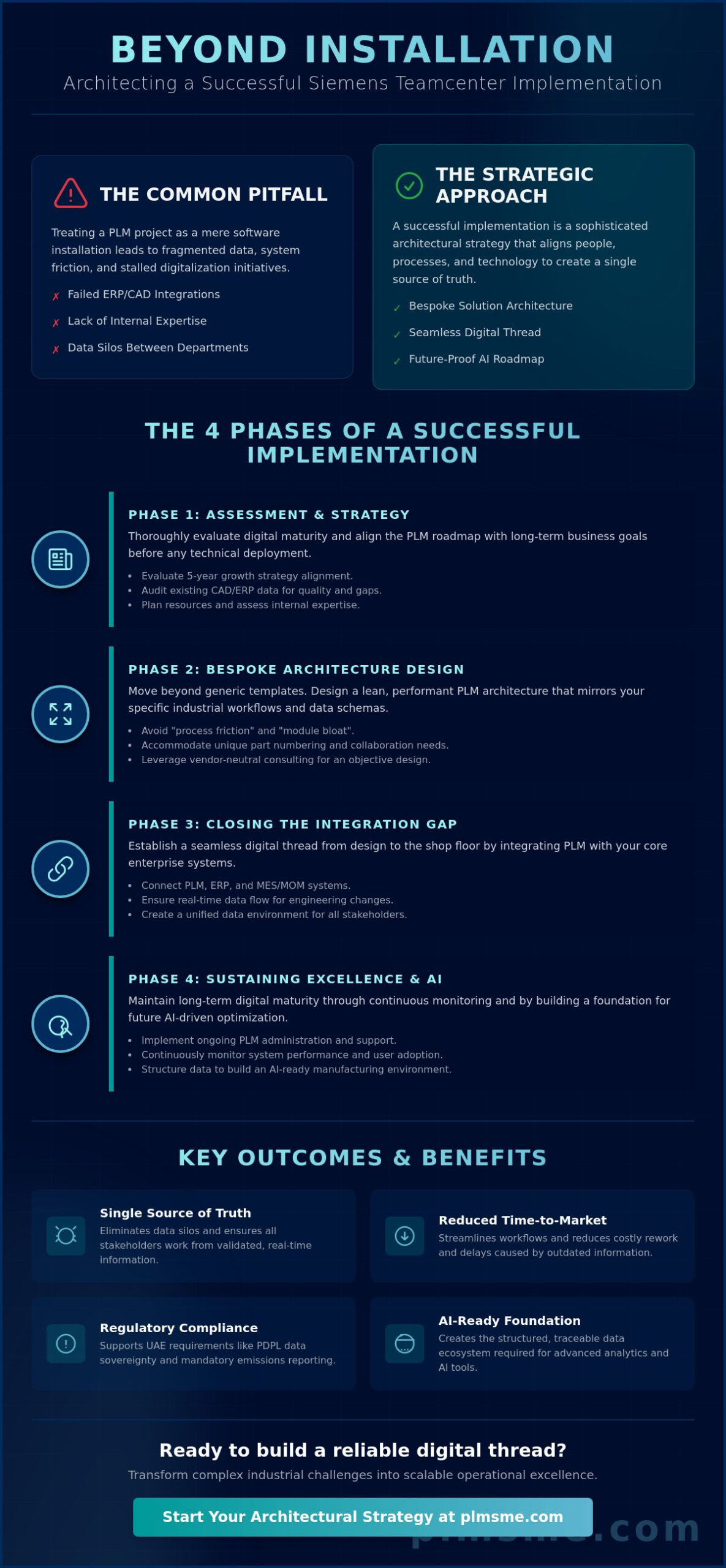
Execution requires more than technical skill; it demands a disciplined project management approach that accounts for the specific operational realities of the UAE industrial sector. To understand how to balance the core variables of such complex initiatives, click here to explore the project management triangle. A successful Teamcenter implementation Dubai is best managed through a four-stage methodological framework: Discovery, Development, Validation, and Go-Live. This structured progression ensures that every technical configuration serves a documented business need, preventing the common pitfall of deploying features that users eventually ignore. By treating the transition as a journey rather than a single event, manufacturers can maintain production stability while incrementally building their digital capabilities.
Phase 1: Vision and Roadmap Alignment
The first stage involves translating the high-level findings of a digital maturity report into actionable technical requirements. We focus on defining clear KPIs for implementation success, such as a 20% reduction in engineering change cycle times or improved compliance with UAE Federal Decree-Law No. 11. Securing stakeholder buy-in across engineering and IT departments is critical here. It ensures that the digital roadmap isn’t just an IT initiative but a shared vision for operational excellence that resonates with those on the shop floor.
Phase 2: Execution and Integration
During the development phase, the core platform is deployed and the Business Modeler IDE (BMIDE) is configured to match your specific industrial workflows. This isn’t about generic setups; it’s about developing specialized Teamcenter integration for your existing CAD environments, whether you’re using NX, Solid Edge, or third-party tools. We conduct rigorous user acceptance testing (UAT) using real-world engineering scenarios. This allows us to validate that the system handles complex assemblies and metadata exactly as required before moving toward full-scale production use.
The final transition requires orchestrating a Go-Live phase that prioritizes minimal production downtime. This involves a “cut-over” strategy where data is synchronized and users are transitioned in a controlled manner. Validation continues well after the initial launch, with rigorous testing of CAD integrations and data workflows to ensure the digital thread remains unbroken. By following this methodical path, manufacturers avoid the high cost of stalled PLM deployments and instead establish a reliable, future-proof foundation for their industrial digitalisation efforts.
Integrating PLM with ERP, MES, and MOM Systems
A Teamcenter implementation Dubai project reaches its full potential only when the software acts as the central nervous system of the entire enterprise. Connecting the digital thread from design to the shop floor requires more than basic data exchange; it requires deep technical integration that allows information to flow bi-directionally between Product Lifecycle Management (PLM) and Enterprise Resource Planning (ERP). Without this connectivity, manufacturers face an “integration gap” where engineering revisions fail to update production orders in real time. This disconnect leads to scrap, rework, and costly inventory discrepancies that undermine the efficiency gains of a PLM system.
Bridging Engineering and Production
Automating the transfer of the Bill of Materials (BOM) from PLM to ERP is a primary objective for achieving operational excellence. This automation ensures that production always utilizes the latest approved revision, effectively eliminating the manual data entry errors that plague fragmented systems. By synchronising Manufacturing Operations Management (MOM) and Manufacturing Execution Systems (MES), leaders gain real-time visibility into shop floor performance. This feedback loop allows engineering teams to see how their designs perform during assembly, enabling rapid adjustments and continuous improvement. Beyond the shop floor, unlocking Teamcenter CRM integration benefits provides end-to-end customer lifecycle visibility. Direct links between customer requirements and engineering data ensure that every product configuration perfectly matches client specifications and local market needs.
Best Practices for Complex Integrations
Successful integration strategies often hinge on the choice between industry-standard middleware and custom-developed API connectors. While middleware offers a faster initial setup, bespoke Teamcenter integration development provides the precision needed for highly specialised industrial workflows. Maintaining data synchronicity across globally distributed manufacturing sites requires robust conflict resolution protocols. This ensures that a change made in a Dubai facility is instantly reflected across the entire network, maintaining a single version of the truth. This level of technical cohesion is essential for organizations aiming to achieve the highest levels of digital maturity. A Digital Twin is a virtual representation of a physical product or process that serves as the real-time digital counterpart for simulation, integration, testing, and monitoring.
To ensure your systems communicate effectively, it’s vital to partner with experts who understand the architectural nuances of cross-platform connectivity. We provide the technical oversight necessary to bridge these gaps and secure your digital thread.
Sustaining Excellence: PLM Administration and AI Roadmaps
The successful launch of a Teamcenter implementation Dubai project marks the start of a new operational phase rather than the end of a technical task. A PLM environment is a dynamic ecosystem that requires ongoing attention to remain aligned with evolving engineering requirements and industrial standards. Without a dedicated strategy for post-go-live support, systems often suffer from performance degradation or “configuration drift,” where the software no longer matches the actual shop floor processes. Maintaining a high-performance environment involves regular solution architecture audits and timely updates to leverage the latest security and functionality enhancements from Siemens.
Evolving your PLM environment through a structured approach ensures that the system grows alongside your business. This involves more than just reactive fixes; it requires a proactive look at how new modules or features can solve emerging industrial challenges. Engaging specialized Siemens Teamcenter consulting ensures that your digitalization roadmap remains aligned with both your current operational needs and your long-term AI readiness goals. By treating the software as a living asset, manufacturers in the UAE can ensure their digital foundation remains robust enough to support increasing production volumes and complex product configurations.
Beyond the technical rigour of software deployment, celebrating major project milestones is essential for maintaining team morale in the UAE’s competitive industrial sector. To elevate your next corporate gala or private celebration with world-class mentalism, visit Thomas McElroy for professional entertainment that leaves a lasting impression.
Similarly, rewarding a leadership team after a successful multi-month implementation often involves exclusive corporate retreats or private getaways; for those looking to experience the highest standards of hospitality in the Mediterranean, tombenzon.com provides access to some of the most prestigious boutique villas in Mykonos.
Managed Services for Continuous Improvement
Specialized maintenance is essential for ensuring system availability and preventing bottlenecks that could halt production. Offloading these tasks through a PLM System Administration Retainer allows your internal team to focus on core engineering innovation rather than server logs or license management. We provide proactive troubleshooting and continuous performance monitoring to ensure that the digital thread remains unbroken as your data volume increases. This level of support is vital for businesses that need to maintain high availability within their Siemens Teamcenter environment without the overhead of a full-time, in-house technical team.
While digital support ensures system uptime, maintaining the physical integrity of the production environment is equally important; for expert damage repair and restoration in the UAE, The Solution offers specialized services to protect and restore industrial assets.
The Path to Industrial AI
A well-maintained PLM system serves as the critical data foundation for future industrial automation solutions in the GCC. As manufacturers in the region look toward 2026 and beyond, the focus is shifting toward predictive analytics and AI-driven design optimisation. Tools like Teamcenter Copilot require structured, high-fidelity data to provide meaningful insights. By establishing a clean data model during your Teamcenter implementation Dubai, you’re building the infrastructure for Industrial AI and machine learning integrations.
PLM-Sme FZC functions as a strategic “thinking partner,” engaging deeply with your long-term digitalisation vision. Our role extends beyond the initial setup to include ongoing strategic consulting and roadmap development. We help you navigate the transition from basic data management to advanced digital twin simulations and automated workflows. This methodical approach ensures that your investment in PLM continues to drive operational excellence and supports your journey toward complete digital maturity in a competitive global market.
Securing Your Industrial Digitalisation Strategy
Building a resilient digital thread requires moving beyond basic software deployment toward a structured, architectural methodology. You’ve seen how aligning people and processes ensures that your Teamcenter implementation Dubai project remains a strategic asset rather than a technical burden. By bridging the gap between engineering design and the shop floor through robust ERP, MES, and MOM integrations, you establish the high-fidelity data foundation necessary for modern industrial competition. Long-term success then depends on proactive system administration and a clear roadmap for future AI adoption that evolves with your operational needs.
As a Siemens Digital Industries Alliance Partner, PLM-Sme FZC provides the technical oversight needed for end-to-end PLM implementation and complex cross-platform connectivity. We function as your thinking partner to ensure your data foundation is clean, secure, and ready for the next generation of GCC industrial automation. Request your Digital Maturity Assessment from PLM-Sme FZC to identify the specific technical requirements and architectural gaps for your next phase of growth. We look forward to supporting your organisation’s transition toward sustained operational excellence and digital maturity.
Frequently Asked Questions
What is the typical timeline for a Siemens Teamcenter implementation in the UAE?
A typical Teamcenter implementation Dubai project spans six to twelve months depending on the scope of data migration and the complexity of existing integrations. Smaller deployments focusing on core PDM may take less time; however, full-scale enterprise rollouts require a methodical progression through discovery, development, and validation. This duration ensures that workflows are properly tested and that user training is completed before the final production cut-over.
How does Teamcenter integrate with existing ERP systems like SAP or Oracle?
Teamcenter integrates with ERP systems like SAP or Oracle through standardized gateways or custom-developed API connectors. These integrations facilitate the bi-directional flow of Bill of Materials (BOM) data and engineering changes, ensuring that production orders in the ERP reflect the latest approved designs. This technical bridge eliminates manual data entry and reduces the risk of manufacturing errors caused by using outdated revisions on the shop floor.
Why should we choose an independent PLM consultant over a software vendor?
Choosing an independent consultant provides an objective perspective on your solution architecture without the bias of software license sales. Independent experts focus on aligning the platform with your specific industrial processes rather than maximizing module volume. This collaborative approach ensures that the configuration remains lean, cost-effective, and technically optimized for your long-term digital vision rather than following a generic, vendor-driven template.
What are the most common challenges during a Teamcenter deployment?
The most frequent challenges include poor data quality in legacy systems, resistance to process changes among engineering teams, and technical gaps in cross-platform integrations. Many businesses also struggle with a lack of internal expertise to manage the complex solution architecture required for a high-performance environment; in such cases, Woloyem helps you to learn and master projet and service management to help teams develop the necessary skills. Addressing these issues early through a structured readiness phase prevents costly delays and ensures a more stable transition during the final deployment.
Can Teamcenter be implemented in phases to reduce initial costs?
Implementing Teamcenter in phases is a recommended strategy to manage initial costs and reduce operational risk. Starting with core Product Data Management (PDM) allows teams to stabilize their data foundation before expanding into advanced modules like change management or ERP integration. This incremental approach provides immediate value to the engineering department while allowing the organization to build technical maturity at a manageable and sustainable pace. For a comprehensive breakdown of budgeting variables and how to avoid unforeseen budget overruns, reviewing a detailed analysis of PLM implementation cost for manufacturing can help organizations plan each phase with greater financial precision.
What is the role of a Digital Maturity Assessment in the implementation process?
A Digital Maturity Assessment functions as the strategic baseline for your entire implementation roadmap. It identifies current technical debt, evaluates data quality, and determines the organization’s readiness for advanced industrial automation. By understanding these gaps before the project begins, manufacturers can design a Teamcenter implementation Dubai that addresses specific weaknesses and prioritizes the most impactful digital improvements for their business.
Does Teamcenter support multi-CAD environments (e.g., SolidWorks, NX, and Catia)?
Teamcenter is designed as a CAD-agnostic platform that supports multi-CAD environments including SolidWorks, NX, Catia, and AutoCAD. It uses the JT data format for high-performance visualization across different departments without requiring native CAD licenses for every user. This flexibility allows engineering teams to use the most appropriate design tools for their specific tasks while maintaining a single, unified source of truth for all product data.
What ongoing support is required after the initial PLM go-live?
Ongoing support after go-live includes system administration, performance monitoring, and regular solution architecture audits to prevent system-wide bottlenecks. Manufacturers often utilize a retainer service to manage firmware updates and proactive troubleshooting without the cost of a full-time in-house specialist. Continuous performance monitoring ensures the environment scales effectively as data volumes grow and as the organization integrates more advanced industrial AI solutions.