
Aerospace PLM Consulting: Strategic Roadmaps for Manufacturing in 2026
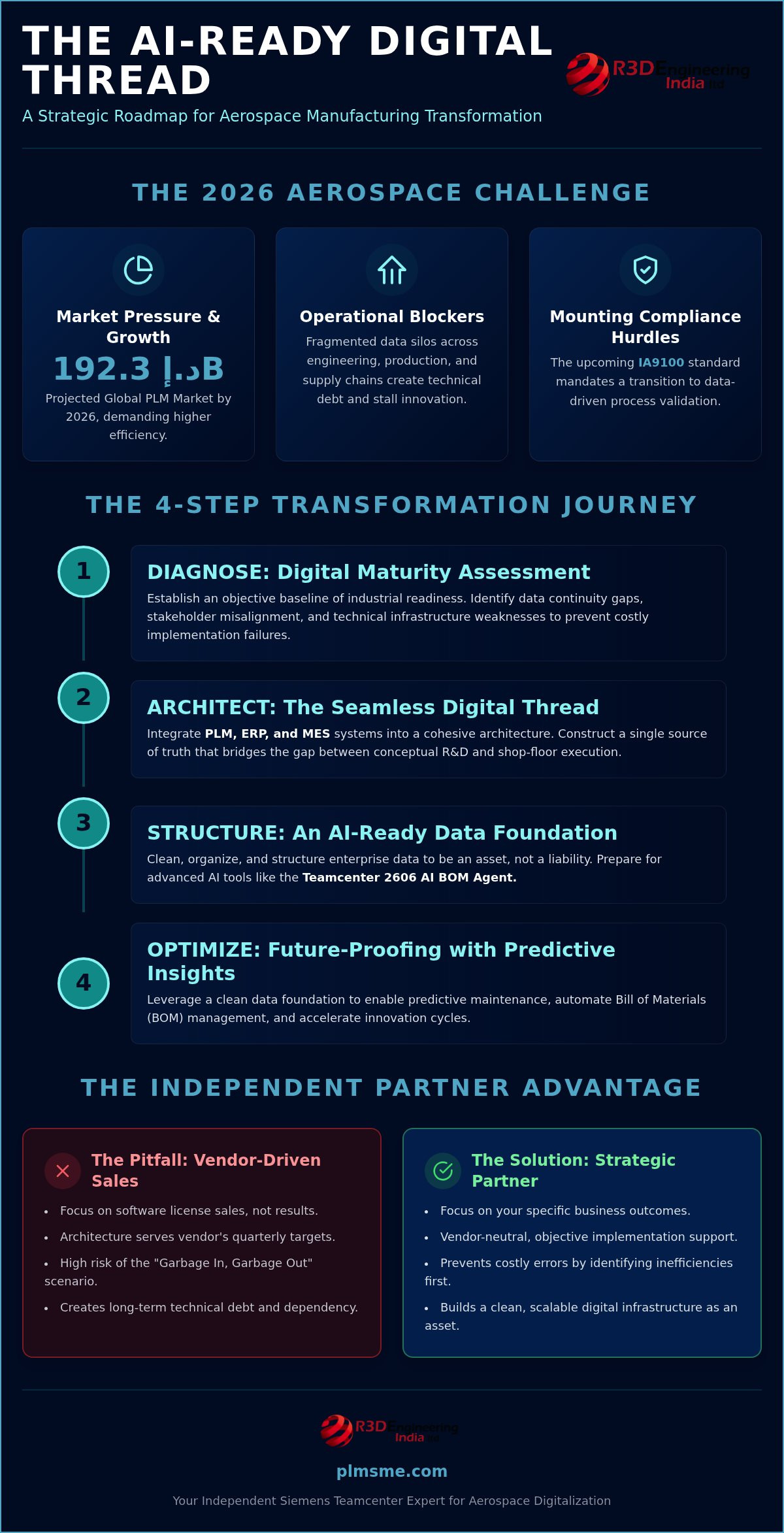
The global product lifecycle management market is estimated to reach د.إ 192.3 billion in 2026, yet many aerospace manufacturers remain trapped in a cycle of fragmented data and legacy technical debt. You’re likely feeling the mounting pressure of the upcoming IA9100 standard and the urgent need to harmonize data across engineering and production silos. It’s a common struggle to maintain compliance while trying to modernize aging systems that no longer support the pace of innovation. This article demonstrates how specialized PLM consulting aerospace manufacturing can transform these operational hurdles into a strategic advantage.
You’ll learn how to master the complexities of modern production through objective digital maturity assessments and AI-integrated Teamcenter architectures. We’ll provide a clear overview of building a digital roadmap that bridges the gap between PLM, ERP, and MES layers. We also examine how to structure your data for the latest Teamcenter 2606 AI features, ensuring your facility is ready for predictive maintenance and automated BOM management. By the end of this guide, you’ll have a structured path toward a seamless, AI-ready digital thread that supports long-term growth in the UAE aerospace sector.
Key Takeaways
- Identify the structural barriers to innovation by analyzing how engineering silos affect the 2026 aerospace landscape.
- Use a Digital Maturity Report as a diagnostic tool to assess your industrial readiness and prevent implementation failures.
- Construct a seamless digital thread by integrating PLM, ERP, and MES through expert system architecture.
- Leverage specialized PLM consulting aerospace manufacturing to build the clean, AI-ready data structures required for predictive maintenance.
- Gain a competitive edge by partnering with an independent Siemens Teamcenter expert for vendor-neutral, end-to-end implementation support.
Navigating Complexity in Aerospace Manufacturing: The Need for Expert PLM Consulting
The 2026 aerospace sector is undergoing a fundamental shift. UAE manufacturers are now prioritizing decarbonization, urban air mobility, and advanced space-tech projects. These goals require a level of agility that traditional engineering silos simply can’t support. When design data is isolated from production, innovation stalls and costs rise. Establishing a single source of truth through Product Lifecycle Management (PLM) is no longer optional; it’s the foundation for managing the massive volumes of certification data required for the new IA9100 standards. As the global PLM market is projected to reach د.إ 192.3 billion in 2026, the stakes for local manufacturers have never been higher. With the publication of IA9100 expected in the fourth quarter of 2026, the transition to data-driven process validation is mandatory for those aiming to remain competitive.
Expert PLM consulting aerospace manufacturing serves as the vital link between conceptual R&D and shop-floor execution. It ensures that strategic vision translates into measurable industrial results rather than just remaining a high-level concept.
Addressing Challenges in Modern Aerospace Development
Modern avionics systems have seen an explosion in electronics and embedded software. This complexity makes traceability difficult across multi-tier supply chains. Manufacturers must balance the rigor of Model-Based Systems Engineering (MBSE) with aggressive time-to-market schedules. Without a structured digital thread, maintaining compliance becomes a reactive, manual burden. Specialized consulting helps automate these processes. It ensures that every design change is reflected across the entire lifecycle in real time, from the initial requirement to the final assembly.
Shifting from Software Sales to Strategic Thinking Partners
A software license is not a digital transformation strategy. Many organizations realize too late that implementing a platform like Teamcenter requires deep PLM system architecture consulting rather than just a technical installation. Independent advisors provide the objectivity needed to select architectures that serve the business, not the software vendor’s quarterly targets. They act as thinking partners who understand the long-term vision of the enterprise.
Strategic partners identify hidden inefficiencies in legacy engineering workflows before migration begins. This prevents the “garbage in, garbage out” scenario that often leads to implementation failure. By focusing on Siemens Teamcenter consulting that prioritizes your specific operational needs, you can reduce technical debt and build a scalable foundation. This approach ensures your data remains clean, organized, and ready for the AI-driven tools, such as the Teamcenter AI BOM agent, entering the market in 2026. Specialized PLM consulting aerospace manufacturing ensures your digital infrastructure is an asset, not a liability.
Establishing a Vision: The Role of Digital Maturity Reports in Aerospace PLM
Jumping into a PLM implementation without a diagnostic phase is a primary cause of project failure in high-stakes environments. A Digital Maturity Report acts as the essential diagnostic tool for aerospace industrial readiness. It moves beyond high-level goals to provide a granular view of your current operations. By identifying gaps in data continuity, stakeholder alignment, and technical infrastructure, you can prevent costly course corrections later. This assessment phase is where specialized PLM consulting aerospace manufacturing adds the most value. It transforms a vague “as-is” state into a structured “to-be” digital vision for the entire enterprise.
Many UAE manufacturers struggle with fragmented data across engineering and production silos. A thorough assessment uncovers why these silos exist, whether they’re caused by legacy software limitations or cultural resistance. Addressing these issues early ensures that the subsequent digitalization efforts are built on a stable foundation. This phase involves deep engagement with your technical teams to understand the reality of your current workflows, ensuring the resulting strategy is grounded in practical execution rather than theoretical ideals.
Core Components of a digital maturity report manufacturing
The reporting process evaluates data management practices against stringent aerospace-specific standards. With IA9100 publication approaching in late 2026, the report focuses on your ability to handle data-driven process validation and cybersecurity. We also assess organizational readiness and digital literacy among engineering teams. It’s vital to know if your staff is prepared for the shift from document-centric to data-centric workflows. Finally, we review current IT/OT infrastructure for scalability. This ensures your architecture is ready for the high-performance demands of AI-ready data structures and predictive maintenance models.
Translating Maturity Data into a Digitalization Roadmap
Once the gaps are identified, the data must be converted into an actionable industrial digitalization roadmap UAE manufacturers can follow. This involves prioritizing PLM initiatives based on technical urgency and ROI for aerospace OEMs. Instead of a massive, overwhelming overhaul, we set realistic milestones that align with long-term business objectives and global market trends. This methodical approach ensures that every step taken strengthens the digital thread. If you want to ensure your modernization efforts yield tangible results, beginning with a bespoke digital maturity report provides the clarity needed to proceed with confidence.
Engineering the Digital Thread: Architecting PLM, ERP, and MES Integrations
The digital thread serves as the operational nervous system for modern aerospace production. It facilitates a seamless flow of data from the initial conceptual design through to the end customer. Without this continuity, manufacturers face significant risks in traceability and quality control. Implementing such a thread isn’t a simple software configuration task. It requires deep PLM consulting aerospace manufacturing to align disparate systems into a unified framework. This ensures that every stakeholder, from the design engineer to the maintenance technician, accesses the same verified data set.
Reducing technical debt is a major priority for UAE firms modernizing their facilities. Standardized integration protocols, such as REST APIs or robust middleware, replace the fragile point-to-point connections of the past. This shift is why PLM system architecture consulting is a technical necessity. It ensures that your digital infrastructure remains scalable and maintainable as your production volume grows. During complex migrations from legacy aerospace platforms, maintaining data integrity is paramount. You don’t want to carry over decades of “dirty” data into a new, high-performance environment. A structured migration strategy cleanses data at the source, ensuring the new system operates with maximum accuracy.
Connecting Engineering to the Enterprise: PLM and ERP
Synchronizing the Engineering Bill of Materials (EBOM) with the Manufacturing Bill of Materials (MBOM) is a critical junction. When these two structures aren’t aligned, procurement errors and assembly delays occur. Integrating PLM with your ERP system ensures that every design change is instantly visible to the supply chain. This real-time visibility allows for better risk management and cost control. Managing change orders across the enterprise through a unified interface prevents the costly production errors that often plague aerospace OEMs. It’s about ensuring the shop floor always works from the latest approved design, reducing scrap and rework.
Bridging the Gap to the Shop Floor: PLM, MES, and MOM
Efficiency on high-precision aerospace assembly lines depends on closing the loop between engineering and execution. Teamcenter MOM (Manufacturing Operations Management) integration allows for a direct data exchange with the shop floor. This isn’t just about sending instructions down; it’s about feeding production data back into the engineering phase. When you capture real-time performance and quality metrics from the shop floor, you can refine future designs for better manufacturability. This bidirectional data flow optimizes connectivity and ensures that your manufacturing processes are as agile as your design cycles. It’s the final piece of the digital thread that ensures total lifecycle visibility.
Future-Proofing Production: Incorporating AI Roadmaps into Aerospace PLM
AI readiness has emerged as the next competitive frontier for UAE aerospace manufacturers. While many organizations view AI as a standalone tool, its effectiveness depends entirely on the quality of the underlying data architecture. Product lifecycle management systems provide the “clean data” required to train reliable industrial AI models. Without a structured data foundation, AI initiatives often fail to move beyond the pilot phase. Specialized PLM consulting aerospace manufacturing ensures that your data is not just stored, but curated for machine learning consumption. This strategic preparation allows you to move from descriptive analytics to predictive insights, anticipating production bottlenecks before they occur.
Developing a strategic industrial automation solutions GCC roadmap is essential for firms looking to integrate these advanced capabilities. High-impact use cases such as generative design and autonomous inspection are already reshaping the industry. For instance, generative design algorithms can optimize aircraft components for weight and strength in ways human engineers might overlook. Autonomous inspection systems, powered by real-time PLM data, ensure that every part meets the rigorous safety standards of the 2026 aerospace landscape. These technologies aren’t just futuristic concepts; they’re becoming standard requirements for high-tier suppliers.
Building the Foundation for Industrial AI in Aerospace
Standardizing metadata and data structures is the first step toward machine learning integration. AI models require consistent, high-fidelity data to provide accurate predictions. Transitioning to predictive insights involves leveraging tools like the Teamcenter AI BOM agent, released in June 2026, to manage complex part relationships automatically. This level of automation allows engineering teams to focus on high-value innovation rather than manual data entry. By using AI to optimize manufacturing process planning, organizations can allocate resources more efficiently, reducing waste and energy consumption in line with national sustainability goals.
AI-Driven Automation in the Aerospace Sector
Integrating AI with industrial automation creates smarter, self-correcting factories. When shop-floor sensors feed data back into a digital twin, AI can run real-time simulations to test stress levels or performance variables. This allows for immediate adjustments to the manufacturing process, preventing defects before they happen. Scaling these AI initiatives across national manufacturing operations requires a methodical approach to system architecture. It’s about building a scalable framework that supports both local production and global supply chain integration. If you’re ready to modernize your facility, our team provides the expert industrial automation and AI solutions needed to bridge the gap between legacy systems and the autonomous future.
Driving Implementation Success: Why an Independent Siemens Teamcenter Partner Matters
Success in PLM consulting aerospace manufacturing is often determined by the objectivity of the advisor. Software vendors naturally prioritize the sale of licenses, but an independent partner focuses on the practical success of the deployment. This neutrality ensures that the system architecture serves your specific production requirements rather than fitting into a pre-packaged template. By focusing on end-to-end implementation support, independent consultants bridge the gap between technical capability and user adoption. They provide the strategic oversight needed to navigate the complexities of modern aerospace regulations while ensuring the platform delivers measurable value from day one.
Maximizing the value of Siemens Teamcenter consulting requires a partner who understands the nuances of the UAE industrial landscape. It’s not just about turning on features; it’s about architecting a solution that supports the entire product lifecycle without creating new silos. This involves a deep dive into your existing processes to identify where Teamcenter can provide the most significant impact, from engineering collaboration to shop-floor execution. A dedicated partner acts as a thinking partner, aligning the technical roadmap with your long-term business vision.
The Value of Specialized Teamcenter Expertise
Customizing Teamcenter to fit specific aerospace manufacturing workflows is a technical necessity. Every OEM has unique requirements for managing complex CAD, CAM, and CAE extensions. A specialized partner ensures these tools work in harmony within the Teamcenter environment, preventing data loss during critical handovers. Seamless data migration from disparate legacy platforms is another area where expertise is vital. You need a partner who can move massive datasets without compromising the integrity of your certification history or engineering records. This level of precision is essential for maintaining compliance with evolving international standards.
Securing the Future with a PLM Administration Retainer
Long-term PLM health is not a one-time achievement. Ongoing system health checks are vital for aerospace manufacturers to prevent performance degradation and downtime. A PLM system administration retainer provides access to specialized architecture support for evolving digitalization needs. This allows you to manage system updates and performance tuning without disrupting active production lines. It also ensures your team always has an expert partner to consult as new technologies, like AI agents or cloud-native architectures, emerge. This proactive approach protects your investment and ensures your digital infrastructure remains a reliable asset for years to come.
Securing Your Competitive Edge in the 2026 Aerospace Market
Success in the modern aerospace sector requires more than just high-performance hardware; it demands a sophisticated digital foundation. We’ve explored how a structured digital thread and AI-ready data architectures are essential for meeting the stringent IA9100 standards and managing the complexities of urban air mobility. By prioritizing a comprehensive maturity assessment and vendor-independent system architecture, UAE manufacturers can eliminate technical debt and bridge the gap between engineering and the shop floor. Specialized PLM consulting aerospace manufacturing provides the technical objectivity needed to turn these complex digital visions into operational reality.
As a Siemens Digital Industries Alliance Partner, PLM-Sme FZC offers access to specialized Siemens Teamcenter solution architects who understand the nuances of the local industrial landscape. We focus on delivering expert digital transformation roadmaps that prioritize long-term scalability and technical health. Don’t leave your digitalization strategy to chance or vendor bias. Request your comprehensive Digital Maturity Assessment from PLM-Sme FZC to begin architecting a more resilient and innovative future for your manufacturing operations. Your journey toward a seamless, AI-integrated digital thread starts with a single, data-driven step.
Frequently Asked Questions
What is the primary benefit of PLM consulting for aerospace manufacturers?
The primary benefit of PLM consulting for aerospace manufacturers is the strategic alignment of technical systems with long-term business objectives. Expert consultants provide the architectural oversight needed to bridge gaps between design and production. This ensures that software investments lead to measurable gains in efficiency and regulatory compliance. By leveraging specialized PLM consulting aerospace manufacturing, firms can avoid common pitfalls of vendor-driven implementations while building a scalable foundation for future innovation.
How does a digital maturity report help in an aerospace PLM implementation?
A digital maturity report serves as a diagnostic roadmap that identifies current technical gaps and organizational readiness before a project begins. It evaluates existing data management practices against stringent aerospace standards like IA9100. This assessment prevents implementation failure by highlighting hidden inefficiencies in legacy workflows. By establishing a clear baseline, manufacturers can prioritize their digitalization efforts based on technical urgency and ROI. It ensures that resources are allocated to the most critical areas first.
Can Siemens Teamcenter be integrated with existing ERP and MES systems?
Siemens Teamcenter can be integrated with existing ERP and MES systems through standardized protocols such as REST APIs or robust middleware. This connectivity is essential for synchronizing the Engineering Bill of Materials (EBOM) with the Manufacturing Bill of Materials (MBOM). A well-architected integration ensures a seamless flow of data across the enterprise, reducing manual entry errors. It allows for real-time change management, ensuring the shop floor always operates from the latest approved design revisions.
What are the most common challenges in aerospace PLM implementation?
The most common challenges include fragmented data across disconnected silos, high technical debt from legacy systems, and the complexity of maintaining certification traceability. Manufacturers often struggle to align engineering requirements with production realities, leading to costly rework. Additionally, cultural resistance to new data-centric workflows can hinder user adoption. Specialized PLM consulting aerospace manufacturing addresses these hurdles by providing structured change management and vendor-neutral architectural guidance to ensure a smooth transition to data-driven processes.
Why should a manufacturer choose an independent PLM consultant over a vendor?
Choosing an independent consultant ensures that the system architecture is designed to serve the manufacturer’s specific operational needs rather than a software vendor’s sales targets. Independent advisors provide objective guidance on platform selection and configuration, focusing on long-term scalability. They act as thinking partners who prioritize your vision, helping to navigate complex vendor ecosystems. This approach reduces the risk of vendor lock-in and ensures the final solution is optimized for unique aerospace manufacturing workflows.
How does an AI roadmap fit into a Product Lifecycle Management strategy?
An AI roadmap integrates into a PLM strategy by using the platform as the primary source of clean, structured data required for machine learning. PLM systems curate the metadata and engineering records that train industrial AI models. By standardizing data structures within the PLM environment, manufacturers can move from descriptive analytics to predictive insights. This preparation ensures that new tools, like the Teamcenter AI BOM agent, can be deployed effectively to automate complex resource allocation.
What is the ‘Digital Thread’ in the context of aerospace production?
The digital thread represents a continuous, bidirectional flow of verified data that connects every stage of the product lifecycle. In aerospace production, this means design requirements, engineering changes, and shop-floor quality metrics are all linked in a single environment. This connectivity ensures total traceability, which is vital for meeting international safety regulations. By closing the loop between conceptual design and execution, the digital thread enables manufacturers to optimize performance and refine future designs.
How long does a typical digital maturity assessment take for an aerospace manufacturer?
A typical digital maturity assessment for an aerospace manufacturer generally takes between four and eight weeks. This duration depends on organizational size and the complexity of existing systems. This timeframe allows for deep engagement with technical teams and a thorough review of IT/OT infrastructure. The process involves data gathering, stakeholder interviews, and gap analysis against industry benchmarks. The result is a comprehensive report and a prioritized roadmap, providing a structured path for digital transformation.