
Strategic PLM Implementation Partner Saudi Arabia: Navigating Vision 2030
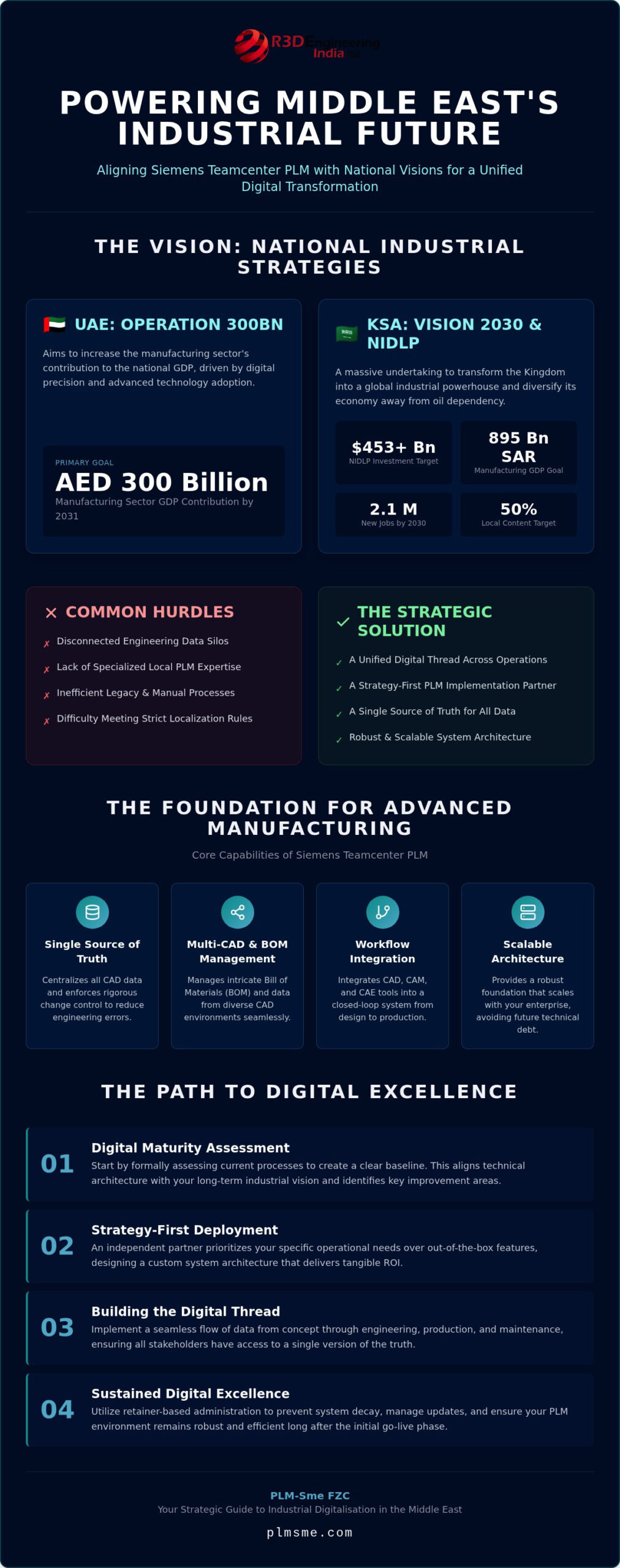
The UAE’s industrial strategy, ‘Operation 300bn’, aims to increase the manufacturing sector’s contribution to GDP to AED 300 billion by 2031, a goal that demands digital precision across every stage of the product lifecycle. Most industrial leaders in the Emirates realize that achieving this requires more than just basic automation; it necessitates a complete digital overhaul. You likely understand the frustration of managing disconnected engineering data while trying to satisfy strict UAE industrial localization requirements. It’s a common hurdle that often stems from a lack of specialized Teamcenter expertise within the local UAE market.
Selecting the right PLM implementation partner UAE is the most critical decision you’ll make to ensure your Siemens Teamcenter deployment delivers on its promise. This article outlines the essential criteria for selecting a strategic guide capable of building a unified digital thread that connects your entire operation. You’ll discover how to leverage the latest AI capabilities in Teamcenter 2606 to improve engineering efficiency and secure a long-term ROI. We will examine the specific technical methodologies, from digital maturity assessments to system architecture, needed to align your digitalization efforts with the ‘Operation 300bn’ objectives and broader UAE Vision goals.
Key Takeaways
- Understand how Product Lifecycle Management serves as the technical backbone for Saudi Arabia’s National Industrial Development and Logistics Program (NIDLP) and Industry 4.0 goals.
- Learn why selecting an independent PLM implementation partner Saudi Arabia ensures a strategy-first deployment of Siemens Teamcenter that prioritizes your specific operational needs.
- Identify the necessity of starting your digitalization journey with a formal digital maturity report to align technical architecture with long-term industrial vision.
- Discover how retainer-based administration prevents system decay and ensures your digital thread remains robust and efficient long after the initial go-live phase.
Navigating the Saudi Industrial Transformation with PLM
The National Industrial Development and Logistics Program (NIDLP) represents a massive undertaking, aiming to attract over $453 billion in investment to transform the Kingdom into a global industrial powerhouse. At the center of this transformation is Product Lifecycle Management (PLM), which serves as the structural framework for modernizing industrial operations. Rather than treating software as a standalone tool, a strategic PLM implementation partner Saudi Arabia views it as the backbone of the Kingdom’s Industry 4.0 ambitions. This shift involves moving away from legacy, manual processes toward high-tech, digitally-enabled discrete production that can compete on a global scale.
Localization is a key pillar of this strategy. The “Made in Saudi” initiative targets 50% local content in government procurement, a goal that’s impossible to reach without robust digital systems. PLM enables the localization of complex engineering expertise by providing a centralized environment where local talent can collaborate on sophisticated product data. This ensures that intellectual property and manufacturing know-how remain within the Kingdom, fostering a self-sustaining industrial ecosystem that supports the 2.1 million jobs the National Industrial Strategy aims to create by 2030.
Aligning with Saudi Vision 2030
Saudi Vision 2030 focuses on diversifying the economy to reduce long-term dependency on oil and gas. Industrial digitalization is the primary lever for this change. By adopting advanced PLM strategies, Saudi enterprises in high-growth sectors like automotive and aerospace can meet the rigorous digital standards required for government-backed projects. For instance, the development of domestic EV manufacturing through companies like Lucid Motors and Ceer Motors requires the precise coordination of complex supply chains and engineering data that only a mature PLM environment can provide. Aligning with these standards is essential for any firm contributing to the target of increasing the manufacturing sector’s GDP contribution to 895 billion SAR by 2030.
The Digital Thread in Saudi Manufacturing
Modern manufacturing requires a seamless flow of data from the initial conceptual design through to local production and maintenance. This connectivity ensures that every stakeholder has access to a single version of the truth, reducing errors and accelerating time-to-market. Traceability is equally critical, as Saudi industrial regulations increasingly demand detailed records of material origins and production processes to ensure compliance and safety. A dedicated PLM implementation partner Saudi Arabia helps build this infrastructure to support high-stakes industrial cities like those overseen by MODON. The digital thread functions as the essential nervous system of a modern Saudi factory, transmitting vital data across every phase of the product’s life.
Siemens Teamcenter: The Foundation for Advanced Manufacturing
Siemens Teamcenter stands as the dominant PLM platform for complex discrete industries across the GCC. Its capacity to handle multi-CAD environments and intricate Bill of Materials (BOM) management makes it the logical choice for the Saudi Industrial Transformation. By centralizing CAD data and enforcing rigorous change control, Teamcenter provides a single source of truth. This reduces engineering errors and ensures every stakeholder works from the latest revisions, which is vital for high-precision manufacturing.
Partnering with a certified Siemens Digital Industries Alliance Partner is about more than software access. It’s about deep technical proficiency. A qualified PLM implementation partner Saudi Arabia understands how to extend core modules into a holistic engineering environment. This includes incorporating CAD, CAM, and CAE tools to create a seamless workflow. Such integration ensures the digital models created by your engineers directly inform the manufacturing processes on the shop floor, creating a closed-loop system that drives efficiency.
Architecture and System Design
Success starts by moving beyond basic, out-of-the-box features. Saudi industrial enterprises are growing fast. They require systems that scale without collapsing under technical debt. Professional PLM system architecture consulting identifies the specific configurations needed for long-term expansion. A robust solution architecture ensures your Teamcenter environment remains agile. This allows for the rapid introduction of new product lines as market demands shift, keeping your operations competitive in a volatile global market.
Integrating the Industrial Ecosystem
Total visibility requires Teamcenter to communicate fluently with your ERP, CRM, and MES platforms. Bridging the gap between the engineering office and the Saudi shop floor is essential for maintaining production speed. For example, exploring Teamcenter CRM integration benefits allows engineering teams to incorporate customer feedback directly into the design phase. This connectivity creates a responsive ecosystem where data flows freely. You might consider a digital maturity assessment to map your current capabilities before committing to a full-scale deployment.
Evaluating the Role of an Independent PLM Implementation Partner
Industrial firms in the Kingdom often make the mistake of treating a software purchase as a complete solution. Large-scale resellers frequently prioritize license volume over actual business process optimization. Choosing an independent PLM implementation partner Saudi Arabia shifts the focus from software features to strategic alignment. An independent advisor acts as a “thinking partner,” engaging deeply with your long-term vision rather than just executing a technical checklist. This objectivity is vital when selecting and configuring specific modules, ensuring you don’t over-invest in functionality your current operations aren’t ready to absorb.
Avoiding the “one-size-fits-all” trap requires a partner that prioritizes your unique manufacturing environment. Vendor-led projects often ignore the subtle cultural and operational nuances of the Saudi shop floor. By remaining vendor-neutral, a boutique consultancy can offer honest assessments of which Siemens Teamcenter capabilities will drive the highest ROI for your specific discrete production needs. This approach ensures the software serves the strategy, not the other way around.
The Collaborative Support Model
Boutique specialists provide a level of agility that massive global integrators struggle to match. This model emphasizes tailored quality and direct access to senior consultants who’ve navigated complex industrial challenges. Trust is built through transparency and a collaborative spirit, where the consultant functions as an extension of your internal team. Local market knowledge is indispensable here. Understanding the regulatory environment and the specific requirements of the Saudi industrial sector ensures that the digital strategy remains grounded in reality and compliant with national standards.
Expertise in Complex Migrations
Transitioning from legacy systems to a modern digital thread is a high-stakes operation. It involves more than just moving files; it requires comprehensive data cleansing and robust migration strategies. Saudi discrete manufacturers often face challenges with fragmented data across multiple departments. A specialized PLM implementation partner Saudi Arabia manages this transition by ensuring data integrity and minimizing downtime. Maintaining continuity of operations during a digital transformation is non-negotiable. The goal is a steady, deliberate progression that protects existing manufacturing output while building the foundation for future growth.
Executing a Successful PLM Implementation Roadmap
Deploying a PLM system isn’t a single event. It’s a structured journey. A reliable PLM implementation partner Saudi Arabia ensures that each phase builds upon the previous one. This prevents the common pitfall of system sprawl, where software is installed but never fully utilized. You need a clear industrial digitalization roadmap to guide the transition. This roadmap serves as a blueprint for aligning technical capabilities with business goals. It establishes measurable KPIs, such as reducing engineering change cycle times or improving first-pass yield on the shop floor.
Setting these benchmarks allows executive leadership to track progress and justify the investment. Without concrete metrics, digital transformation often feels abstract and disconnected from the bottom line. A methodical approach ensures that every configuration choice supports a specific business outcome. This creates a sense of stability and comprehensive oversight, suggesting the brand is in total control of the complex digital processes it describes.
Digital Maturity Assessment
Every project must begin with a baseline. A digital maturity report manufacturing provides this essential starting point. This report analyzes your current data silos, existing workflows, and readiness for AI-driven automation. By identifying low-hanging fruit, you can achieve immediate ROI in your Saudi operations. This builds momentum for larger, more complex phases of the deployment. Establishing a Digitalization Vision first ensures that you select technical tools based on actual need rather than speculative features.
Implementation and Integration Development
Moving from vision to reality requires specialized technical skill. Developing robust integrations between Siemens Teamcenter and your Manufacturing Operations Management (MOM) or Manufacturing Execution Systems (MES) is critical for total visibility. A key challenge for Saudi firms is finding the right balance between configuration and customization. Excessive customization leads to high maintenance costs and difficult upgrades. A boutique PLM implementation partner Saudi Arabia helps you leverage Teamcenter’s core capabilities while developing targeted integrations that bridge gaps between departments. User adoption is the final hurdle. Training the Saudi workforce for digital excellence ensures the system becomes a part of daily operations. If you’re ready to define your path forward, you can book a digital maturity assessment to evaluate your current industrial landscape.
Sustaining Digital Excellence with Professional PLM Administration
Reaching the “go-live” milestone is a significant achievement, but it’s merely the beginning of the system’s lifecycle. Industrial environments are dynamic; as production volumes increase and product complexity grows, the PLM environment must evolve to remain effective. Without ongoing oversight, systems often suffer from “system decay,” where performance lags and data integrity begins to slip. A dedicated PLM implementation partner Saudi Arabia provides the necessary continuity to ensure your digital thread remains robust as your business expands.
System health requires a shift from reactive troubleshooting to proactive management. This involves regular solution architecture updates that align with your changing business requirements. As you scale, your Teamcenter environment must be tuned to handle larger datasets and more complex integrations. Relying on a structured support model ensures that your technical infrastructure doesn’t become a bottleneck for your engineering teams.
Managed Services and Retainers
A PLM system administration retainer offers a cost-effective way to access senior-level expertise without the burden of full-time internal hires. This model focuses on ensuring continuous performance and maximum uptime for your critical engineering systems. It’s about more than fixing bugs; it’s about reducing technical debt through consistent maintenance and optimization. Proactive administration prevents small configuration issues from ballooning into major operational disruptions. By securing specialized support, Saudi firms can focus on their core manufacturing objectives while resting assured that their digital foundation is being managed by experts.
The Road to Industrial AI
The future of manufacturing lies in the integration of industrial automation solutions in the GCC with advanced AI capabilities. Predictive maintenance and generative design are no longer experimental concepts; they’re becoming competitive necessities. However, these technologies rely heavily on the quality of the underlying information. Clean PLM data is the prerequisite for any industrial AI strategy. Without a structured digital thread, AI models lack the context needed to provide accurate insights. Building an AI roadmap tailored to your specific manufacturing needs ensures you’re prepared to leverage these tools as they mature, turning your PLM data into a genuine strategic asset.
Securing Your Digital Future in the Kingdom’s Industrial Landscape
The path toward achieving the National Industrial Strategy’s ambitious targets requires a shift from fragmented data to a unified digital thread. You’ve seen how a structured roadmap, beginning with a comprehensive digital maturity report, provides the clarity needed to navigate complex Siemens Teamcenter deployments. Success isn’t defined by the go-live date alone; it’s sustained through proactive administration and a commitment to long-term system health.
Selecting a strategic PLM implementation partner Saudi Arabia ensures that your technical architecture remains agile enough to support future industrial AI initiatives. As a Siemens Digital Industries Alliance Partner, we specialize in building the resilient Teamcenter environments that Saudi discrete manufacturers need to compete globally. Our expertise in digital maturity assessments allows us to identify the precise technical path that aligns with your specific vision.
Partner with PLM-Sme FZC for your Saudi industrial transformation and begin building a more efficient, data-driven operation today. The Kingdom’s industrial future is digital, and with the right architectural foundation, your enterprise will be ready to lead it.
Frequently Asked Questions
What should I look for in a PLM implementation partner in Saudi Arabia?
Look for a PLM implementation partner Saudi Arabia with deep technical expertise in Siemens Teamcenter and a proven track record. They should function as a strategic thinking partner rather than just a software reseller. It’s essential that they understand the local regulatory landscape and the specific requirements of the National Industrial Strategy to ensure your deployment aligns with national digitalization standards.
How does Siemens Teamcenter support Saudi Vision 2030 industrial goals?
Siemens Teamcenter acts as the digital foundation for the high-tech manufacturing sectors prioritized by Vision 2030. It enables the localization of engineering expertise and supports the “Made in Saudi” initiative by creating a robust digital thread. This connectivity is vital for meeting the National Industrial Strategy’s target of increasing the manufacturing sector’s contribution to GDP to 895 billion SAR by 2030.
Why is a digital maturity assessment necessary before PLM implementation?
An assessment establishes a clear baseline of your current data silos, workflows, and technical readiness. It prevents the common mistake of deploying complex software into inefficient processes. By identifying low-hanging fruit, you can secure immediate ROI. This step ensures your PLM implementation partner Saudi Arabia designs a system architecture that solves actual operational bottlenecks rather than just installing features.
Can PLM be integrated with my existing SAP or Oracle ERP system?
Yes, Teamcenter is designed to integrate seamlessly with major ERP platforms like SAP and Oracle. This integration creates a bidirectional flow of data between engineering and finance or supply chain departments. It ensures that Bill of Materials changes in the PLM environment are reflected accurately in the ERP system, reducing manual entry errors and improving overall procurement efficiency across your Saudi operations.
What is the typical timeline for a PLM implementation in a Saudi manufacturing firm?
Timelines vary based on complexity, but a phased deployment typically takes between six to eighteen months. The initial phase often focuses on core data management and CAD integration, providing value within the first few months. Subsequent phases involve more complex integrations with MES or ERP systems. A methodical, phased approach ensures minimal disruption to ongoing production while building a sustainable digital foundation.
What are the benefits of a PLM system administration retainer?
A retainer provides consistent access to senior PLM architects who monitor system health and performance. It prevents system decay by ensuring that software updates and configuration changes are handled proactively. This model is often more cost-effective than hiring a full-time internal team. It allows your engineers to focus on product development while experts manage the underlying technical infrastructure and scalability requirements.
How does PLM help Saudi manufacturers with regulatory compliance?
PLM systems provide automated traceability and a secure audit trail for every design change and production step. This is critical for meeting the rigorous safety and quality standards required by Saudi industrial regulators and government-backed projects. By centralizing documentation and enforcing standardized workflows, you ensure that all products meet the necessary compliance criteria throughout their entire lifecycle, reducing the risk of costly delays.
Is Siemens Teamcenter available as a cloud solution for Saudi companies?
Yes, Siemens offers Teamcenter X, a SaaS-based cloud solution that provides the full power of the platform with reduced IT overhead. This is an excellent option for Saudi firms looking for rapid deployment and scalability. However, many large-scale industrial sites in the Kingdom still prefer hybrid or on-premise deployments to maintain strict control over data sovereignty and ensure high-speed access within local manufacturing facilities.