
Maximizing Industrial Value: Key PLM CRM Integration Benefits for 2026
What if your engineering team could anticipate customer requirements before the sales department even finalized a lead? For many industrial leaders in the UAE, the gap between what is designed and what is sold remains a significant hurdle to growth. You likely recognize the frustration of sales teams promising configurations that aren’t technically feasible or engineering teams receiving critical field feedback only after a product line is established. These silos don’t just slow you down; they create a culture of reactive fixes rather than proactive innovation.
Understanding the core PLM CRM integration benefits is the first step toward evolving from a product-out to a customer-in manufacturing strategy. By synchronizing engineering and customer data, you transform the traditional product lifecycle into a continuous value loop that drives revenue. This article explores how connecting systems like Siemens Teamcenter 2606 with modern CRM platforms accelerates time-to-market for customer-requested features and reduces rework through real-world field data. We will outline a clear roadmap for industrial digitalization that aligns with the UAE’s Operation 300bn goals, ensuring your technical architecture supports a long-term strategic vision.
Key Takeaways
- Implementing a continuous “Digital Thread” to bridge the operational gap between engineering design and customer-facing sales teams.
- Maximizing core PLM CRM integration benefits to accelerate time-to-market and improve product quality via closed-loop feedback from the field.
- Designing a robust technical architecture that enables bidirectional data flow between Siemens Teamcenter and CRM platforms through specialized middleware.
- Utilizing digital maturity assessments as the essential first step in building an AI-ready digitalization roadmap and vision.
- Aligning corporate digitalization strategies with UAE national initiatives like Operation 300bn to drive localized industrial innovation.
Bridging the Gap Between Engineering and the Customer Experience
Discrete manufacturing often suffers from a fundamental misalignment between commercial vision and technical execution. Sales teams frequently capture customer requirements that engineering cannot fulfill; conversely, engineering develops features that the market doesn’t value. This disconnect stems from traditional organizational silos where data remains trapped within departmental systems. By 2026, the shift toward mass customization has made these silos unsustainable. Realizing the full spectrum of PLM CRM integration benefits requires a shift in how we view the product lifecycle management process; extending it beyond the factory gates to include the actual usage and sentiment of the end user.
The “Digital Thread” provides the technical framework for this extension. It ensures that product data flows seamlessly from initial concept through to field service and eventual decommissioning. Without CRM data, PLM systems operate in a vacuum, lacking the real-world context needed to drive meaningful innovation. When these systems don’t talk, the business loses its ability to react to market shifts with the necessary agility.
Identifying Data Silos in Discrete Manufacturing
Operating with fragmented data systems leads to “over-the-wall” communication, where R&D receives static requirements without understanding the underlying customer pain points. This lack of transparency results in missed market opportunities and expensive late-stage design changes. Organizations often find that developing a comprehensive industrial digitalization roadmap is the only way to expose these gaps. A roadmap provides a structured method for identifying where data stops flowing, allowing leadership to replace manual entry with automated, bidirectional synchronization. This reduces the risk of sales teams promising configurations that aren’t technically feasible, saving both time and reputation.
The Customer-Centric Product Lifecycle
A truly integrated ecosystem uses CRM insights to prioritize the engineering backlog. Instead of guessing which features to develop next, engineers can analyze customer support trends and sales feedback to focus on high-impact improvements. This closed-loop system ensures that field service data feeds directly back into the PLM for quality enhancements. Key advantages include:
- Unified Source of Truth: Aligning technical specifications with commercial contracts prevents errors in the order-to-production pipeline.
- Quality Improvement: Identifying recurring field failures through CRM tickets allows engineering to issue rapid design revisions or service bulletins.
- Innovation Velocity: Reducing the time spent on duplicate data entry frees up engineering resources for high-value R&D tasks.
Establishing these PLM CRM integration benefits transforms the product lifecycle into a customer-centric loop. It ensures that every engineering decision is grounded in market reality, driving both customer satisfaction and long-term revenue growth.
Core PLM CRM Integration Benefits for Industrial Performance
Industrial performance relies on the velocity of information. When your engineering and sales systems don’t sync, you’re essentially operating with a blind spot that affects everything from quoting accuracy to product reliability. One of the most tangible PLM CRM integration benefits is the drastic reduction in administrative friction. By eliminating dual data entry, organizations remove the manual errors that typically plague the transition from a sales opportunity to a production order. For leadership teams, reviewing a CIO-level overview of PLM provides the necessary context for why these integrations are strategic assets rather than mere IT projects.
Enhancing the “Configure, Price, Quote” (CPQ) process is another critical advantage. When sales teams have real-time access to engineering data, they can generate quotes based on current technical capabilities and component availability. This ensures that every configuration sold is one that the factory can actually build. It prevents the costly “re-quoting” cycles that often frustrate customers and delay revenue recognition. If you’re looking to optimize these workflows, starting with a digital maturity assessment can help identify which data points will yield the highest return on investment.
Shortening the Sales-to-Engineering Feedback Loop
Integrated systems allow sales personnel to validate technical feasibility instantly during the discovery phase. For complex industrial equipment, this reduces the “Design-to-Order” cycle from weeks to days. Instead of waiting for a back-and-forth exchange with R&D, sales can pull approved modules directly into their CRM environment. This synchronization ensures that customer requirements are accurately captured in the PLM requirements module from the very first interaction. It creates a seamless handoff that minimizes the risk of scope creep or misunderstood specifications during the detailed design phase.
Data-Driven Innovation and Product Evolution
The integration enables a closed-loop feedback system where CRM complaint trends trigger engineering change orders (ECOs) automatically. If field service data shows a recurring failure in a specific component, engineering receives that data in real time within the Siemens Teamcenter environment. This allows for rapid product evolution based on actual usage rather than theoretical models. Furthermore, identifying under-utilized product features through customer usage data helps teams streamline future designs and reduce manufacturing complexity. Building a foundation for a digital maturity report manufacturing through integrated data provides the empirical evidence needed to justify long-term R&D investments and digitalization initiatives.
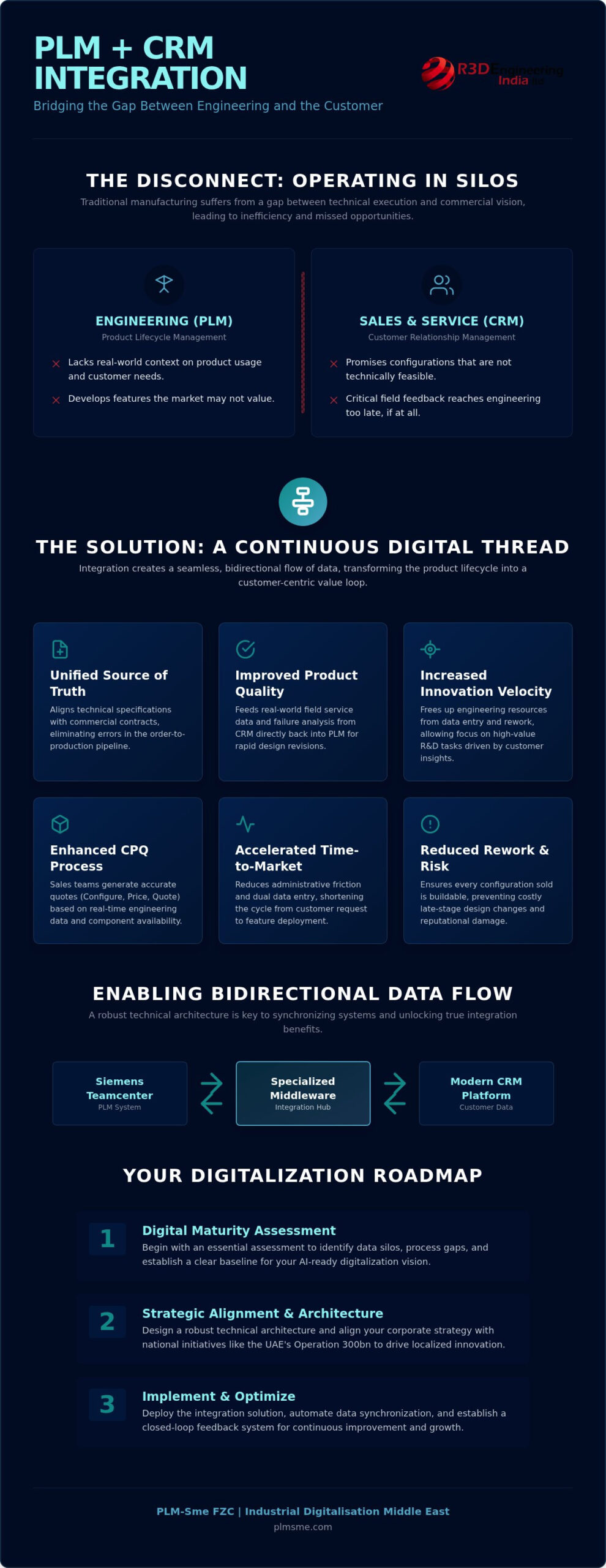
Technical Architecture: Synchronizing Siemens Teamcenter with CRM
Designing a robust interface between Siemens Teamcenter and a CRM platform requires more than a simple API connection. It necessitates a structured technical architecture that maintains data integrity while facilitating high-volume industrial transactions. Middleware serves as the essential orchestrator in this ecosystem, managing data transformation and ensuring that the differing schemas of engineering and sales systems don’t conflict. This architectural layer is where many PLM CRM integration benefits are realized; it allows for a “single source of truth” without overwhelming either system with irrelevant metadata. To prevent the accumulation of technical debt, organizations often leverage PLM system architecture consulting to ensure the integration remains scalable as product complexity grows.
The bidirectional flow of data is the heartbeat of this synchronization. CRM systems typically push customer requirements and configuration preferences into the PLM environment. In return, the PLM system provides real-time updates on product availability, engineering change status, and technical documentation. This exchange is foundational for achieving customer-centric servitization, where the focus shifts from selling a physical asset to providing ongoing value through its entire lifecycle.
Teamcenter Integration Development Best Practices
Successful implementations often utilize Siemens Teamcenter Active Workspace to provide non-engineering users with a streamlined, web-based interface. This allows sales and service teams to view product structures and status updates without needing specialized CAD training. Development teams should focus on mapping CRM accounts directly to PLM project structures. This mapping ensures full traceability from the initial sales lead to the final manufactured serial number. With the release of Siemens Teamcenter 2606, developers can now utilize enhanced AI-driven data mapping tools to ensure the system architecture is ready for future autonomous workflows.
Managing Security and Data Governance
Protecting Intellectual Property (IP) is a primary concern when opening engineering data to commercial teams. Implementing Role-Based Access Control (RBAC) across both platforms ensures that sales personnel see only what’s necessary for quoting and customer support, while core engineering files remain secure. Maintaining this complex web of permissions and data flows requires consistent oversight. A PLM administration retainer provides the technical expertise needed for long-term system health, ensuring that security patches and data governance policies are updated in line with evolving industrial standards. This proactive management approach secures the PLM CRM integration benefits against internal data drift and external security threats.
Strategic Implementation: Building Your Digitalization Roadmap
Deploying a connected ecosystem is a strategic undertaking that demands a methodical progression. It isn’t just about software; it’s about alignment between your technical capabilities and commercial objectives. With 50% of UAE organizations investing between USD 50 million and USD 99.9 million annually in digital technologies, the pressure to deliver measurable PLM CRM integration benefits is high. Success requires a phased approach that moves from objective assessment to continuous optimization. This structured path ensures that your technical architecture supports long-term growth rather than creating new silos.
- Phase 1: Conducting a comprehensive digital maturity assessment to identify data gaps and process bottlenecks.
- Phase 2: Defining a digitalization vision and an AI-ready roadmap that aligns with national initiatives like Operation 300bn.
- Phase 3: Selecting the right integration touchpoints, such as CPQ or field service loops, based on projected ROI.
- Phase 4: Executing pilot implementations combined with aggressive change management to ensure user adoption.
- Phase 5: Maintaining continuous optimization through managed services to keep the integration performant.
Assessing AI Readiness for Integration
Clean, integrated data is the non-negotiable prerequisite for industrial AI. Without the synchronization of product and customer data, predictive maintenance models lack the context of how a specific customer uses an asset in the real world. Preparing your architecture for automated design or AI-driven production requires a level of data hygiene that siloed systems cannot provide. Consulting with a Siemens Teamcenter consulting partner ensures your roadmap accounts for these technical requirements from the outset. This specialized guidance helps you leverage the AI enhancements found in the Siemens Teamcenter 2606 release while avoiding the accumulation of technical debt.
Measuring the ROI of PLM CRM Connectivity
Quantifying the impact of integrated systems involves tracking specific Key Performance Indicators (KPIs) that reflect both engineering efficiency and commercial success. Organizations typically see a marked reduction in engineering rework as field data informs design revisions earlier in the product lifecycle. Sales cycle times also decrease because configuration validation happens in real time within the CRM interface. A vendor-independent digitalization strategy allows you to focus on these outcomes rather than software-specific features. To begin your journey, you can request a digital maturity report to identify the highest-value opportunities for your specific operation.
The Future of Industrial Connectivity in the UAE
The UAE’s industrial landscape is undergoing a radical shift, driven by government initiatives like Operation 300bn and the Technology Transformation Program. To remain competitive within this USD 1.82 billion digital transformation market, firms must align their internal systems with these national objectives. Integrating engineering data with customer insights isn’t just a technical upgrade; it’s a strategic necessity for localized innovation. The deployment of industrial automation solutions GCC wide relies on this underlying connectivity to ensure that production remains agile and responsive to regional market demands.
As we transition toward Industry 5.0, the focus expands from pure efficiency to human-centric design. This evolution requires a deep understanding of how products are used, which is only possible when CRM data is fully accessible to R&D teams. One of the long-term PLM CRM integration benefits is the ability to create personalized, sustainable products that reflect the values of a modern workforce and consumer base. Achieving this level of sophistication requires an independent perspective. PLM-Sme FZC provides the objective guidance needed to navigate these complex software architectures without the bias of a software vendor.
Adapting to National Digitalization Standards
Regional requirements for data sovereignty and industrial standards are becoming increasingly stringent. Integrated PLM systems support the UAE’s sustainability targets by reducing material waste through more accurate initial designs and better field-service lifecycle management. By leveraging local expertise, firms can ensure their implementations comply with UAE-specific regulations while maximizing operational efficiency. This localized approach is critical for companies operating in high-growth sectors where technical precision and regulatory compliance are equally prioritized. It ensures that your digitalization vision remains compliant with the evolving legal landscape of the GCC.
Your Next Step Toward Digital Maturity
Moving from a conceptual roadmap to concrete technical execution requires a “thinking partner” who understands the nuances of the UAE industrial sector. It’s about more than just software installation; it’s about building a resilient digital foundation. A neutral advisor helps you select the right integration touchpoints that offer the best return on investment for your specific operational scale. To begin this transition with a clear understanding of your current capabilities, you should Book a Digital Maturity Assessment with PLM-Sme FZC. This objective evaluation provides the baseline needed to realize the full PLM CRM integration benefits and secure your place in the future of UAE industry.
Securing Your Position in the UAE’s Industrial Future
The evolution of the UAE’s manufacturing sector requires a departure from siloed operations toward a unified digital thread. By connecting engineering intelligence with real-world customer sentiment, organizations can move beyond static production and embrace mass customization. Realizing the full PLM CRM integration benefits ensures that your technical architecture doesn’t just store data but actively drives revenue through accelerated time-to-market and improved product reliability. This transformation is essential for staying competitive in a market that increasingly values agility and customer-centricity.
Success in this transition depends on a structured roadmap that prioritizes data integrity and AI readiness. As an independent Siemens Digital Industries Alliance Partner, PLM-Sme FZC offers the objective expertise needed to navigate these complex software ecosystems. We specialize in Siemens Teamcenter implementation and vendor-independent consulting, helping you build a resilient foundation for Industry 5.0. Your journey toward a connected enterprise begins with an honest evaluation of your current technical landscape.
Request your Digital Maturity Report from PLM-Sme FZC to identify the strategic touchpoints that will define your competitive advantage in 2026. The path to industrial excellence is complex, but with the right thinking partner, your digitalization vision is well within reach.
Frequently Asked Questions
What are the primary benefits of PLM CRM integration for manufacturers?
The primary PLM CRM integration benefits for manufacturers include accelerated time-to-market and enhanced product quality through closed-loop feedback. By synchronizing engineering and customer data, firms eliminate the manual errors associated with dual data entry. This alignment ensures that sales teams only promise technically feasible configurations while providing R&D with real-world usage data to drive innovation and revenue growth.
How does Siemens Teamcenter integrate with popular CRM platforms?
Siemens Teamcenter integrates with popular CRM platforms using specialized middleware and robust APIs to facilitate bidirectional data flow. This architecture allows CRM users to access product structures via Active Workspace without needing full PLM licenses. It ensures that technical specifications and commercial contracts remain perfectly aligned throughout the product lifecycle, preventing the disconnect that often occurs during the transition from sales to production.
Do I need to complete a digital maturity assessment before integrating PLM and CRM?
Conducting a digital maturity assessment is the necessary first step before any integration project begins. This evaluation identifies existing data silos and process bottlenecks that could undermine the integration’s success. It provides a baseline for your digitalization vision and roadmap consulting, ensuring that the technical architecture is robust enough to support complex, high-volume transactions and long-term industrial scalability.
How long does a typical PLM CRM integration project take in the UAE?
A typical integration project in the UAE generally spans four to nine months, depending on the complexity of the legacy systems and data structures. This timeline accounts for system architecture design, custom development, and comprehensive testing phases. Factors such as the volume of data and the specific requirements for bidirectional synchronization will influence the final delivery schedule for your unique industrial environment.
Can PLM CRM integration help with industrial AI readiness?
Achieving the full range of PLM CRM integration benefits is a prerequisite for industrial AI readiness. Predictive maintenance and automated design algorithms require clean, structured data from both engineering and customer environments to function accurately. Without this integrated foundation, AI models lack the real-world context needed to provide actionable insights or reliable forecasts for complex manufacturing operations in the UAE.
What is the role of an independent PLM consultant in system integration?
An independent PLM consultant functions as a neutral advisor who provides objective system architecture and roadmap consulting. Unlike software vendors, an independent specialist focuses on tailored quality and long-term vision rather than selling specific software licenses. This role is critical for navigating complex digital processes and ensuring the technical solution aligns perfectly with your unique industrial challenges and strategic goals.
Does PLM CRM integration improve the Configure, Price, Quote (CPQ) process?
Integration significantly improves the Configure, Price, Quote (CPQ) process by providing sales teams with real-time technical validation. When CRM systems pull data directly from the PLM environment, quotes are based on current engineering standards and component availability. This eliminates the need for expensive re-quoting cycles and ensures that every order is technically feasible before it ever reaches the factory floor.
How do I ensure data security when connecting engineering and sales systems?
Ensuring data security involves implementing Role-Based Access Control (RBAC) across both integrated platforms to protect sensitive Intellectual Property. This framework allows commercial teams to view necessary product status updates while strictly restricting access to core engineering CAD files. Regular oversight through a PLM system administration retainer ensures that security protocols remain current and effective against evolving digital threats to your infrastructure.