
AI Consulting for Manufacturing in the UAE: Building Data-Driven Roadmaps
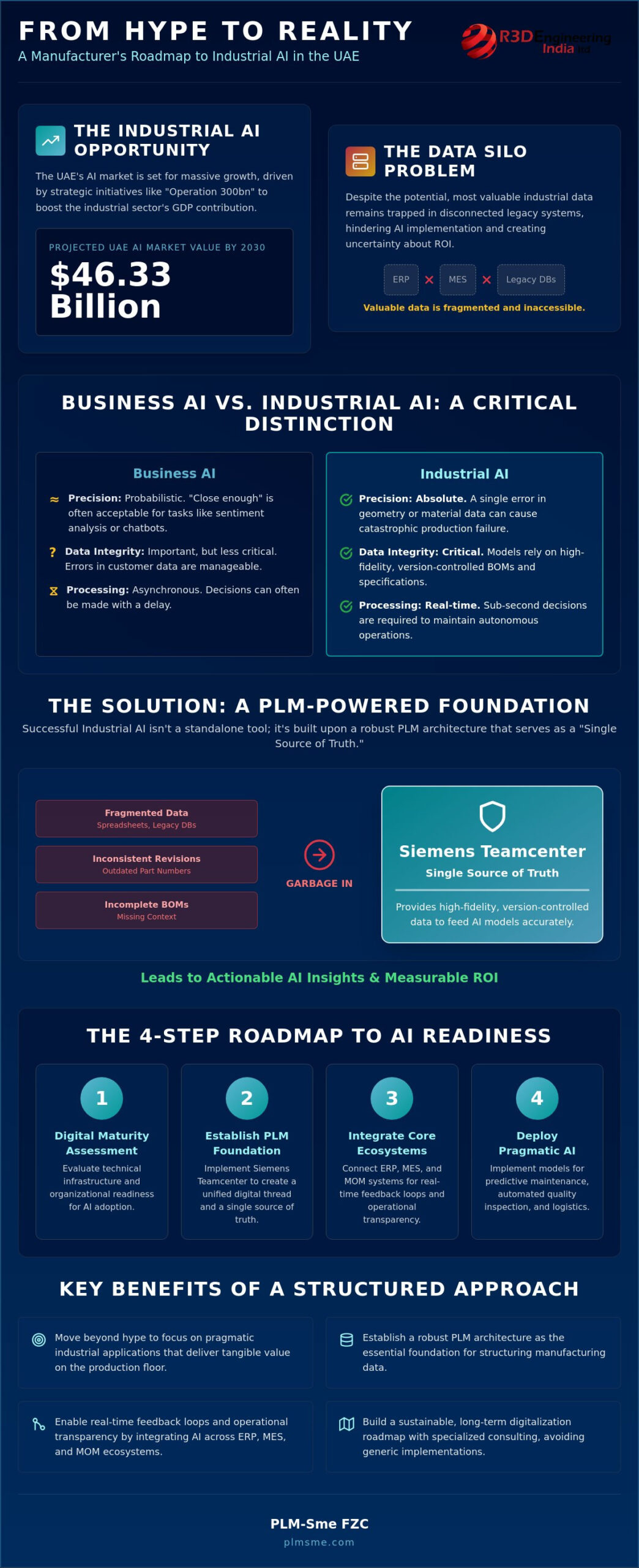
While the UAE’s AI market is projected to reach $46.33 billion by 2030, many regional manufacturers still find that their most valuable industrial data remains trapped within disconnected legacy systems. You likely understand that the pressure to modernize is high; however, the uncertainty regarding actual ROI in a live production environment often makes it difficult to commit to large scale changes. It’s a common challenge to feel that the national industrial vision is within reach, but the specialized technical expertise needed to implement it on the shop floor feels scarce.
This article provides a clear path to transition from AI hype to industrial reality by establishing a robust PLM foundation. By engaging with expert AI consulting for manufacturing Dubai, you can build a roadmap that prioritizes data integrity and system cohesion. We’ll examine how seamless integration with Siemens Teamcenter serves as the backbone for these initiatives. You’ll learn how a structured approach to digital maturity leads to measurable improvements in operational efficiency and a more resilient, data-driven production cycle.
Key Takeaways
- Identify how to move beyond generative AI hype by focusing on pragmatic industrial applications that deliver tangible value on the production floor.
- Understand why a robust Siemens Teamcenter architecture serves as the essential foundation for structuring manufacturing data for machine learning models.
- Discover the methodology for conducting a comprehensive digital maturity assessment to evaluate both technical infrastructure and organizational readiness.
- Learn the technical requirements for integrating AI across ERP, MES, and MOM ecosystems to enable real-time feedback loops and operational transparency.
- See why specialized AI consulting for manufacturing Dubai offers a more sustainable, long-term digitalization roadmap than generic, one-size-fits-all software implementations.
Navigating the Industrial AI Landscape in the UAE Manufacturing Sector
Smart factories and autonomous operations are no longer conceptual. They’re becoming the standard for manufacturers in the region who want to stay competitive. This transformation is a core part of the Fourth Industrial Revolution (Industry 4.0), where physical systems are deeply integrated with digital intelligence. Local initiatives, such as the Industrial Technology Transformation Index (ITTI), provide a framework for this evolution, yet the technical execution remains complex. Engaging with generic IT firms often leads to fragmented solutions because these vendors lack the specialized knowledge of discrete manufacturing processes. This is why specialized AI consulting for manufacturing Dubai is critical; it bridges the gap between high-level data science and the practical constraints of a factory floor.
Current trends in the UAE manufacturing sector include:
- Deployment of autonomous mobile robots (AMRs) in complex logistics environments.
- Predictive maintenance models based on real-time sensor fusion and historical performance.
- Automated quality inspection using high-precision computer vision to reduce scrap rates.
The Distinction Between Business AI and Industrial AI
There’s a fundamental difference between deploying a chatbot and deploying an industrial model. Business AI often operates on probabilities where “close enough” is acceptable, but the precision requirements of shop-floor models are absolute. Data integrity in manufacturing is more critical than in almost any other sector; a single discrepancy in product geometry or material specification can lead to catastrophic production failures. Real-time processing is the final hurdle. Industrial AI must process sensor data and make sub-second decisions to maintain the flow of autonomous operations without interruption.
Economic Drivers for AI Adoption in 2026
Manufacturers are increasingly using AI to reduce technical debt. By implementing intelligent system automation, companies can bridge the gap between legacy hardware and modern software architectures. This is essential for global supply chain competitiveness, especially as international partners demand higher transparency and faster lead times. Industrial AI is the synthesis of machine learning and PLM data. By partnering for AI consulting for manufacturing Dubai, companies gain access to the architectural wisdom required to link disparate data silos and transform their operations from reactive to predictive.
Establishing PLM Architecture as the Foundation for Manufacturing AI
Manufacturers often make the mistake of treating AI as a standalone software layer. This siloed approach usually fails because it ignores the richest source of industrial intelligence: the Product Lifecycle Management (PLM) system. For any organization pursuing AI consulting for manufacturing Dubai, the first step isn’t selecting a machine learning model; it’s ensuring the PLM architecture is robust enough to serve as a “single source of truth.” When data is scattered across disconnected spreadsheets and legacy databases, AI models lack the context needed to provide actionable insights.
Siemens Teamcenter provides the structural integrity required to feed AI models with high-fidelity data. Without this foundation, the “Garbage In, Garbage Out” principle takes hold, where AI outputs are rendered useless by inconsistent part numbers, outdated revisions, or incomplete bill of materials (BOM) data. Effective PLM system architecture consulting prevents these fragmented data silos by creating a unified digital thread. This thread connects engineering, manufacturing, and service departments, ensuring that the data used to train AI models is accurate, version-controlled, and reflective of the actual physical product.
Leveraging Siemens Teamcenter for AI Readiness
Integrating AI into the production environment requires more than just raw data; it requires engineering context. By utilizing Teamcenter data, manufacturers can train predictive maintenance models that understand the exact engineering tolerances and historical performance of a specific component. This depth of information is also vital for generative design AI, where CAD, CAM, and CAE data informs the system about material constraints and manufacturing feasibility. Because of this complexity, engaging in Siemens Teamcenter consulting is a critical prerequisite for any advanced AI initiative.
Architecture Design Dictating AI Success
The success of an industrial AI project is often decided at the architectural level. Designing a scalable solution architecture is essential for high-volume data processing, ensuring that as your sensor network grows, your system doesn’t buckle under the load. Optimized PLM paths reduce latency in AI-driven decision-making, which is crucial for real-time shop floor adjustments. This alignment is a key driver behind the UAE’s AI Ambitions, as the nation seeks to lead in high-tech industrial output.
A neutral, vendor-independent approach to architecture design ensures that the focus remains on your specific operational goals rather than pushing a particular software suite. This objective perspective allows for the creation of a bespoke roadmap that balances technical excellence with cost-effectiveness. If you’re ready to evaluate your current setup, a comprehensive digital maturity assessment can identify the exact gaps in your data architecture. By grounding your strategy in a mature PLM foundation, you ensure that your AI investments translate into measurable industrial performance.
Conducting a Digital Maturity Assessment for AI Readiness
Jumping straight into AI without a clear understanding of your starting point often leads to wasted resources and project fatigue. A digital maturity assessment serves as the essential diagnostic phase of any successful transformation. When engaging in AI consulting for manufacturing Dubai, the primary objective is to map your existing technical infrastructure against your long-term operational goals. This process identifies where data is accessible and where it remains siloed in legacy systems or paper-based records. It provides the clarity needed to move from fragmented manual processes to automated, AI-enhanced workflows that actually scale across the production floor.
Cultural readiness is just as critical as technical capacity. Your engineering and production teams must be prepared to shift from manual, intuition-based decision-making to automated, data-driven workflows. This alignment ensures that once AI models are deployed, they are actually utilized by the staff on the shop floor rather than being bypassed by old habits. The UAE’s Industry 4.0 initiative provides a national framework for this evolution, encouraging manufacturers to adopt advanced technologies to boost global competitiveness. Without a team that understands the logic behind the data, even the most sophisticated machine learning model will fail to deliver its full potential.
The Components of a Digital Maturity Report
A comprehensive report provides more than just a surface-level overview; it delivers precise data quality scoring and accessibility benchmarks. It analyzes system interoperability across the enterprise, ensuring that your PLM, ERP, and MES systems can communicate without manual intervention. For a more detailed framework on how these assessments are structured, you can refer to the digital maturity report manufacturing documentation. This structured approach highlights specific high-impact use cases where AI can provide immediate relief for production bottlenecks, such as predictive maintenance or real-time scrap reduction.
Benchmarking Your AI Potential
Benchmarking involves comparing your internal capabilities against regional industry standards and global best practices. This isn’t about chasing every digital trend; it’s about prioritizing AI projects based on their technical feasibility and projected ROI within your specific production environment. A phased approach is essential to minimize operational disruption during the transition. By focusing on low-complexity, high-value implementations first, you build the internal momentum and technical confidence needed for larger enterprise-wide integrations. Expert AI consulting for manufacturing Dubai helps you navigate these priorities, ensuring your roadmap is grounded in technical reality rather than marketing speculation. This methodical progression ensures that every step forward adds measurable value to the bottom line.
Integrating AI Across ERP, MES, and MOM Ecosystems
Establishing a mature PLM foundation is the first step toward industrial intelligence, but the true power of AI is realized when it spans the entire enterprise. For manufacturers in the UAE, this means breaking down the walls between engineering (PLM), resource planning (ERP), and execution (MES). Creating a unified data fabric allows AI models to observe the entire product lifecycle in real time. Without this cross-system visibility, AI remains limited to isolated tasks, unable to account for the supply chain disruptions or shop floor variables that dictate actual production success. Expert AI consulting for manufacturing Dubai focuses on these technical bridges, ensuring that data flows securely and accurately across every software layer.
One of the most significant hurdles in digital transformation is the manual handling of data between disconnected platforms. When engineering changes in the PLM don’t automatically update the manufacturing instructions in the MES, the risk of production errors increases. Specialized Teamcenter integration development solves this by automating the synchronization of data, which significantly reduces manual data entry and the associated human error. By enabling real-time shop floor feedback loops, manufacturers can implement AI-driven Manufacturing Operations Management (MOM) that adjusts schedules and resource allocation based on live machine performance data.
Building Interactive Connections Between Systems
Synchronizing PLM data with ERP systems allows AI to perform sophisticated inventory optimization. By analyzing the engineering bill of materials (BOM) alongside current stock levels and lead times, AI can predict material shortages before they impact the production line. This level of foresight is only possible when the systems share a common language. Additionally, leveraging Teamcenter CRM integration benefits ensures that customer feedback and market demands directly inform the product development cycle. This customer-centric approach allows AI to identify which product features are most valued, helping engineering teams prioritize designs that align with actual market performance.
Overcoming Integration Friction
Connecting legacy ERP or MES platforms with modern AI layers often requires custom middleware and bespoke integration development. These connections must be designed to maintain data security and governance, especially when dealing with sensitive intellectual property or cross-border supply chain data. It’s not enough to simply move data; you must ensure the integrity of that data as it travels between different database architectures. AI success is proportional to the depth of system integration. If your organization struggles with fragmented data across multiple platforms, our team provides the technical expertise needed for seamless Teamcenter Integration Development. By removing technical friction, you create an environment where AI can provide enterprise-wide visibility and measurable operational improvements.
Partnering for Strategic AI Roadmap Execution
Executing an industrial AI strategy is a marathon rather than a sprint. While generalist vendors often focus on rapid staff augmentation, these outsourced teams frequently lack the deep industrial process knowledge required to navigate complex production environments. A boutique consultancy acts as a supportive guide, engaging with your long-term vision rather than just executing isolated tasks. This level of partnership is particularly vital when seeking AI consulting for manufacturing Dubai, where understanding local regulatory frameworks like the UAE Personal Data Protection Law (PDPL) is non-negotiable for secure data processing. By aligning with a partner who understands the specific constraints of the regional market, you ensure that your digital transformation remains compliant with national standards and Ministry of Industry and Advanced Technology (MoIAT) guidelines.
Local expertise provides a significant advantage when navigating the “Make it in the Emirates” ecosystem. A partner with regional roots understands the nuances of the Industrial Technology Transformation Index (ITTI) and can help you leverage government-backed incentives effectively. This objective, neutral advice is far more valuable than a biased vendor pitch. It allows you to build a roadmap based on technical excellence and operational reality rather than software sales targets. This strategic alignment ensures that your investment in AI translates into a sustainable competitive advantage in the global manufacturing arena.
Developing the Industrial Digitalisation Roadmap
Developing a sustainable digitalisation vision requires a phased approach that respects the complexity of your current operations. We establish three-year and five-year milestones that ensure your AI evolution remains manageable and cost-effective. Integrating industrial automation solutions GCC into this broader vision allows you to align technical milestones with corporate financial objectives. This structured progression ensures that every upgrade, from sensor deployment to machine learning integration, contributes directly to the national goal of increasing the industrial sector’s contribution to the GDP.
Ongoing Support and System Evolution
The industrial landscape is constantly shifting, so your technology must keep pace. Managed services and a dedicated PLM administration retainer ensure that your AI models maintain accuracy as production variables change. As new Siemens Teamcenter features emerge, your roadmap must adapt to leverage these advancements without disrupting existing workflows. This steady, methodical oversight prevents technical debt and ensures your systems remain agile and responsive to market demands. To begin your journey with a thinking partner who understands the nuances of the UAE market, contact PLM-Sme FZC for a specialized digital maturity assessment today. We provide the technical clarity and strategic oversight needed to transform your industrial data into a powerful engine for growth.
Securing Your Industrial Future through Data-Driven Intelligence
Transitioning from fragmented data to an integrated AI ecosystem requires a methodical approach that prioritizes architectural integrity. By grounding your digital transformation in a robust PLM foundation and ensuring connectivity across ERP and MES layers, you create the transparency needed for measurable operational gains. Success isn’t just about the software; it’s about the strategic roadmap that connects your technical milestones with corporate growth. Our team functions as a supportive thinking partner to help you navigate the complexities of AI consulting for manufacturing Dubai while maintaining a neutral, results-oriented perspective.
As a Siemens Digital Industries Alliance Partner specialized in Siemens Teamcenter implementation, we offer independent, vendor-neutral advisory services tailored to the UAE’s unique industrial landscape. We focus on building scalable solutions that respect your current operational constraints while preparing you for future autonomous capabilities. Request Your Industrial Digital Maturity Assessment to begin building a roadmap that scales with your ambitions. With a clear strategy and a solid data foundation, your facility is well-positioned to lead the region’s digital evolution.
Frequently Asked Questions
What is the first step in AI consulting for manufacturing?
The first step in AI consulting for manufacturing is conducting a comprehensive digital maturity assessment. This diagnostic process identifies existing data silos and evaluates whether your current technical infrastructure can support advanced machine learning models. By mapping your current state, you establish a clear baseline for your digitalization vision and roadmap, ensuring that future technological investments are grounded in technical reality.
How does Siemens Teamcenter support AI implementation?
Siemens Teamcenter supports AI implementation by serving as the single source of truth for all product and process data. It organizes complex engineering information into structured formats that machine learning algorithms can consume efficiently. This high-fidelity data foundation is critical for training accurate models, as it ensures the AI has access to version-controlled and verified product lifecycle information.
Do we need to replace our legacy ERP before adopting AI?
You don’t necessarily need to replace your legacy ERP system before adopting AI. Most manufacturers find it more cost-effective to develop custom integrations that allow the PLM and AI layers to communicate with existing databases. This approach bridges the gap between older systems and modern intelligence layers, preserving historical data while adding predictive capabilities to your operations.
How long does it take to develop an industrial digitalization roadmap?
Developing an industrial digitalization roadmap typically takes between four to eight weeks, depending on the complexity of your production environment. This timeframe includes the initial maturity assessment, stakeholder interviews, and the definition of three to five-year milestones. A well-structured roadmap ensures that every technological step aligns with your long-term financial objectives and operational requirements.
What is the difference between a vendor and an independent PLM consultant?
The primary difference is objectivity; a software vendor often prioritizes selling specific licenses, while an independent PLM consultant focuses on your specific operational challenges. Independent advisors provide neutral guidance on system architecture and integration. This ensures you select the best-fit solutions for your factory without being influenced by a single provider’s sales targets or software limitations.
Can AI be used for predictive maintenance in discrete manufacturing?
Yes, AI is highly effective for predictive maintenance in discrete manufacturing environments. By combining real-time sensor data from the shop floor with the engineering context found in your PLM system, AI can predict component failures before they happen. This proactive approach significantly reduces unplanned downtime and extends the operational lifecycle of your most expensive production machinery.
How much does a digital maturity assessment cost for a UAE factory?
The cost of a digital maturity assessment for a UAE factory varies based on the size of the facility and the depth of the technical audit required. Factors such as the number of integrated systems and production lines influence the final scope. Engaging in AI consulting for manufacturing Dubai provides the clarity needed to avoid expensive implementation errors and ensures your budget is allocated to high-impact projects.
What are the risks of implementing AI without a structured roadmap?
Implementing AI without a structured roadmap often leads to fragmented data silos and a poor return on investment. Without a clear plan, manufacturers risk accumulating technical debt by investing in incompatible tools that cannot scale across the enterprise. A roadmap provides the necessary governance to ensure that AI initiatives remain secure, compliant, and fully integrated into the broader manufacturing ecosystem.