
PLM Business Case Template for Manufacturing: A Strategic Framework for 2026
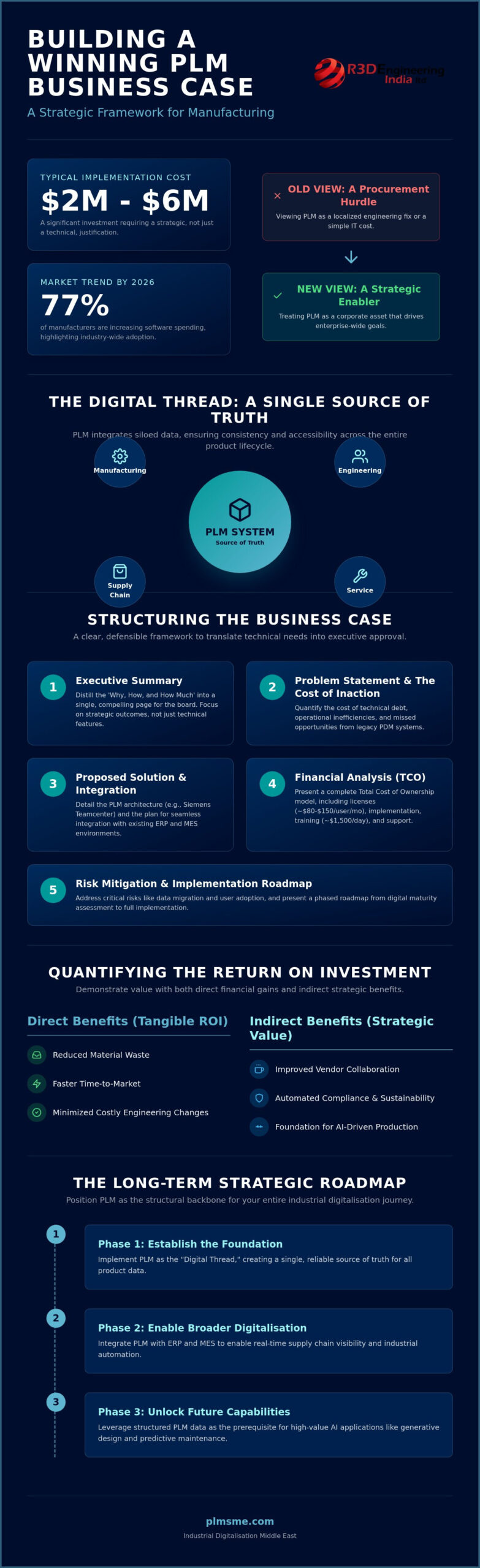
If your implementation costs are projected to reach between $2 million and $6 million, you can’t afford to treat your software pitch like a routine procurement request. Many engineering leaders struggle to translate the necessity of data integrity into a language the board understands, often fearing that a new system won’t integrate with existing ERP or MES environments. Utilizing a structured PLM business case template for manufacturing is no longer optional. It is a strategic requirement to ensure your technical architecture aligns with executive financial goals in a 2026 market where 77% of manufacturers are increasing their software spending.
You likely recognize that legacy PDM systems can’t support the agility required for modern digital twins and AI-driven production. This guide provides a clear, defensible framework to help you master the art of justifying your PLM investment. We will show you how to quantify complex benefits, align engineering requirements with financial metrics, and develop a reliable roadmap for a Siemens Teamcenter implementation that scales with your organization.
Key Takeaways
- Transitioning from viewing PLM as a simple procurement hurdle to a strategic “Digital Thread” that aligns product strategy with enterprise-wide execution.
- Structuring your PLM business case template for manufacturing to include clear problem statements that quantify the cost of technical debt and operational inefficiencies.
- Identifying both direct ROI, such as reduced material waste, and indirect benefits like improved vendor collaboration to satisfy C-suite financial scrutiny.
- Integrating system architecture planning early in the process to ensure seamless connectivity between your PLM, ERP, and MES environments.
- Executing a phased roadmap that begins with a digital maturity assessment to establish a clear baseline for long-term implementation success.
Defining the Strategic Foundation of a PLM Business Case
A successful implementation begins by reframing the software as a strategic alignment tool rather than a standard procurement hurdle. Many manufacturers approach PLM as a localized engineering fix, but this narrow view often fails to secure C-suite approval. A robust PLM business case template for manufacturing should treat the system as the definitive source of truth across the entire enterprise. It’s about bridging the gap between siloed departmental data and a fully integrated digital ecosystem. Without this integration, manufacturers face high technical debt and fragmented workflows that hinder speed to market.
The core value proposition lies in the “Digital Thread.” This concept ensures that data remains consistent and accessible throughout all product lifecycle stages. When engineering, manufacturing, and service teams work from the same data set, errors decrease and innovation accelerates. However, achieving this requires more than just technical configuration. It demands active executive sponsorship to validate the underlying business assumptions. Leaders must ensure the project remains a corporate priority rather than an isolated IT initiative, as this support is vital for overcoming the organizational resistance that often accompanies digital transformation.
Aligning PLM with the Industrial Digitalisation Roadmap
PLM serves as the structural backbone for any broader digitalisation strategy. As we look toward 2026, the corporate vision must move beyond tactical fixes to prioritize long-term scalability. A well-constructed business case demonstrates how PLM enables future capabilities like real-time supply chain visibility. It’s the first step in a larger journey, providing the stable foundation needed to support subsequent investments in industrial automation and advanced analytics.
AI Readiness: The New Pillar of the Business Case
AI is a competitive necessity, but these models are only as effective as the data that feeds them. Structured data within a PLM system is the fundamental prerequisite for manufacturing AI. By including AI roadmap alignment in your PLM business case template for manufacturing, you can quantify the future value of generative design and predictive maintenance. This forward-looking approach positions the investment as a necessary asset for 2026 and beyond.
Structuring the PLM Business Case Template: Key Components
A professional PLM business case template for manufacturing serves as the bridge between technical necessity and financial approval. The executive summary must distill the “Why, How, and How Much” into a single page for the board. It isn’t enough to list features. You must document the cost of inaction. In 2026, with implementation costs for mid-market manufacturers ranging from $2 million to $6 million, the board needs to see that these figures represent a strategic investment rather than a sunk cost. Highlighting the 9.8% CAGR of the PLM market underscores that your competitors are already moving toward these integrated ecosystems.
The proposed solution section should detail the Siemens Teamcenter architecture and the specific implementation scope. Financial analysis must extend beyond software licenses, which typically range from $80 to $150 per user per month. A complete TCO model includes implementation services, training costs at roughly $1,500 per day, and ongoing support. To optimize the broader software budget, using LicenseIQ to recover wasted spend on Microsoft 365 licenses can help fund these high-impact digital initiatives. To ensure these systems don’t become isolated islands of data, factoring in Teamcenter Integration Development is vital for connecting your PLM to existing ERP and MES environments. Finally, risk mitigation strategies must address data migration and user adoption to prevent project stalls.
The Strategic Justification Section
This component maps PLM capabilities to specific business KPIs. You should define how a centralized “Source of Truth” reduces time-to-market and minimizes costly engineering changes. In the current regulatory climate, linking PLM to sustainability goals is a significant advantage. The system should track material composition and circularity data, transforming compliance from a manual burden into an automated design constraint. This alignment ensures the business case resonates with both the CFO and the Chief Sustainability Officer.
Operational and Technical Requirements
Defining the technical scope is critical for preventing scope creep. Your PLM business case template for manufacturing needs to outline the specific CAD/CAM/CAE extensions required for your engineering workflows. It should also specify the need for:
- System and solution architecture consulting to ensure long-term scalability.
- Data migration protocols for legacy PDM systems.
- Ongoing PLM system administration retainers to maintain system health.
- Integration costs for CAD systems, which typically range between $20,000 and $100,000 in 2026.
By clearly defining these requirements, you demonstrate a thorough understanding of the project’s complexity and the resources needed for success.
Quantifying ROI: Direct and Indirect Benefits in Manufacturing
Building a PLM business case template for manufacturing requires a dual focus on immediate cost reductions and long-term value creation. While the initial investment for mid-market implementation is significant, the returns manifest through both direct financial savings and broader operational improvements. Your financial model should present three distinct scenarios: conservative, moderate, and aggressive. This approach allows the board to visualize the range of potential outcomes based on different adoption speeds and process optimization levels.
Direct ROI is often the easiest to measure. It includes quantifiable labor savings from reduced data entry, the elimination of maintenance fees for legacy PDM systems, and a measurable decrease in material waste. However, the indirect benefits often provide the most strategic value. Faster innovation cycles and improved product quality are difficult to ignore when 77% of manufacturers are increasing their software budgets to remain competitive. You must also account for the “Cost of Inaction” (COI). Delaying a PLM transition for another year doesn’t just stall progress; it compounds technical debt and version control errors that can cost thousands in scrapped production runs.
Engineering Productivity and Time-to-Market
Measuring the reduction in non-value-added time is a critical component of any ROI calculation. Engineers often spend up to 20% of their day simply searching for data or verifying revisions. Specialized Siemens Teamcenter consulting accelerates the design-to-manufacturing handoff by automating these workflows. By achieving “First Time Right” engineering, you drastically reduce the number of Engineering Change Orders (ECOs) that typically bottleneck production and delay product launches.
Supply Chain and Quality Improvements
Revision control errors are a primary driver of scrap and rework in complex manufacturing. A centralized PLM system ensures that both internal production teams and external vendors have real-time access to the latest Bill of Materials (BOM). This transparency eliminates the risk of manufacturing outdated designs. Additionally, as sustainability becomes a core design constraint, a structured PLM environment streamlines compliance audits. It allows you to track material circularity and environmental impact without the manual overhead of traditional spreadsheet-based tracking, resulting in significant administrative savings.
Addressing Technical Architecture and Integration Requirements
Many manufacturing leaders focus on software features while neglecting the underlying structural integrity of their digital ecosystem. A PLM business case template for manufacturing must emphasize that software is merely one component of a larger, interconnected environment. Without a rigorous PLM system architecture consulting plan, a business case is likely to fail during the execution phase. Poor architecture generates technical debt, creating fragmented data silos and performance bottlenecks that require expensive retroactive fixes. In a market where cloud-native PLM is growing at a 10.96% CAGR, building on an unoptimized foundation is a significant strategic risk.
Positioning Siemens Teamcenter as the central hub for CRM, MOM, and shop floor connectivity is vital for long-term scalability. Quantifying the ROI of PLM system integration with ERP and MES involves measuring the elimination of manual data duplication and the acceleration of engineering change management. Complex integrations in 2026 typically range from $15,000 to $100,000. While this represents a notable upfront cost, it removes the errors that occur when engineering data is manually entered into production systems. To ensure your technical foundation is sound, our System and Solution Architecture services can align your technical roadmap with your broader executive goals.
The Digital Thread: Integrating PLM, ERP, and MES
The true power of the “Digital Thread” lies in the seamless data flow between engineering design and shop floor execution. Establishing these interactive connections between system components justifies the investment by reducing production lead times. Additionally, Teamcenter CRM integration enhances the customer feedback loop. It allows real-world usage data to inform future design iterations, ensuring your products remain relevant in a rapidly evolving market.
System Administration and Long-Term Stability
A defensible business case must account for the platform’s health beyond the initial go-live date. Including a PLM system administration retainer ensures ongoing performance and stability as data volumes grow. Professional system architecture offers a much higher ROI than “out-of-the-box” implementations because it is tailored to your specific manufacturing constraints. This structured approach also ensures the platform remains AI-ready. With 70% of automotive software professionals already using AI to optimize systems, continuous updates are necessary to leverage predictive design and maintenance tools effectively.
Executing the Roadmap: From Business Case to Implementation
Transitioning from a strategic document to a functional system requires a shift from justification to execution. While the PLM business case template for manufacturing provides the financial and technical rationale, the implementation phase demands a structured, step-by-step roadmap. This process ensures that the high-level vision for 2026 translates into tangible operational improvements without disrupting current production cycles. A successful rollout isn’t just about software installation; it’s about managing the cultural and technical evolution of your engineering data.
- Step 1: Conduct a Digital Maturity Assessment to establish your baseline. This identifies exactly where your data silos exist and which processes are currently ready for automation.
- Step 2: Develop a tailored digitalisation vision and AI roadmap. This ensures your PLM investment is aligned with emerging trends like predictive design and digital twin performance monitoring.
- Step 3: Finalise the business case using the structured template. By this stage, your ROI assumptions are backed by maturity data rather than generic industry averages.
- Step 4: Select an independent Siemens Digital Industries Alliance Partner for implementation. Independence is crucial here; you need an advisor who prioritizes your specific system architecture over software license quotas.
- Step 5: Establish a phased rollout plan with clear milestones and KPI tracking. Since large-scale implementations can take between 18 and 48 months, breaking the project into manageable modules prevents stakeholder fatigue.
The Role of the Digital Maturity Report
A maturity report provides the empirical evidence needed for a defensible business case. It moves the conversation beyond vague promises of “better collaboration” to concrete metrics, such as reducing ECO cycle times or improving BOM accuracy. This assessment helps identify high-impact areas for quick wins during the first phase of your PLM journey. Using these findings to align stakeholders ensures that engineering, finance, and IT all start the transformation from a shared understanding of the current state and the desired future ecosystem.
Partnering for Success: Implementation and Beyond
Selecting a vendor-independent consultancy provides the objectivity required for complex system architecture. Transitioning from a validated PLM business case template for manufacturing to active implementation support ensures that the architectural integrity defined in your roadmap is maintained during the build. Long-term stability requires more than just a successful go-live. It demands ongoing support through managed services and specialized development to keep your digital ecosystem healthy as your product complexity grows. By securing the future of your platform with a dedicated administration retainer, you protect the ROI you worked so hard to justify.
Securing Your 2026 Digital Manufacturing Roadmap
A successful PLM transition requires moving beyond software features to embrace a comprehensive architectural vision. You’ve seen how the “Digital Thread” serves as the backbone for industrial innovation, connecting engineering data to execution and future AI readiness. By leveraging a structured PLM business case template for manufacturing, you transform a complex investment into a clear, defensible strategy that aligns technical requirements with executive goals. This approach eliminates the risk of technical debt. It ensures your system remains scalable as product complexity increases.
As a Siemens Digital Industries Alliance Partner, we bring specialized expertise in Siemens Teamcenter implementation and industrial AI roadmaps to every project. We function as your thinking partner, providing the objective guidance needed to navigate complex digital transformations. To begin your journey with a data-driven foundation, request a Digital Maturity Assessment to build your PLM business case. It’s time to bridge the gap between your current siloed data and a fully integrated, future-ready ecosystem. Your path to a more efficient, innovative manufacturing future starts here.
Frequently Asked Questions
What should be included in a PLM business case template?
A comprehensive PLM business case template for manufacturing must include an executive summary, a detailed problem statement, a proposed technical solution, and a robust financial analysis. It should also feature a risk mitigation plan and a phased implementation roadmap. By documenting the cost of inaction alongside the expected benefits, you provide the board with a complete view of the strategic necessity for the system.
How do you calculate the ROI of a PLM system for manufacturing?
ROI calculations should combine direct labor savings from reduced data searching with indirect benefits like faster time-to-market and reduced scrap. You must quantify the reduction in engineering change orders and the elimination of legacy system maintenance fees. Presenting conservative, moderate, and aggressive growth scenarios helps the board understand the potential financial impact under different adoption levels within the organization.
Why do most PLM business cases fail to get board approval?
Most failures occur when the business case focuses solely on technical features rather than strategic financial outcomes. Boards often reject proposals that lack a clear connection to corporate KPIs or fail to address the complexities of system integration. If the documentation doesn’t quantify soft benefits like data integrity or provide a defensible roadmap, it’s perceived as a high-risk IT expense rather than a value-driving investment.
Is a Digital Maturity Assessment necessary before building a business case?
Establishing a baseline through a maturity assessment is vital for creating an accurate and defensible business case. It identifies existing data silos and process inefficiencies that the PLM system will address. Without this data, your ROI projections are based on generic industry averages rather than your actual operational reality. This assessment ensures that your implementation strategy is grounded in your company’s specific technical needs.
How does Siemens Teamcenter compare to other PLM solutions in a business case?
Siemens Teamcenter is often positioned as an enterprise-grade operating layer that offers deeper integration capabilities than many mid-market or niche platforms. In a business case, its ability to connect seamlessly with MOM and shop floor systems provides a stronger argument for long-term scalability. While implementation is more complex, the breadth of its digital twin and AI-readiness features often justifies the investment for large-scale manufacturers.
What are the hidden costs of PLM implementation I should include in my template?
You must account for data migration, user training, and ongoing system administration retainers beyond the initial software license fees. Integration costs for CAD systems, which can range from $20,000 to $100,000 in 2026, are frequently overlooked. Including these figures in your PLM business case template for manufacturing prevents budget overruns and ensures the board has a transparent view of the total cost of ownership.
How can PLM help with AI readiness in manufacturing?
PLM provides the structured, high-quality data foundation that AI models require to generate accurate design improvements or predictive maintenance schedules. Without a centralized source of truth, AI initiatives often fail due to fragmented or inconsistent data sets. By organizing your engineering data within a PLM environment, you ensure your organization can leverage AI tools to optimize software-defined systems and other complex products effectively.
Should I include ERP integration in the initial PLM business case?
Including ERP integration in the initial case is essential for establishing a true Digital Thread across your organization. While simple integrations can cost between $3,000 and $15,000, they eliminate the manual data entry errors that occur between engineering and production. Justifying this connectivity early ensures that your technical architecture supports seamless data flow, which is a key driver of long-term ROI and operational efficiency.