
Strategic Teamcenter System Administration: Ensuring Industrial Performance in 2026
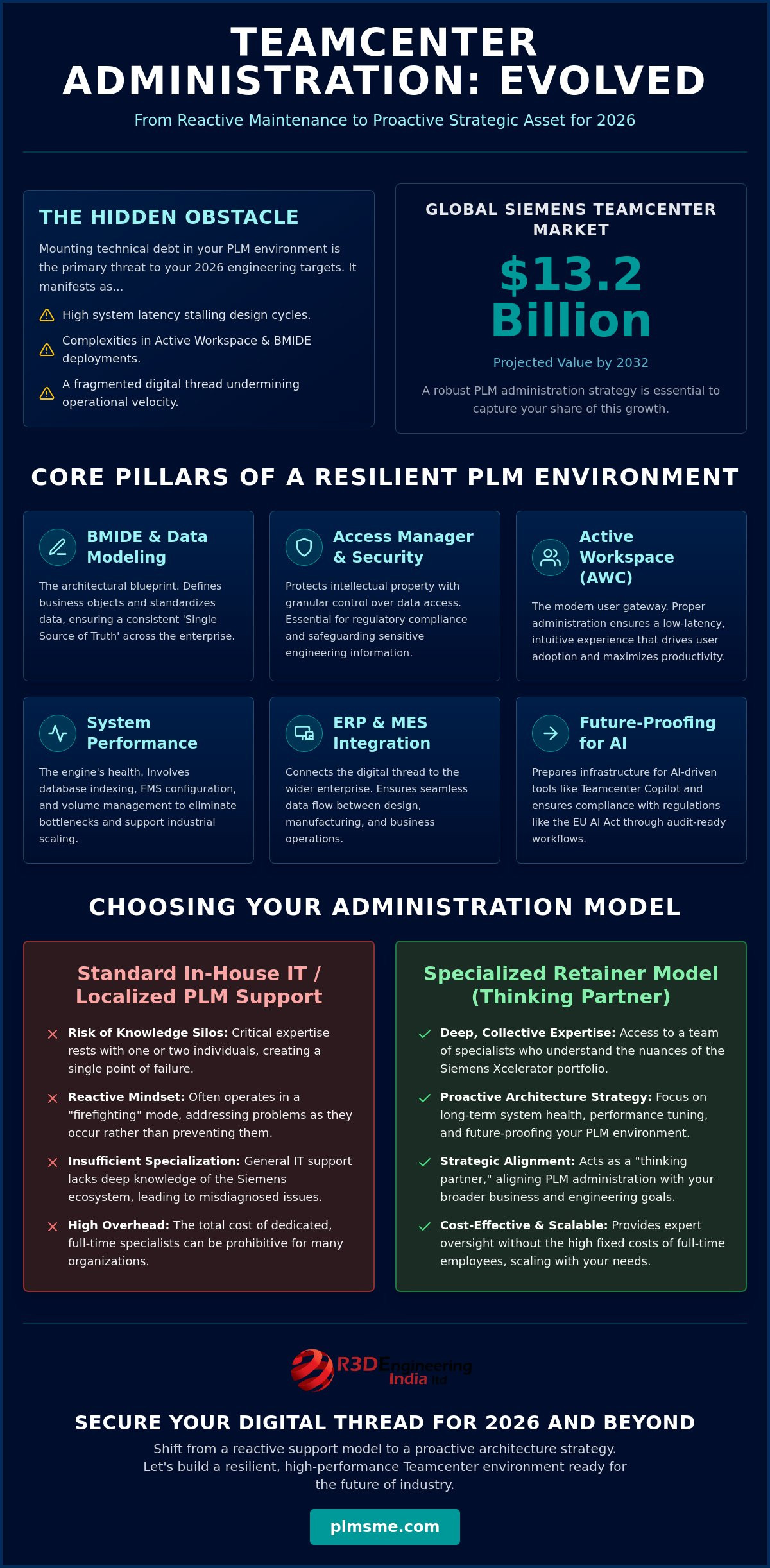
What if the primary obstacle to your 2026 engineering targets isn’t a lack of innovation, but the mounting technical debt hidden within your PLM environment? You’ve likely felt the friction of high system latency stalling your design cycles or struggled with the intricate complexities of Active Workspace updates and BMIDE deployments. It’s a common frustration for industrial leaders who recognize that a fragmented digital thread directly undermines operational velocity, especially as the Global Siemens Teamcenter Market grows toward a projected $13.2 billion by 2032.
We understand that managing a complex ecosystem while integrating with ERP and MES systems requires more than just basic upkeep. Effective Teamcenter system administration is now a strategic necessity for securing your digital thread and ensuring your infrastructure can handle the demands of the newly released Teamcenter 2606. This guide explores how expert administration optimizes system performance and reduces the technical overhead that often hampers complex industrial operations.
You’ll discover the critical role of specialized oversight in maintaining compliance with upcoming 2026 regulations, such as the EU AI Act, which demands audit-ready workflows. We’ll also preview how a structured approach to system architecture prepares your enterprise for AI-driven tools like Teamcenter Copilot without overwhelming your internal IT resources.
Key Takeaways
- Understand why Teamcenter system administration has evolved from basic data management into a critical function for orchestrating the enterprise digital thread.
- Identify the core technical pillars, including BMIDE and Access Manager, that are essential for maintaining a secure and scalable PLM environment.
- Evaluate the financial and operational trade-offs between in-house staffing and specialized retainer models to avoid the risks of localized knowledge silos.
- Prepare your infrastructure for high-performance integrations with ERP and MES systems while ensuring your data model is ready for AI-driven automation.
- Learn how to shift from a reactive support mindset to a proactive architecture strategy that supports complex industrial growth through 2026.
Defining Teamcenter System Administration in the Modern Enterprise
The role of Teamcenter has transformed. It’s no longer just about storing 3D models or managing drawing revisions. In 2026, it functions as the central nervous system for industrial operations. This shift toward digital thread orchestration means that Teamcenter system administration must evolve from a reactive maintenance task into a proactive strategic function. It’s about ensuring that every piece of data, from initial design to manufacturing execution, flows without friction through the enterprise.
At its core, this discipline focuses on three pillars: maximizing system uptime, protecting data integrity, and facilitating seamless user accessibility. Without these, even the most advanced digitalization roadmaps fail to deliver ROI. This technical foundation is exactly why administration is inseparable from PLM system architecture consulting. You can’t design a high-performing solution if the underlying system isn’t tuned to support it. While functional support helps users navigate the interface, technical administration ensures the environment remains stable under the heavy transactional loads typical of 2026 industrial operations.
The Scope of Modern Administration
Why Standard IT Support is Often Insufficient
Standard IT teams often lack the specialized knowledge required for the Siemens Digital Industries Software ecosystem. Treating a Teamcenter database like a generic SQL instance leads to risks like data corruption or synchronization failures. Specialized Teamcenter system administration demands a deep understanding of engineering workflows. A five-second latency during a CAD save isn’t just a minor IT ticket; it’s a significant bottleneck that halts production and drains engineering resources. This requires a “thinking partner” who understands the technical nuances of the Siemens Xcelerator portfolio.
Core Pillars of a Resilient Teamcenter Environment
Maintaining a high-performing PLM environment requires more than basic troubleshooting. It demands a structured approach to the core technical pillars that govern data flow and security. When Teamcenter system administration is executed strategically, it transforms the platform from a static repository into a dynamic engine that supports rapid industrial scaling. This resilience is built on precise data modeling, rigorous access protocols, and a focus on the end-user experience through Active Workspace (AWC).
A resilient environment ensures that as your organization grows, the system doesn’t become a bottleneck. By focusing on database indexing and volume management, administrators can maintain low-latency access even as data complexity increases. This technical stability is vital for companies looking to adopt Industry 4.0 initiatives, as a modern infrastructure integrates the Siemens Teamcenter product lifecycle management software with broader enterprise automation strategies. Achieving this level of performance requires a deep dive into the following foundational areas.
BMIDE and Configuration Management
The Business Modeler IDE (BMIDE) is the primary tool for defining how your business operates within Teamcenter. It allows for the standardization of business objects and attributes across the entire enterprise, ensuring consistency in how data is categorized and retrieved. Effective administration involves managing hot-deployments carefully to update the data model without disrupting production environments. This proactive configuration management is essential to prevent PLM architecture design failures that often stem from poorly defined data schemas. If you’re unsure about your current data model’s health, a digital maturity assessment can provide the clarity needed to optimize your configuration.
Security and Access Control
Protecting intellectual property is a non-negotiable aspect of industrial operations. Utilizing the Access Manager and its Rule Tree logic allows administrators to implement complex permission structures that mirror organizational hierarchies. This is particularly critical for managing secure login protocols for shop-floor access, where RFID or multi-factor authentication might be required. In the UAE, auditing user activities is not just a best practice; it’s a necessity for ensuring data sovereignty and compliance with local industrial regulations. To find out more about the legal frameworks that govern these data standards in the region, specialized legal counsel can provide essential support. A robust security protocol ensures that the right people have access to the right data at the right time, without compromising the integrity of the digital thread.
Optimizing Active Workspace (AWC) also plays a significant role in this pillar. By tailoring the interface for non-CAD users, administrators reduce the learning curve and improve cross-departmental collaboration. This ensures that stakeholders in procurement, manufacturing, and quality control can interact with the PLM data they need through a streamlined, high-performance web client.
Evaluating In-House vs. Retainer-Based Administration Models
Deciding how to resource your Teamcenter system administration is a pivotal business choice that dictates the long-term stability of your Product Lifecycle Management strategy. Many organizations default to in-house hiring, assuming it provides better control. However, a deeper analysis of the Total Cost of Ownership (TCO) reveals that the hidden expenses of recruitment, retention, and specialized training often outweigh the perceived benefits of a permanent headcount. When you factor in the overhead of managing a highly specialized technical role, the internal model can become surprisingly rigid and costly.
One of the most significant risks for small in-house teams is the creation of knowledge silos. When a single administrator holds the keys to your BMIDE configurations and access manager logic, your operations become vulnerable to talent churn. If that individual leaves, they take years of undocumented system context with them. This creates a single point of failure that can paralyze engineering productivity during critical project phases. A PLM administration retainer offers a scalable alternative. During major implementation phases, such as migrating to the latest Teamcenter 2606 release, you can ramp up support without the long-term commitment of hiring additional permanent staff. This flexibility ensures that your system performance remains high without bloating your fixed costs.
The Challenges of In-House Recruitment
Finding Siemens-certified talent in the national market is increasingly difficult. The scarcity of high-level administrators leads to intense competition and the risk of talent poaching. Beyond the salary, the cost of keeping an internal team updated on the evolving Siemens Xcelerator portfolio is substantial. Often, internal staff get bogged down in day-to-day tickets, leaving little room for the strategic innovation required to maintain a competitive digital thread. This gap between basic maintenance and high-level system architecture often leads to mounting technical debt. Navigating these high-stakes professional challenges can be demanding, and for those seeking expert mental health support, resources like hope-therapy-center.com provide specialized services to help maintain the mental resilience needed for such complex roles.
Benefits of a Managed Service Retainer
Shifting to a managed service model converts unpredictable capital expenditure into a predictable monthly operational expenditure (OPEX). You gain immediate access to a pool of multi-disciplinary Teamcenter experts who bring experience from diverse industrial environments. This model moves beyond reactive support. Proactive system monitoring identifies potential issues before they cause downtime, ensuring reliability for your manufacturing and engineering teams. Partnering with a specialized firm provides the wisdom of a seasoned professional who functions as a thinking partner for your long-term vision. This approach ensures your Teamcenter system administration remains agile, objective, and focused on quality rather than just checking boxes.
Future-Proofing Performance: Integrations and AI Readiness
By 2026, the definition of a successful PLM environment has shifted from internal data management to cross-platform orchestration. Your Teamcenter system administration strategy must now account for a highly interconnected ecosystem where data moves fluidly between engineering, procurement, and the shop floor. With the global Siemens Teamcenter market projected to reach 13.2 billion USD by 2032, the focus has moved toward ensuring that PLM acts as the enterprise orchestration engine. This requires more than just keeping the lights on; it demands a Teamcenter solution architecture capable of supporting real-time data exchange with ERP and MES systems.
A robust administration framework is the backbone of an industrial digitalization roadmap UAE companies are increasingly adopting to stay competitive. Without precise administrative oversight, integrations become brittle, leading to synchronization errors that compromise the digital thread. Ensuring that your system is ready for the next wave of industrial automation means prioritizing architectural stability and data cleanliness today.
Bridging the Gap with ERP and MES
Efficient manufacturing depends on the seamless transfer of the Bill of Materials (BOM) from PLM to ERP. Manual data entry is a significant source of error that can be eliminated through automated integration middleware. Administrators must maintain stable APIs to ensure that system upgrades don’t break these vital connections. Managing Manufacturing Operations Management (MOM) connectivity is equally critical, as it provides the real-time shop floor visibility needed for agile production. When these systems are properly aligned, release cycles can be significantly shortened. Some major automotive users, for instance, have reduced deployment cycles from 18 months down to 12 months through such optimized workflows.
Preparing for Industrial AI
The release of Teamcenter 2606 introduces advanced AI tools like Teamcenter Copilot and the BOM Agent. These tools are only as effective as the data they process. Teamcenter system administration now involves rigorous data cleansing and the implementation of metadata standards required for machine learning models. Administrators must also manage the increased computational load that AI-integrated PLM environments demand. Preparing for regulations like the EU AI Act requires audit-ready digital threads and explainable change workflows, making the administrator’s role in data governance more important than ever. If you need to evaluate your current system’s readiness for these advancements, consider our Teamcenter Integration Development services to build a more resilient infrastructure.
Strategic Administration with PLM-Sme FZC: The Thinking Partner Approach
Effective Teamcenter system administration is not a static task list; it’s a dynamic orchestration of engineering intent. At PLM-Sme FZC, we move beyond the traditional reactive ‘break-fix’ support model to provide a proactive solution architecture. This approach ensures that your system doesn’t just run but actively supports your evolving business goals. We function as a vendor-independent advisor, offering objective guidance that prioritizes your operational efficiency over software vendor quotas. By positioning ourselves as a boutique specialist, we deliver the agility and technical depth required to manage the sophisticated Siemens Xcelerator portfolio in high-stakes industrial environments.
Integrating administration with your long-term digital maturity goals is the only way to ensure sustainable performance. We look past immediate technical hurdles to identify how your data model and system configuration can better serve your digitalization roadmap. This strategic oversight reduces the accumulation of technical debt, which often occurs when systems are managed through short-term patches rather than architectural foresight. Our focus is on building a stable, high-performance foundation that allows your engineering teams to innovate without being hindered by system limitations.
Our Methodology for System Health
We maintain system integrity through a structured cycle of regular audits and digital maturity assessments. These evaluations provide a clear baseline of your current capabilities and highlight areas where performance can be optimized or security tightened. We provide customized reporting that moves beyond raw uptime statistics to analyze user adoption rates and system bottlenecks. This transparency allows decision-makers to see the direct impact of administrative efforts on engineering productivity. PLM-Sme FZC defines its ‘Thinking Partner’ philosophy as a commitment to aligning every technical decision with our client’s long-term industrial vision.
National Support for UAE Manufacturers
Operating from our central consultancy, we provide expert guidance to manufacturers across all Emirates, from the industrial hubs of Abu Dhabi to the innovation centers in Dubai and Sharjah. We understand the specific national industrial regulations and security requirements that govern data sovereignty within the UAE. This regional expertise ensures that your Teamcenter environment remains compliant while performing at the highest level. Whether you are managing a complex discrete manufacturing facility or a specialized engineering firm, our retainers are tailored to meet the unique demands of your operation. Please contact us to discuss your Teamcenter administration needs and learn how a proactive partnership can secure your digital thread.
Securing Industrial Velocity through 2026
The industrial landscape of 2026 demands a shift from reactive troubleshooting to proactive orchestration. A stable PLM environment isn’t just about uptime; it’s the foundation for AI-driven automation and seamless cross-platform data flow. Effective Teamcenter system administration ensures your digital thread remains unbroken while reducing the technical debt that often stalls innovation. By moving away from localized knowledge silos and adopting a strategic support model, your organization maintains the agility required for rapid deployment cycles and long-term scalability.
As a Siemens Digital Industries Alliance Partner, PLM-Sme FZC provides the specialized expertise needed to navigate complex ERP, MES, and MOM integrations. We function as a vendor-independent strategic advisory, focusing on your specific operational vision rather than generic software maintenance. Our methodology prioritizes transparency and tailored quality to ensure your infrastructure is ready for the next decade of industrial growth. We’re committed to helping you build a resilient foundation that turns your data into a decisive competitive advantage.
Secure your digital future with a PLM Administration Retainer and transform your system into a high-performance asset. We look forward to partnering with you to achieve industrial excellence.
Frequently Asked Questions
What is the difference between a Teamcenter system administrator and a PLM administrator?
Teamcenter system administration focuses on the technical infrastructure, server-side components, and database integrity of the Siemens software. A PLM administrator often has a broader functional scope, managing business processes, user training, and cross-platform workflows. While the roles overlap, the system admin is the guardian of the technical foundation, ensuring the environment remains stable and performant under heavy transactional loads.
How does a PLM administration retainer reduce technical debt over time?
A retainer model shifts focus from reactive “break-fix” cycles to proactive architectural maintenance. By conducting regular system audits and implementing standardized data models through BMIDE, administrators prevent the accumulation of inefficient patches. This methodical approach ensures that system configurations remain clean and documented, which simplifies future upgrades and prevents the performance degradation typically caused by years of unmanaged customizations.
Can Teamcenter administration be handled remotely for UAE-based companies?
Remote Teamcenter system administration is a standard practice for UAE-based manufacturers, provided that secure VPN or dedicated connection protocols are established. This allows specialized consultants to monitor server health, manage deployments, and troubleshoot latency issues without the need for a physical on-site presence. It ensures immediate access to expert oversight while maintaining compliance with local data residency and security requirements across the Emirates.
What are the most common performance bottlenecks in a Teamcenter environment?
Performance issues often stem from inefficient database indexing, unoptimized FMS configurations, or bloated volume servers. High latency is also frequently caused by complex Access Manager rule trees that haven’t been streamlined. Identifying these bottlenecks requires regular monitoring of server logs and transactional data to ensure that engineering workflows, such as large assembly saves, remain responsive and efficient for all users.
How often should we perform a system health check on our Teamcenter installation?
We recommend performing a comprehensive system health check at least once per quarter. These assessments should evaluate database growth, volume server capacity, and user adoption metrics to identify emerging risks. More frequent checks are necessary before and after major milestones, such as a major version migration or the deployment of new integrations with enterprise ERP and MES systems.
Does PLM-Sme FZC provide support for Active Workspace customization and administration?
PLM-Sme FZC provides full support for Active Workspace administration, including the configuration of stylesheets, tiles, and workspace folders. Our team focuses on tailoring the user interface to meet the specific needs of non-CAD users, ensuring that procurement and quality teams can access critical data easily. We also manage the underlying indexing and gateway services required to keep the web-based environment fast and reliable.
What certifications should a professional Teamcenter administrator hold?
A professional administrator should ideally hold Siemens Certified Professional credentials specifically for Teamcenter Installation and Administration. Experience with BMIDE configuration and Active Workspace setup is also critical for modern environments. Beyond formal certifications, a seasoned expert should demonstrate a deep understanding of Teamcenter solution architecture and a track record of managing complex industrial environments that involve multi-system integrations.