
Industrial Digitalization Consultant Dubai: Navigating UAE Manufacturing in 2026
Most UAE manufacturers assume that purchasing a high-end software license is the finish line for digital transformation; in reality, it’s often the start of a costly integration nightmare. You’ve likely felt the frustration of data trapped in silos, where your ERP doesn’t talk to the shop floor and your engineering data feels disconnected from production. It’s exhausting to manage fragmented systems while trying to meet the UAE’s 2026 sustainability mandates and aggressive productivity goals. You need a system that works, not just a folder full of expensive licenses.
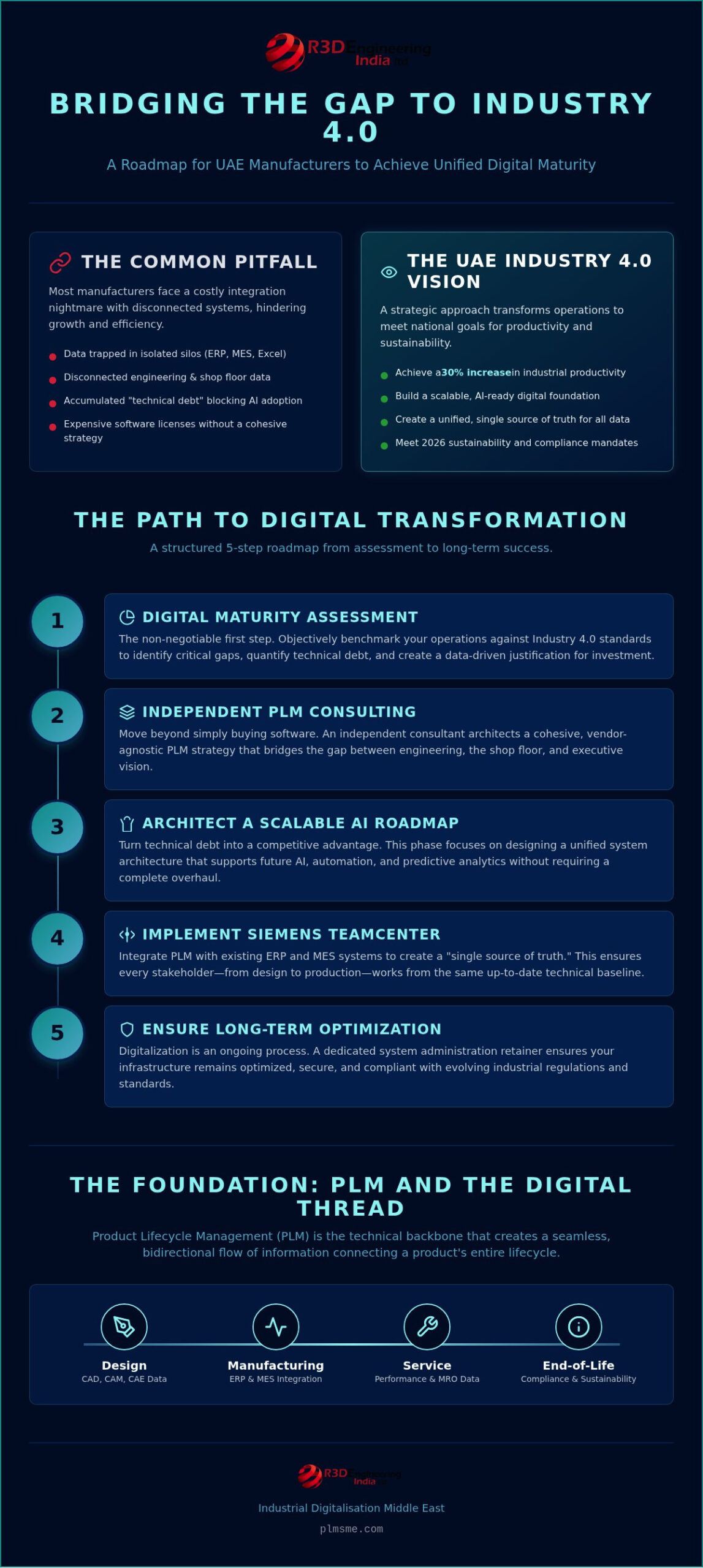
Partnering with a specialized industrial digitalization consultant Dubai ensures you move beyond simply buying tools to building a cohesive, AI-ready PLM architecture. This article explores how to bridge the gap between legacy processes and Siemens Teamcenter 2606 to achieve the 30% productivity gains targeted by the UAE Industry 4.0 program. We’ll examine the shift from fragmented data to unified digital maturity, providing a clear roadmap for manufacturers to transition into a more competitive, automated future. You’ll discover how a strategic approach turns technical debt into a scalable foundation for AI implementation and long-term operational success.
Key Takeaways
- Identify why a formal Digital Maturity Assessment is the non-negotiable first step for any manufacturer transitioning to Industry 4.0.
- Understand how an industrial digitalization consultant Dubai provides the objective architecture needed to bridge gaps between engineering, the shop floor, and executive levels.
- Learn the difference between simply purchasing software licenses and architecting a vendor-independent PLM strategy that supports long-term growth.
- Explore the methodology for integrating Siemens Teamcenter with existing ERP and MES systems to create a single, AI-ready source of truth.
- Discover how a dedicated system administration retainer ensures your digital infrastructure remains optimized and compliant with evolving industrial regulations.
Navigating Industrial Digitalization in the UAE Manufacturing Sector
Industrial digitalization across the UAE has evolved beyond simple automation. By 2026, the sector has shifted toward a sophisticated integration of Product Lifecycle Management (PLM), Enterprise Resource Planning (ERP), and Artificial Intelligence (AI). This convergence is the engine behind the UAE Industry 4.0 program, which targets a 30% increase in industrial productivity. However, achieving these gains requires more than off-the-shelf software. Many manufacturers realize that a generalist consultant lacks the technical depth to bridge the gap between engineering and the shop floor. Engaging a specialized industrial digitalization consultant Dubai is essential to dismantle data silos that broader strategy firms often overlook.
Digitalization is no longer a series of isolated IT projects. It has become a long-term strategic vision. Success depends on moving away from reactive software patches toward a structured architecture that supports the Fourth Industrial Revolution. Without this foresight, companies accumulate technical debt that makes future AI adoption nearly impossible. True transformation requires a roadmap that treats data as a continuous asset rather than a departmental byproduct.
The Role of PLM in the Digital Thread
Product Lifecycle Management serves as the technical foundation for all industrial data. While ERP manages the business transactions, PLM manages the product’s intellectual property. It connects CAD, CAM, and CAE data directly to the broader manufacturing ecosystem. This integration ensures that every stakeholder works from the same technical baseline. For UAE manufacturers, the Digital Thread is the seamless, bidirectional flow of information that connects a product’s design, manufacturing, and service data into a single, accessible record. This connectivity ensures that engineering changes are reflected instantly on the production line, reducing errors and waste.
Addressing the Fragmented Data Challenge
The most common pitfall in national digital transformation is the “island of automation” effect. Manufacturers often deploy advanced MES or ERP systems that don’t communicate with each other. This fragmentation creates significant barriers to AI readiness. You can’t run predictive analytics if your shop floor data is trapped in an Excel sheet while your procurement is in a siloed ERP. This lack of transparency leads to inflated operational costs and missed production targets.
Technical debt is the hidden cost of these fragmented systems. It slows down manufacturing agility and increases the risk of failed software implementations. A qualified industrial digitalization consultant Dubai focuses on creating a unified system architecture. This approach ensures that data flows naturally between departments, allowing for real-time decision-making and a clear path toward autonomous operations. By resolving these silos early, manufacturers can build a scalable foundation that accommodates future technological shifts without requiring a total system overhaul.
Conducting a Digital Maturity Assessment for Industrial Operations
Every successful digitalization roadmap begins with an objective baseline. You can’t navigate toward an AI-ready architecture if you don’t have a transparent view of your current technical debt and system capabilities. A digital maturity assessment serves as this diagnostic foundation, benchmarking your existing shop floor and back-office operations against global Industry 4.0 standards. This process isn’t about criticizing current methods; it’s about identifying the specific gaps that hinder scalability and data flow. For manufacturers participating in the national Smart Manufacturing Initiative, these reports provide the data-driven justification needed for large-scale capital investments.
The tangible value of a maturity report lies in its ability to prevent over-investment. Many companies rush into purchasing advanced software licenses only to find their internal infrastructure isn’t ready to support the data load. An industrial digitalization consultant Dubai ensures that your technology stack evolves in lockstep with your team’s capabilities. By identifying which processes are ready for automation and which require manual optimization first, you avoid the high cost of failed implementations and ensure every dirham spent contributes to a unified digital vision.
The 5 Stages of Industrial Digital Maturity
Industrial maturity is a methodical progression rather than a single jump. Most manufacturers in the region currently find themselves transitioning between the second and third stages of this journey. Understanding where you sit on this scale is vital for setting realistic milestones for a 2026-2030 roadmap:
- Stage 1: Computerization – Isolated use of digital tools and legacy systems with manual data entry.
- Stage 2: Connectivity – Networked systems that allow for basic data exchange, though information often remains in silos.
- Stage 3: Visibility – A “digital shadow” of operations where real-time data is accessible across the enterprise.
- Stage 4: Transparency – Systems that don’t just show what is happening, but use data to explain why it’s happening through root cause analysis.
- Stage 5: Predictability and Self-Optimization – Fully autonomous operations where AI-driven models simulate scenarios and optimize production without human intervention.
The Strategic Value of a Digital Maturity Report
Working with an industrial digitalization consultant Dubai provides the neutral oversight needed to benchmark these stages accurately. A comprehensive report defines the specific KPIs for your assessment, such as data accuracy rates, system interoperability, and workforce digital literacy. Understanding The Strategic Value of a Digital Maturity Report in Manufacturing allows leadership to prioritize high-impact projects that build the “Digital Thread” mentioned previously. If you’re ready to move beyond fragmented systems, scheduling a formal digital maturity assessment is the most reliable way to define your technical trajectory for the coming decade.
Evaluating Independent PLM Consulting vs. Vendor Implementation
Choosing between a software reseller and a strategic advisor is often the difference between owning a tool and achieving a transformation. Resellers are primarily incentivized by license volume, which can lead to bloated software packages that don’t align with your actual operational needs. An industrial digitalization consultant Dubai focuses instead on the structural integrity of your data. This independence is crucial for building a vendor-neutral architecture. Even when utilizing powerful platforms like Siemens Teamcenter, your system must be designed to communicate effectively with existing ERP and CRM stakeholders without creating restrictive vendor lock-in.
Managing the relationship between these different stakeholders is a complex task that requires a neutral perspective. Engineering teams, procurement departments, and sales offices all have different data priorities. A strategic consultant acts as a bridge, ensuring that the “Digital Thread” remains unbroken across the entire organization. Hiring a specialized boutique consultancy is often more cost-effective than engaging a mass-market firm. You gain access to seasoned professionals who have navigated complex industrial challenges and possess the technical depth to offer bespoke advice rather than one-size-fits-all solutions.
Prioritizing Architecture Over Licenses
Many industrial projects fail because they follow a software-first mentality. Buying a license before mapping your internal processes is like purchasing a roof before the foundation is poured. This backwards approach leads to expensive technical debt and systems that your team won’t actually use. A boutique specialist acts as a thinking partner for the board, providing the technical clarity needed to align digital goals with business outcomes. Understanding The Role of PLM in System Architecture Consulting helps leadership see beyond the software interface to the underlying data structures that drive long-term value. This oversight ensures that your digital infrastructure is built to scale as your manufacturing requirements evolve.
Managing Siemens Teamcenter Ecosystems
While independence is vital, working with a Siemens Digital Industries Alliance Partner provides essential access to the latest technical standards and support. The release of Teamcenter 2606 in June 2026 introduced sophisticated AI-powered features and enhanced visual experiences that require precise configuration to be effective. A qualified industrial digitalization consultant Dubai balances these standard features with bespoke integration development. This ensures that your Teamcenter environment isn’t just an “out of the box” installation, but a tailored engine that supports your specific manufacturing workflows. By focusing on tailored quality rather than mass-market deployment, you ensure your system remains agile and compliant with the region’s shifting regulatory requirements.
Architecting a Scalable Roadmap for AI and Industrial Automation
Creating a roadmap for industrial AI requires more than selecting an algorithm; it demands a structural overhaul of how data flows from engineering to the factory floor. While many firms focus on the user interface of AI tools, a specialized industrial digitalization consultant Dubai prioritizes the underlying data integrity. This involves preparing your technical architecture for advanced capabilities like Predictive Maintenance and Generative Design. By structuring your Product Lifecycle Management (PLM) data correctly today, you ensure that future AI models have the high-fidelity information required to generate accurate simulations and operational insights. Understanding these Industrial Automation Solutions in the GCC: Strategic Trends for 2026 is essential for staying competitive in a rapidly evolving market.
The transition to autonomous operations depends on the seamless integration of PLM with Enterprise Resource Planning (ERP), Manufacturing Execution Systems (MES), and Manufacturing Operations Management (MOM). This connectivity creates a closed-loop system where real-time shop floor data informs engineering decisions and vice versa. Without this integration, AI remains a localized experiment rather than an enterprise-wide asset. A methodical approach ensures that your automation strategy scales alongside your production volume, avoiding the common trap of isolated “islands of technology” that cannot communicate with one another.
The Synergy of PLM and ERP Integration
Successful Siemens Teamcenter implementations often hinge on how well the system communicates with the broader business ecosystem. Best practices for Teamcenter and ERP connectivity involve establishing a “single source of truth” where engineering data is automatically pushed to procurement and production modules. By utilizing automated MOM integrations, manufacturers can reduce data duplication and eliminate the manual errors that frequently plague complex assembly lines. Synchronizing engineering data with procurement through PLM-ERP integration reduces time-to-market by eliminating manual data reentry and ensuring supply chain visibility during the design phase.
Future-Proofing with AI Readiness
Assessing a manufacturer’s AI readiness is a core capability of a seasoned industrial digitalization consultant Dubai. This assessment looks beyond your current hardware to evaluate the cleanliness and accessibility of your product data. High-quality PLM data is the primary fuel for training manufacturing AI models; poor data leads to unreliable predictions and increased operational risk. Establishing a digital vision that scales ensures that your current investments in PLM and automation are not rendered obsolete by the next wave of technological innovation. If you are ready to architect a data structure that supports autonomous manufacturing, you can book a roadmap consulting session to define your path toward AI integration.
Implementing Siemens Teamcenter with PLM-Sme FZC
PLM-Sme FZC functions as a Siemens Digital Industries Alliance Partner, delivering end-to-end implementation support that addresses the specific needs of the UAE’s manufacturing landscape. We don’t just install software; we architect the digital backbone of your operations. As an industrial digitalization consultant Dubai, our focus remains on ensuring that Siemens Teamcenter 2606 integrates seamlessly with your existing ERP and MES systems. This holistic approach bridges the gap between executive vision and shop-floor execution, turning complex data into a strategic asset.
Strategic Consulting for National Growth
Success in the discrete manufacturing sector depends on alignment with national goals for productivity and sustainability. By Building a Strategic Industrial Digitalisation Roadmap for UAE Manufacturing in 2026, companies can establish a clear trajectory for digital excellence. We provide the technical depth required to support these national industrial strategies, offering case studies in discrete industry transformation that demonstrate the value of a structured, architecture-first approach. Our independent perspective ensures that your roadmap prioritizes operational efficiency over vendor-driven software packages.
Support and Managed Services
Ongoing maintenance is critical for protecting your digital investment and reducing technical debt. A dedicated PLM system administration retainer offers the specialized support needed to keep your systems running at peak performance while managing regular updates and security patches. This managed service model provides the stability of an expert team without the costs associated with full-time internal hires. As your industrial digitalization consultant Dubai, we provide the system and solution architecture necessary for long-term scalability, ensuring your data remains AI-ready as technology evolves.
Taking the first step toward a unified digital thread requires an objective understanding of your current capabilities. Contacting PLM-Sme FZC for a digital maturity assessment provides the diagnostic baseline needed to begin your transformation. We work as a collaborative thinking partner to define your technical requirements and execute a roadmap that delivers measurable results.
Architecting the Future of UAE Manufacturing
Navigating the complexities of the 2026 industrial landscape requires a shift from reactive software procurement to proactive system architecture. Success depends on establishing a clear digital thread that connects engineering, procurement, and production through a unified PLM foundation. By prioritizing a formal maturity assessment, manufacturers can identify technical debt and build a scalable roadmap that supports the national push for AI-driven productivity. This methodical approach ensures that your investments in automation deliver measurable long-term value rather than fragmented silos.
As a Siemens Digital Industries Alliance Partner specialized in the UAE manufacturing sector, PLM-Sme FZC provides the technical depth needed to bridge the gap between high-level vision and practical execution. Partnering with an expert industrial digitalization consultant Dubai ensures your team has the guidance required to master Siemens Teamcenter and prepare for the next generation of industrial AI. Don’t leave your digital transformation to chance; start with a data-driven strategy built for the unique demands of the region.
Request your Industrial Digital Maturity Assessment from PLM-Sme FZC to define your trajectory toward autonomous manufacturing excellence.
Frequently Asked Questions
What does an industrial digitalization consultant actually do?
An industrial digitalization consultant Dubai acts as a strategic technical advisor who aligns your manufacturing processes with advanced digital architectures. They conduct digital maturity assessments to identify operational gaps and design vendor-independent system architectures. Beyond just software selection, they manage the integration of PLM, ERP, and MES systems to ensure a continuous digital thread. This role is essential for navigating complex technical debt and preparing your data structures for future AI implementation.
How long does a typical Siemens Teamcenter implementation take in the UAE?
The duration of a Siemens Teamcenter implementation varies based on the scope of data migration and the complexity of existing integrations. A standard deployment for a mid-sized discrete manufacturer typically ranges from 6 to 12 months. More complex enterprise-level transformations involving deep ERP and MES connectivity may extend to 18 months or longer. A structured roadmap and a clear maturity assessment are vital for maintaining this timeline and avoiding common implementation delays.
Why is a digital maturity report necessary before buying PLM software?
A digital maturity report serves as a diagnostic baseline that prevents manufacturers from over-investing in unnecessary software licenses. It identifies your current technical debt and evaluates your team’s readiness to adopt new digital workflows. Without this assessment, companies often purchase advanced tools that their internal infrastructure cannot yet support. This report ensures that your digitalization roadmap is grounded in reality and focuses on high-impact projects that deliver immediate operational value.
Can PLM be integrated with my existing ERP and MES systems?
Yes, integrating PLM with ERP and MES systems is a fundamental requirement for creating a closed-loop manufacturing environment. This connectivity allows for the bidirectional flow of data between engineering and the shop floor, reducing manual data entry and errors. A specialized industrial digitalization consultant Dubai designs the architecture for these integrations, ensuring that engineering changes in PLM are reflected instantly in procurement and production schedules. This synchronization is critical for reducing time-to-market.
What is the difference between an independent PLM consultant and a software vendor?
Software vendors are primarily focused on the volume of license sales and may prioritize their own product features over your specific operational needs. In contrast, an independent PLM consultant acts as a neutral thinking partner focused on system architecture and long-term scalability. They provide objective advice on how to integrate various tools without creating vendor lock-in. This independence ensures that your digital strategy remains flexible and aligned with your unique business objectives rather than software sales targets.
How does industrial digitalization support AI adoption in manufacturing?
Industrial digitalization provides the high-fidelity data structures required to train and deploy effective AI models. AI in manufacturing relies on the digital thread created by integrated PLM and MES systems to access real-time operational data. Without a structured digital foundation, AI remains a localized experiment with limited scalability. By digitizing your product lifecycle data today, you build the necessary infrastructure for predictive maintenance, generative design, and fully autonomous production environments.
What are the costs associated with an industrial digitalization roadmap?
The investment for a digitalization roadmap depends on the depth of the assessment and the scale of the enterprise. A focused strategy engagement typically covers the maturity report and a conceptual architectural blueprint. Larger enterprise-wide blueprints involve more extensive data mapping and multi-year implementation planning. While initial costs vary, a well-structured roadmap prevents the high expenses associated with failed software implementations and redundant technical debt that often plagues unguided projects.