
PLM Consultancy Dubai: Driving Industrial Digitalization
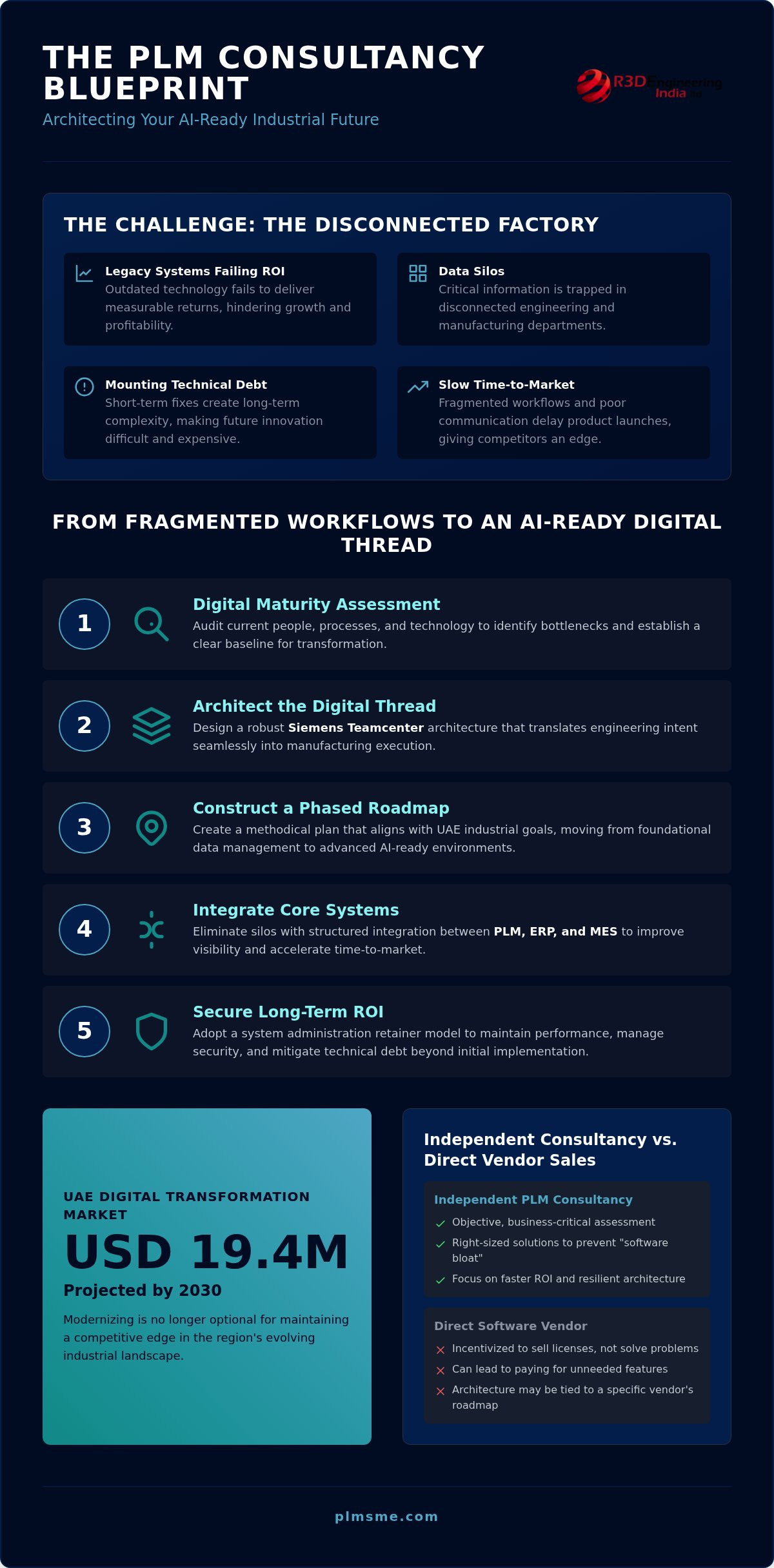
Most manufacturers view PLM as a software purchase, but it’s actually the architectural foundation that determines whether your industrial AI initiatives will succeed or stall. With the UAE digital transformation market projected to reach USD 19.4 million by 2030, the pressure to modernize is no longer optional. You’ve likely experienced the frustration of data silos between engineering and manufacturing or legacy systems that fail to deliver a clear ROI. It’s common to feel that technical debt is holding back your time-to-market goals while competitors accelerate.
Partnering with professional PLM consultancy services Dubai can bridge these gaps by moving beyond basic installations toward strategic architectural alignment. This article explores how specialized digital maturity assessments and the latest Siemens Teamcenter 2606 architecture create a roadmap for sustainable growth. We’ll examine the process of integrating PLM with ERP and MES systems to ensure your data remains a fluid, competitive asset. You’ll discover how to transition from fragmented workflows to an AI-ready digital thread that supports the UAE’s broader Industry 4.0 vision.
Key Takeaways
- Identify operational bottlenecks and establish a clear baseline for transformation by conducting a thorough digital maturity assessment of your current people, processes, and technology.
- Utilize specialized PLM consultancy services Dubai to architect Siemens Teamcenter as a robust digital thread, ensuring engineering intent is seamlessly translated into manufacturing execution.
- Construct a phased digitalization roadmap that aligns with the UAE’s industrial goals, moving methodically from foundational data management to advanced AI-ready environments.
- Eliminate data silos through structured integration between PLM, ERP, and MES systems to improve visibility and accelerate time-to-market for complex discrete products.
- Secure long-term ROI and mitigate technical debt by adopting a system administration retainer model that maintains performance and security beyond the initial implementation.
Evaluating the Impact of PLM Consultancy on Industrial Digitalization
Industrial digitalization is often mistaken for a simple software upgrade. In reality, it requires a profound shift in how an organization handles its intellectual property. Professional PLM consultancy services Dubai act as a strategic bridge, connecting engineering intent with actual manufacturing execution. While traditional systems focused on basic CAD file management, modern industrial leaders are moving toward a unified Product Lifecycle Management strategy. This transition ensures that data isn’t just stored; it’s actively driving value across the enterprise. UAE manufacturers face unique challenges, such as aligning with national industrial strategies while maintaining global competitiveness. Navigating these requirements demands a partner who understands both international standards and the local industrial ecosystem.
Success in this space rests on three core pillars that define a mature digital enterprise:
- Strategy: Defining a clear digitalization vision and roadmap that aligns with long-term business goals.
- Architecture: Designing a scalable system and solution architecture that integrates PLM with ERP and MES.
- Continuous Support: Providing ongoing system administration to manage evolution and prevent technical debt.
The Digital Thread in Discrete Manufacturing
Discrete manufacturing thrives on precision and traceability. By implementing a centralized platform, companies create a single source of truth that eliminates the friction between design teams and the shop floor. This connectivity ensures that engineering changes are reflected instantly in production schedules and quality control protocols. The Digital Thread is the backbone of Industry 4.0 readiness, providing a continuous flow of data from initial concept through to final production and maintenance.
Why Independent Consultancy Outperforms Direct Vendor Sales
Software vendors are naturally incentivized to sell licenses, often leading to “software bloat” where organizations pay for features they don’t need. An independent consultant provides an objective, neutral assessment of your specific industrial environment. This approach focuses on business-critical requirements first, ensuring the system architecture supports your long-term vision rather than just a specific vendor’s roadmap. Specialized firms are uniquely positioned to bridge the gap between IT infrastructure and engineering workflows.
Engaging PLM consultancy services Dubai ensures that your technology stack is right-sized for your current maturity level while remaining flexible for future AI integration. These consultants act as thinking partners who understand that a successful rollout requires more than just technical configuration; it requires cultural and process alignment. By prioritizing a manageable, structured solution over mass-market promises, independent advisors help you achieve a faster return on investment and a more resilient digital foundation.
Assessing Digital Maturity to Establish a Transformation Vision
Before committing to a technical overhaul, industrial leaders must understand their current baseline. A digital maturity assessment serves as a diagnostic audit of your organization’s people, processes, and technology. Without this clarity, manufacturers often invest in expensive tools that solve the wrong problems. By identifying specific bottlenecks in data flow, PLM consultancy services Dubai help firms address the root causes of increased time-to-market and material waste. This analysis isn’t just about software; it’s about evaluating how information moves from a designer’s workstation to the factory floor.
Setting realistic benchmarks is critical for securing executive buy-in and defining a clear path forward. You can learn more about The Strategic Value of a Digital Maturity Report in Manufacturing to see how these documents bridge the gap between abstract goals and concrete execution. Moving from a “current state” analysis to a “future state” vision allows you to prioritize high-impact changes that lead to measurable performance enhancements. This structured approach ensures that every step of your transformation is backed by data rather than guesswork.
Components of a Digital Maturity Report
A comprehensive report evaluates the depth of your CAD, CAM, and CAE tool utilization. It’s not enough to own the software; your teams must use it to its full potential to maintain a competitive edge. The assessment also analyzes your readiness for advanced industrial automation and AI. Mapping internal skill gaps is equally important. If your workforce isn’t prepared for a digital shift, even the most sophisticated architecture will fail to deliver results. For those ready to begin, requesting a digital maturity assessment is the most effective way to start this journey.
Establishing an AI-Ready Vision
Artificial Intelligence is the next frontier for UAE manufacturing, but AI readiness is impossible without structured, high-quality PLM data. For AI to assist in predictive engineering or maintenance, it needs a clean and reliable dataset to analyze. Your transformation vision should include specific KPIs such as innovation speed, cost reduction, and quality improvement. By partnering with PLM consultancy services Dubai, you can define exactly how AI will leverage your product data to automate complex decision-making processes. This forward-thinking strategy ensures your organization doesn’t just modernize but leads the market in technical efficiency.
Architecting Siemens Teamcenter for Seamless System Integration
Siemens Teamcenter is the preferred platform for complex discrete manufacturing in the region because it effectively manages the high-complexity data sets required by modern industrial leaders. However, the software’s inherent power requires careful configuration to deliver tangible results. Engaging Strategic Siemens Teamcenter Consulting is a critical step in ensuring the platform aligns with your specific operational needs. A well-designed architecture supports multi-site collaboration and secure remote access, which are essential as manufacturers align with national digital-transformation mandates. Expert PLM consultancy services Dubai provide the technical oversight needed to manage complex migrations from legacy PDM systems while preserving data integrity and intellectual property.
Connecting PLM with ERP, MES, and MOM
The technical challenge of integrating Siemens Teamcenter with SAP or Oracle ERP is a common hurdle for growing enterprises. Success lies in closing the loop between engineering and the shop floor through robust MES and MOM connectivity. When these systems communicate effectively, the need for manual data entry disappears. Industry benchmarks show that this level of integration can reduce manual data entry errors by as much as 40%. This shift doesn’t just save time; it ensures that the manufacturing team is always working from the most current engineering revision, preventing costly scrap and rework.
Specialized Integration Development
Standard “out-of-the-box” solutions rarely suffice for the unique workflows found in specialized industrial sectors. Customizing Teamcenter to handle specific industry standards and regional compliance requirements is often necessary. This is where PLM system architecture consulting adds the most value. By focusing on a clean, sustainable integration layer, organizations can avoid the technical debt that often plagues rushed implementations. Leveraging CAD, CAM, and CAE extensions within this architecture allows for a truly integrated product development environment. PLM consultancy services Dubai ensure these tools aren’t just installed but are strategically woven into the fabric of your daily operations.
Building a scalable system architecture is an investment in your company’s future agility. It allows you to add new capabilities, such as digital twin simulation or advanced AI analytics, without tearing down existing infrastructure. This methodical approach ensures that your PLM environment remains a stable, high-performance asset that grows alongside your business ambitions.
Constructing a National Industrial Digitalization Roadmap
Digital transformation is a multi-year journey that often fails without a structured, logical sequence. Professional PLM consultancy services Dubai provide the specialized expertise to phase this transformation, moving methodically from foundational data management to advanced AI integration. This structured approach aligns your internal roadmap with national industrial goals and UAE-wide manufacturing standards. By utilizing a framework like building a strategic industrial digitalisation roadmap for UAE manufacturing, industrial leaders can identify ‘quick wins’ early in the process. These initial successes, such as reducing engineering change order cycle times, demonstrate immediate value to stakeholders and secure the ongoing executive funding required for more complex future phases.
Phase 1: Foundation and Standardization
Establishing a solid base is the non-negotiable first priority for any industrial leader. This phase involves standardizing part numbering, Bill of Materials (BOM) management, and change control processes across the entire organization. You can’t automate a disorganized process, so cleaning up legacy data and establishing a single source of truth is essential. Eliminating paper-based workflows in favor of digital approvals and electronic signatures speeds up engineering cycles while improving traceability. During this period, consultants help you establish the necessary infrastructure for secure data hosting. Whether you opt for a cloud-first strategy or a secure on-premise environment, the goal is to create a resilient platform that supports future growth without increasing technical debt.
Phase 2: Expansion and Integration
Once the foundation is stable, the focus shifts to extending the digital thread beyond the internal engineering department. This expansion includes providing secure PLM access to suppliers and external partners, allowing for real-time collaborative design and shorter feedback loops. Integrating real-time shop floor data into the PLM environment creates a dynamic ‘Digital Twin’ that accurately reflects actual production conditions. This level of visibility allows for predictive maintenance and more accurate production scheduling. To ensure these sophisticated tools are adopted effectively, developing specialized training programs for internal teams is essential. High-quality training reduces resistance to change and ensures the organization extracts maximum value from the new system architecture. If you’re ready to define your path forward, you can start your roadmap consulting today.
Securing Long-Term ROI via PLM System Administration Retainers
Many industrial leaders view the ‘Go-Live’ milestone as the conclusion of their digital transformation project. In reality, this date marks the beginning of the system’s operational lifecycle, where the focus shifts from deployment to value extraction. Maintaining a high-performance environment requires consistent oversight to ensure the initial investment continues to yield a positive return. Utilizing PLM consultancy services Dubai for ongoing administration allows firms to adapt their system architecture as business requirements evolve. A retainer model provides a predictable cost structure that significantly reduces the total cost of ownership compared to reactive, ad-hoc support interventions. This steady approach ensures that the platform remains an asset rather than a burden as the organization grows.
The complexity of modern industrial systems means that performance issues or security vulnerabilities can emerge without warning. Relying on internal IT teams that lack specialized engineering software expertise often leads to prolonged downtime or sub-optimal configurations. A professional retainer ensures that experts who understand the intersection of IT and engineering are always available to maintain system health. This continuous improvement cycle allows for the integration of new modules or the refinement of existing workflows without the need for a complete system overhaul.
Reducing Technical Debt and System Downtime
Proactive monitoring and performance tuning of the Siemens Teamcenter environment are essential to prevent the accumulation of technical debt. Without regular maintenance, system performance can degrade, leading to user frustration and operational delays that ripple across the shop floor. Managing regular software updates and patch deployments is a complex task that must be handled without disrupting active production lines. Consultants ensure these updates are tested and deployed during planned maintenance windows, preserving system stability. Consistent administration prevents the erosion of data quality over time, ensuring the ‘single source of truth’ remains accurate and reliable for all stakeholders.
Partnering with a Siemens Digital Industries Alliance Partner
Working with a Siemens Digital Industries Alliance Partner ensures your organization has direct access to specialized technical resources and the latest industry best practices. These partners possess the deep expertise required to manage the nuances of Teamcenter’s complex architecture, especially when integrated with other enterprise systems. They also provide early-release insights for emerging AI tools, allowing you to stay ahead of technological shifts and maintain a competitive edge. This collaborative approach transforms the consultant from a service provider into a long-term thinking partner who is invested in your continued success. To secure your digital foundation and maximize system performance, Contact PLM-Sme for a professional system administration retainer.
Accelerating Your Industrial Digitalization Journey
Industrial transformation requires a methodical approach that balances high-level vision with technical precision. By establishing a clear baseline through a digital maturity assessment, manufacturers can avoid the common pitfalls of stalled legacy implementations and fragmented data silos. Utilizing professional PLM consultancy services Dubai ensures that your Siemens Teamcenter architecture is not only seamless today but also fully prepared for the AI-driven demands of tomorrow’s manufacturing landscape.
PLM-Sme operates as a boutique consultancy with national UAE coverage, functioning as a dedicated thinking partner for discrete manufacturers across the region. As a Siemens Digital Industries Alliance Partner, we specialize in end-to-end Siemens Teamcenter architecture and complex system integration. Our focus remains on delivering a clear digitalization roadmap that improves time-to-market and secures long-term ROI through proactive system administration retainers. Taking this first step toward architectural alignment is what separates industrial leaders from those hindered by technical debt. It’s time to transform your product lifecycle into a competitive advantage.
Request Your Digital Maturity Assessment from PLM-Sme to begin architecting a resilient digital future.
Frequently Asked Questions
What are the primary benefits of hiring a PLM consultant in the UAE?
Hiring a consultant provides a strategic bridge between engineering intent and manufacturing execution while ensuring compliance with UAE industrial standards. These experts offer neutral, vendor-agnostic advice to help you avoid software bloat and focus on business-critical requirements. By partnering with specialized PLM consultancy services Dubai, manufacturers can eliminate data silos and establish a resilient digital thread that supports long-term growth and national digitalization goals.
How long does a typical Siemens Teamcenter implementation take for a manufacturer?
A foundational Siemens Teamcenter implementation typically spans six to twelve months, depending on the complexity of your data environment and existing processes. The timeline is usually divided into phases, starting with a digital maturity assessment and moving through system architecture design to final deployment. Highly complex discrete manufacturing environments with multiple site integrations may require a longer, multi-year roadmap to achieve full digital maturity across all departments.
Why is a digital maturity assessment necessary before buying PLM software?
A digital maturity assessment is essential because it identifies specific operational bottlenecks and internal skill gaps before you commit capital to software licenses. This diagnostic audit ensures that the chosen technology stack is right-sized for your current capabilities and future ambitions. Without this baseline, organizations often purchase expensive features they aren’t ready to use, leading to failed implementations and a lack of clear return on investment.
Can PLM systems like Teamcenter integrate with our existing ERP software?
Siemens Teamcenter is designed to integrate seamlessly with major ERP platforms like SAP and Oracle through specialized PLM consultancy services Dubai. Closing the loop between engineering and the shop floor requires robust connectivity between PLM, ERP, and MES systems. This integration eliminates manual data entry, which industry benchmarks suggest can reduce data errors by up to 40% while ensuring that manufacturing teams always use the latest engineering revisions.
What is the difference between an independent PLM consultant and a software vendor?
An independent consultant acts as a neutral “thinking partner” focused on system architecture and long-term business outcomes, whereas a software vendor is primarily motivated by license sales. Consultants prioritize your specific industrial challenges and provide objective advice on which tools actually add value. This independence allows them to bridge the gap between IT infrastructure and engineering workflows without being tied to a specific vendor’s sales targets or proprietary roadmap.
How does PLM support the implementation of Industrial AI?
PLM serves as the essential foundation for Industrial AI by creating a structured digital thread of high-quality, reliable product data. AI models require clean and organized datasets to perform predictive engineering, maintenance, or automated decision-making. Without a mature PLM environment to manage this data, AI initiatives often fail because the underlying information is fragmented or inconsistent. A well-architected PLM system ensures your data is AI-ready from the start.
What are the ongoing costs associated with PLM system administration?
Ongoing costs typically include system administration retainers for proactive monitoring, patch management, and performance tuning of the Siemens Teamcenter environment. These retainers are designed to reduce the total cost of ownership by preventing technical debt and minimizing system downtime. While costs vary based on the level of support required, a retainer model is consistently more cost-effective than relying on ad-hoc, reactive fixes when critical system issues arise during production.
How do we measure the ROI of our industrial digitalization roadmap?
Measuring ROI involves tracking specific performance KPIs such as reduced engineering change cycle times, lower manufacturing scrap rates, and improved time-to-market for new products. You should also consider the reduction in manual data entry errors and the increased efficiency of cross-departmental collaboration. A structured digitalization roadmap allows you to identify ‘quick wins’ in the early phases, providing tangible evidence of value to secure ongoing executive funding for your transformation.