
Building a Business Case for Digitalization in Manufacturing: A Strategic Framework for 2026
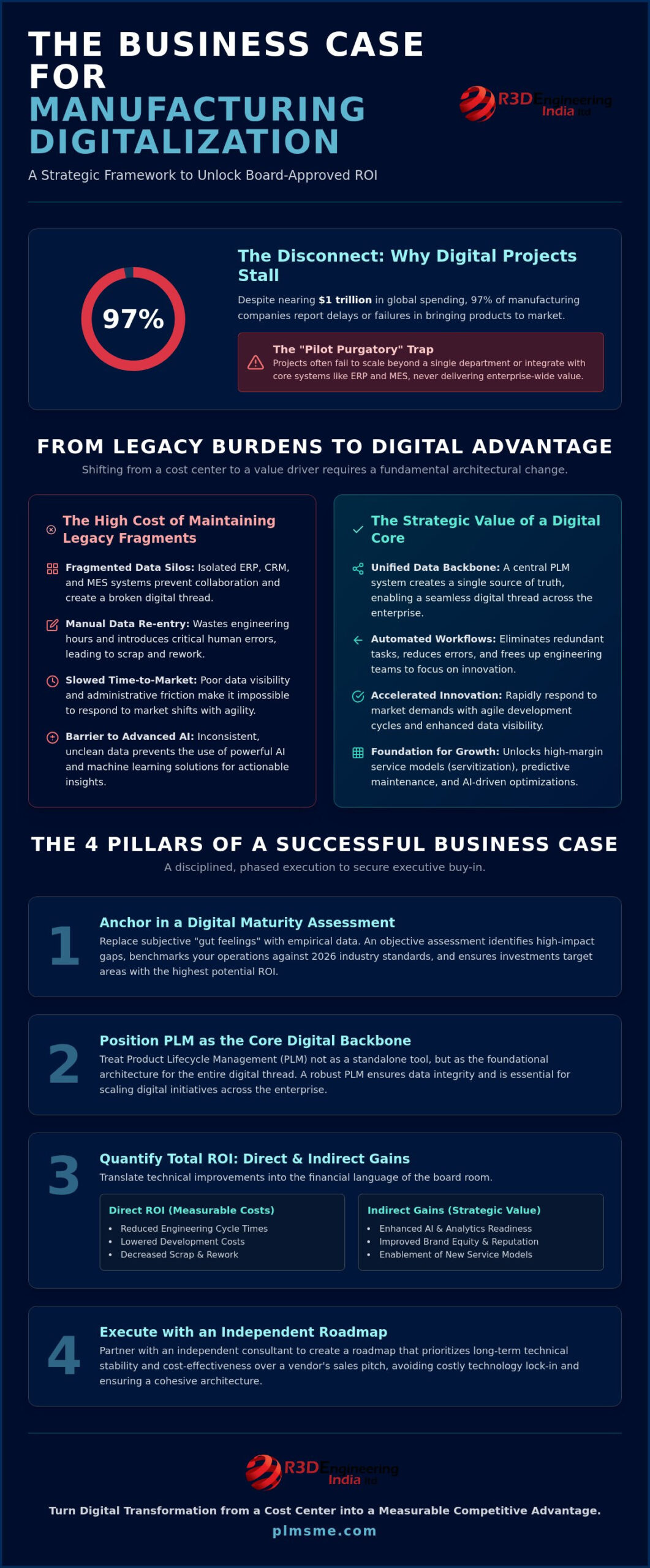
Why do 97% of manufacturing companies report delays or failures in bringing products to market, even as global spending on digital transformation accelerates toward $1 trillion? The disconnect isn’t usually the technology itself; it’s the inability to bridge the gap between technical potential and fiscal reality when building a business case for digitalization in manufacturing. You’ve likely felt the frustration of trying to explain how a PLM upgrade or a new digital thread reduces development costs by 50% only to be met with skepticism from the board. Without a structured approach, digital projects often end up in “pilot purgatory,” never scaling beyond a single department or failing to integrate with ERP and MES systems.
You aren’t alone in facing these hurdles. This guide provides a strategic framework for 2026 that transforms technical digitalization goals into a board-approved roadmap anchored in financial ROI. We’ll explore how to measure digital maturity, justify the value of independent consultancy over vendor-led implementation, and move from fragmented systems to a cohesive, high-performance architecture. By aligning your technical vision with a disciplined investment strategy, you can turn digital transformation from a cost center into a measurable competitive advantage.
Key Takeaways
- Learn why building a business case for digitalization in manufacturing requires shifting from viewing technology as a software purchase to a structural, strategic roadmap.
- Discover how an objective digital maturity assessment identifies high-impact gaps, ensuring your investments target areas with the highest potential for operational efficiency.
- Understand the role of PLM as a foundational backbone and why robust system architecture is essential for scaling digital threads across the entire enterprise.
- Master the methodology for quantifying both direct ROI, such as reduced engineering cycle times, and indirect gains like AI readiness and improved brand equity.
- Identify the critical differences between vendor-led sales pitches and independent roadmaps that prioritize long-term technical stability and cost-effectiveness.
Defining the Business Case for Industrial Digitalization
Digitalization is frequently misunderstood as a series of isolated software upgrades or a localized IT project. In reality, it represents a structural pivot that redefines how a company operates, competes, and survives. When building a business case for digitalization in manufacturing, executives often struggle because they focus on the features of a tool rather than the strategic resilience of the organization. A successful case doesn’t just ask for budget; it demonstrates how digital connectivity eliminates the compounding interest of technical debt and fragmented data silos. By positioning transformation as a strategic imperative, you move the conversation from “what does this cost” to “what is the cost of doing nothing.”
The High Cost of Maintaining Legacy Fragments
Stagnation is never free. It carries a hidden tax that manifests as manual data re-entry and administrative friction. Engineering teams often spend hours manually transferring data from CAD environments to ERP systems because their software doesn’t communicate. This redundancy doesn’t just waste time; it introduces human error that leads to scrap and rework. Poor data visibility creates a ripple effect, slowing down time-to-market and making it impossible to respond to market shifts with agility. Without a unified data backbone, the promise of Smart manufacturing remains an unreachable concept. Fragmented systems act as a barrier to advanced AI solutions, as these technologies require clean, integrated data sets to provide actionable insights.
Shifting from Cost-Center to Value-Driver
Anchoring the Case in a Digital Maturity Assessment
Attempting to secure capital without a baseline is a common reason digital projects fail. Every robust strategy for building a business case for digitalization in manufacturing must begin with an objective digital maturity assessment. This process removes the guesswork from the proposal. It replaces subjective “gut feelings” with empirical data that highlights exactly where the organization stands relative to 2026 industrial standards. By benchmarking current operations, you can justify investment not as a generic tech spend, but as a specific remedy for identified operational weaknesses.
A structured assessment acts as a diagnostic tool. It uncovers the technical debt that often hides beneath the surface of daily production. When you present a case to the board, they aren’t just looking for new tools; they’re looking for evidence that the proposed changes will actually move the needle on performance. Starting with a clear maturity profile ensures that the roadmap is grounded in reality. It allows you to move from conceptual ambition to a disciplined, phased execution that addresses the most critical bottlenecks first.
Identifying Strategic Gaps in the Value Chain
A comprehensive audit examines more than just software. It assesses the health of your data infrastructure and AI readiness. Many manufacturers find that their existing ERP, CRM, and MES systems operate in isolation, creating fragmented workflows. These departmental silos hinder cross-functional collaboration and create friction in the digital thread. Understanding how these factors affect manufacturing upgrading is critical for long-term scalability. Without this clarity, companies risk investing in advanced AI or automation tools that their current infrastructure cannot support. Mapping these gaps early ensures that the foundation is strong enough for future growth.
Evidence-Based Decision Making for the Board
Executives require clarity and risk mitigation. Using a Digital Maturity Report allows you to translate complex technical gaps into prioritized investment phases. This report provides a maturity score that serves as a common language between engineering and the finance department. When you present a “current state vs. future state” visual roadmap, you reduce investment risk by targeting validated bottlenecks. This approach demonstrates a level of oversight that vendor-led pitches often lack. Engaging with a specialist to conduct a digital maturity assessment is the most reliable way to ensure your building a business case for digitalization in manufacturing is both ambitious and achievable.
Positioning PLM as the Core Digitalization Backbone
Successful manufacturing digitalization doesn’t start with the shop floor; it starts with the product data. While many organizations prioritize ERP systems for financial management, the real engine of innovation is Product Lifecycle Management (PLM). When building a business case for digitalization in manufacturing, you must position PLM as the central source of truth for the entire enterprise. Without this foundation, your digital thread remains broken. This fragmentation leads to data silos that stall engineering efficiency and compromise product quality. Moving beyond basic CAD management to full lifecycle oversight is the only way to ensure your technical goals align with your business outcomes.
The goal isn’t just to store files, but to create a seamless flow of information from initial ideation through to retirement. Integrating PLM with ERP and MES systems allows for a bidirectional exchange of data that eliminates manual entry errors. This connectivity ensures that engineering changes are reflected on the factory floor instantly, reducing scrap and rework. By establishing PLM as the backbone, you create a scalable environment capable of supporting advanced technologies like AI and autonomous production systems.
Siemens Teamcenter: More Than Just Software
Siemens Teamcenter has become the industry standard for discrete manufacturing because it manages complex product data across global teams with precision. It isn’t just a repository. A comprehensive deployment involves end-to-end implementation support and strategic data migration to ensure legacy information remains both accessible and accurate. By integrating CAD, CAM, and CAE extensions into a unified digital environment, engineering teams reduce the friction of switching between disparate tools. Maintaining peak system performance is equally vital, which is why a PLM system administration retainer is a critical component of a sustainable, long-term business case.
Architecture Design as a Success Predictor
The ROI of your digital investment isn’t determined by the software license itself, but by the underlying system design. Engaging in PLM system architecture consulting ensures your infrastructure is built for long-term scalability rather than short-term fixes. Vendor-independent design helps you avoid technical debt by creating a system that prioritizes your unique workflows over a software provider’s default settings. This architectural clarity enables interactive connections between PLM and Manufacturing Operations Management (MOM) systems. It bridges the gap between the virtual design and physical production, ensuring every engineering update is reflected on the shop floor in real time.
Quantifying ROI and Financial Justification
Securing board approval requires moving beyond technical jargon to hard financial metrics. Generic ROI templates often fail because they don’t account for the specific engineering complexities inherent in production. When building a business case for digitalization in manufacturing, your financial model must distinguish between immediate operational savings and long-term strategic value. Direct ROI is often found in the reduction of scrap and rework, which can be quantified through existing quality management data. Indirect ROI, while harder to measure, includes improved brand equity and the foundational AI readiness required to stay competitive in a hyper-connected market.
Delaying these investments carries a significant opportunity cost. As competitors adopt AI-enabled digital threads to achieve a 50% reduction in development costs, those relying on legacy systems face increasing margin compression. A phased investment strategy allows you to manage cash flow while demonstrating incremental value. This approach builds trust with stakeholders and ensures that each stage of the digitalization journey pays for the next. Research indicates that 72% of manufacturers using machine learning already report reduced costs, proving that the financial benefits are tangible for those who execute with a clear plan.
The 5-Step Financial Modeling Process
A disciplined approach to modeling ensures that every dollar spent is tied to a specific business outcome. Use this structured progression to build your case:
- Audit current inefficiencies: Identify labor costs tied to manual data entry and fragmented workflows between CAD and ERP.
- Estimate productivity gains: Use industry benchmarks, such as the 30% faster time-to-market enabled by digital threads, to project revenue increases.
- Factor in specialized support: Account for the cost-reduction provided by a PLM administration retainer compared to the expense of hiring and training full-time internal experts.
- Project long-term savings: Calculate the reduction in technical debt and the lower total cost of ownership achieved through scalable architecture.
- Phase the rollout: Align technology spending with specific business milestones to maintain liquidity and reduce upfront risk.
Speaking the Language of the CFO
To win over financial leadership, you must present your case using Net Present Value (NPV) and Internal Rate of Return (IRR). CFOs prioritize risk mitigation, so a roadmap that utilizes expert implementation rather than unproven internal trials is highly persuasive. Building a business case for digitalization in manufacturing is ultimately a risk management exercise. The true ROI of digitalization includes the ability to pivot to new market demands in 2026. This agility is what separates market leaders from those stuck in “pilot purgatory.”
If you’re ready to quantify your transformation, our team can help you develop a customized financial justification for your digitalization projects that stands up to executive scrutiny.
Executing the Vision with an Independent Roadmap
The final step in securing board approval is demonstrating a clear path from investment to operational reality. Many manufacturers fall into the trap of following a vendor-led sales pitch, which often prioritizes software license quotas over actual process efficiency. An independent advisor provides a neutral perspective, ensuring that the technology stack is tailored to your specific workflows. By building a strategic industrial digitalization roadmap, you move away from generic solutions and toward a system that actually supports your engineering and production requirements. This objectivity is a critical component when building a business case for digitalization in manufacturing, as it proves to stakeholders that the chosen path is based on technical merit rather than marketing pressure.
Developing a Bespoke Digital Vision
The Role of End-to-End Implementation Support
Establish your digitalization vision with a professional roadmap to ensure your transformation is grounded in technical excellence and strategic clarity.
Driving Competitive Advantage Through Strategic Execution
The manufacturing landscape of 2026 demands a shift from reactive technology purchases to proactive strategic frameworks. Successfully building a business case for digitalization in manufacturing requires an objective understanding of your current digital maturity and a clear vision for integrating PLM as your data backbone. By quantifying both direct and indirect ROI, you transform technical goals into a language that resonates with executive leadership. This approach ensures that every investment is tied to measurable operational excellence and long-term resilience.
As a Siemens Digital Industries Alliance Partner, PLM-Sme FZC functions as your independent thinking partner. We specialize in Siemens Teamcenter and the complex integrations between PLM, ERP, and MES systems that define modern discrete manufacturing. Our technical depth ensures your roadmap is both stable and financially justified, avoiding the common pitfalls of vendor-biased implementation. We focus on creating a cohesive digital thread that supports your specific engineering and production workflows.
Secure your manufacturing future with a Digital Maturity Assessment from PLM-Sme FZC. Taking this first step provides the empirical evidence needed to move from conceptual planning to board-approved execution. Your journey toward a resilient, AI-ready enterprise starts with a validated baseline and a partner who understands the complexities of industrial transformation.
Frequently Asked Questions
What is a business case for digitalization in manufacturing?
A business case for digitalization in manufacturing is a strategic document that justifies technology investments by aligning technical capabilities with specific financial outcomes. It moves beyond a simple software purchase to outline a structural roadmap for value delivery and operational resilience. This document provides the board with the evidence needed to approve capital expenditure by demonstrating how digital tools will solve existing bottlenecks and drive long-term growth.
How do you calculate the ROI of a PLM system like Siemens Teamcenter?
Calculating ROI involves measuring direct cost reductions in engineering cycle times, scrap, and rework. You also need to factor in indirect value, such as faster time-to-market and the ability to manage complex product configurations with higher precision. By comparing these productivity gains against the total cost of ownership, including implementation and administration retainers, you can present a clear Net Present Value (NPV) to your financial leadership.
Why is a digital maturity assessment necessary before building a business case?
A digital maturity assessment establishes an objective baseline of your current technical state and identifies the most critical gaps in your value chain. It prevents the risk of investing in advanced AI or automation tools that your existing data infrastructure cannot support. Starting with this assessment ensures that your business case is grounded in reality rather than conceptual ambition, making it much easier to justify phased investment priorities.
What are the main risks of failing to build a proper digitalization roadmap?
The most common risk is falling into “pilot purgatory,” where digital projects remain localized and never scale to deliver enterprise-level value. Without a roadmap, manufacturers often face fragmented system architectures and high levels of technical debt. This lack of structure leads to failed integrations between PLM, ERP, and MES systems, which ultimately results in missed market opportunities and an inability to compete with more agile, digitally connected peers.
How does PLM integration with ERP impact the business case?
Integration between PLM and ERP creates a seamless digital thread that eliminates manual data re-entry and reduces human error. It ensures that engineering changes are reflected in procurement and financial systems in real time, leading to more accurate cost tracking. This connectivity strengthens the business case by proving that digitalization will fundamentally improve cross-functional collaboration and supply chain responsiveness, directly impacting the bottom line.
What is the difference between an independent PLM consultant and a software vendor?
An independent consultant acts as a neutral “thinking partner” focused on your specific business outcomes, whereas a vendor is often motivated by software license quotas. Independent advisors provide objective system architecture and implementation support tailored to your unique workflows. This objectivity helps you avoid vendor lock-in and ensures that your technical stack is built for long-term scalability and cost-effectiveness rather than a one-size-fits-all sales pitch.
Can small and medium-sized manufacturers (SMEs) afford a digital transformation?
SMEs can afford transformation by adopting a phased approach that targets the highest-impact operational bottlenecks first. Digitalization doesn’t require an immediate, total overhaul of your entire facility. By building a business case for digitalization in manufacturing that focuses on incremental wins, SMEs can use the savings from initial projects to fund subsequent phases. This disciplined strategy manages cash flow while steadily building a high-performance digital infrastructure.
How does an AI roadmap fit into a manufacturing business case for 2026?
An AI roadmap identifies the data infrastructure requirements needed to support machine learning and autonomous systems. Since 79% of manufacturers are exploring AI in 2026, including this roadmap in your business case demonstrates that your current investments are future-proof. It positions digitalization as the essential foundation for advanced capabilities like generative design and predictive maintenance, ensuring your organization remains competitive as the industry moves toward hyper-connectivity.