
Teamcenter CRM Integration: Strategic Digitalisation Guide
What if your sales team could configure a complex, engineer-to-order product with total technical accuracy before the engineering department even sees the request? For many industrial leaders, the reality is far messier. You’ve likely experienced the friction of inaccurate quotes, manual data entry errors between platforms like Salesforce and Teamcenter, and the persistent silos that stretch lead times. Realizing the full range of Teamcenter CRM integration benefits is the most effective way to close this gap and establish a true digital thread that connects sales logic with engineering reality.
Bridging the divide between customer demand and technical execution isn’t just a software task; it’s a strategic move to accelerate time-to-market. In this guide, we’ll outline how connecting your CRM with the latest Siemens Teamcenter 2606 environment creates a seamless flow of information. You’ll discover how to achieve faster quote-to-production cycles and higher configuration accuracy for even the most complex products. We’ll also explore how a structured digitalisation roadmap ensures your systems work as a unified, high-performing ecosystem that eliminates manual errors and drives long-term value through architectural clarity.
Key Takeaways
- Learn how establishing a unified digital thread between Salesforce or Microsoft Dynamics and Teamcenter eliminates the disconnect between sales promises and engineering reality.
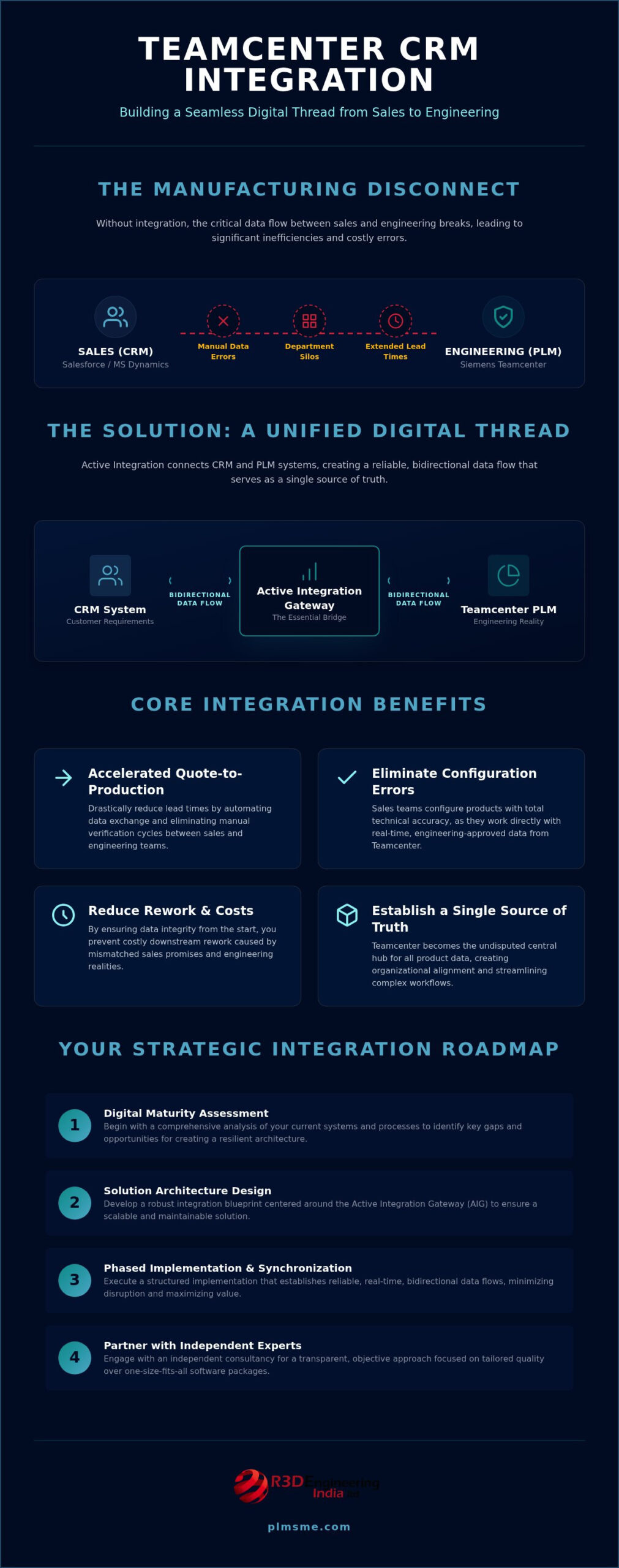
- Understand the role of the Active Integration Gateway (AIG) in enabling a reliable, bidirectional data flow that keeps your CRM and PLM systems synchronized in real time.
- Explore the core Teamcenter CRM integration benefits, including accelerated quote-to-production cycles and the elimination of manual configuration errors for complex products.
- Discover why a comprehensive Digital Maturity Assessment is the essential first step in designing a resilient solution architecture for your digitalisation journey.
- Gain insights into why an independent consultancy approach ensures a transparent, objective implementation that focuses on tailored quality over one-size-fits-all software packages.
Bridging the Divide: Why Teamcenter CRM Integration is Essential
The digital thread represents a continuous flow of data that connects initial customer requirements directly to final engineering specifications. In many manufacturing environments, this thread breaks between the Sales department and the Engineering floor. Integrating Customer Relationship Management (CRM) systems with Siemens Teamcenter addresses this gap, ensuring that the voice of the customer informs every stage of product development. This connectivity is a core component of effective Product Lifecycle Management, allowing organizations to maintain a single, unbroken chain of information from lead to delivery.
Relying on manual data transfer between Sales and Engineering creates a high cost in terms of both time and accuracy. When these departments operate in silos, the delay in production often stems from the need to re-verify or re-enter data that already exists in another system. While ERP systems manage the transactional aspects of a business, they often lack the deep technical context found in engineering data. CRM data is the missing link that provides the “why” behind the “what,” making it essential for a holistic product lifecycle. For companies in the UAE, this integration aligns with national industrial digitalisation goals by fostering a more agile, data-driven manufacturing sector that can compete on a global stage.
Identifying Inefficiencies in the Quote-to-Production Cycle
Significant bottlenecks occur when sales teams lack visibility into engineering constraints. Without real-time access to what’s actually buildable, sales representatives may promise custom configurations that are either technically impossible or prohibitively expensive to manufacture. This misalignment leads to friction and delays during the critical transition from a signed quote to the production line. Using outdated product configurations is another common pitfall, often resulting in customer dissatisfaction when the delivered product doesn’t meet the initial expectations set during the sales process.
- Manual entry remains the primary source of technical debt, as it introduces human error into complex technical specifications.
- Delayed feedback loops between departments extend lead times and increase the risk of missed market opportunities.
- One of the primary Teamcenter CRM integration benefits is the reduction of rework caused by mismatched data sets.
The Role of Siemens Teamcenter as the Single Source of Truth
Siemens Teamcenter centralizes product data to support global sales operations, ensuring that every stakeholder accesses the same technical reality. This centralization allows the platform to function as a thinking partner between departments. Instead of working in isolation, Sales and Engineering collaborate through a shared data model. This approach reduces internal clarifications and allows for faster, more accurate responses to complex customer inquiries. By providing a unified view, Teamcenter CRM integration benefits the entire organization through improved data integrity and streamlined workflows.
Siemens Teamcenter serves as the foundational architecture for industrial digitalisation by unifying disparate data streams into a single, actionable product record.
Analyzing the Technical Mechanism of Active Integration
Achieving a seamless connection between sales and engineering requires a robust middleware layer capable of handling complex data mapping. The Siemens Active Integration Gateway (AIG) serves as this essential bridge. It functions as a standardized connectivity layer that simplifies the exchange of information between Teamcenter and external enterprise systems. By utilizing AIG, organizations can implement a strategic business approach for managing the entire life cycle, ensuring that data doesn’t just move between systems but retains its technical context and integrity.
Modern integration strategies favor low-code frameworks within the AIG environment. These frameworks significantly reduce implementation timelines and associated costs by providing pre-configured templates for common integration scenarios. This approach allows for a more agile deployment, enabling businesses to realize Teamcenter CRM integration benefits much faster than traditional custom-coded methods. Maintaining data integrity across a complex IT landscape becomes a manageable task when the underlying architecture is designed for transparency and reliability.
The Power of Bidirectional Data Exchange
True integration isn’t a one-way street. When engineering changes occur within Teamcenter, those updates must reflect immediately in the CRM to ensure sales quotes remain accurate. This bidirectional flow ensures that the sales team isn’t selling obsolete configurations, which is one of the most immediate Teamcenter CRM integration benefits experienced by front-end teams. It also allows field data and customer feedback collected in systems like Salesforce, Microsoft Dynamics, or Oracle to flow back into the R&D cycle. This feedback loop is vital for continuous product improvement and ensures semantic consistency across different software architectures, preventing the “lost in translation” errors typical of manual processes.
Leveraging AIG for Scalable System Architecture
Building a flexible IT landscape is critical for long-term growth. AIG provides a scalable foundation that supports a company’s increasing digital maturity. Whether you’re integrating Teamcenter with Salesforce or Microsoft Dynamics, the connectivity engine ensures a stable link that minimizes system downtime. This robust architecture allows for future expansions without requiring a total overhaul of existing connections. To ensure your framework is optimized for these goals, starting with a professional system and solution architecture assessment can prevent costly missteps during the implementation phase.
Quantifiable Teamcenter CRM Integration Benefits for Manufacturers
Manufacturers specializing in Engineer-to-Order (ETO) and Configure-to-Order (CTO) models face constant pressure to deliver accurate quotes rapidly. One of the primary Teamcenter CRM integration benefits is the drastic acceleration of the ‘Time-to-Quote’ cycle. By automating the validation loops between sales and engineering, companies can eliminate the configuration errors that typically arise from manual data handling. This ensures that every quote is technically feasible and financially viable before it ever reaches the customer’s desk.
Integrating customer usage data directly into the PLM environment enhances the accuracy of the Digital Twin. This real-world feedback allows R&D teams to refine product designs based on actual performance rather than assumptions. When organizations leverage these Teamcenter CRM integration benefits, they gain a clearer understanding of how product lifecycle management benefits the bottom line through reduced waste and more targeted innovation. It’s about moving from a reactive stance to a proactive, data-driven strategy that treats customer data as a critical engineering asset.
Operational Efficiency and Cost Reduction
Rework is a silent profit killer in complex manufacturing. By ensuring sales teams only offer configurations that engineering has already validated, businesses can significantly lower technical debt and project delays. Automating cross-system data migration also lowers administrative overhead, freeing up high-value personnel for more strategic tasks. This level of synchronization optimizes resource allocation, as it allows leaders to forecast demand more accurately by seeing exactly what’s being quoted and how those requirements align with current production capacities.
Driving Revenue through Enhanced Customer Experience
Today’s customers expect faster, more reliable lead times, even for highly customized products. Mass customization is only sustainable when the engineering burden doesn’t scale linearly with sales volume. Connecting Teamcenter to your CRM enables this scalability, allowing your team to handle complex requests without a corresponding spike in overhead. However, achieving these results requires a clear understanding of your current technical standing. Reviewing the strategic value of a digital maturity report in manufacturing is a critical step to identify which integration points will yield the highest return on investment for your specific operations.
Developing Your Integration Roadmap: A 5-Step Strategy
Successful digitalisation isn’t a single event but a structured progression from your current state to a future-ready architecture. While the software provides the tools, the roadmap provides the direction. To capture the full range of Teamcenter CRM integration benefits, manufacturers must follow a methodology that prioritizes strategic alignment over mere technical connectivity. This five-step strategy ensures that your investment yields measurable results without compromising system stability.
- Step 1: Conducting a Digital Maturity Assessment. You can’t build a bridge without understanding the terrain. This phase identifies technical gaps and establishes a baseline for data readiness.
- Step 2: Designing a Solution Architecture. Every integration must align with your broader Digitalisation Vision. This ensures that the CRM link doesn’t become an isolated silo but part of a cohesive ecosystem.
- Step 3: Developing via AIG Best Practices. Utilizing the Active Integration Gateway (AIG) allows for standardized, low-code development that remains maintainable as your systems evolve.
- Step 4: Executing Phased Implementation. A big-bang approach often introduces unnecessary risk. We recommend a phased data migration plan that validates integrity at every milestone.
- Step 5: Establishing a Retainer for Performance. Long-term success requires ongoing oversight. A PLM System Administration Retainer ensures that the CRM-PLM link remains optimized as your business processes change.
Why Architecture Design Dictates Integration Success
Poorly planned connections often result in “spaghetti” integrations, where disparate systems are linked with fragile, custom logic that breaks during the next software update. A structured approach avoids this by focusing on a holistic PLM architecture that accounts for connectivity across ERP, CRM, and MES platforms. It’s about building a resilient framework that can handle the complexities of modern manufacturing. For a deeper look at these principles, explore the role of PLM in system architecture consulting to understand how high-level design prevents technical debt.
Navigating Implementation Challenges in the UAE
Deploying enterprise software in the UAE requires careful attention to local data residency and security requirements. Beyond the technical hurdles, managing the cultural shift between sales and engineering departments is often the most significant challenge. Sales teams must trust the engineering data, while engineers must understand the commercial pressures of the quote cycle. Engaging in strategic Siemens Teamcenter consulting mitigates these project risks by providing an objective, expert perspective that bridges the gap between technical execution and business strategy.
If you’re ready to define a clear path for your industrial transformation, our team is here to help you design a Digitalisation Vision & Roadmap Consulting plan tailored to your operational goals.
Partnering for Success: The Independent PLM Consultant Advantage
Selecting the right partner is as critical as the software itself when bridging the gap between sales and engineering. While software vendors are often incentivized by license volume, an independent consultant prioritizes the long-term integrity of your system architecture. This objectivity ensures that the Teamcenter CRM integration benefits you pursue are grounded in your specific operational reality rather than a generic product roadmap. A neutral advisor provides a superior return on investment by designing a solution that is right-sized for your current digital maturity while remaining scalable for future growth.
Working with a boutique specialist allows for a “thinking partner” relationship where the consultant engages deeply with your long-term vision. This collaborative approach moves beyond simple task execution to offer bespoke advice that navigates the nuances of your industry. By focusing on tailored quality over one-size-fits-all implementation, independent experts ensure that the resulting digital thread is robust, maintainable, and aligned with your business goals. Continuous performance is further secured through a specialized PLM System Administration Retainer, providing the expert oversight needed to keep complex CRM-PLM links optimized as your processes evolve.
Boutique Specialization in Siemens Teamcenter
PLM-Sme FZC provides access to specialized Teamcenter integration development expertise that is often unavailable through generalist IT firms. We act as a supportive guide through complex industrial challenges, ensuring that your technical methodology supports your commercial objectives. For UAE industrial operations, having national-scale support means having a partner who understands the local regulatory environment and the specific demands of the regional manufacturing sector. This boutique focus ensures that your digitalisation journey is managed with precision and agility.
Securing Your Digital Future with AI-Ready Roadmaps
A unified PLM-CRM thread is the essential foundation for the next wave of industrial automation. By establishing a clean, bidirectional data flow today, you’re preparing your integrated data for future AI and predictive analytics applications. These technologies require high-integrity data to provide meaningful insights into demand forecasting and product optimization. A structured digitalisation roadmap ensures that your current integration isn’t just a fix for today’s silos but a launchpad for future innovation. It’s about building an ecosystem where data flows seamlessly from the first customer requirement to the final product delivery.
If you’re ready to eliminate the inefficiencies in your quote-to-production cycle, the first step is understanding your current technical standing. Request a Digital Maturity Assessment to start your integration journey and define a clear path toward a fully integrated, customer-centric enterprise.
Advancing Your Industrial Digitalisation Strategy
Establishing a unified digital thread between your sales and engineering departments is a foundational step in modern industrial transformation. By leveraging the Active Integration Gateway to synchronize CRM and PLM environments, you eliminate the technical debt associated with manual data entry and configuration errors. We’ve explored how these connections accelerate the quote-to-production cycle and provide a scalable framework for future AI adoption. Realizing the full scope of Teamcenter CRM integration benefits requires a deliberate, architecture-first approach that prioritizes long-term system integrity over short-term software fixes.
As an independent Siemens Digital Industries Alliance Partner, PLM-Sme FZC serves as a neutral advisor to help you navigate these complex transitions. Our authoritative digital maturity reports and deep expertise in UAE industrial digitalisation provide the clarity needed to execute a successful roadmap. We don’t just implement software; we partner with you to ensure your technical systems support your commercial vision.
Build your future-proof digitalisation roadmap with PLM-Sme FZC and secure a competitive advantage in the evolving manufacturing landscape. Your journey toward a more agile, customer-centric enterprise starts with a clear strategic vision.
Frequently Asked Questions
What are the primary benefits of Teamcenter CRM integration for manufacturers?
Core Teamcenter CRM integration benefits focus on bridging the gap between sales logic and engineering reality. By establishing a bidirectional data flow, manufacturers can realize several advantages:
- Accelerated quote-to-production cycles.
- Elimination of manual data entry errors.
- Reduced rework through technical feasibility validation.
This synchronization establishes a unified digital thread that improves customer satisfaction through accurate lead times and precise product configurations.
Does Teamcenter integrate with Salesforce and Microsoft Dynamics?
Yes, Siemens Teamcenter provides robust connectivity with major CRM platforms including Salesforce, Microsoft Dynamics, and Oracle. These integrations are typically facilitated through the Active Integration Gateway (AIG), which allows for bidirectional data flow. It ensures that engineering changes in Teamcenter automatically update sales data in the CRM. Customer requirements from the field then flow directly into the product development lifecycle for continuous improvement.
How long does a typical PLM-CRM integration project take?
The duration of an integration project varies based on data complexity and the scope of your digitalisation roadmap. A standard implementation often ranges from several months to a year, depending on the number of touchpoints. You’ll find that starting with a clear solution architecture and a phased plan helps manage timelines. It ensures each milestone delivers measurable value without disrupting your ongoing operations.
Is a Digital Maturity Assessment necessary before starting an integration?
A Digital Maturity Assessment is highly recommended to identify technical gaps and establish a baseline for your integration strategy. This assessment ensures your systems are prepared for the complexities of a unified digital thread and helps avoid costly architectural missteps. By understanding your current standing, you can design a roadmap that aligns with your specific operational goals. It ensures a higher return on your digitalisation investment.
What is the difference between ERP and CRM integration in Teamcenter?
ERP integration focuses on transactional data like inventory and costs, whereas CRM integration manages the relationship between customer requirements and engineering. While ERP handles the logistics of production, CRM integration ensures the product being sold is technically valid according to engineering constraints. Both are essential components of a complete industrial digitalisation strategy, but they serve different roles. One isn’t a replacement for the other.
Can Teamcenter CRM integration support Engineer-to-Order (ETO) processes?
Teamcenter CRM integration benefits are particularly evident in ETO processes where custom configurations are the norm. It allows sales teams to validate complex customer requirements against real-time engineering data, ensuring every custom order is buildable. This reduces the friction of back-and-forth clarifications between departments. It significantly lowers lead times and technical debt while improving the accuracy of highly specialized product quotes.
How do I maintain the integration after it is deployed?
Long-term performance is best managed through a specialized PLM System Administration Retainer. This service provides the ongoing oversight needed to keep the CRM-PLM link optimized as your business processes and software versions evolve. Regular monitoring and data integrity checks prevent technical debt from accumulating. It ensures the integration continues to deliver value as your company’s digital maturity increases over time.
What is the role of the Active Integration Gateway (AIG) in this process?
The Active Integration Gateway (AIG) acts as the standardized connectivity layer that enables seamless communication between Teamcenter and external enterprise systems. It provides a low-code framework for mapping complex data structures, which reduces implementation costs and simplifies maintenance. AIG ensures the bidirectional flow of information remains stable and secure. It serves as the technical backbone for a resilient and scalable industrial IT landscape.