
Teamcenter Product Configurator Implementation Services: From Product Variability to Governed Configurations
What if the hardest part of product configuration isn’t defining the rules, but deciding which rules and product data your organisation can trust? Variant complexity often leads to repeated engineering work and inconsistent product definitions, especially when configuration logic is spread across teams or systems. Teamcenter product configurator implementation services should address that foundation before automating variability. Product teams need a shared, governed basis for creating configurations that reflect real product and operational requirements.
It’s reasonable to expect a configurator to reduce manual effort, but technology alone can’t resolve unclear ownership, fragmented source data, or poorly scoped processes. This article explains how to define a realistic implementation scope, align configuration logic with engineering data, and plan integrations around lifecycle needs. It also covers delivery and governance decisions that help sustain the solution after deployment. By considering architecture, migration, integration, and ongoing system administration together, teams can shape a structured PLM implementation around product complexity and business goals, rather than treating it as a software installation.
Key Takeaways
- Map product variability before automating it. Identify where variants create repeated engineering effort or inconsistent definitions.
- Connect options, configuration rules, and product structures so valid combinations are governed by shared product data.
- Match the implementation approach to your operating model. Consider repeatability, engineering involvement, rule stability, and validation needs.
- Structure delivery around clear scope, data assessment, rule modelling, validation, deployment, and governance.
- Align architecture, migration, integrations, and relevant CAD/CAM/CAE extensions to support implementation continuity and long-term PLM operations.
Why Teamcenter Product Configurator Implementation Starts with Product Variability
Product configuration is the structured selection of options and combinations that meet defined product requirements. A customer’s choice might affect dimensions, materials, performance characteristics, or compatible components. A Product configurator supports this kind of guided selection, but implementing one requires more than presenting choices on a screen.
Adding options to a product record or CAD assembly captures individual data; it doesn’t necessarily define which options work together, which choices depend on others, or how an approved configuration is represented across the product lifecycle. Those relationships need agreed rules and accountable owners. Governed product variability is the controlled definition of options, constraints, and product data that enables teams to create valid, repeatable configurations.
As variants accumulate, teams can lose the benefits of engineering reuse. Similar designs may be recreated, option logic may live in spreadsheets or individual expertise, and sales teams may interpret choices differently from engineering. Discrepancies can then flow into product definitions used by downstream functions. The aim isn’t to eliminate variety, but to make intended variety understandable and controlled.
What business problems can product configuration address?
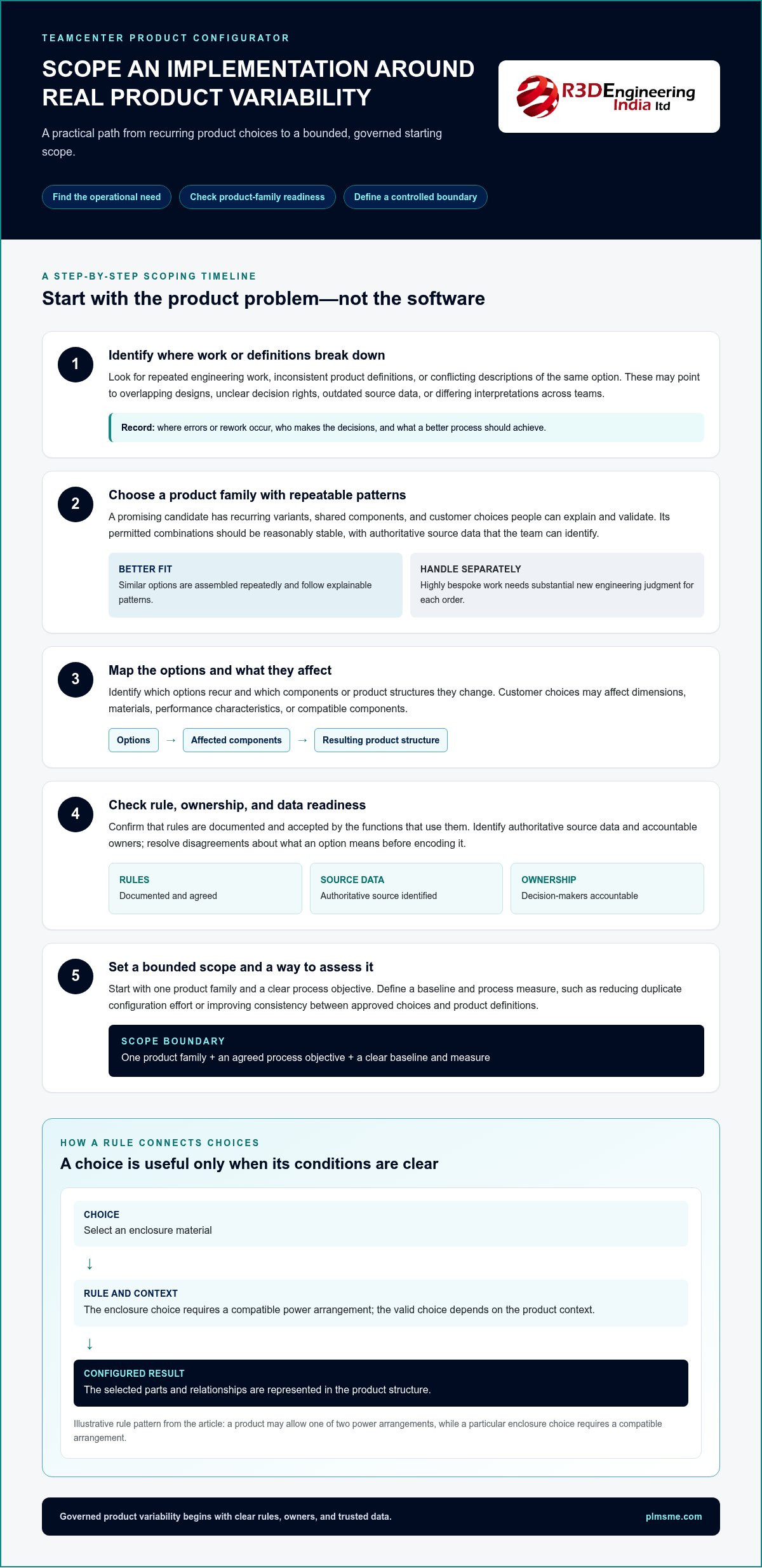
Start by identifying the operational problem rather than assuming the software is the problem. Repeated engineering work may point to overlapping designs or product information that isn’t reused consistently. Conflicting descriptions of the same option may instead reveal unclear decision rights, outdated source data, or different interpretations across sales, engineering, and manufacturing.
Separate these causes before defining implementation scope. A configurator can encode approved selection logic, but it can’t decide which team owns a product rule or resolve disagreement about what a choice means. Document where errors or rework occur, who makes the relevant decisions, and what a better process should achieve. This keeps Teamcenter product configurator implementation services focused on a business need, not just a software installation.
Which product families are suitable implementation candidates?
Look for a family with recurring variants, shared components, and customer choices that follow patterns people can explain and validate. Options are stronger candidates when their permitted combinations are reasonably stable and product teams can identify authoritative source data. Highly bespoke work, where each order requires substantial new engineering judgment, may be better handled separately rather than forced into fixed rules.
Start with a bounded scope. For example, select one product family where teams repeatedly assemble similar options, then define a process objective, such as reducing duplicate configuration effort or improving consistency between approved choices and product definitions. Before proceeding, assess:
- Which options recur, and which components or structures do they affect?
- Are the rules documented and accepted by the functions that use them?
- Can the team evaluate progress against a clear baseline and process measure?
If the answers reveal unresolved ownership or source-data issues, include those in the scope. A well-chosen starting family gives the implementation a practical boundary while exposing the governance decisions needed before expansion.
How Teamcenter Product Configurator Connects Options, Rules, and Product Data
A governed configuration model links four elements: the options a user can select, the context in which those options apply, the rules that constrain selections, and the product structures that represent the result. An option might define an enclosure material; a context could specify the product family or intended operating conditions; a rule determines which material choices are valid; and the product structure records the selected parts and relationships.
Configuration data describes available choices and the selected product structure; configuration rules determine which combinations of those choices are valid. Keeping that distinction clear makes ownership and change tracking easier. Rules shouldn’t depend solely on a salesperson’s memory or an engineer’s spreadsheet. They need to express approved product logic in a form teams can apply consistently.
Rules can include or require choices, exclude incompatible combinations, or make an option available only in a defined context. For example, a product might allow one of two power arrangements, while a particular enclosure choice requires a compatible arrangement. An exception might permit an otherwise unavailable choice for a specific product context. These are illustrative patterns, not a fixed template: suitable rule types depend on the product and its decision logic. If sales and engineering definitions conflict, the relevant business and engineering owners need to resolve the discrepancy before it becomes a rule.
Connecting configuration logic to authoritative product data
For each definition, identify its authoritative source and accountable owner. Product management may own the meaning of a customer-facing option; engineering may maintain technical constraints and approved component relationships. Product structures, CAD definitions, and any process-planning information used downstream should have clear sources, so the configuration model doesn’t rely on competing copies.
These connections shape implementation scope. A selected option may need to correspond to an engineering definition, affect a bill of materials, or inform process-planning relationships. Mapping those dependencies early helps teams determine which data must be migrated, aligned, or integrated, and which lifecycle functions need the validated configuration. Manufacturing and supply-chain considerations can also influence what product information needs to pass between engineering and downstream operations, so define those handoffs in the project scope.
Maintaining rule and configuration integrity
Configuration logic changes as products evolve. A controlled change process should record who can propose, review, approve, and release changes to options, rules, structures, and related engineering definitions. It should also clarify how teams handle effective changes, existing configurations, and exceptions. Without these responsibilities, a once-valid combination may become inconsistent with a revised product definition.
During implementation, test representative valid and invalid combinations against approved product information. Then review whether the resulting structures support the intended engineering and manufacturing work. Validation is a cross-functional responsibility, not just a software check. PLM architecture and integration support can connect configuration requirements with data, systems, and lifecycle processes as part of a tailored implementation.
Choosing a Teamcenter Configurator Implementation Approach That Fits the Product
The right implementation scope depends on how products are sold, engineered, and validated, not simply on how many variants exist. Configure-to-order (CTO) environments generally rely on repeatable selections from established definitions. Engineer-to-order (ETO) work involves more project-specific engineering. Many organisations sit between these models. A practical assessment weighs repeatability, engineering involvement, rule stability, and the validation needed before a configuration can move forward.
| Implementation context | Repeatability | Engineering involvement | Rule stability | Validation focus |
|---|---|---|---|---|
| Configure-to-order | High, recurring choices | Lower during selection, higher for product definition | Established | Check allowed combinations and resulting product definitions |
| Engineer-to-order | Variable by project | High throughout definition and review | May change with project requirements | Review engineering decisions, exceptions, and downstream readiness |
| Blended | Reusable options alongside unique requirements | Focused on exceptions and project-specific work | Stable core, variable extensions | Validate standard choices and route non-standard work for review |
Implementation complexity is easier to manage when boundaries and decision rights are explicit. Define the product family, selection scenarios, systems, and lifecycle steps in scope. Identify what remains outside the first release, and assign owners to approve rule changes and exceptions. Product changes can affect manufacturing performance, a concern explored in The effect of product changes on manufacturing performance. Include downstream validation in the scope, but don’t try to automate every product process at once.
When does a configure-to-order scope make sense?
CTO is a strong candidate where customers select from recurring combinations and engineering definitions are already established. A focused scope can test whether the selection logic and resulting product definition meet operational needs, while keeping evaluation tied to a clear product family and process. Customer choice remains bounded by approved options; it isn’t unrestricted design customisation. Stable rules make that distinction easier to apply consistently.
How should engineer-to-order requirements affect implementation scope?
ETO work often needs engineering review because requirements can introduce project-specific decisions that don’t fit a fixed selection path. A blended approach can govern reusable options while routing unique requirements into connected engineering workflows for assessment and approval. The configurator can support the repeatable portion, but the implementation shouldn’t assume every bespoke requirement can be automated. Define how exceptions are reviewed and who owns the resulting engineering definition.
A staged product-family rollout is usually more appropriate than a broad transformation when rule ownership, source data, or validation practices vary between families. Start with a product that has a clear process objective and manageable boundaries. Use the lessons from that release to refine governance and technical scope before extending to families with different engineering or integration needs. Teamcenter product configurator implementation services should follow this sequence, balancing an initial outcome with a credible path for expansion.
Planning a Teamcenter Product Configurator Implementation in Practical Phases
A phased plan makes implementation decisions visible before they become expensive to unwind. Each phase should have a clear purpose, accountable decision-makers, and an agreed completion condition. The sequence below is a practical guide, not a fixed schedule. Project timelines depend on product-family scope, data readiness, integration needs, and how quickly business and engineering owners can make decisions.
Establishing scope and preparing data
Discovery should define the product-family boundary, business objective, user roles, and current configuration process. It should also surface duplicate definitions, data-quality issues, and authoritative sources for options, rules, structures, and engineering information. Assign ownership early: product or business leads should approve option intent, engineering owners should resolve technical logic, and designated data or system owners should oversee source definitions and change decisions.
- Scope: Agree on the product family, users, processes, and outcomes in bounds. Accountable decision-makers: business sponsor and product-family lead. Completion condition: approved scope and measurable objective.
- Assess data: Review option definitions, product structures, engineering data, and known quality issues. Accountable decision-makers: data owners and engineering leads. Completion condition: source-of-truth decisions and data gaps are documented.
- Model rules: Translate approved product logic into rule definitions, including dependencies and exceptions. Accountable decision-makers: business and engineering owners. Completion condition: rules have named owners and cross-functional agreement.
- Configure: Set up the agreed configuration model and relevant product-data relationships. Accountable decision-makers: PLM solution and architecture leads, with product owners. Completion condition: in-scope selections and structures are represented for testing.
- Validate: Test representative valid and invalid combinations against agreed business and engineering rules. Accountable decision-makers: engineering, quality, and relevant downstream process owners. Completion condition: results are reviewed, defects are resolved or assigned, and acceptance criteria are met.
- Deploy: Prepare users, release controls, and the production transition for the agreed scope. Accountable decision-makers: business sponsor and system owner. Completion condition: user acceptance is recorded and deployment readiness is approved.
- Govern: Establish ongoing responsibilities for rule changes, product updates, support, and administration. Accountable decision-makers: designated business and PLM system owners. Completion condition: change and support procedures have assigned owners.
Validating rollout and sustaining the model
Validation should cover more than a successful selection. Include representative edge cases and confirm that outcomes support relevant CAD, bills of materials, and downstream handoffs within the project scope. User acceptance should involve the roles that depend on those outputs, so discrepancies are caught before deployment rather than passed to another team. Capture feedback and route issues to the owner responsible for the underlying rule or data.
For Teamcenter product configurator implementation services, plan architecture, migration, integration, and post-launch administration as connected workstreams where the project requires them. This grounds delivery in existing systems and operational ownership. To plan phased Teamcenter implementation support, align scope, data readiness, decision owners, and validation gates before configuration work begins.
Delivering Teamcenter Product Configurator Implementation with PLM-Sme FZC
PLM-Sme FZC is a Siemens Digital Industries Alliance Partner with Teamcenter implementation capabilities. Its approach connects configuration delivery to the wider PLM environment, shaping the work around product complexity, business requirements, and existing systems. Teamcenter product configurator implementation services can cover more than options and rules. Architecture, data migration, integration development, and CAD/CAM/CAE extensions can also support agreed product and process needs.
Connecting implementation to the wider PLM environment
Architecture decisions should account for how engineering teams work today and how product information needs to move across enterprise systems. For example, a configuration may depend on engineering definitions in Teamcenter and require relevant information to connect with ERP, CRM, MES, or MOM processes. The project scope determines which data and handoffs need attention, and whether migration, integration development, or CAD/CAM/CAE extensions are needed.
Planning these relationships early helps avoid treating the configurator as an isolated application change. Teams can define which systems own particular data, what information must be migrated, and where interfaces are needed to support lifecycle processes. PLM-Sme FZC’s Teamcenter consulting and industrial digitalization guide provides related context on connecting Teamcenter decisions with broader industrial digitalisation objectives.
Sustaining configuration after deployment
Deployment isn’t the end of the implementation. Product options and rules may evolve, integrations may need to reflect process changes, and teams need clear ownership for maintaining the PLM environment. Ongoing system administration supports continued operation, while architecture and integration capabilities help address changing product and system requirements. The support model should match the organisation’s operating responsibilities and implementation scope.
Governance makes that support practical. Assign owners to review changes to configuration logic and related product data, define how updates are approved, and establish how issues are managed after launch. These responsibilities help keep configuration definitions aligned as product and process needs change. PLM system architecture consulting can help teams consider how PLM structures and connected systems fit together as requirements develop.
PLM-Sme FZC brings implementation, architecture, migration, integration, and system administration capabilities together as a collaborative delivery effort. To discuss your product-family scope, system context, and implementation objectives, contact PLM-Sme FZC with the configuration challenges your teams need to address.
Turn Configuration Priorities into a Governed Delivery Plan
Translate product variability into decisions your teams can own: which family to address first, what information should guide configuration, and how changes will be managed over time. A focused plan gives engineering and business stakeholders a shared basis for setting priorities and shaping an implementation around existing systems and operational needs.
PLM-Sme FZC is a Siemens Digital Industries Alliance Partner, bringing Teamcenter implementation, architecture, migration, and integration development capabilities to this work. Teamcenter product configurator implementation services can be tailored to your product scope and the connections your PLM environment requires, with a delivery approach grounded in your objectives rather than a one-size-fits-all template.
Discuss your Teamcenter product configuration implementation with PLM-Sme FZC. Bring your product-family priorities, system context, and desired outcomes to start planning configurations your organisation can govern and sustain.
Frequently Asked Questions
What does a Teamcenter product configurator implementation include?
A Teamcenter product configurator implementation typically covers product scope, data assessment, option and rule modelling, solution configuration, and validation. The work also includes agreeing who approves product logic and what outcomes show the process is ready for use. For example, a project might set an acceptance condition that a selected option produces the approved engineering definition. The precise work depends on the product family, existing environment, connected systems, and governance requirements.
Can Teamcenter Product Configurator support configure-to-order and engineer-to-order products?
It can support configure-to-order and blended configure-to-order and engineer-to-order scenarios, depending on product and process requirements. A manufacturer might govern recurring selections, then direct a request outside those choices to engineering for assessment. That boundary matters: customer selection within approved constraints is different from unrestricted design work. Define which requests can follow repeatable configuration logic and which need project-specific review before setting the implementation scope.
How do configuration rules help prevent invalid product combinations?
Rules encode relationships between options so a selection can be assessed against defined product requirements. For example, a rule may make one component unavailable when another selected feature is incompatible. Teams can turn these relationships into test cases, including combinations that should be accepted and those that should be rejected. Rule quality depends on approved engineering definitions and business ownership, so assign a decision-maker to resolve conflicts and review proposed rule changes.
Does Teamcenter product configuration connect to CAD and BOM data?
It can connect to relevant CAD definitions and product structures, including bills of materials, when those relationships fall within the solution scope. A useful discovery exercise is to trace a sample option from its approved engineering definition to the structure a downstream team needs. This reveals where data relationships already exist and where alignment or integration work may be required. The design should reflect the organisation’s Teamcenter environment and engineering processes.
What data should be prepared before implementing a product configurator?
Prepare an inventory of product families, options, rules, structures, and the systems that maintain them. Add practical context such as definition status, applicable product context, and the person or function responsible for approval. Then flag duplicate terms, incomplete records, and conflicting logic for resolution. For example, two teams may use different labels for the same customer choice. Resolve that ambiguity before modelling to help prevent inconsistent definitions from entering the configuration process.
How should a manufacturer validate configured product variants?
Build a test set from approved product requirements, covering both expected selections and combinations that should fail. Record the expected outcome for each case, then compare it with the generated product information and any in-scope CAD, BOM, or manufacturing handoff. Involve the teams that use those outputs, not only the implementation team. Document accepted exceptions and unresolved issues so stakeholders can make a clear user-acceptance decision.
Can Teamcenter product configurator integrate with ERP, MES, or CRM systems?
Yes, integration development can connect Teamcenter with ERP, MES, CRM, or MOM systems when required by the business process and agreed project scope. Start by identifying what information must pass between systems, which system owns each definition, and which team acts on the information. For instance, a product-structure handoff may need its own end-to-end test. Include those scenarios in integration planning and deployment readiness rather than treating connectivity as an afterthought.