
PLM Transformation Vision Workshop: Aligning Strategy, Systems and Teams
What if a PLM transformation vision workshop ended with decisions teams could act on, not just a shared statement of intent? Stakeholders often define success differently, and discussions can turn to software before business priorities are clear. Without a structured path from strategy to action, workshop outcomes may be too abstract to guide investment or implementation.
Alignment needs to go beyond agreeing on a future state. A business-led PLM transformation vision workshop connects organisational priorities with the capabilities, processes and systems needed to support them. This article explains how to prepare the discussion, bring different stakeholder perspectives together and turn priorities into practical decisions. You’ll also learn how to assign owners and define next steps, linking workshop outcomes to a wider digitalisation vision and roadmap. The goal is a clear direction that can inform PLM architecture and implementation, rather than a list of aspirations or an early commitment to a particular software solution.
Key Takeaways
- Use maturity findings, process pain points and system context as evidence to shape the discussion, not as conclusions reached in advance.
- Build the PLM transformation vision workshop agenda around current challenges, future-state principles and prioritised themes.
- Balance executive goals with working-level process realities and the impacts transformation may have on teams.
- Translate priorities into capability changes, system implications, dependencies and accountable owners.
- Connect workshop decisions to assessment, roadmap development and technical delivery so the vision can guide practical next steps.
Why a PLM Transformation Vision Workshop Must Start with Business Priorities
A PLM transformation vision workshop is a facilitated session where decision-makers and affected teams align on desired outcomes, transformation priorities and the choices needed to move forward. It gives the organisation a shared basis for deciding how product lifecycle management should support its strategy, rather than starting with a preferred system or a list of features.
The product lifecycle spans a product’s journey from inception through disposal, while Product lifecycle management (PLM) concerns managing information and processes across that journey. The practical scope of a transformation depends on the business. One organisation may need better control of engineering changes, while another may prioritise connecting product information with manufacturing or service. Business objectives help determine which capabilities matter and how systems should support them.
A useful definition: A PLM vision workshop creates shared direction by translating business priorities into practical decisions about the capabilities, processes and systems required to manage products throughout their lifecycle.
This is not a product demonstration focused on a particular solution’s features. Nor is it a requirements workshop for documenting detailed user needs, or a solution-design session for defining architecture and configuration. Those activities may follow. The vision workshop establishes why change matters, which outcomes take priority and what decisions are needed before implementation planning begins. That distinction keeps the discussion vendor-neutral and anchored in organisational needs.
What questions should a PLM vision workshop answer?
Start with the operational and product-development challenges that make transformation necessary. Where do handovers lose context? Which lifecycle information is difficult to access, maintain or trust? Then clarify the business outcomes PLM capabilities should support, such as improving change control or enabling more consistent collaboration across engineering and manufacturing. Treat these as prompts, not assumed benefits. Participants need to agree which outcomes matter to their organisation.
The workshop should also bring different perspectives into the open. Executives may focus on strategic priorities, engineering on design data and change processes, IT on integration and architecture, and operations on usable information at the point of work. Making these differences explicit gives the group a basis for resolving trade-offs instead of mistaking silence for agreement.
Who needs a voice in the transformation vision?
Include sponsors and decision-makers who can set direction, prioritise outcomes and resolve competing needs. Represent functions affected by lifecycle information, including engineering, manufacturing and IT, alongside other relevant teams such as quality, supply chain or service. Match participation to the decisions under discussion.
Not every contributor needs to attend every conversation. Keep essential decision-makers involved throughout, and bring subject-matter contributors into the topics where their process knowledge is needed. This keeps the discussion focused while ensuring decisions draw on relevant expertise.
Preparing the PLM Transformation Vision Workshop Around Evidence and Decisions
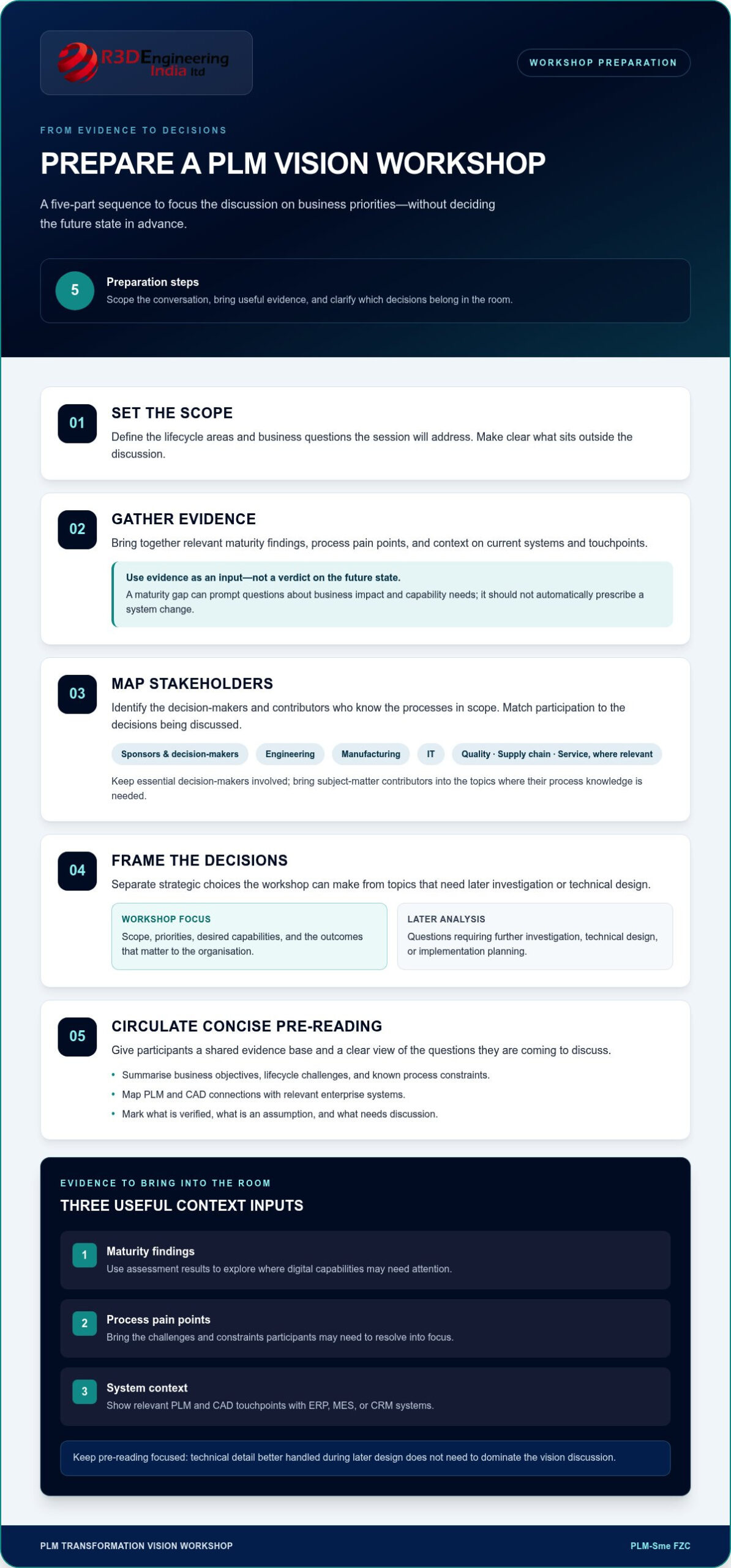
Preparation gives the workshop a clear purpose without deciding its conclusions in advance. For a PLM transformation vision workshop, use a simple sequence: set the scope, gather evidence, map stakeholders, frame the decisions and circulate concise pre-reading. Each step helps participants focus on choices the group can make, while flagging questions that need further analysis or technical design.
- Set the scope: Define the lifecycle areas and business questions the session will address, along with what sits outside it.
- Gather evidence: Assemble relevant maturity findings, process pain points and system context.
- Map stakeholders: Identify decision-makers and contributors with knowledge of the processes in scope.
- Frame decisions: Separate strategic choices for the workshop from topics requiring later investigation.
- Circulate pre-reading: Share a focused summary so participants arrive prepared to discuss priorities.
Existing assessment results can help identify where digital capabilities may need attention. A digital maturity report in manufacturing can provide useful context, alongside process pain points and an overview of current PLM, CAD and enterprise-system touchpoints. Treat these as inputs to discussion, not a verdict on the future state. A maturity gap, for example, can prompt questions about business impact and capability needs. It shouldn’t automatically prescribe a system change.
What should participants review before the session?
Keep the pre-read concise and decision-oriented. Summarise business objectives, lifecycle challenges and known process constraints, then map how PLM and CAD connect with relevant enterprise systems such as ERP, MES or CRM. Mark what’s verified, what’s an assumption and what needs discussion. This gives participants a shared evidence base without burying them in technical detail better handled during later design.
How should facilitators frame workshop decisions?
Turn broad ambitions into clear prompts about scope, priority and desired capability. Instead of accepting “improve collaboration,” for example, ask which handoffs need attention and what information teams need to make them work better. Record the decision owner, dependencies and open questions as they emerge. Neutral facilitation keeps preferred software from taking over the conversation and maintains a clear link between business goals and practical PLM choices.
For wider context on connecting product decisions to business value, Harvard Division of Continuing Education explores product-led growth strategies. The same principle applies here: clarify the value sought before deciding how systems should support it. Organisations shaping that direction can connect workshop preparation with digitalisation vision and roadmap consulting, carrying evidence and decisions into a practical transformation path.
Building the Workshop Agenda: From PLM Challenges to a Shared Future State
Once the evidence and decision scope are clear, the agenda should move participants from describing today’s friction to agreeing on future-state direction. A useful sequence is to map current challenges, define guiding principles, develop transformation themes, then prioritise them. This bridges executive objectives and the process realities experienced by engineering, manufacturing, IT and other teams.
Begin with the lifecycle information flows that matter most. Trace how product data, approvals or engineering changes move between roles and systems, and note where delays, duplication or unclear ownership arise. Then ask what the future state needs to enable. Principles such as reliable product information, clear change accountability or connected engineering and manufacturing processes can guide later decisions without prescribing a specific configuration.
Which agenda activities move discussion toward alignment?
Use explicit criteria to compare different views of the desired state. Participants might assess each proposed theme by its business relevance, dependencies on other capabilities and organisational readiness. For example, improved cross-functional change control may depend on clearer ownership and shared data definitions before system integration can deliver its full value. Capture the reasoning behind each priority so the group understands why foundational work comes first.
A simple prioritisation exercise can sort themes into:
- Foundational capabilities: prerequisites such as consistent lifecycle data or defined process ownership.
- Priority improvements: changes that directly support agreed business outcomes.
- Later opportunities: valuable ideas that depend on earlier capabilities or further analysis.
This is not a ranking of departments or people. It makes dependencies and trade-offs visible, helping decision-makers distinguish what should shape the roadmap now from what can be explored later.
How can the workshop address people and process change?
For each future-state theme, identify which roles, handoffs and responsibilities may change. A more controlled engineering-change process, for instance, could affect how engineering initiates changes, how manufacturing assesses impact and how IT supports information flow. Discuss the capabilities and ownership required alongside the technology implications. Adoption depends on people understanding how new processes affect their work.
Not every viewpoint needs to be resolved in the room. Record areas of agreement, differing perspectives and questions that need follow-up. A PLM transformation vision workshop should produce a shared direction, not manufactured consensus. A shared PLM vision connects business outcomes to the lifecycle capabilities and process changes needed to achieve them. With priorities and differences documented, the next stage can translate that direction into a practical roadmap.
Turning Workshop Discussion into a Practical PLM Vision and Roadmap
A vision becomes useful when its priorities can guide planning and technical decisions. The workshop should leave a clear record of what the organisation wants PLM to enable, why those outcomes matter and what needs further validation. It informs roadmap development, but doesn’t replace detailed assessment, architecture or implementation planning.
What should the workshop deliver?
Keep the outputs distinct so decisions don’t get lost among ideas. A concise vision statement should capture the agreed business outcomes and scope. Document the principles that will guide future choices, the priority capabilities and the decisions made during the session alongside it.
A decision log makes the results actionable. For each decision, record its rationale, accountable owner, dependencies and follow-up action. Keep assumptions and open questions visible too. For example, a priority to improve product-change visibility may depend on validating current information flows before defining a technical approach. That question belongs in roadmap or assessment work, not as an untested premise in the vision.
How do vision outputs become implementation direction?
Translate each priority into the capabilities and process changes it may require, then identify possible system implications. A need for consistent engineering-to-manufacturing information, for instance, can prompt analysis of PLM architecture and interactions with ERP or MES. The workshop sets direction. Subsequent assessment and architecture work establish requirements, dependencies and a suitable implementation approach.
Separate foundational work from longer-term opportunities without assigning unsupported dates. A roadmap can sequence priorities based on dependencies, readiness and business value, while detailed implementation planning defines the work packages and technical decisions.
| Workshop output | Roadmap development | Implementation planning |
|---|---|---|
| Vision, principles and priority themes | Validated capabilities, dependencies and sequencing | Defined scope, architecture and delivery activities |
| Decisions, owners and rationale | Actions, ownership and planning assumptions | Assigned responsibilities and execution controls |
| Assumptions and open questions | Assessment and analysis to resolve key uncertainties | Technical design and configuration decisions |
This separation preserves strategic intent while giving technical teams room to validate the right solution. A strategic industrial digitalisation roadmap is a natural next step for turning agreed priorities into sequenced planning. For a PLM transformation vision workshop to support delivery, each theme should carry a clear owner and next action into that process.
Develop your PLM vision and roadmap to connect strategic priorities with architecture and implementation planning.
Facilitating the Next Steps with a PLM Transformation Partner
A workshop creates value when its priorities lead to owned actions. Connect each agreed theme to a named owner, a next step and any dependency that could affect progress. Without that link, even a well-aligned vision can remain an abstract statement rather than a basis for planning.
What makes facilitation useful for complex PLM discussions?
Effective facilitation keeps strategic choices separate from detailed configuration and implementation debates. If discussion moves too quickly into system features, the facilitator can bring it back to the business outcome while capturing technical questions for later analysis. This lets business, engineering and IT perspectives inform the conversation without allowing one function to dominate.
It also makes uncertainty explicit. Record assumptions, dependencies, unresolved questions and the person responsible for follow-up. For example, if a priority depends on how product data currently flows between PLM and ERP, capture that as an assessment action rather than treating the future integration design as settled. The resulting record gives decision-makers a clear starting point for the next phase.
How can PLM-Sme support the journey beyond the workshop?
PLM-Sme FZC connects digital maturity assessment and vision and roadmap consulting with practical PLM architecture and delivery. Assessment findings can inform the priorities under consideration, and roadmap work can develop those priorities into a sequence of capabilities and actions. This creates continuity from business intent to technical planning, with decisions grounded in the organisation’s context.
Where agreed priorities call for Siemens Teamcenter, the next work may involve architecture and integration with relevant enterprise systems, including ERP, CRM, MES or MOM. The approach should follow the business needs and dependencies identified through assessment and planning, rather than being assumed during the vision discussion. PLM implementation support can carry approved direction into delivery, while PLM system administration can provide ongoing operational support.
A collaborative technical and strategic partner can help maintain alignment as the work moves from vision to assessment, roadmap and implementation. The aim isn’t to extend the workshop indefinitely, but to keep its decisions visible and useful as technical detail develops.
If you’re shaping a PLM transformation vision workshop, discuss your PLM vision and business outcomes with PLM-Sme to explore how they can inform the next planning steps.
Turn Shared PLM Priorities into Progress
A successful PLM transformation vision workshop gives stakeholders more than a shared ambition. It clarifies which business outcomes matter, connects them to priority capabilities and records decisions with owners and next actions. Keeping assumptions visible also helps the organisation distinguish strategic direction from questions that need further assessment or technical design.
That direction can inform a practical roadmap, linking business priorities with PLM architecture, enterprise-system integration and implementation planning. PLM-Sme FZC brings together digitalisation strategy and technical delivery, including Teamcenter implementation, integration and ongoing administration. As a Siemens Digital Industries Alliance Partner, the firm supports organisations through connected stages of PLM transformation.
Ready to align stakeholders around your PLM vision and intended business outcomes? Discuss your PLM transformation vision with PLM-Sme and define practical next steps for your roadmap.
Frequently Asked Questions
What is a PLM transformation vision workshop?
A PLM transformation vision workshop is a facilitated session for aligning stakeholders on the business outcomes, priorities and decisions that should guide PLM change. It helps participants connect organisational goals to the capabilities and processes needed across the product lifecycle. Rather than selecting software or designing a detailed solution, the session establishes shared direction and identifies the decisions, assumptions and follow-up work that can shape assessment and roadmap development.
Who should attend a PLM transformation vision workshop?
Include executive sponsors and decision-makers who can set priorities and resolve trade-offs, alongside representatives from functions affected by product lifecycle information. Engineering, manufacturing and IT are often central, with quality, supply chain or service contributors included where relevant. Keep decision-makers engaged throughout, and invite subject-matter experts for the topics they know best. This balances authority with practical process knowledge without making every participant responsible for every decision.
How long should a PLM vision workshop take?
There isn’t one appropriate duration for every PLM vision workshop. Scope, the number of business areas involved, the evidence available and the decisions required all affect the time needed. A focused session may address a defined set of priorities, while broader transformation discussions may benefit from staged workshops. Plan enough time to understand current challenges, compare future-state needs, resolve strategic choices and capture owners, dependencies and open questions without rushing those outcomes.
What should a PLM transformation workshop deliver?
A PLM transformation workshop should produce a concise vision linked to agreed business outcomes, guiding principles and prioritised themes. It should also document decisions, their rationale, accountable owners, dependencies, assumptions and unresolved questions. These outputs give roadmap development a clear starting point. They don’t replace detailed assessment, architecture or implementation planning; instead, they show what those later activities need to validate, define or translate into delivery work.
How is a PLM vision workshop different from a requirements workshop?
A PLM vision workshop establishes why transformation matters and which outcomes should guide it. A requirements workshop focuses on documenting more specific needs, such as user tasks, process rules or information requirements. The vision session helps determine direction and priority before teams define detailed requirements or technical designs. Keeping the purposes distinct reduces the risk of jumping into configuration discussions before stakeholders agree on the business problems PLM should address.
Can a PLM transformation vision workshop address resistance to change?
Yes, it can surface concerns and clarify how proposed process changes may affect roles, responsibilities and handoffs. Include the perspectives of affected teams, invite practical examples and record differing views rather than forcing quick agreement. The workshop can identify adoption needs, ownership questions and communication considerations for follow-up. It won’t resolve every concern on its own, but it can make change impacts visible and help shape a transformation approach grounded in operational realities.