
Consequences of Poor Product Data Management in Manufacturing
A product-data error rarely stays where it begins. A missing revision or conflicting part definition can trigger repeated searches and manual re-entry, then spread from engineering into procurement, production, and service. The consequences of poor product data management are more than documentation problems: they can disrupt decisions and work across the manufacturing lifecycle.
If teams are correcting the same information in multiple systems or aren’t sure who owns a change, the challenge is tracing those symptoms back to the processes and controls that allow unreliable data to circulate. This article explains how data problems affect engineering and operations, what warning signs to look for, and how to prioritise the risks.
We’ll follow the impact from product definition and engineering change through planning, manufacturing, and downstream support. We’ll also look at how governance, aligned processes, and PLM capabilities can help establish controlled product information across systems. A digital maturity assessment can identify where improvement should begin, while a roadmap connects priorities to architecture and implementation. PLM technology can support better control, but lasting improvement also depends on ownership and process alignment.
Key Takeaways
- Distinguish product data from documents and channel content to pinpoint what information is unreliable, incomplete, or uncontrolled.
- Trace revision mismatches and repeated corrections to their effects on engineering and manufacturing work.
- Separate data-quality, process, governance, and integration failures to uncover why problems persist across PLM, ERP, and MES.
- Prioritise assessment by tracing critical product information, evaluating its operational importance, and assigning clear ownership.
- Address the consequences of poor product data management through coordinated governance, process design, data remediation, and PLM-supported control.
What poor product data management means across the product lifecycle
Poor product data management is the failure to keep product information reliable, complete, consistent, accessible, and controlled as it is created, changed, and reused across the lifecycle. It can affect a single record or the links between product definitions, revisions, documents, and business systems. The consequences begin when teams can’t confidently use the information available to them.
Product data management (PDM) provides a foundation for organising product information as part of broader product lifecycle management (PLM). In manufacturing, the scope extends beyond a document repository. It includes structured definitions and the relationships that help teams interpret and apply them.
Which information counts as product data?
Product data commonly includes part identifiers, descriptions and attributes, configurations, bills of materials (BOMs), and revision or release status. These records help define what a product is and how its components relate. CAD files and engineering documents provide models, drawings, specifications, and other detailed information. They are not interchangeable with structured records, but they can be linked to them so users can identify which file or document applies to a particular part and revision.
Digital assets, such as product images or media, and channel-specific content, such as formatted catalogue descriptions, serve different purposes. They may draw on product data, but they don’t necessarily control the engineering definition. The data boundary depends on the product, business process, and system architecture.
How product data moves between business functions
A product definition may begin in engineering, where teams create or revise parts, configurations, and BOMs. Manufacturing planning uses that information to prepare production processes and requirements. ERP exchanges support business planning, while MES exchanges can provide production teams with information needed to execute work. Service functions may then rely on the released definition and revision history to understand the product being maintained.
Each handoff depends on clear ownership and mapping. Teams need to know which system maintains each field, how its meaning translates between systems, and when changes should flow. Otherwise, accurate information in one system may appear incomplete or different in another.
This distinction helps isolate the source of a problem. If an ERP or MES record differs because a field was mapped incorrectly or an update failed to transfer, the issue may lie in the interface. If the originating product record already contains the wrong value, the source data is defective. Both can produce similar symptoms, but they need different corrective actions. Trace the information back to its origin before treating every mismatch as a software connection problem.
How poor product data disrupts engineering and manufacturing operations
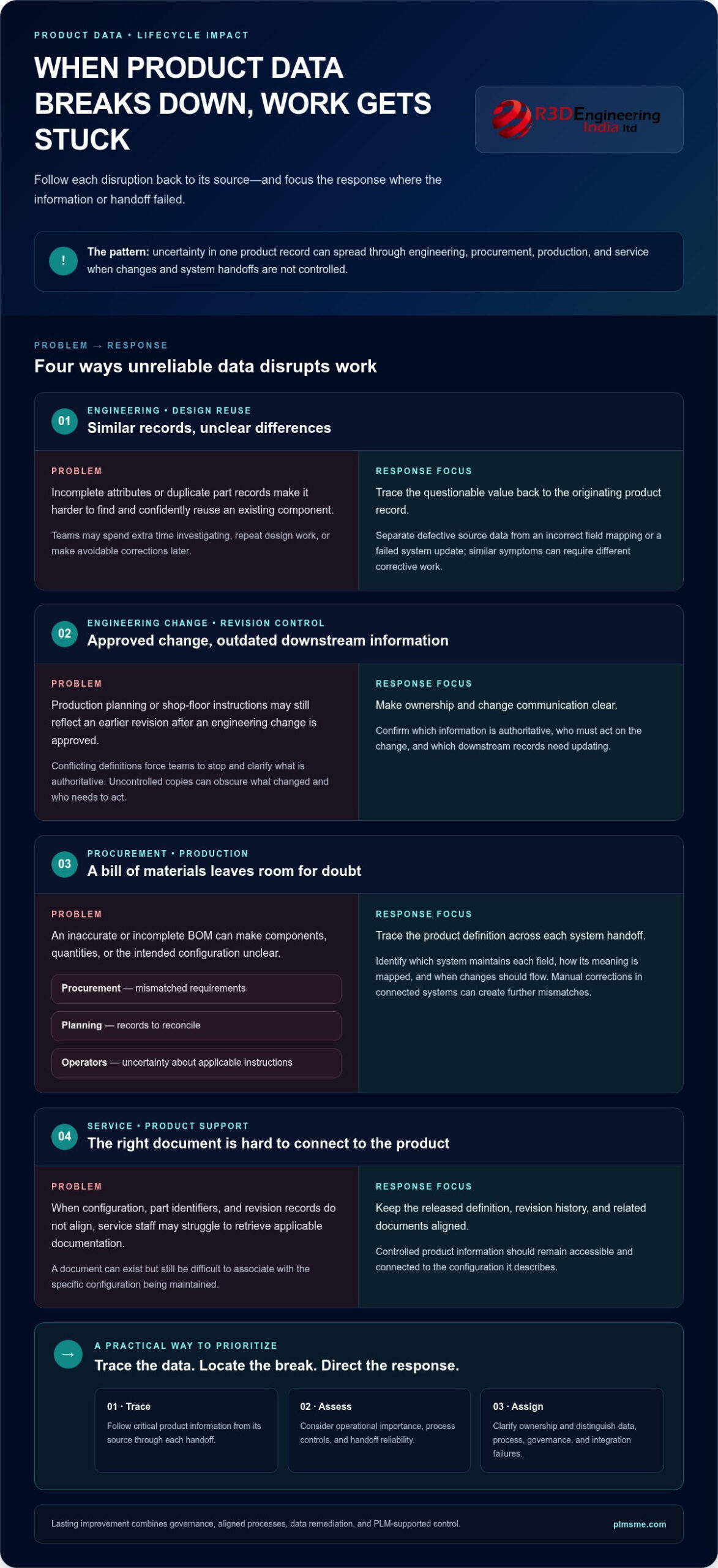
A product record can look usable while still leaving teams with critical questions: Is this the released revision? Does the bill of materials match the intended configuration? Has a design change reached planning? When answers require repeated searches, clarification, or manual correction, engineers and operations staff spend time resolving uncertainty instead of progressing their work.
Engineering rework, delays, and change confusion
Incomplete attributes and duplicate part records make design reuse harder. An engineer searching for an existing component may miss a suitable record or find several similar entries with unclear differences. That can prompt extra investigation, duplicate design work, or avoidable correction later. The scale of these effects depends on the product, workflow, and controls in place.
Revision control adds another risk. If an engineering change is approved but production planning or shop-floor instructions still reflect an earlier revision, teams may be working from conflicting definitions. They then have to stop and clarify which information is authoritative. Uncontrolled copies or unclear change communication also make it harder to confirm what changed, who needs to act, and which downstream records require updating.
Manufacturing and service consequences
In manufacturing, an inaccurate or incomplete bill of materials can create ambiguity about components, quantities, or the configuration to plan. Procurement may work from mismatched requirements, production planning may need to reconcile records, and operators may face uncertainty about which instructions apply. Manual corrections in connected systems can introduce further mismatches.
The same problem can continue after production. Service staff may struggle to retrieve applicable documentation if product configuration, part identifiers, and revision records don’t align. A document may exist, for example, but be difficult to associate with the specific configuration being maintained. The impact depends on the criticality of the information, the process controls around it, and the reliability of system handoffs.
To investigate a disruption, trace the affected information from its source through each handoff. Check whether the original product definition was wrong, a change was poorly controlled or communicated, or a system exchange failed to carry the correct value. This directs corrective work to the actual cause instead of relying on repeated manual fixes. A structured product data and PLM assessment can help identify where process, governance, or integration improvements should be prioritised.
Why product data problems persist across PLM, ERP, and MES
Product information can pass through PLM, ERP, and MES while its meaning changes, its accuracy goes unchecked, or its ownership stays unclear. A duplicate part record may look like a system issue when the deeper cause is that teams use different rules to create and maintain records. Moving incorrect data between systems can reproduce the defect at each handoff instead of correcting it.
System connectivity does not itself guarantee data consistency.
| Failure pattern | Typical signal | Where to investigate |
|---|---|---|
| Data quality | Missing attributes, incorrect values, or duplicate records | Source records and validation rules |
| Process | Changes are applied late or handled differently between teams | Workflows, handoffs, and exception handling |
| Governance | No clear owner or shared definition for an attribute | Accountability, standards, and change approval |
| Integration | Values fail to transfer or arrive in the wrong field or format | Interface mappings, transfer logs, and error handling |
Separating data-quality failures from integration failures
Start by comparing the source value with the value received downstream. If an engineering record already contains an incorrect attribute, the defect is in the source data. If that value is accurate but ERP receives it in the wrong field, the mapping or interface may be responsible. Validation rules can flag missing or out-of-range values, while exception logs can reveal failed transfers or rejected records. These checks help distinguish causes before choosing a remedy.
Clarifying ownership, definitions, and change control
Persistent issues often reflect a decision-making gap, not just a technology problem. Each important attribute needs an accountable owner, and teams need shared definitions so the same field isn’t interpreted differently across PLM, ERP, and MES. Change approval and revision control establish how edits are reviewed, released, and communicated to downstream users. Without those agreements, even a correctly functioning interface can distribute conflicting interpretations.
Architecture should support these responsibilities by defining where information is mastered, how it flows, and how exceptions are managed. For further context, see this guide to PLM system architecture consulting. Identifying whether the source, process, governance, or connection is failing helps organisations address root causes rather than layering another transfer or manual correction onto the problem.
How to assess and prioritise the consequences of poor product data
Start with evidence from real product records and workflows, not only stakeholder impressions. A repeatable assessment reveals where defects originate, which processes depend on them, and who can address them. This makes the consequences easier to rank and turns a broad concern into practical improvement priorities.
Tracing critical data from source to use
Select representative products that reflect different levels of complexity or operational importance. For each, follow key parts, configurations, and revisions through the process, from where information is created to where teams use it. Record the originating system, the person or role responsible for changes, and the PLM, ERP, MES, or other systems that consume the data.
Observe work as it happens. Compare records with the information people actually rely on, and note manual re-entry, spreadsheets or other workarounds, duplicate records, exceptions, and unclear handoffs. These details help distinguish a perceived issue from a recurring defect and show where a process or system boundary contributes to it.
Ranking risks and setting improvement priorities
Assess each finding against factors relevant to the product and process. A simple low, medium, or high rating can support discussion without implying false precision. Consider:
- Operational consequence: What work could be delayed, repeated, or performed using the wrong information?
- Reach and dependency: Which teams and downstream processes rely on the data?
- Criticality: Could the information affect safety, compliance, or an essential operational decision?
- Recurrence and detectability: How often does the issue appear, and how likely is it to be caught before use?
- Reuse and change frequency: Does the data support multiple products or processes, or change often enough to need stronger controls?
Use the ranking to separate immediate containment from structural improvement. A team might first clarify which released information should be used in a live workflow, then address recurring causes through shared definitions, assigned ownership, process changes, or integration improvements. Priorities should reflect actual exposure and business context, rather than treating every incomplete field as equally urgent.
A digital maturity assessment and report can frame findings across processes, systems, and organisational readiness. The results should inform a tailored roadmap, not trigger an automatic software rollout. PLM-Sme FZC provides digital maturity assessments and roadmap consulting to help organisations establish evidence-based improvement priorities.
Improving product data management with governance and PLM
Reducing recurring data defects takes more than introducing a new system. Improvement depends on coordinated governance, process design, data remediation, system architecture, and user enablement. PLM can support a controlled product definition by managing how information is created, reviewed, released, and made accessible across functions. Its effectiveness depends on clear ownership and processes that people follow.
Building controls that prevent recurring data defects
Define consistent naming conventions and shared attribute meanings so teams can create and interpret records reliably. Set mandatory fields where information is essential, and use validation to flag incomplete or invalid entries before they move downstream. Assign owners for critical data and establish change workflows that make approval, release, and revision status clear.
Configuration alone won’t establish these practices. Teams need training on how controls affect their work and where to raise exceptions. Monitor recurring exceptions and relevant data-quality indicators over time. Patterns such as repeated missing attributes or rejected transfers can reveal whether a rule, workflow, or integration needs attention.
Connecting PLM improvement to a practical transformation roadmap
A tailored PLM approach should reflect assessed business needs. PLM-Sme FZC designs and deploys Siemens Teamcenter platforms, with services that include data migration, system architecture, CAD/CAM/CAE extensions, and integration development. Exchanges with ERP, CRM, MES, or MOM systems should be designed around the organisation’s processes, system responsibilities, and information flows, rather than assumed to follow a universal pattern.
Migration decisions also benefit from governance. Teams need to determine which records to carry forward, how to resolve duplicate or incomplete data, and how to preserve useful relationships between product definitions and related information. A roadmap can sequence this work so process and ownership questions are addressed alongside technical implementation, not left until after configuration.
The consequences of poor product data management are best addressed by establishing the current state, agreeing on priorities, and translating findings into a practical roadmap. PLM-Sme FZC provides Teamcenter implementation, integration development, and ongoing PLM system administration to support this work as part of an organisation’s digitalisation plans.
Build a more reliable product data foundation
The consequences of poor product data management can travel from engineering into planning, production, and service, especially when teams rely on conflicting definitions or unclear change controls. The practical response is to trace information through real workflows, identify whether defects stem from data, process, ownership, or system handoffs, and rank improvements by operational importance.
Technology can support controlled product definitions and revisions, but it works best alongside clear governance, aligned processes, and user adoption. A digital maturity assessment can help establish priorities, while digitalisation roadmap consulting connects those priorities to implementation. Depending on assessed needs, the work can include Siemens Teamcenter implementation, data migration, and system integration support.
Start with the current state, then shape a roadmap around your organisation’s processes and architecture. Discuss a product data improvement roadmap with PLM-Sme FZC and take a measured step toward more consistent information across the product lifecycle.
Frequently Asked Questions
What are the consequences of poor product data management?
The consequences can include repeated engineering searches, avoidable rework, delayed clarification, and conflicting information across business systems. If a released revision doesn’t match the information used for planning or production, teams may need to investigate which definition applies. Procurement, manufacturing, and service can also face uncertainty when records or supporting documents are incomplete. The actual impact depends on the product, the data involved, and the controls around its use.
How does poor product data affect manufacturing?
Poor product data can make manufacturing planning and execution less reliable. An incomplete or inaccurate bill of materials may leave planners unclear about components or quantities, while a revision mismatch can create confusion about which design information applies to production. Teams may spend time reconciling records, seeking clarification, or correcting information manually. The effects vary according to the information’s operational importance and how effectively product definitions move between engineering and manufacturing systems.
Can poor product data cause engineering rework?
Yes. Engineers may repeat work when they can’t find a suitable existing part, encounter duplicate records with unclear differences, or lack complete attributes needed to assess design reuse. A change that isn’t clearly controlled or communicated can also lead teams to work from different revisions, prompting investigation and correction. These outcomes depend on the design process, the quality of product records, and how revisions are approved and shared.
What are the common causes of poor product data quality?
Common causes include unclear ownership, inconsistent definitions for shared attributes, duplicate records, weak change control, and manual entry across disconnected systems. Integration mappings can also transfer information incorrectly, while an inaccurate source record can spread downstream even when the interface works as designed. In some organisations, processes and system configuration don’t reflect how teams create or use product information. Identifying the cause matters because each failure pattern calls for a different corrective response.
How can a company identify product data problems?
Trace representative products, configurations, and revisions from where information originates to where teams use it. Compare records across engineering, planning, manufacturing, and service workflows. Note missing or conflicting fields, duplicate entries, manual corrections, workarounds, failed transfers, and unclear handoffs. Then assess each issue by its operational consequence, how widely it affects teams, how often it recurs, and whether users can detect it before acting. This creates evidence for prioritising improvements.
Can PLM software fix poor product data management?
PLM software can support controlled product definitions, revisions, and cross-functional access, but software alone can’t establish reliable ownership or consistent processes. Organisations also need agreed data definitions, appropriate validation, clear change workflows, user enablement, and integration rules that match business needs. PLM implementation can include data migration and connections with ERP, MES, CRM, or MOM systems. The right scope depends on an assessment of current data, processes, architecture, and priorities.