
Closed-Loop Quality PLM Integration Services: Connecting Feedback to Improvement
What if connecting quality systems still leaves issues stranded between teams? Quality evidence often sits across engineering, manufacturing, and service, while handoffs can slow investigations or weaken traceability. The challenge is not connectivity alone. Closed loop quality PLM integration services must also establish governed feedback workflows, so teams know where information belongs, who acts on it, and how decisions relate to the correct product and revision.
This article explains how PLM integration can link downstream findings, such as production defects and service feedback, to upstream design and planning workflows. You’ll learn which data and process elements form a closed loop, how to define system responsibilities and integration scope, and which measures can help track adoption and improvement. It also covers how assessment, architecture, integration development, and ongoing PLM administration can support a practical approach tailored to your systems and workflows.
Key Takeaways
- Map each quality event from initial capture through investigation, disposition, corrective action, and verified learning.
- Clarify which system owns product data and which systems hold operational, customer, and quality evidence.
- Compare manual handoffs, point-to-point connections, and governed workflows to choose an approach that fits your process and system boundaries.
- Scope closed loop quality PLM integration services around documented workflows, data ownership, and measurable adoption goals.
- Use a phased plan, from process discovery and architecture through testing, rollout, and ongoing review, to build a practical path to improvement.
Why closed-loop quality PLM integration services matter across the product lifecycle
A quality issue rarely belongs to one team or one system. A design review may identify a risk, manufacturing may record a recurring deviation, a supplier may report a material concern, or product service may surface a field issue. When each record is isolated, teams can lose time reconciling versions, evidence, and ownership before they can investigate the issue itself. Manual handoffs can also separate a finding from the product configuration or decision history needed to assess it.
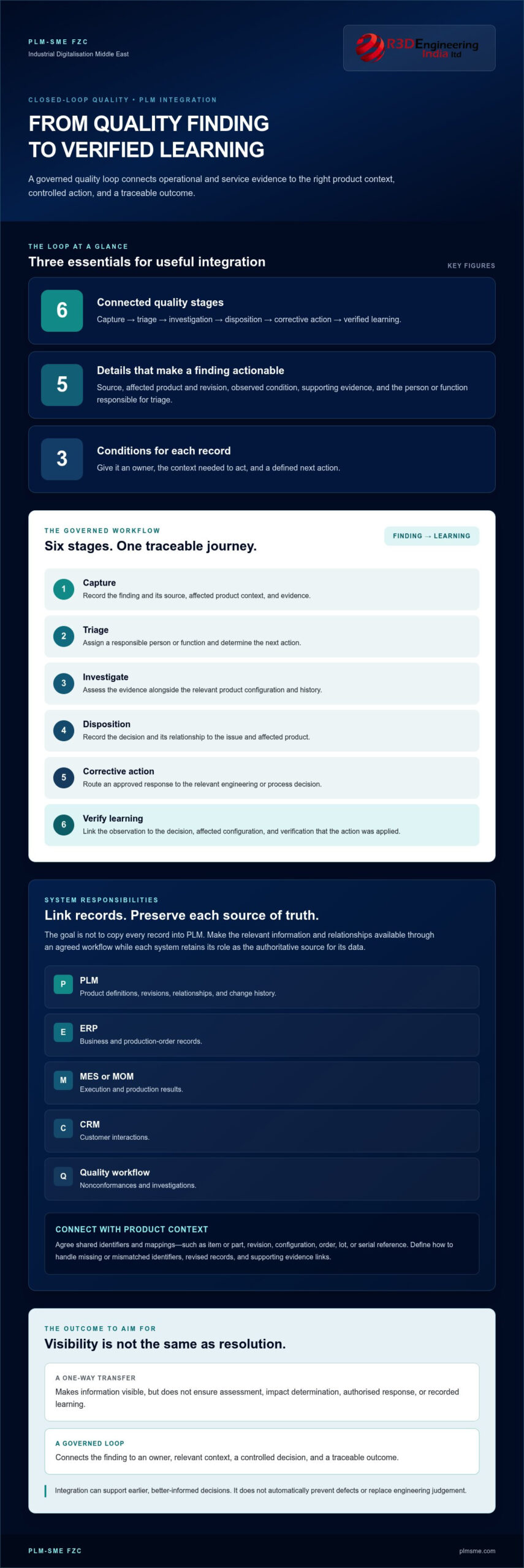
Closed-loop quality means more than transferring a defect record between applications. A one-way transfer can make information visible, but it does not ensure that someone assesses the issue, determines its impact, authorises a response, and records whether the learning was applied. A governed loop gives each stage an owner, the context needed to act, and a traceable outcome.
Closed-loop quality is a governed cycle that turns product and process feedback into investigated, controlled action and verified learning. It can support earlier, better-informed decisions, but it does not automatically prevent defects or replace engineering judgement.
Where quality feedback begins and where it needs to return
Feedback can begin in design reviews, production inspections, supplier communications, nonconformance records, or service investigations. For a finding to be actionable, capture its source, the affected product and revision, the observed condition, supporting evidence, and the person or function responsible for triage. If those details are missing, the report may be visible but difficult to compare, route, or investigate.
The response should return to the relevant engineering or process decision. For example, a manufacturing deviation could prompt a review of a drawing requirement, followed by an approved change if the evidence supports one. Link the original observation to the investigation, decision, affected configuration, and verification of the action. This lets teams distinguish a completed handoff from an issue that has been resolved and learned from.
What PLM integration contributes to quality management
PLM provides structured context for product definitions, revisions, relationships, and change history. Integration can link quality evidence held in operational or service systems to engineering records that show what was designed, released, or changed. The goal is not to copy every record into PLM. Instead, make relevant information and relationships available through an agreed workflow while preserving each system’s role as the authoritative source for its data.
This approach supports traceability across lifecycle activities. Teams can follow an issue to the affected product context, see how an approved change relates to it, and retain the investigation history. For a broader view of how PLM fits into an enterprise structure, explore PLM system architecture consulting. The wider concept of Product Lifecycle Management (PLM) also frames product information as connected across lifecycle stages.
Effective closed loop quality PLM integration services connect technology with workflow design. Before defining interfaces, establish who owns issue classification, investigation, disposition, change approval, and verification. Those responsibilities determine which data must be linked, where decisions are recorded, and how the organisation can tell whether feedback has made its way back into product or process improvement.
Designing the data and workflow architecture for closed-loop quality
Start architecture work with the quality event, not the interface. Map the record’s journey from its source through triage, investigation, disposition, corrective action, and learning. At each stage, specify the information required, the system that owns the record, the accountable person or function, and the condition that allows work to advance. This makes the process visible before integration development begins.
Integration is effective when each record has an owner, context, and a defined next action. Without those elements, even a technically successful data exchange can become an operational dead end.
Connecting systems without losing product context
Separate authoritative product information from evidence about operations, customers, and quality. PLM may own product definitions, revisions, and change history; ERP may manage business and production-order records; MES or MOM may hold execution and production results; CRM may capture customer interactions; and a quality workflow may manage nonconformances and investigations. These roles vary by organisation. Document the source of truth for each data element instead of assuming every system should hold a full copy.
To link an issue to the right product context, agree on shared identifiers and mappings. Depending on the process, these may include an item or part identifier, revision, configuration, order, lot, or serial reference. Define how the architecture will handle missing or mismatched identifiers, revised records, and links to supporting evidence. Teamcenter can provide the PLM context for product structures and changes, exchanging selected information with ERP, MES, MOM, or CRM according to system boundaries and business needs. Choose exchanges based on data ownership, workflow timing, and system capabilities rather than assuming one interface pattern fits every process. NIST on PLM Information Integration offers relevant context on representing and exchanging manufacturing information across PLM.
Making quality workflows traceable and actionable
Model the issue as a chain of linked records rather than a collection of attachments. A quality event can point to its source evidence, affected product context, investigation findings, disposition, corrective action, and any related change-control record. For customer feedback, the CRM record can retain the interaction while a linked quality workflow captures assessment and follow-through. This preserves useful context without making CRM the owner of engineering decisions. Teamcenter CRM integration can support this kind of information flow.
Assign responsibility at each transition. Quality or operations can own triage, designated technical authorities can lead investigations, authorised roles can approve disposition and changes, and implementation owners can document completion and verification. Set closure criteria so an issue is not considered finished simply because a task was transferred. Teams defining closed loop quality PLM integration services can use these workflow and ownership decisions to guide architecture and development. PLM-Sme’s PLM architecture and integration support can connect those decisions to an implementation approach.
Evaluating closed-loop quality integration approaches and success measures
Choose an integration approach by identifying the process gap, the systems involved, and the level of control the workflow needs. A recurring delay between recording a production issue and getting it reviewed by engineering may call for a different design than connecting customer complaints to product change control. More connectivity is not automatically better: every exchange brings decisions about ownership, data quality, exceptions, and support.
The approaches below have different trade-offs. The right fit depends on the issue lifecycle, system boundaries, and the organisation’s ability to govern the workflow.
| Approach | Best suited to | Considerations |
|---|---|---|
| Manual handoff | Low-volume processes or early discovery, where a person reviews and routes records. | Simple to start, but relies on consistent procedures and can make status and traceability harder to maintain across teams. |
| Point-to-point connection | A defined exchange between two systems, such as sending selected issue information from manufacturing to PLM. | Can address a specific gap, but mapping, error handling, and change management need clear ownership. Additional connections can increase maintenance complexity. |
| Governed lifecycle workflow | Cross-functional processes that need linked records, explicit approvals, and traceable progression through investigation and action. | Requires agreement on roles, statuses, data ownership, and exception paths. Its scope should match the process rather than expand by default to every system. |
Choosing an integration scope that fits the quality problem
Start with one recurring handoff or visibility gap. Document where the process begins, which decisions are delayed or repeated, and what information teams need at each step. Then classify the required exchange: does a system need a synchronised copy, a reference link to the authoritative record, or a controlled workflow transition that requests an action?
Include the engineering, manufacturing, quality, service, and IT stakeholders affected by the process. They can identify practical constraints such as inconsistent identifiers, duplicate records, or approval responsibilities that differ by issue type. This discovery helps closed loop quality PLM integration services stay aligned with business needs and data ownership instead of becoming broad, unfocused system connectivity.
Measuring whether the feedback loop is working
Set a baseline before rollout. For each measure, define how it is calculated, where the data comes from, how often it is reviewed, and who owns it. Useful measures may include issue ageing by workflow stage, completeness of links to the affected product and revision, recurrence of similar issues, and adoption of required workflow steps. Interpret results in context: a change in recorded recurrence, for example, may reflect changes in reporting as well as changes in underlying quality.
Pair workflow measures with product-quality indicators that suit the organisation, such as the rate of relevant nonconformances or repeat findings. An integration launch or an increase in record volume does not, by itself, demonstrate improvement. Review exceptions and missing data with process owners, then adjust mappings, guidance, or responsibilities where the evidence shows friction. This helps teams assess whether feedback is reaching decision-makers and whether actions are being recorded and followed through.
Planning a closed-loop quality PLM integration project step by step
A disciplined project starts with the current process, not a preferred interface. Document how quality issues are raised and resolved, which systems hold the records, who owns the data, and where handoffs create delay or uncertainty. This gives business and technical teams a shared definition of the problem and a basis for prioritising scope.
Use a sequenced plan to carry the work from discovery into operation:
- Discover the issue lifecycle. Map how an issue is recorded, assessed, investigated, dispositioned, and closed. Capture pain points, affected teams, the system landscape, data owners, and existing ways of tracking status.
- Define requirements and scope. Select representative business scenarios, then specify the data, workflow, access, and traceability each requires. Identify records to synchronise, reference, or move through a controlled workflow. Include migration only where historical information is needed for the agreed process.
- Design the architecture. Document system boundaries, authoritative sources, data mappings, dependencies, security roles, and exception routes. Set acceptance criteria for exchanged information and process outcomes before development begins.
- Develop and configure. Build the agreed integrations and workflow in manageable increments. Apply change control to updates in mappings, interfaces, or process rules so design decisions remain documented and reviewable.
- Test with realistic cases. Validate expected exchanges as well as exceptions, including rejected records, revised products, incomplete source data, and access restrictions. Confirm that errors can be identified, assigned, corrected, and resubmitted through an understood process.
- Roll out and review. Validate the workflow with intended users, plan deployment sequencing around operational needs, and communicate changed responsibilities. After release, review performance against the baseline and refine the workflow based on observed issues and user feedback.
Preparing requirements, architecture, and delivery governance
Turn each business scenario into a clear requirement: what triggers the workflow, what data must be available, who can view or change it, and what evidence demonstrates completion? Record dependencies and acceptance criteria alongside interface boundaries. Agree on decision rights between business owners and technical teams, including who approves scope changes and how unresolved data or process exceptions are escalated. This governance keeps delivery aligned as details emerge.
Testing, deploying, and sustaining the integrated workflow
Testing should confirm more than whether fields arrive in the right place. Integration validation should test both data accuracy and workflow outcomes. Check that records retain the correct product and revision context, approvals route to the intended roles, and exceptions reach accountable owners. User validation can reveal ambiguous steps before deployment. Define who monitors interfaces, handles support issues, and reviews the workflow after launch so the integration remains governed as systems and processes change.
For a project shaped around your systems, responsibilities, and quality workflows, plan your PLM integration approach with PLM-Sme. A well-scoped closed loop quality PLM integration services project connects architecture decisions to delivery, validation, and ongoing administration.
Delivering closed-loop quality with PLM-Sme integration services
Turning a quality workflow into a working integration takes more than connecting Teamcenter to another application. PLM-Sme FZC supports the work through assessment, architecture, integration development, implementation, and ongoing administration, aligning technical design with business processes and system responsibilities. Depending on the project scope, connected enterprise systems may include ERP, CRM, MES, or MOM. The aim is to make quality feedback useful in the relevant product lifecycle context while respecting each system’s role.
PLM-Sme FZC is an independent industrial digitalisation consultancy and a Siemens Digital Industries Alliance Partner. Its work combines Teamcenter expertise with a broader view of enterprise architecture, helping organisations shape an integration approach around their existing landscape rather than treating connectivity as a stand-alone task.
Moving from digital assessment to an integration roadmap
A digital maturity assessment can establish how quality information currently moves, where records are held, and which handoffs create friction. Reviewing these processes alongside system boundaries and data ownership gives stakeholders a grounded view of readiness and priorities. The assessment can inform a roadmap that sequences architecture and integration work according to business needs, dependencies, and the workflow areas selected for improvement. For manufacturing assessment context, see digital maturity reporting for manufacturing.
This planning stage also helps distinguish foundational work from later extensions. An organisation may first need to clarify identifiers, ownership, or change processes before connecting additional systems. A roadmap can make these dependencies visible and guide decisions on what to address first, keeping implementation aligned with operational priorities.
Supporting implementation and ongoing PLM operations
Once scope and architecture are established, Teamcenter implementation support and integration development can connect selected workflows to relevant enterprise systems. This may involve defining data mappings, developing exchanges, and validating them against agreed business scenarios. PLM-Sme FZC’s work across ERP, CRM, MES, and MOM integration can connect operational or customer information with the product context required for quality investigations and controlled change.
Implementation is followed by the practical work of maintaining the PLM environment. A PLM System Administration Retainer supports ongoing administration as users, configurations, and process needs evolve. Clear ownership between business teams and system administrators helps keep integrations understandable and workflows aligned with current responsibilities. Closed loop quality PLM integration services are most useful when assessment, architecture, delivery, and administration are treated as connected parts of the same effort.
To discuss your quality workflow, current system landscape, and integration objectives, discuss closed-loop quality integration services with PLM-Sme FZC.
Turn quality feedback into your next improvement priority
Select one quality workflow where better product context or clearer ownership could help teams make decisions. Use it to define what a useful outcome looks like, which information must travel with the issue, and how the organisation will review adoption. A focused starting point can create a foundation for broader improvement without requiring every system or process to change at once.
The right closed loop quality PLM integration services approach should fit your operating model, data responsibilities, and existing architecture. PLM-Sme can help shape that approach through assessment, architecture, Teamcenter integration development, implementation support, and ongoing administration, with scope aligned to your objectives.
Discuss your closed-loop quality integration objectives with PLM-Sme to identify a practical path from feedback to informed action. Each well-governed workflow creates an opportunity to strengthen how your teams learn and improve.
Frequently Asked Questions
What is closed-loop quality in PLM?
Closed-loop quality in PLM connects a quality concern to the product decisions it may affect, then records what the organisation learned. For example, an investigation into a field complaint might reveal that a requirement needs review. Teams can use the product’s applicable configuration and change history to assess the finding, document an approved response, and preserve the reasoning for later reference. The loop depends on governed decisions, not software acting without human review.
Can PLM integration work with an existing QMS?
Yes. PLM integration can work alongside an existing quality management system. A practical design might keep nonconformance records and approvals in the QMS while linking each record to relevant product information in PLM. For closed loop quality PLM integration services, define how identifiers correspond, which statuses need to be visible across systems, and how failed or incomplete exchanges are handled. Integration can coordinate records without requiring replacement of the QMS.
How does closed-loop quality connect PLM with MES and ERP?
PLM can provide product definitions and approved change context, while MES and ERP retain records relevant to production execution and business operations. For instance, an investigation may need to relate an affected revision to a manufacturing order or production record. Specify which reference is exchanged and how updates are managed. This helps teams retrieve relevant context without treating PLM, MES, and ERP as interchangeable repositories.
Is closed-loop quality only relevant to manufacturers with a large PLM system?
No. The approach can suit organisations with different levels of PLM capability because it starts with a quality process rather than system size. A team might begin by improving traceability for one recurring issue type, using existing records and a clearly assigned review path. That focused scope can expose data gaps and responsibility questions before wider integration is considered. Design the workflow around process complexity and available system capabilities.
What data should a closed-loop quality integration connect?
Connect information that supports a defined decision or workflow step. A selected process may need an issue reference, affected item and revision, evidence location, investigation status, disposition, corrective action, and related change record. Customer or production information may also be relevant, depending on the issue. Before choosing fields, identify how long records need to remain useful, who can access them, and how identifiers are reconciled across source systems.
How can a company measure whether PLM quality integration is working?
Record how the current process performs, then compare the same measures after deployment. For example, track how long issues remain in each review stage, whether affected product references are present, and whether teams complete required workflow actions. Pair these process indicators with quality measures relevant to the issue type. Assign an owner to each metric and review data quality, since incomplete records can make apparent changes difficult to interpret.
Does closed-loop quality require replacing existing enterprise systems?
No. Existing systems can continue managing their established functions while integration connects the information and actions needed for a quality process. A business might retain production records in MES, commercial records in ERP, customer interactions in CRM, and product definitions in PLM. The important design decision is how records relate and where authoritative updates occur. Replacing a system may be a separate strategic choice, but it is not necessary to link feedback.