
The Critical Role of PLM in a Robust Industrial AI Strategy for 2026
While the global AI in PLM market is projected to reach 39.26 billion AED in 2026, many UAE manufacturers remain stuck in a cycle of failed pilots and fragmented data silos. You’ve likely realized that even the most sophisticated algorithms can’t compensate for poor data quality or a lack of structure. Understanding the critical role of PLM in AI strategy is no longer a secondary technical goal; it’s the primary governor of your organization’s ability to scale intelligence across the product lifecycle.
We agree that your industrial AI is only as effective as the data it consumes. This article demonstrates why Product Lifecycle Management (PLM) is the indispensable foundation for any successful manufacturing AI transformation. You’ll gain a clear framework for assessing your current AI readiness and validation that your PLM investment is a mandatory prerequisite for future success. We’ll preview how a connected digital thread enables the transition from simple digitalization to the high-value world of agentic AI and predictive analytics.
Key Takeaways
- Understand why structured data infrastructure is the primary governor of AI success, preventing the common failure of industrial pilots.
- Discover the specific role of PLM in AI strategy as a high-fidelity data engine that fuels predictive models and engineering analytics.
- Learn how to eliminate “isolated AI” by integrating Siemens Teamcenter with ERP and MES systems for comprehensive enterprise visibility.
- Identify the practical steps to move from legacy data silos to a scalable AI roadmap through a structured digital maturity assessment.
- Explore how vendor-independent consulting and digital maturity reports secure long-term ROI for UAE-based manufacturing transformations.
Establishing the Foundation: Why PLM is Central to Industrial AI Strategy
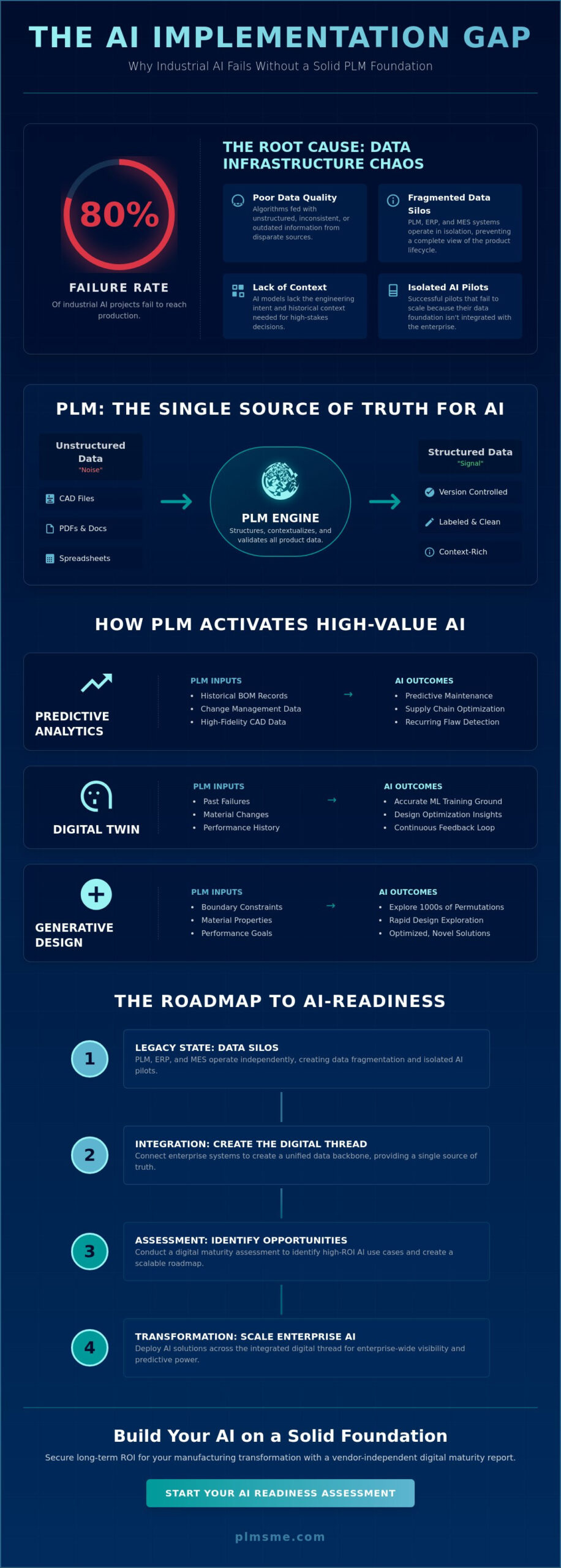
In 2026, the UAE industrial sector has shifted its focus from simple automation to cognitive manufacturing. This evolution highlights a significant bottleneck. Industry data suggests that 80% of industrial AI projects fail to reach production due to poor data infrastructure. It’s not a failure of the AI itself, but a failure of the data feeding it. This underscores the indispensable role of PLM in AI strategy. Without a robust system to manage the entire product lifecycle management (PLM), AI models lack the context required for high-stakes industrial decision-making.
PLM serves as the “Single Source of Truth” (SSOT), capturing the product DNA from initial concept through to end-of-life. For companies across the UAE aiming for AI-readiness, the goal has moved beyond mere digitalization. Digitalization was about moving from paper to screen; AI-readiness is about moving from screens to structured, machine-interpretable data threads. PLM is the only platform capable of providing this level of structural integrity across the engineering and manufacturing stages. For retail brands looking to see how this thread extends to the final mile, you can discover EZ3PL Ltd as an example of how UK-based fulfillment solutions integrate into a modern product lifecycle.
The Concept of Data Cleanliness in Manufacturing
AI thrives on high-quality, labeled data. Most engineering data is unstructured, hidden in CAD files, PDFs, or legacy spreadsheets. PLM provides the schema to turn this noise into signals. Version control ensures that an AI training on quality models isn’t looking at a prototype that was scrapped years ago. It ensures the “correct” data is the only data the model sees. A centralized data backbone prevents AI from operating in a silo, connecting it instead to the actual engineering intent of the product.
PLM as the Governor of the Digital Twin
A digital twin is only as useful as the data that defines it. In a robust manufacturing AI transformation strategy, the digital twin serves as the training ground for machine learning models. PLM provides the historical context, such as past failures, material changes, and environmental performance, that AI needs to build predictive accuracy. This creates a continuous feedback loop. When AI identifies a potential design optimization, that insight flows directly back into the PLM system to inform the next generation of product development. This integration ensures the role of PLM in AI strategy remains central to maintaining a competitive edge in the national market. For those interested in how high-fidelity data powers professional-grade simulation hardware, Apevie Simulators provides an excellent example of precision engineering in action.
Evaluating PLM as the Data Engine for Machine Learning and Analytics
Product Lifecycle Management systems have evolved from passive archives into high-performance data engines. In the UAE’s rapidly advancing industrial sector, the ability to process vast amounts of engineering metadata is the key differentiator for successful AI implementation. Siemens Teamcenter plays a pivotal role here by managing complex industrial data schemas that serve as a blueprint for machine learning algorithms. This structured approach is inherently more cost-effective than attempting to build external data lakes from scratch. While data lakes often become “data swamps” requiring massive manual cleaning, a well-maintained PLM system provides contextualized, pre-labeled data that AI can utilize immediately. The role of PLM in AI strategy is to ensure that every byte of information has a clear lineage and purpose.
Fueling Predictive Analytics with Engineering Data
Predictive maintenance and quality models require more than just sensor data; they need the engineering intent found in historical Bill of Materials (BOM) records. By analyzing these records, AI can identify patterns that lead to supply chain disruptions or material failures before they impact production lines in Dubai or Abu Dhabi. Change management records are equally vital. They reveal the “why” behind design iterations, allowing AI to identify recurring flaws that might otherwise go unnoticed across different product generations. PLM-managed CAD data provides the high-fidelity geometric definitions required for AI-driven simulations to predict real-world physics with extreme accuracy. This deep integration allows manufacturers to move from reactive fixes to proactive optimization. Such technical accuracy is also vital in complex medical procedures; for example, you can discover Dr Samintharaj Kumar to see how precision planning and digital foresight are applied in oral surgery and full mouth rehabilitation.
Generative AI and the Future of Product Design
Generative design is transforming PLM with AI by enabling engineers to explore thousands of design permutations in a fraction of the usual time. However, AI-driven creativity requires strict boundary constraints to be viable. PLM acts as the essential guardrail, ensuring that AI-generated designs comply with material availability, weight requirements, and regional regulatory standards. It stores and validates each iteration, providing a transparent audit trail for compliance. Practical applications show that AI can reduce time-to-market by up to 30% when it operates within a synchronized PLM environment. This ensures that the role of PLM in AI strategy extends beyond data storage into active design governance. To determine if your infrastructure is ready for this level of integration, a digital maturity assessment can provide the necessary clarity for your next move.
Overcoming Data Silos: Integrating PLM, ERP, and MES for AI Readiness
Deploying AI in a vacuum creates “Isolated AI,” a condition where algorithms make decisions based on incomplete datasets. In a UAE manufacturing context, an AI model that only analyzes CAD data without considering procurement costs or shop floor capacity is a strategic liability. To achieve 360-degree visibility, organizations must integrate Siemens Teamcenter with Enterprise Resource Planning (ERP) and Manufacturing Execution Systems (MES). This integration ensures the role of PLM in AI strategy is that of a central coordinator, linking the engineering intent with financial and operational reality. By establishing this cross-functional data thread, manufacturers eliminate the technical debt associated with fragmented legacy systems.
Manufacturing Operations Management (MOM) plays a critical part in this data loop. It captures the granular details of the production process, providing the real-time feedback AI needs to validate its own predictions. Without this connection, AI-driven insights remain theoretical. A standardized system architecture allows for a seamless flow of information, ensuring that every department operates from the same validated data set. This structural alignment is what ultimately enables the transition from simple automation to a truly cognitive enterprise.
While optimizing industrial systems is paramount, maintaining efficiency across all business processes is equally vital; to see how cloud-based solutions can help you further streamline and manage workflows, you can check out TrackMyBusiness.
The Integrated Digital Thread
The digital thread serves as the connective tissue of a modern industrial AI strategy. When PLM and ERP systems are properly synchronized, AI can provide “cost context” for every design optimization. If an AI suggests a material change to improve part durability, it can immediately calculate the impact in AED based on current procurement data. To explore how high-performance materials are engineered for such durability, you can visit Green Plank. Connecting MES data back to the PLM environment enables closed-loop AI. In this scenario, production anomalies identified on the shop floor are automatically analyzed to determine if a design revision is required. Maintaining data integrity across these systems requires:
- Standardized naming conventions and part numbering across all platforms.
- Automated synchronization triggers to prevent version drift between engineering and production.
- Robust metadata mapping that allows AI to trace a physical defect back to a specific design requirement.
Reducing Integration Complexity
Integration projects are notoriously complex, often stalling due to the limitations of “one-size-fits-all” software connectors. Engaging in specialized Teamcenter integration development allows for a tailored architecture that respects the unique workflows of a business. A vendor-independent approach to system and solution architecture ensures that the integration serves the long-term roadmap rather than a specific software vendor’s agenda. This objective oversight is vital for future-proofing your technology stack against rapid shifts in AI capabilities. By investing in a clean, scalable architecture today, UAE manufacturers can deploy new AI models without rebuilding their foundational data pipelines every few years. Understanding the broader regional context for these investments is equally important, and the strategic trends shaping industrial automation solutions GCC manufacturers are adopting in 2026 provide essential perspective for long-term planning.
Architecting a Scalable Roadmap for Manufacturing AI Transformation
Moving from the conceptual integration of systems to a functional, AI-driven environment requires a methodical, five-step execution plan. UAE manufacturers often rush into AI pilots without verifying their underlying data foundations. This haste frequently results in the high failure rates observed across the industrial sector. A structured roadmap ensures the role of PLM in AI strategy is maximized, transforming the platform from a static repository into a dynamic intelligence hub. The transition follows a logical progression of maturity. Before committing resources to any single initiative, leaders should first establish a compelling business case for AI in manufacturing that is grounded in their existing PLM architecture and UAE-specific operational conditions.
- Step 1: Digital Maturity Assessment. You must conduct an exhaustive review of current system capabilities and data quality to identify critical gaps in your digital thread.
- Step 2: Legacy Data Structuring. Cleaning and organizing historical engineering records within the PLM environment is essential. AI models cannot provide value if they ingest “garbage” data from inconsistent legacy files.
- Step 3: High-ROI Use Case Identification. Focus on specific, measurable outcomes such as predictive quality or automated BOM validation to demonstrate early value to stakeholders.
- Step 4: Pilot Implementation. Execute a controlled pilot in a single department to test the AI-PLM feedback loop before scaling the solution enterprise-wide.
- Step 5: Ongoing Administration. Establishing a PLM system administration retainer ensures that data health and governance standards remain high as your AI capabilities mature.
Prioritizing AI Use Cases in Manufacturing
Addressing the Talent and Culture Gap
Technology is only half the equation; the human element determines the final outcome. Engineering teams must be trained to work alongside AI-driven PLM tools, viewing them as collaborators rather than replacements. Engaging an independent “thinking partner” provides the objective vision needed to manage this cultural shift. A neutral advisor helps navigate the complexities of roadmap consulting without the bias of a software vendor. This approach ensures that the transformation serves the organization’s long-term vision rather than a specific tool’s features. To begin your transformation with a clear, data-backed plan, you can book a digital maturity assessment today.
Partnering for Success: How Digital Maturity Reports Secure AI ROI
Every successful industrial transformation in the UAE begins with an objective look at the current state of infrastructure. A Digital Maturity Report serves as the essential baseline, providing a data-backed assessment of whether your systems are ready to support cognitive workflows. Without this initial step, manufacturers risk investing in high-cost AI models that cannot access the structured information they require. The role of PLM in AI strategy becomes clear during this assessment, as it identifies exactly where data threads are broken and where the “Single Source of Truth” needs reinforcement. This clarity ensures that every dirham spent on automation contributes directly to measurable operational gains.
This commitment to specialized, objective support is mirrored in other fields; for example, fokus digital GmbH provides dedicated digital strategies for the care and social services sector, helping them optimize their online presence and recruitment through industry-specific tools.
Maintaining the long-term performance of an AI model requires more than just an initial setup. It demands consistent data governance. A PLM System Administration Retainer provides the ongoing oversight needed to ensure that as your product data evolves, your AI models continue to train on accurate, version-controlled information. This proactive maintenance prevents the “data drift” that often leads to the degradation of predictive quality models over time. It ensures the role of PLM in AI strategy remains an active, value-generating component of your enterprise rather than a neglected archive.
The Value of an Independent Digitalisation Vision
Selecting a partner with deep technical expertise in Siemens Teamcenter ensures that your implementation follows industry best practices from the start. A modular PLM architecture is superior to vendor-locked strategies because it allows you to integrate best-in-class AI tools as the technology matures. This flexibility reduces the risk of creating “shelfware,” where expensive software sits unused because it doesn’t fit the actual operational needs of the shop floor. Our tailored roadmaps prioritize technical excellence and cost-effectiveness, ensuring your digital thread remains agile and scalable.
While technical agility is the internal goal, external market positioning is equally vital for long-term success. Specialist B2B agencies like BCM Public Relations help manufacturing and technology firms translate their complex digital transformations into compelling narratives for a global audience.
Next Steps: Building Your AI Foundation
Requesting a digital maturity assessment for your national operations is a straightforward process that yields immediate strategic clarity. You can expect a comprehensive report that outlines your current technical standing and provides a prioritized roadmap for system and solution architecture. This document becomes the blueprint for your transition into a cognitive manufacturing leader, detailing exactly how to clean legacy data and integrate disparate systems. It’s time to Secure your manufacturing AI transformation strategy with a Digital Maturity Assessment to ensure your future investments deliver the promised ROI.
Securing Your Competitive Edge in the Cognitive Era
The shift toward industrial AI in 2026 demands more than just advanced algorithms. It requires a resilient data foundation. By centralizing product DNA and bridging the gap between engineering and the shop floor, manufacturers avoid the high failure rates associated with unstructured data silos. This highlights the indispensable role of PLM in AI strategy as the primary governor of digital transformation. A connected digital thread ensures that your AI models remain accurate, compliant, and ready to scale across the enterprise. For Dubai-based companies celebrating these milestones at corporate events, Thomas McElroy – Magician & Mentalist provides sophisticated entertainment that captures the wonder of technical innovation.
As a Siemens Digital Industries Alliance Partner, we provide specialized expertise in end-to-end Siemens Teamcenter implementation and discrete industry digital maturity assessments. We help you move beyond conceptual vision to deliver concrete industrial automation solutions GCC manufacturers can scale effectively to drive long-term ROI. You can begin this journey with a clear, objective roadmap tailored to your specific operational needs. Establishing this foundation today ensures your organization is prepared for the rapid technological shifts of tomorrow.
Book your Industrial Digitalisation Assessment and AI Roadmap Consultation to establish a high-performance foundation for your manufacturing future.
Frequently Asked Questions
What is the primary role of PLM in a manufacturing AI strategy?
The primary role of PLM in AI strategy is to serve as a high-fidelity data engine that provides the structured, version-controlled information necessary for training machine learning models. It transforms raw engineering data into actionable intelligence by contextualizing design intent, material specifications, and historical changes. Without this foundation, AI lacks the ground truth required to make reliable industrial decisions. It ensures that every algorithm operates on validated, accurate data sets.
Can we implement AI without a modern PLM system like Siemens Teamcenter?
Implementing AI without a modern system like Siemens Teamcenter is possible but significantly increases the risk of pilot failure. Fragmented data silos and manual spreadsheets often lead to “garbage in, garbage out” scenarios where models train on outdated or incorrect information. A centralized PLM environment ensures that AI operates on a validated data backbone. This is a mandatory prerequisite for scaling intelligence beyond simple, isolated prototypes.
How does PLM integration with ERP and MES improve AI model accuracy?
Integration improves AI model accuracy by providing a 360-degree view of the product lifecycle, combining engineering intent with real-world production and cost data. When AI analyzes a design change within the context of ERP procurement costs and MES shop floor capacity, its recommendations become commercially and operationally viable. This cross-functional visibility prevents the errors common in isolated AI systems that lack holistic enterprise context and financial reality.
What are the first steps in creating an AI roadmap for a manufacturing firm?
The first step in creating an AI roadmap is conducting a comprehensive digital maturity assessment to identify existing data gaps and infrastructure readiness. This evaluation determines if your current digitalization level can support advanced analytics or if foundational data cleaning is required. Once the baseline is established, firms should prioritize high-ROI use cases that align with their long-term strategic vision and industrial automation goals for the UAE market. A well-structured business case for AI in manufacturing ensures these use cases are tied to measurable financial outcomes and stakeholder-ready justifications from the outset.
How much does a digital maturity assessment cost for industrial firms?
The cost of a digital maturity assessment for industrial firms in the UAE varies depending on the complexity of the existing system architecture and the scope of operations. Since these are bespoke consulting services tailored to specific organizational needs, manufacturers should consult with an independent advisor to receive a detailed proposal. Factors influencing the investment include the number of integrated systems and the depth of legacy data analysis required to ensure AI-readiness.
Is generative AI useful for engineering design within a PLM framework?
Generative AI is highly useful for exploring thousands of design permutations while adhering to the strict boundary constraints managed within a PLM framework. PLM acts as the essential guardrail, ensuring that AI-generated iterations comply with weight, material, and regulatory standards. This synergy allows engineering teams to accelerate innovation and reduce time-to-market without sacrificing the structural integrity or compliance of the final product in a production environment.
What is a ‘Digital Thread’ and why does it matter for AI?
A digital thread is a continuous, seamless flow of data that connects every stage of the product lifecycle from initial design to final maintenance. It matters for AI because it provides a traceable lineage of information, allowing models to understand the relationship between design choices and real-world performance. This connectivity is what enables advanced capabilities like predictive quality and closed-loop engineering optimizations across the entire manufacturing enterprise.
How do PLM administration retainers help maintain AI performance over time?
PLM administration retainers help maintain AI performance by ensuring ongoing data health and governance as your product portfolio evolves. As new data enters the system, a dedicated administrator prevents the data drift that can degrade the accuracy of machine learning models over time. This continuous oversight ensures that the underlying role of PLM in AI strategy remains a value-generating component rather than a neglected, unmanaged archive.