
PLM Audit & Health Assessment UAE: 2026 Practical Guide
What if recurring PLM delays stem not from the software itself, but from processes, data, architecture, or integrations? A PLM audit and health assessment UAE manufacturers can act on starts with evidence, not a generic checklist. It examines how the system supports day-to-day work and identifies technical or operational issues that may be getting in the way.
A useful assessment gives teams clear answers without losing sight of ongoing operations. It separates symptoms from root causes, then connects each finding to business priorities so stakeholders can decide what to address first.
This practical guide explains what a PLM health assessment can examine, from workflows and data integrity to system architecture, performance, access, and connections with ERP, CAD, MES, or MOM environments. You’ll learn how to interpret findings, prioritise improvements, and turn results into realistic next steps for PLM improvement and wider industrial digitalisation. The goal is decision support: a clear view of current system health and a practical path forward.
Key Takeaways
- A PLM health assessment examines how processes, data, configuration, architecture, and integrations support industrial operations.
- A focused PLM audit and health assessment UAE organisations can use distinguishes immediate operational risks from structural issues and longer-term opportunities.
- Prioritise findings by business impact, process dependencies, evidence strength, and implementation dependencies.
- Prepare by defining objectives and system boundaries, gathering relevant evidence, and involving stakeholders across business, engineering, IT, and integrations.
- Translate assessment findings into practical next steps, from roadmap and architecture decisions to implementation scope and ongoing administration.
What a PLM audit and health assessment means for UAE industrial operations
A PLM audit is a structured review of how well a Product Lifecycle Management environment supports an organisation’s work. It looks beyond whether the software runs to examine how people use the system, how product data is managed, and how configured workflows and supporting processes fit together. The aim is to assess system fitness against business needs, not simply produce a list of technical observations.
“Audit” can describe very different activities. A PLM audit and health assessment UAE industrial organisations undertake focuses on the PLM environment and its role in managing product information and processes. It is not a workplace safety audit, a financial audit, or a healthcare licensing review. The broader purpose of Product Lifecycle Management (PLM) is to connect people, data, processes, and business systems across a product’s lifecycle. An assessment reviews how effectively those connections work in the organisation’s actual context.
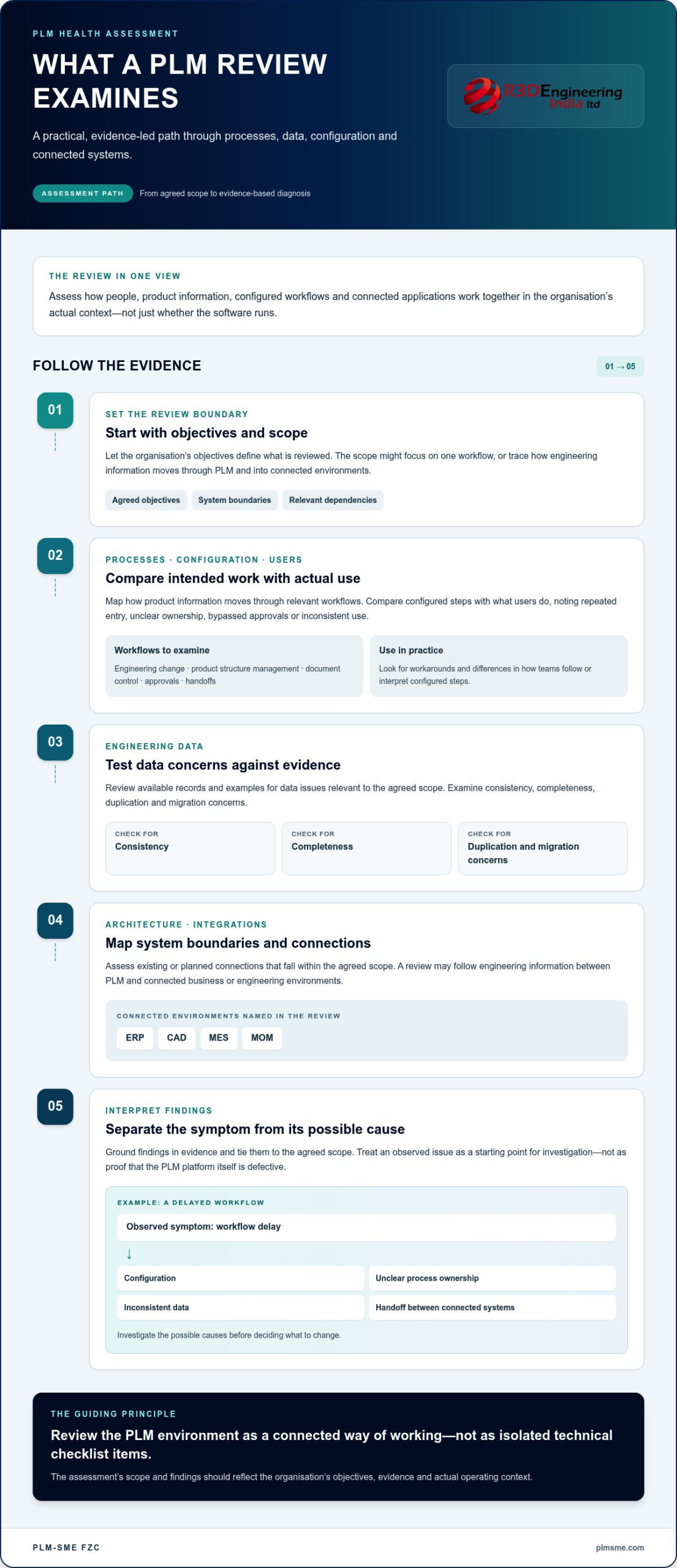
A software inspection may check technical components in isolation. A health assessment relates technical evidence to operational use. For example, a delayed workflow could result from configuration, unclear process ownership, inconsistent data, or a handoff between connected systems. The assessment investigates these possible causes rather than assuming the PLM platform itself is defective.
What does a PLM health assessment examine?
The assessment considers how processes, system configuration, users, data, and connected applications interact. Its scope should reflect the organisation’s objectives and current environment. A review might focus on one workflow or trace how engineering information moves through PLM and into connected ERP, CAD, MES, or MOM environments. Findings should be grounded in evidence and tied to the agreed scope, rather than presented as a universal checklist.
A system-health review is distinct from a broader digital maturity assessment. The first investigates the fitness and use of the current PLM environment. A digital maturity assessment takes a wider view of how digital capabilities support business goals and where future development may be needed. The two can inform one another, but they answer different questions.
When should an industrial organisation consider an assessment?
Consider a review when teams encounter recurring friction or when a planned change could affect how the PLM environment operates. These signals are reasons to investigate, not proof of platform failure. For example, duplicated product records may point to data practices or system handoffs as well as technical configuration.
- Workflows differ between teams, or users rely on manual steps to complete routine tasks.
- Product information appears in multiple places, or responsibility for system decisions is unclear.
- An upgrade, organisational change, or planned integration could affect existing processes and dependencies.
Assessing PLM health at these points helps teams establish a shared view of current conditions before deciding what to change. The diagnosis can clarify whether the next step is process alignment, configuration work, architecture review, integration planning, or a broader digitalisation discussion. It should not assume the answer in advance.
The PLM health assessment domains: processes, data, architecture, and integrations
A useful assessment connects how work is meant to happen with how the PLM environment is configured and used. It examines relevant business processes, system configuration, engineering data, technical architecture, user experience, and connected applications. Let the organisation’s objectives set the scope: a review focused on engineering change, for example, need not expand into every system or product lifecycle process.
PLM health depends on evidence across processes, data, technology, and user adoption, assessed together rather than as isolated checklist items. This approach helps distinguish an observed issue, such as repeated manual entry, from a suspected cause that still needs investigation.
- Processes: Review relevant workflows, including engineering change, product structure management, document control, approvals, and handoffs.
- Configuration and users: Compare configured workflows and system practices with actual use. Note where users follow workarounds or interpret steps differently.
- Data: Examine consistency, completeness, duplication, and migration concerns using evidence from the organisation’s environment.
- Architecture and integrations: Map system boundaries and assess the connections that exist or are planned within the agreed scope.
This structure keeps a PLM audit and health assessment UAE focused on industrial requirements. PLM here means Product Lifecycle Management; health sector regulators in the country have a separate remit and do not define the technical domains of a PLM review.
Reviewing PLM workflows, configuration, and engineering data
Map how product information moves through the agreed processes, from creation and revision to review, release, and handoff. Compare the intended workflow with what users actually do. Look for repeated entry, unclear ownership, bypassed approvals, or inconsistent use of configured steps. Then test data concerns against available records and examples. Separate verified duplication or migration gaps from assumptions that need more evidence.
Assessing system architecture and enterprise connections
Document the PLM components and boundaries relevant to the review, including connected environments and dependencies. Where connections exist, trace the required information exchange with CAD, ERP, MES, or MOM systems. Identify what information moves, where a handoff occurs, and what evidence points to an issue. Record observed failures separately from unverified explanations so investigation and corrective decisions remain evidence-based.
Findings are more useful when they reflect the whole working environment, not just a software setting. When the review identifies a need to address process ownership or system boundaries, PLM-Sme FZC provides PLM system architecture and integration support to help define the technical work required, without assuming that a platform change is the answer.
How to interpret PLM audit findings and prioritise the right improvements
A PLM assessment can produce findings across workflows, configuration, data, and connected systems. Its value comes from interpreting them in context, then deciding what needs attention now, what requires further investigation, and what belongs in a longer-term improvement plan. A long list of findings is not automatically a useful plan.
For a PLM audit and health assessment UAE organisations can use to guide action, compare findings by business impact, process dependency, evidence strength, and implementation dependency. A frequently reported issue may affect a low-impact task, while a less common weakness could interrupt a critical engineering release. Frequency matters, but it should not determine priority on its own.
| Finding category | What it may indicate | Typical response |
|---|---|---|
| Immediate operational risk | A verified problem is disrupting a critical workflow or creating uncertainty in a key handoff. | Stabilise the affected process, assign an owner, and confirm the issue and its scope. |
| Structural issue | Evidence points to a recurring weakness in process design, configuration, data governance, or system architecture. | Investigate root causes and dependencies before defining a corrective change. |
| Longer-term opportunity | A potential improvement could support future business objectives, but isn’t required to resolve an immediate issue. | Assess it against the digitalisation vision and sequence it into a roadmap where appropriate. |
Separating symptoms, root causes, and improvement opportunities
Repeated manual entry is a symptom, not a diagnosis. It may reflect a process gap, unsuitable configuration, inconsistent product data, or an integration issue. Trace the information flow and compare user accounts with system evidence. Record verified findings separately from assumptions, and specify what further analysis would confirm or rule out a suspected cause. This keeps recommendations proportionate to the evidence.
Turning findings into an evidence-based priority sequence
Assess each finding against the organisation’s stated objectives. Consider its operational impact, which processes depend on the affected capability, how strong the supporting evidence is, and whether other changes must happen first. Then group practical actions into stages:
- Stabilise: Address evidenced issues that interfere with priority work or create immediate process uncertainty.
- Extend: Improve existing workflows, configuration, data practices, or integrations once key dependencies are understood.
- Transform: Plan broader architecture or digitalisation changes aligned with longer-term objectives.
These horizons prevent every observation from becoming an urgent project. For example, a confirmed handoff problem might need near-term investigation, while a wider redesign could wait until its dependencies and business purpose are clear. Keep the sequence adaptable as evidence develops. A universal severity score or unsupported savings estimate is not a substitute for transparent reasoning that stakeholders can review and act on.
For each finding, state the evidence, operational implication, confidence level, and next decision or investigation. This turns assessment results into a manageable sequence of decisions rather than an unprioritised remediation backlog.
Preparing for a PLM audit in the UAE: evidence, people, and scope
Good preparation keeps a PLM review focused on the questions the organisation needs answered. Before gathering evidence, agree which decisions the findings should support, which parts of the environment are in scope, and how review activity can fit around operational work. This helps stakeholders provide relevant information without turning preparation into a separate documentation project.
Defining assessment scope and involving the right stakeholders
Set objectives around specific operational or transformation questions, then define the processes, PLM components, and connected platforms the assessment will cover. Involve business owners, engineering users, IT, system owners, and integration stakeholders who are relevant to that scope. Representative users show how work happens in practice, while owners explain documented processes, system responsibilities, and dependencies. Comparing these perspectives helps reveal gaps without assuming either account is complete.
- Agree the objectives. State the decisions the review should inform, such as understanding a workflow problem, preparing for an upgrade, or assessing integration readiness.
- Set system boundaries. Identify relevant PLM processes and components, plus connected platforms included in the review. Record what is out of scope to prevent assumptions.
- Identify stakeholders. Select business and process owners, engineering users, IT representatives, and integration stakeholders who can speak to the agreed scope.
- Gather existing evidence. Assemble current documentation and records before scheduling discussions, so interviews can focus on gaps and real operating practices.
- Set review priorities. Identify critical workflows, known friction points, and operational constraints that should guide interviews and walkthroughs.
When an organisation has broader questions about digital capabilities alongside PLM, a digital maturity report in manufacturing can provide wider context. Keep that perspective distinct from the PLM system review: the assessment scope should still reflect the immediate questions and decisions at hand.
Organising evidence and reducing disruption during the review
Start with information the organisation already maintains. Useful evidence may include process maps, system and architecture documentation, change records, configuration references, sample workflow records, and diagrams or descriptions of integration flows. Gather material relevant to the agreed scope. If a record is missing or outdated, note it as an evidence gap rather than treating it as proof of a technical fault.
- Current process maps and work instructions for in-scope workflows
- System boundaries, architecture information, and relevant configuration documentation
- Change records or representative examples of workflow use
- Integration flow documentation for connected platforms included in scope
Plan interviews and walkthroughs around participants’ operational responsibilities. Use representative scenarios to understand how tasks move between roles and systems, and avoid requesting broad data exports when targeted examples can answer the question. Handle records in line with the organisation’s information controls, agree who can access them, and keep evidence collection proportionate to the assessment.
A clearly scoped PLM audit and health assessment UAE organisations can prepare for in this way is more likely to produce findings that stakeholders can validate and use. PLM-Sme FZC provides PLM assessment and roadmap support to connect assessment priorities with broader digital direction.
From PLM health assessment to a practical digitalisation roadmap
Assessment findings become valuable when they guide decisions, not simply describe current conditions. Once evidence and priorities are clear, an organisation can decide which issues require process changes, where architecture or integration work is needed, and whether broader digitalisation goals call for a longer-term plan. Recommendations should reflect the organisation’s objectives, dependencies, and operating environment.
Keep the stages distinct. An assessment diagnoses system and process health. Roadmap design translates that diagnosis into initiatives and a sequence of decisions. Implementation delivers agreed changes, while ongoing administration supports the PLM environment after those changes are in place. These stages connect, but one does not automatically commit an organisation to the next.
Connecting assessment findings to roadmap decisions
Translate prioritised findings into initiatives, dependencies, and decisions. A workflow issue might first require process ownership to be clarified; an integration concern may need architecture analysis before implementation scope can be defined. A broader industrial digitalisation roadmap for manufacturing provides context for aligning PLM priorities with wider transformation objectives. The sequence and scope should reflect each organisation’s needs and environment.
A useful roadmap records why an initiative matters, what it depends on, and what decision is needed before work proceeds. It can separate stabilising current operations from extending existing capabilities or considering more substantial transformation. This makes the plan easier to discuss across business, engineering, and IT teams, and helps avoid treating every assessment observation as an immediate implementation requirement.
Choosing a delivery path that supports customer continuity
Independent assessment supports informed technology and architecture decisions by keeping diagnosis separate from a predetermined platform recommendation. The next step may be process improvement, system architecture, integration development, implementation support, or further analysis. A suitable path should preserve useful existing capabilities and reflect the organisation’s priorities, rather than introduce change for its own sake.
For organisations establishing a PLM foundation, TeamCenter FOUNDATION is a pre-configured PLM Start deployment that includes 15 years of configuration knowledge. Built around the START-EXTEND-TRANSFORM methodology, it is one option for creating a PLM foundation, not a mandatory conclusion of an assessment. PLM-Sme FZC also provides Teamcenter implementation support, including scope definition, migration and translation projects, system administration, and maintenance.
PLM-Sme FZC connects diagnosis with practical next steps through digitalisation vision and roadmap consulting, system architecture, and PLM implementation support. A considered PLM audit and health assessment UAE organisations can use should clarify both what the evidence shows and which decisions remain open. To discuss how an assessment can inform your PLM priorities, explore PLM assessment support.
Turn assessment insight into your next decision
The next step doesn’t need to be a broad transformation programme. Start by choosing one decision the assessment should clarify, then use the evidence to shape a manageable path forward. A well-scoped PLM audit and health assessment UAE organisations undertake can create a sound basis for that decision while leaving room to adjust priorities as business needs evolve.
PLM-Sme FZC connects digital maturity assessments and reports with roadmap consulting and relevant technical delivery. Depending on the findings, that work may involve architecture, Teamcenter implementation, integration development, or ongoing administration. The aim is to align the work with your environment and objectives, not prescribe change for its own sake.
Ready to clarify your PLM priorities? Discuss a PLM audit and health assessment for your industrial environment with PLM-Sme FZC and identify a practical starting point for your next improvement decision.
Frequently Asked Questions
What is a PLM audit and health assessment?
A PLM audit and health assessment evaluates whether a Product Lifecycle Management environment supports the organisation’s product-related work. It considers the relationship between technology and the way people manage product information and processes. Unlike a software-only inspection, it asks whether the system is fit for its intended operational purpose. The review concerns PLM, not workplace safety, financial, or healthcare licensing audits.
What does a PLM health assessment typically review?
A PLM health assessment typically reviews workflows, configuration, product data, system architecture, user experience, and relevant connections with other applications. The exact scope depends on the organisation’s objectives and current setup. For instance, a review may examine how a product revision is controlled from engineering approval through downstream release. It should distinguish evidence of an actual issue from questions that need further investigation.
How do you prepare for a PLM audit?
Begin by identifying the decision the audit should support, such as whether a workflow is ready for an upcoming change. Select a representative product process or transaction that stakeholders can walk through, and identify the people who own or use it. Make existing records accessible through approved information-handling practices. A focused example helps reviewers compare the intended process with actual work without requiring teams to prepare extensive new documentation.
How long does a PLM health assessment take?
There isn’t a fixed duration for every PLM health assessment. Timing depends on the agreed scope, the number of processes and system boundaries involved, stakeholder availability, and how readily relevant evidence can be reviewed. A focused review of one workflow differs from a wider assessment involving several teams and connected systems. Set milestones after scope and access needs are understood rather than assuming a standard timeline.
Is a PLM health assessment the same as a digital maturity assessment?
No. A PLM health assessment examines the current PLM environment and how it supports defined product processes. A digital maturity assessment considers broader organisational capabilities and readiness for digitalisation. For example, the PLM review may identify a constraint in engineering information management, while a maturity assessment considers how that constraint relates to wider transformation priorities. The two can complement each other, but their scope and questions differ.
What should a PLM audit report include?
A useful report should state the assessment objectives and boundaries, describe the evidence reviewed, and present findings in language that technical teams and business owners can act on. For each finding, it can identify the observed condition, potential operational relevance, confidence level, and any further analysis needed. Recommendations should indicate dependencies and proposed next decisions, so readers can distinguish confirmed actions from options requiring discussion.
Can a PLM audit identify integration problems?
Yes, when relevant interfaces are included in scope and evidence is available. Reviewers can trace a defined information exchange, such as an approved engineering item moving from PLM toward ERP, and compare expected behaviour with records or user observations. This can show where a handoff needs investigation. It does not automatically prove the interface is the root cause; process ownership, data quality, or configuration may also need examination.
Does a PLM health assessment require a specific software vendor?
No. The assessment should be guided by business objectives and the organisation’s existing PLM environment, rather than requiring a particular vendor. A vendor-independent review can examine processes, data, architecture, and integrations before technology decisions are made. PLM-Sme FZC is an independent consultancy with Teamcenter capabilities. An assessment provides decision support, not an automatic recommendation to replace or adopt a particular platform.