
PLM Data Governance Framework for Discrete Manufacturing
What if the biggest PLM data risk isn’t missing information, but teams making different decisions about the same information? In discrete manufacturing, inconsistent definitions, unclear ownership, and unreliable data can undermine engineering changes and BOM control at every lifecycle stage. A practical PLM data governance framework discrete manufacturing teams can use puts decision rights and quality controls into everyday work, rather than leaving them in policy documents.
Governance can feel like extra paperwork when its rules don’t match how engineers and manufacturing teams use PLM. Trusted product data depends on clear accountability and controls that work where information is created, reviewed, released, and changed.
This article explains how to assign owners and stewards for critical product data, establish lifecycle rules, and set measurable quality checks. It also shows how to connect governance policies to PLM workflows, system responsibilities, and integrations, including in Teamcenter environments. The aim is to keep product data reliable and usable downstream, from engineering through manufacturing and beyond.
Key Takeaways
- Define decision rights and accountability across product-data domains, lifecycle stages, and downstream uses.
- Separate policy ownership from day-to-day stewardship so data-quality responsibilities are clear and actionable.
- Match preventive, detective, and corrective controls to the right system, owner, and lifecycle point.
- Build a PLM data governance framework discrete manufacturing teams can apply by prioritising a domain, baselining data quality, piloting controls, and scaling what works.
- Translate governance into practical Teamcenter roles, workflows, and architecture, supported by assessment, roadmap, implementation, and administration activities.
Why discrete manufacturers need a PLM data governance framework
Product data rarely stays within one team. Engineering may revise a part record or CAD document while manufacturing works from a different product structure, quality refers to an outdated specification, and supply-chain teams use inconsistent descriptions. Even when each function has useful information, unclear definitions and ownership make it difficult to know which data is authoritative. A PLM data governance framework discrete manufacturing teams can apply sets out how product information is defined, controlled, and trusted as it moves through the lifecycle.
PLM data governance is the set of decision rights, standards, controls, and accountabilities that guides how lifecycle information is created, changed, approved, and used. Its purpose is to support controlled, repeatable lifecycle decisions by making clear who can decide, which rules apply, and how data quality is maintained. Product Data Management (PDM), a core part of PLM, provides capabilities for managing product information through its lifecycle. Governance establishes the business rules for managing that information.
Governance isn’t the same as software administration, document storage, or a one-time data cleanup. Administration maintains system operation and configuration; storage holds information; cleanup addresses existing defects. Governance defines ongoing responsibilities and decision rules so teams can apply consistent controls as data and products change. Cleaning duplicate records may help, but without ownership and rules for creating or revising records, the same problems can return.
Which product data needs governance?
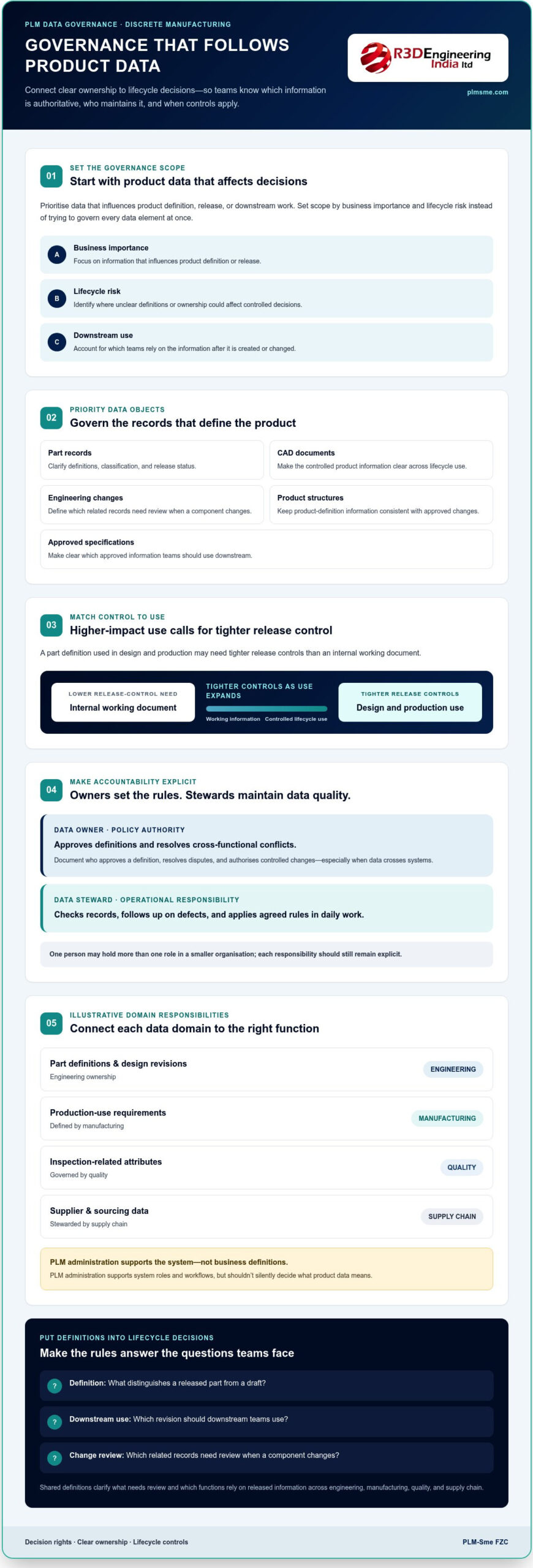
Start with data that influences product definition, release, or downstream work. This often includes part records, CAD documents, engineering changes, product structures, and approved specifications. Define key fields and objects precisely. For example, document what distinguishes a released part from a draft and which revision downstream teams should use. Set the scope according to business importance and lifecycle risk instead of trying to govern every data element at once.
For example, an engineering change may update a component but leave its product structure or approved specification inconsistent. Shared definitions clarify which related records need review and which functions rely on the released information. This reduces ambiguity between engineering, manufacturing, quality, and supply-chain teams without assuming that every function owns the same data.
What governance prevents, and what it doesn’t replace
Defined ownership and lifecycle controls can help prevent duplicate records, unclear accountability, inconsistent definitions, and changes that move forward without the right review. They also make it easier to identify where a data issue should be corrected and who is responsible. A framework doesn’t eliminate every error or guarantee compliance. Its value depends on whether controls are practical, consistently applied, and reviewed as business processes evolve.
Governance complements, rather than replaces, PLM configuration, cybersecurity, and general IT operations. PLM configuration implements system behaviour; cybersecurity protects systems and information; IT operations keep technology running. Governance specifies the business decisions and data-quality expectations those capabilities need to support. A digital maturity report in manufacturing can help organisations assess current capabilities and identify where governance priorities fit within a broader digitalisation roadmap.
Designing governance around product-data domains and lifecycle decisions
Once priority data is identified, the framework needs to show who makes decisions and when. Organise it around product-data domains, lifecycle stages, business risk, and downstream use. A part definition used in design and production may need tighter release controls than an internal working document. The Data Governance in Manufacturing: A Comprehensive Guide provides broader context. The practical task is to connect governance principles to specific product objects and decisions.
Keep policy authority distinct from operational stewardship. Owners decide the rules; stewards maintain operational data quality. An owner approves definitions and resolves cross-functional conflicts. A steward checks records, follows up on defects, and helps apply the agreed rules in daily work. One person may hold more than one role in a smaller organisation, but each responsibility should remain explicit.
Assigning owners, stewards, and decision rights
Assign ownership to the function accountable for the meaning and use of each domain. Engineering may own part definitions and design revisions; manufacturing defines production-use requirements; quality governs inspection-related attributes; and supply chain stewards supplier and sourcing data. PLM administration supports system roles and workflows, but shouldn’t silently decide business definitions. Document who approves a definition, resolves disputes, and authorises controlled changes, especially when data crosses systems.
| Data domain | Accountable owner | Operational steward | Lifecycle decision point |
|---|---|---|---|
| Part records | Engineering | Engineering data steward | Classification and release |
| Product structures | Engineering | Product data steward | Change approval and effectivity |
| Manufacturing attributes | Manufacturing | Manufacturing data steward | Production readiness |
| Quality specifications | Quality | Quality data steward | Approval and revision |
| Supplier data | Supply chain | Supplier data steward | Qualification and use |
Setting lifecycle rules for parts, documents, and BOMs
Define consistent rules for creation, classification, revision, release, supersession, and retention. For example, a released BOM change should identify affected parts and associated documents, follow the required approval path, and preserve the relationship between the approved structure and its specifications. These rules are easier to apply when reflected in system design. The PLM system architecture consulting guide explores how architecture supports connected lifecycle processes.
Keep the framework proportionate. The PLM data governance framework discrete manufacturing organisations need should prioritise decisions with material operational impact, rather than applying identical controls to every object. A digital maturity assessment or roadmap can help align governance priorities with system capabilities. PLM implementation and architecture support can then translate selected rules into practical roles and workflows.
Choosing governance controls that work across PLM and manufacturing systems
A governance rule only works if it is enforced at the right point in the data lifecycle. Match controls to risk: prevent invalid data from entering a process, detect exceptions that slip through, and correct defects with clear accountability. In a PLM data governance framework discrete manufacturing teams can operate, define the control, owner, and system boundary together.
Clear system-of-record assignments reduce conflicting product definitions. That doesn’t mean one platform must own every kind of information. PLM commonly governs product definitions, revisions, and engineering changes; CAD manages design authoring; ERP uses released product information for planning and transactions; MES supports shop-floor execution; and CRM holds customer and commercial context. Define which system owns each object or attribute and which systems consume it.
Matching controls to data risks
Choose controls according to the failure they’re intended to prevent or reveal. A missing classification field calls for a different response than an unapproved engineering revision or a repeated mismatch between released PLM data and downstream records.
- Preventive controls: Apply required-field checks, allowed-value lists, and classification rules when users create or revise records. Data stewards define and review the rules; place the control at the point of entry or change.
- Detective controls: Review exceptions, such as incomplete records or inconsistencies between an approved product structure and a downstream copy. Stewards or domain owners investigate patterns and assign follow-up.
- Corrective controls: Route defects to an accountable owner, correct affected records through approved procedures, and record the resolution. Use these controls when an issue has already reached a released or downstream state.
Workflow approvals are especially useful for controlled releases, revisions, and changes with broad product impact. Set the approval path according to the change’s risk and affected data, rather than adding the same review burden to every edit. Periodic exception reviews can reveal recurring quality issues, unclear ownership, or rules that no longer reflect how teams use the data.
Defining authoritative sources and handoffs
Assign authority by object and, where needed, by attribute. PLM might own a released part revision, while ERP owns a planning value associated with that part. Record who can change the authoritative value, what downstream systems receive, and how consumers recognise an approved release. This avoids treating every platform as a competing master.
For a governed handoff, specify the business event that permits data to move, the information included, and how exceptions are returned for review. For example, a released product definition may pass from PLM to ERP for planning and then inform manufacturing execution. The systems need aligned meaning and status, but this governance view doesn’t require interface-level design. Customer and product context may also cross into CRM; Teamcenter CRM integration benefits illustrate why those boundaries matter. Teams defining these responsibilities can connect governance priorities with PLM integration and architecture support.
Implementing and measuring a practical PLM data governance framework
Move from policy to practice in manageable stages. A PLM data governance framework discrete manufacturing teams can sustain should address a real business risk, fit existing lifecycle work, and improve through evidence rather than assumptions. Start with a defined product-data domain and workflow, then extend the approach as responsibilities and controls prove workable.
- Prioritise domains: Select data with clear business impact, such as a product structure or released part record.
- Baseline quality: Examine a defined sample and record current defects, ownership gaps, and process exceptions.
- Assign owners: Name accountable decision-makers and stewards, including who resolves cross-functional issues.
- Define controls: Set the data rules, approval points, exception routes, and measures for the selected domain.
- Pilot the workflow: Apply the controls to real work and observe where users encounter friction or ambiguity.
- Refine and scale: Address findings, document the updated approach, and extend it to related domains or lifecycle processes.
Piloting governance without creating process drag
Choose a domain with a business sponsor, visible data-quality problems, and a lifecycle workflow that can be observed from creation through release or change. A narrow pilot makes it easier to see whether definitions, responsibilities, and approval steps work together in practice.
Test with the people who create, review, and consume the data. Track where users need clarification, where exceptions stall, and whether the control catches the issue it was designed to address. Refine the rules and workflow based on that feedback before applying them elsewhere. If governance adds steps without making decisions clearer or data more dependable, revisit the design.
Monitoring accountability and continuous improvement
Use measures as diagnostic signals, not universal pass-or-fail targets. Establish a baseline for the selected domain, then examine trends and investigate changes in context. Useful indicators include:
- Completeness: Whether required attributes are populated according to the agreed definition.
- Duplicate rates: How often records represent the same part or object.
- Change-cycle exceptions: Where changes encounter missing information, rework, or process deviations.
- Ownership coverage: Whether governed objects have an accountable owner and steward.
- Workflow adherence: Whether records follow the intended review and release path.
Review these indicators on a defined governance cadence. Stewards need a clear route to escalate conflicting interpretations and propose policy updates; owners should decide whether a rule needs revision. Include governance in reviews of lifecycle workflows and PLM changes so controls keep pace with how work is performed instead of becoming a separate audit exercise.
Digital maturity assessments and roadmap work can help align governance priorities with system capabilities and implementation plans. Learn about PLM assessment and roadmap support to connect governance steps with your organisation’s digitalisation priorities.
Turning the framework into an operating model with PLM expertise
Governance becomes operational when its decisions are reflected in how product data is created, reviewed, released, and maintained. In Teamcenter, this means translating approved definitions and decision rights into system roles, lifecycle workflows, access responsibilities, and architecture. A policy that requires a specific owner to approve a high-impact change should correspond to a clear responsibility in the process, not remain a statement in a governance document.
Translating policy into Teamcenter configuration
Begin by mapping each governed object to its definition, accountable owner, steward, and lifecycle state. Then align Teamcenter roles and workflow steps with the actual engineering and manufacturing process. For example, a change to a released product structure may need defined reviews before approval, while draft work follows a different path. Configuration should support those business decisions rather than impose generic templates that add unnecessary steps.
Make governance visible in system behaviour. Users should be able to understand who can edit or approve information, what status an object holds, and which responsibilities apply at each decision point. Clear definitions and approval ownership also help teams identify when a process or data model needs review. PLM implementation and architecture work can connect these policy choices to the organisation’s existing processes and system landscape.
Sustaining governance through architecture and administration
A governance model must extend across connected systems. Architecture and integration work help preserve agreed meaning as governed data moves between PLM and other business applications. Define data responsibilities and handoffs at a business level, then design the supporting system connections without creating competing definitions.
The support needed can vary with governance maturity. A digital maturity assessment can clarify current capabilities and gaps; a digitalisation roadmap can sequence priorities. End-to-end PLM implementation support can help put agreed roles and controls into practice, while ongoing PLM administration supports controlled system changes and operational continuity.
For a PLM data governance framework discrete manufacturing teams can sustain, treat the operating model as part of daily lifecycle work. Revisit role assignments, definitions, workflows, and integrations when products, processes, or system needs change. This keeps governance connected to practical decisions instead of allowing it to become a static set of rules.
Start by identifying the product-data domains that matter most, the decisions that need stronger control, and the outcomes you want to improve. Discuss a PLM governance approach with PLM specialists to explore how assessment, roadmap, implementation, and administration support can fit your priorities.
Make trusted product data part of everyday decisions
A governance framework delivers lasting value when it evolves alongside products, processes, and business priorities. Treat it as an operating capability: review whether ownership remains clear, whether controls still fit the work, and whether teams can use product data confidently at each handoff. The PLM data governance framework discrete manufacturing organisations build today can provide a practical foundation for future changes without locking them into static rules.
PLM-Sme FZC is a Siemens Digital Industries Alliance Partner, supporting organisations with Teamcenter implementation, architecture, and integration development. Digital maturity assessments and roadmap consulting can help define priorities, while ongoing PLM administration supports the system as governance needs develop. Together, these capabilities connect strategic direction with implementation and continued operations.
Choose a priority data domain and define the decision or outcome you want to improve. Discuss a practical PLM data governance approach with PLM-Sme FZC to connect your governance priorities with assessment, roadmap, implementation, and administration support.
Frequently Asked Questions
Is PLM data governance the same as master data management?
No. They overlap, but address different scopes. Master data management typically coordinates shared foundational records used across functions, such as customer, supplier, or item identities. PLM governance focuses on decision rights and controls for product information as it changes through its lifecycle. A manufacturer can connect both disciplines, but should document which team owns each data object and which system supplies its approved value. Neither practice replaces the other.
Who should own product data governance in a manufacturing company?
Business leaders should sponsor governance, while accountable owners are assigned by data domain and decision. For example, engineering may own design definitions, while quality owns inspection criteria. Data stewards support consistent day-to-day use, and PLM or IT specialists implement and administer system controls. Technical administrators shouldn’t be expected to decide business meaning. Establish an escalation route for disputes, such as when manufacturing and engineering interpret a product attribute differently.
Can PLM data governance support AI use in discrete manufacturing?
Yes. A PLM data governance framework discrete manufacturing teams apply can improve the provenance, consistency, access control, and traceability of datasets considered for AI initiatives. That foundation helps teams understand where information came from and who can approve its use. It doesn’t establish that a dataset suits every model or ensure reliable outputs. Before expanding an AI use case, define permitted data uses, accountable owners, and checks relevant to the model’s purpose.
How can a manufacturer tell whether its PLM data governance is working?
Track indicators tied to the risks and data domains in scope, then compare trends with an initial baseline. For example, review ownership coverage, required-field completeness, duplicate or conflicting records, workflow exceptions, and recurring defects. A rise in exceptions after a process change may signal unclear instructions rather than poor user compliance. Investigate patterns with the relevant owners and use findings to adjust definitions, training, or controls instead of relying on universal target figures.
Does a PLM data governance framework replace engineering change management?
No. Governance defines who can make decisions about product information and what quality expectations apply; engineering change management provides the controlled process for evaluating and approving proposed changes. The two should work together. For example, governance can clarify who owns an affected specification, while the change process ensures that its revision and related product structure are reviewed together. This connection makes responsibilities clearer without treating policy and change execution as the same activity.
How should legacy product data be handled under a new governance framework?
Assess legacy records according to current business use, lifecycle status, quality, and risk before deciding what to do with them. Active product data used for planning or service may need correction or migration, while obsolete records could be archived or access-restricted. Assign an owner to each decision and preserve necessary traceability. Avoid blanket remediation: prioritising records that support current products and operational decisions can focus effort where data reliability matters most.