
IT & OT Convergence Consulting: UAE Buyer’s Guide
What if the biggest risk in IT/OT convergence isn’t the technology, but connecting systems without clear ownership or a measurable production outcome? For manufacturers searching for “IT and OT convergence consulting manufacturing UAE,” the real question is how to align enterprise systems with operational priorities without adding unnecessary complexity.
Production and enterprise teams often work to different priorities, while legacy systems compete with future digitalisation goals for attention. A practical convergence programme starts by understanding current digital maturity and business objectives, then setting clear priorities for architecture, integration, and delivery.
This guide explains how to assess consulting approaches, define integration priorities, and compare delivery models for your manufacturing operation. You’ll learn what to look for in a scoped roadmap, how interfaces between systems such as PLM, ERP, MES, and MOM fit into a wider architecture, and how accountable implementation stages can carry strategy into ongoing operation. The aim is to help you evaluate an approach that connects assessment, architecture, integration, and support to the outcomes that matter on your production floor.
Key Takeaways
- Assess how production priorities, legacy systems, and digital maturity should shape your convergence roadmap.
- Compare strategy-led, platform-led, and integration-led approaches by scope, architecture ownership, and ongoing support.
- Use clear interfaces and governed information flows to connect systems without assuming a single replacement platform is needed.
- For IT and OT convergence consulting manufacturing UAE, prioritise integration around operational outcomes and accountable ownership.
- Sequence implementation through defined decision gates, dependencies, owners, and agreed measures to support sustained delivery.
Defining IT and OT convergence for UAE manufacturing operations
Manufacturing decisions depend on information moving between business systems and the technologies that run production. IT and OT convergence coordinates those systems, data, processes, and governance so teams can use consistent, timely information while maintaining clear operational responsibilities. Simply connecting two applications is not enough. Useful convergence gives data shared meaning, controls how it is exchanged, and establishes who owns decisions and changes.
Definition: Convergence consulting assesses current systems, information flows, dependencies, and ownership across IT and OT. It helps an organisation plan a practical target architecture and implementation priorities aligned with manufacturing needs.
Which systems sit on the IT and OT boundary?
ERP and CRM typically support enterprise planning and customer processes. MES and MOM support manufacturing operations, while PLM manages product definitions and engineering changes. Engineering data meets production information when an approved design, revision, or work instruction needs to reach the operation. OT includes the control and monitoring technologies used in industrial processes, including Industrial Control Systems (ICS).
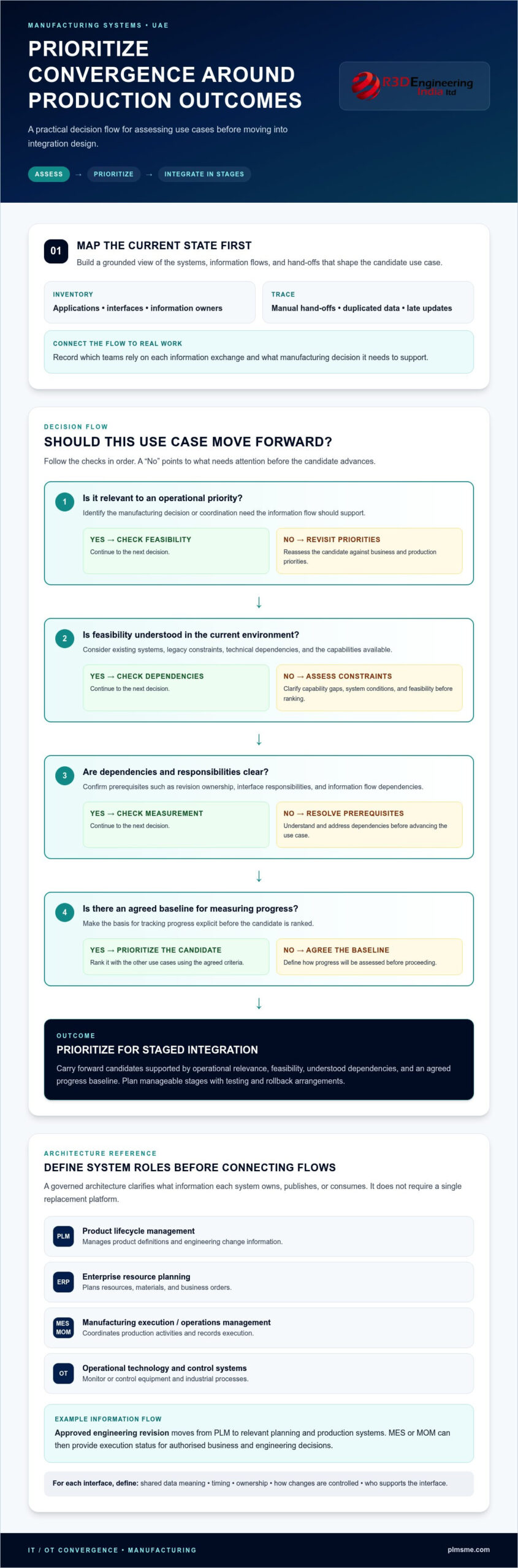
A simple data flow illustrates how responsibilities can be divided:
- PLM: manages product and engineering change information.
- ERP: plans resources, materials, and business orders.
- MES or MOM: coordinates production activities and records execution.
- OT and control systems: monitor or control equipment and processes.
For example, an approved engineering revision can flow from PLM to the relevant planning and production systems. MES or MOM can then provide execution status for authorised business and engineering decisions. Each exchange needs defined data meaning, timing, and ownership.
Why manufacturing teams pursue convergence
Clearer information flows can help teams coordinate planning, engineering changes, and production visibility. Without them, duplicate records, delayed updates, fragmented workflows, and uncertainty over which system holds the authoritative value can complicate decisions. Convergence is intended to address those operating issues, not to promise a predetermined productivity result.
For manufacturers in the UAE, the right scope depends on existing systems, legacy constraints, and digitalisation priorities. IT and OT convergence consulting manufacturing UAE programmes should start with the actual manufacturing context: what information decisions require, where that information originates, and who is accountable for maintaining it. This foundation helps distinguish valuable integration from connectivity that adds complexity without improving coordination.
How consulting connects manufacturing architecture, data, and operational priorities
Convergence architecture should start with the manufacturing decisions the organisation needs to support, not with a preferred platform. An assessment maps the current system landscape, integrations, data flows, stakeholders, dependencies, and constraints. It also clarifies business priorities and capability gaps, giving teams a grounded basis for deciding what to connect, retain, or address first. A manufacturing digital maturity report can help frame this work against current capabilities and objectives.
Mapping the current state and prioritising use cases
Inventory relevant applications, interfaces, information owners, and manual hand-offs. Record where data is duplicated, where updates arrive late, and which teams rely on each information flow. Then rank candidate use cases by operational relevance, feasibility, technical dependencies, and an agreed baseline for measuring progress. For example, making approved engineering changes available to production may depend on resolving revision ownership and interface responsibilities first. This prevents a promising use case from advancing before its prerequisites are understood.
Designing integration around manufacturing workflows
Target architecture is a governed set of interfaces and information flows, not necessarily a single replacement platform. PLM may own product and engineering definitions, ERP may manage orders and material planning, and MES or MOM may coordinate execution and record production status. The architecture specifies which information each system publishes or consumes, how changes are controlled, and who supports each interface. Industrial system architecture consulting can help clarify these relationships across a wider manufacturing environment.
Choose interface standards and protocols based on the actual systems, data requirements, and operating constraints. There is no universal choice that suits every plant. Design decisions should also account for operational continuity: divide work into manageable integration stages, define testing and rollback arrangements, and avoid changes that create unmanaged dependencies across production workflows.
Security belongs in the architecture from the outset. Define access boundaries, responsibilities for maintaining interfaces, and how operational changes are reviewed. The NIST Guide to ICS Security offers reference guidance for considering security in industrial control environments; assess its relevance against the organisation’s own systems and requirements.
For manufacturers seeking IT and OT convergence consulting manufacturing UAE, a clear path from assessment to architecture helps turn priorities into sequenced decisions. A digitalisation roadmap can connect those decisions to accountable implementation work, and digitalisation roadmap consulting can help shape that sequence.
Comparing IT and OT convergence consulting approaches for manufacturers
Connecting systems is not the same as aligning manufacturing workflows. An interface can move information while teams still disagree about its meaning, ownership, or the action it should trigger. A roadmap can also remain a strategy document unless it leads to practical architecture decisions and accountable implementation stages.
Consulting approaches differ in where they place the emphasis. The right fit depends on whether the immediate need is direction, a platform-centred programme, or resolution of specific integration challenges.
| Approach | Typical scope and deliverables | Architecture and implementation | Ongoing support |
|---|---|---|---|
| Strategy-led | Assesses maturity, business priorities, use cases, and capability gaps; produces a target vision and prioritised roadmap. | Defines architectural principles and options. Implementation involvement varies, so recommendations need clear transition points into delivery. | May include progress reviews, or conclude with the roadmap. |
| Platform-led | Centres on selecting, configuring, or extending a core platform to address defined needs. | Platform architecture and deployment receive strong attention. Confirm how surrounding systems and interfaces are handled within the programme. | Can extend to platform administration and optimisation, depending on scope. |
| Integration-led | Targets interfaces and data flows between existing systems, often around a specific operational use case. | Focuses on integration design and implementation. Broader architecture ownership should be explicit to prevent isolated connections. | May cover interface maintenance and support, or hand over after delivery. |
What should a convergence consulting engagement deliver?
Look for outputs that make decisions actionable: a current-state assessment, prioritised use cases, target architecture, and sequenced roadmap. These should identify interface responsibilities, data ownership, dependencies, decision owners, and measures for tracking progress. Distinguish recommendations from delivery commitments. A strategy document describes what to do; configured or implemented systems require defined technical scope, accountable implementation roles, and an agreed handover or administration model.
How to assess platform expertise and fit
Recommendations should begin with manufacturing needs, rather than assuming one platform can solve every integration or governance challenge. Relevant platform experience can help translate architecture into workable implementation choices. Transparent partner relationships also make it easier to understand where specialist expertise informs recommendations.
PLM-Sme FZC is a Siemens Digital Industries Alliance Partner and works with Siemens Teamcenter implementation and integration. This experience fits within a wider manufacturing architecture that can connect PLM with systems such as ERP, CRM, MES, and MOM. For buyers considering IT and OT convergence consulting manufacturing UAE, assess how an engagement carries priorities through assessment, architecture, integration, and ongoing system operation. A strong fit links strategy to delivery without treating connectivity alone as proof of convergence.
Evaluating consulting scope, security, and implementation readiness
A convergence programme can feel risky if it appears to require connecting everything at once. A staged approach reduces that pressure: teams can address a bounded workflow, test interfaces and ownership, then use what they learn to plan dependent work. For IT and OT convergence consulting manufacturing UAE, readiness means agreeing what success looks like and how operational continuity will be protected before implementation begins.
Set scope before selecting the first integration
- Define business objectives. Specify the manufacturing outcomes and workflows in view, such as making approved engineering changes available to production or improving visibility of execution status.
- Build the system inventory. Record relevant ERP, PLM, MES, and MOM environments, data flows, existing interfaces, stakeholders, constraints, and dependencies.
- Prioritise use cases. Assess operational relevance and feasibility, and establish a baseline for each measure. Depending on the workflow, this could include data latency or completion of a defined information hand-off. Agree how the measure will be captured, and set no target until the baseline and business need support it.
- Define scope and deliverables. Clarify included workflows, systems, and stakeholder groups, along with discovery evidence, architecture outputs, implementation responsibilities, and acceptance criteria. Document system dependencies so a change in one interface does not create an unplanned impact elsewhere.
- Establish governance. Name system owners, data stewards, change-control responsibilities, and operational decision rights. Define who approves interface changes and who handles issues after handover.
Plan for risk, continuity, and adoption
Security, safety, and regulatory requirements are essential project inputs, but their applicability depends on the organisation, systems, and operating context. Document the requirements with the relevant internal owners rather than assuming a generic checklist applies. Include resilience expectations, access control, change approval, testing, recovery arrangements, and any constraints on production windows in the design and delivery plan.
Staging is not simply breaking a large project into smaller tasks. Each stage should have a bounded workflow, documented dependencies, test and acceptance criteria, an accountable owner, and a decision gate before the next connection proceeds. For example, teams can validate a data exchange and its operational handling before extending it to additional workflows. This gives IT and production stakeholders a structured way to surface issues while limiting the scope of each change.
Industrial automation and AI solutions can also form part of a broader digitalisation programme. A scoped convergence assessment and roadmap can be shaped around manufacturing priorities through digitalisation roadmap consulting.
Moving from an IT and OT convergence roadmap to sustained delivery
A roadmap creates value when it guides decisions beyond the assessment phase. For manufacturers, the delivery path should connect operational priorities to architecture, sequenced integration, and ongoing review. Each phase needs an accountable owner, agreed dependencies, a decision gate, and measures tied to an established baseline. This makes progress visible and gives teams a clear basis for adjusting the sequence as requirements or constraints become clearer.
Sequencing strategy, architecture, and implementation
Start with digital maturity and manufacturing priorities, then define the target-state architecture and a feasible implementation sequence. A decision gate after assessment can confirm which use cases are ready to proceed. A later gate can verify that proposed interfaces, data ownership, and operational responsibilities are sufficiently defined for implementation. Measures should reflect the intended workflow, such as information availability or completion of a defined hand-off, rather than generic transformation targets.
Integration development can connect relevant PLM, ERP, CRM, MES, and MOM systems according to their responsibilities and the information each workflow needs. For example, an approved product change may need to move from PLM into planning and production processes, with clear controls for revision handling and status feedback. Sequencing interfaces around dependencies helps avoid treating every connection as a prerequisite for every other one. For strategic context, see this industrial digitalisation roadmap for UAE manufacturing.
Maintaining architecture continuity after delivery
Implementation is not the end of the programme. System changes, evolving workflows, and new integration needs can create ongoing work to keep architecture decisions consistent and system administration effective. PLM implementation support and administration can help sustain product data processes and related integrations as the wider manufacturing environment develops.
PLM-Sme supports manufacturers across digital maturity assessment, digitalisation vision and roadmap consulting, system and solution architecture, Teamcenter implementation, integration development, and ongoing PLM administration. This creates a connected path from understanding current capabilities through planning and delivery to continued system operation. The scope can be shaped around manufacturing priorities and relevant dependencies, rather than assuming every organisation needs the same sequence.
For teams considering IT and OT convergence consulting manufacturing UAE, a practical next step is to align the roadmap with business outcomes, accountable owners, and implementation decisions. PLM-Sme’s digitalisation roadmap consulting can help structure that path around your operation.
Turn convergence priorities into sustained progress
Effective convergence is not measured by the number of connected systems. It depends on whether information flows support manufacturing decisions, ownership is clear, and integration work advances in manageable stages. A grounded roadmap links current maturity and operational priorities to architecture choices, accountable implementation, and agreed measures for reviewing progress.
For manufacturers evaluating IT and OT convergence consulting manufacturing UAE, look for an approach that connects assessment and planning with integration and ongoing system operation. PLM-Sme FZC is a Siemens Digital Industries Alliance Partner. Its capabilities span digital maturity assessments, roadmap consulting, system architecture, integration, implementation, and ongoing PLM administration.
Whether your next step is clarifying priorities or shaping a wider programme, discuss your manufacturing convergence roadmap with PLM-Sme and plan a practical approach for your operation.
Frequently Asked Questions
What is IT and OT convergence in manufacturing?
IT and OT convergence coordinates enterprise information systems with the operational technologies and processes used to run manufacturing. Integration connects systems; convergence also aligns shared data context, workflows, governance, and ownership. For example, ERP can send an order and material requirements to MES, which coordinates production and returns execution data. Teams can then use that information for planning and operational decisions, with clear responsibility for the data exchanged.
Why do manufacturers need IT and OT convergence consulting?
Consulting helps manufacturers understand their current systems and determine which connections support operational priorities. For teams seeking IT and OT convergence consulting manufacturing UAE, an assessment can map applications, data flows, dependencies, and capability gaps. Consultants can then help define target architecture, data governance, and accountable roles, while sequencing integration around production requirements. This creates a practical basis for decisions instead of connecting systems without clear use cases or ownership.
How do you choose an IT and OT convergence consultant for manufacturing?
Choose an approach grounded in manufacturing workflows and your existing systems. Consider the assessment method, system and solution architecture capability, integration experience, and how implementation responsibilities are defined. The engagement should clarify who owns interfaces and data decisions, what deliverables will be produced, and how progress will be measured. PLM-Sme connects digital maturity assessments and roadmap consulting with system architecture, Teamcenter implementation, integration development, and ongoing PLM administration, helping carry strategic recommendations into delivery stages.
What systems are commonly included in manufacturing IT and OT convergence?
Common systems include ERP for business planning, CRM for customer information, PLM for product and engineering data, and MES or MOM for manufacturing operations. Operational technologies may also exchange information with these systems, depending on the production environment and use case. Not every programme needs to connect every application. Scope depends on the organisation’s workflows, existing architecture, data responsibilities, technical constraints, and the manufacturing decisions the programme is intended to support.
Does IT and OT convergence mean replacing existing manufacturing systems?
No. Convergence does not automatically require replacing existing systems. Many programmes focus on governed interfaces, reliable data flows, and coordinated workflows across platforms already in use. An assessment can identify where current applications remain suitable, where integration gaps exist, and whether a system’s limitations affect the target architecture. Replacement or retirement may be considered when the organisation’s needs justify it, but it should follow an evidence-based decision rather than be assumed at the outset.
How can manufacturers manage security and operational risk during IT and OT integration?
Start with discovery: document systems, interfaces, dependencies, and operating constraints. Define access controls, data governance, change approval, resilience expectations, and accountable system owners before implementation. Stage integration around bounded workflows, with testing and decision gates that account for production continuity. Security, safety, and regulatory requirements should be identified for the specific project and operating context. Avoid relying on generic assumptions; involve the relevant internal stakeholders in defining applicable requirements and controls.
What should an IT and OT convergence consulting roadmap include?
A practical roadmap should record current-state findings, business priorities, and prioritised use cases, then set out target architecture and integration dependencies. It should define governance, accountable owners, phased delivery stages, and decision gates. Include agreed measures for progress, such as tracking a relevant information hand-off against a baseline, without setting unsupported targets. The roadmap should make clear how assessment leads to implementation and how the organisation will review outcomes as systems and priorities evolve.