
2026 AI Readiness Audit for Discrete Manufacturing
What if your most promising AI use case is the wrong place to start? A discrete manufacturing AI readiness audit looks beyond the idea itself to the evidence that would make it workable: connected product and production data, compatible systems, defined workflows, and clear ownership. AI opportunities can be compelling, but fragmented engineering, product, and shop-floor information can leave teams unsure where to begin.
A readiness assessment helps establish what’s in place, what’s missing, and which dependencies need attention before a pilot is selected. This article explains the dimensions to examine across data quality and access, PLM and enterprise-system integration, operational processes, and AI governance. You’ll learn what evidence to gather, how to identify risks that could stall a pilot, and how to turn findings into a sequenced, realistic action plan. The goal isn’t to produce a single AI score. It’s to understand whether product and operational information is sufficiently connected and governed to support a practical use case, then build a clear path from assessment to implementation.
Key Takeaways
- A discrete manufacturing AI readiness audit examines evidence, capabilities, and constraints before teams choose a model, buy software, or launch a pilot.
- Trace product and engineering information from CAD and PLM into approved production definitions, then identify where ERP, MES, and operational records connect or duplicate data.
- Compare potential use cases by operational relevance, evidence quality, dependencies, and accountable ownership instead of relying on one overall readiness score.
- Keep the assessment focused: define its scope, involve relevant stakeholders, gather evidence, analyse workflows, and review findings before making decisions.
- Use audit findings to shape a sequenced digitalisation roadmap, considering how PLM can support governed product information and connected engineering workflows.
What a Discrete Manufacturing AI Readiness Audit Should Establish
A discrete manufacturing AI readiness audit is an evidence-led review of the capabilities, constraints, and operating conditions that shape whether AI use cases can be deployed and sustained. It examines how information is created, governed, connected, and used across relevant workflows, then identifies what must be addressed before a use case can be assessed responsibly.
AI readiness is the ability to deploy and sustain relevant use cases. That makes readiness more than a model-selection exercise, software purchase, or pilot launch. Those decisions come later, once the organisation understands the operational question, the available evidence, and the dependencies that may affect implementation. An audit helps leaders avoid treating a promising demonstration as proof that an AI application can operate reliably in a real production context.
Why discrete manufacturing readiness differs
Discrete manufacturing depends on relationships between product definitions, engineering revisions, bills of materials, and production information. A design change may affect component requirements, work instructions, quality checks, or the records used to investigate a defect. The relevant Discrete Manufacturing context includes products assembled from identifiable parts, but each manufacturer’s data structures and workflows still need to be examined on their own terms.
Readiness can vary by function. Engineering records may describe design intent and revision status; shop-floor systems may capture production events; quality teams may maintain inspection results and non-conformance records; supply-chain teams may work with supplier and material information. These contexts do not automatically align. Duplicate identifiers, inconsistent revision references, missing timestamps, or unclear links between a product and its production history can complicate use-case design. Trace the relevant information path rather than assuming that a record is complete simply because it exists in a system.
What an audit should help leaders decide
The outcome should support practical decisions about which use cases merit investigation, which need preparation, which should be deferred, and which are not a fit for current priorities. For example, a quality-analysis idea may depend on consistent links between inspection findings, product revisions, and production batches. If those relationships cannot be established, the immediate decision may be to strengthen the evidence foundation before evaluating a pilot.
For each candidate, record the operational question, evidence available, data or integration dependencies, process owner, and unresolved constraints. This makes gaps visible without collapsing them into a single readiness score. It also gives leaders a basis for determining whether a pilot could be evaluated fairly, including who will interpret its output and how its relevance to the workflow will be judged.
Placed within a broader digital maturity report in manufacturing, the audit has a specific role: translate current-state evidence into AI-related decisions and dependencies. It can then inform which foundational work should precede use-case selection, helping teams move from interest in AI to a grounded sequence of decisions.
Which Data, Workflows, and Systems Should the Audit Examine?
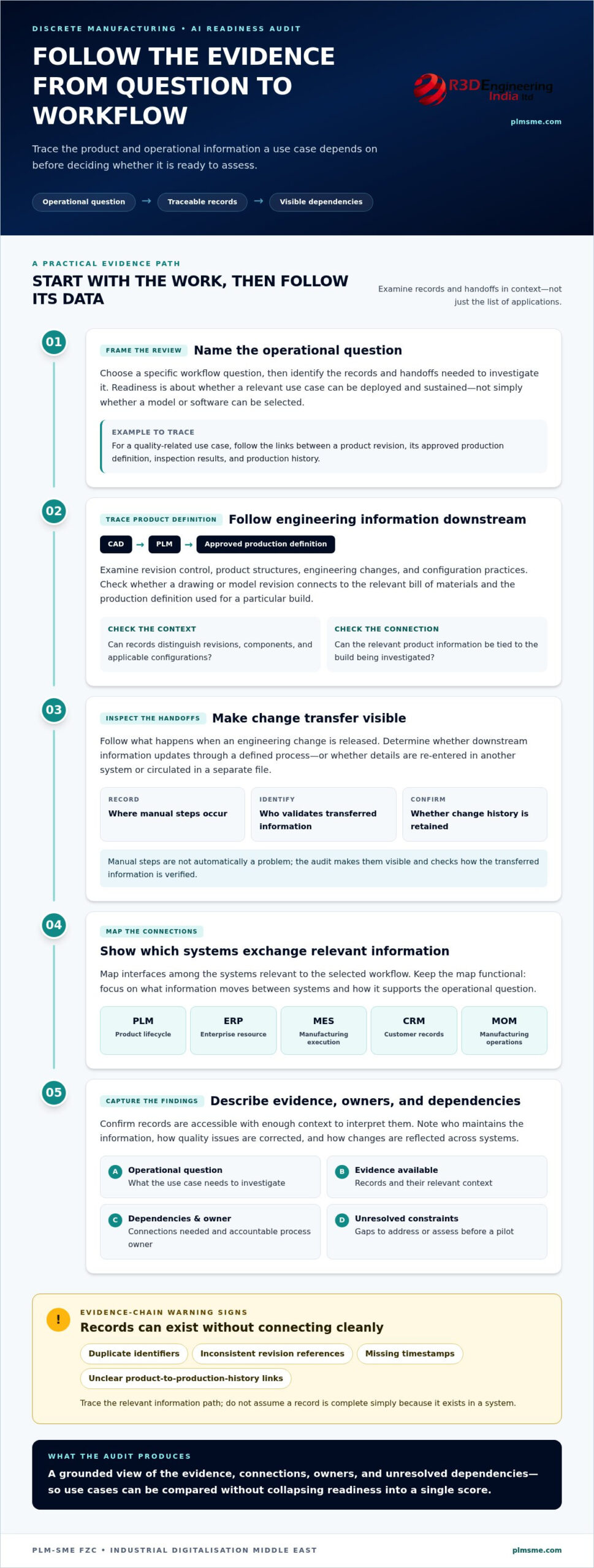
A useful audit follows information through the work, not just across a list of applications. Start with a specific operational question, then identify the records and handoffs needed to investigate it. For a quality-related AI use case, for example, trace how a product revision, its approved production definition, inspection results, and production history are associated. Check whether those records are accessible with enough context to interpret them correctly.
Useful AI readiness evidence includes traceable data, accountable owners, and defined workflows. The discrete manufacturing AI readiness audit should assess each of these in actual records and processes, including who maintains the information, how quality issues are corrected, and how changes are reflected across systems.
Tracing product and engineering information
Follow product information from CAD and PLM through approved production definitions. Examine revision control, product structures, engineering changes, and configuration practices. A drawing or model may be present, for instance, but the audit should establish whether its revision can be connected to the relevant bill of materials and the production definition used for a particular build.
Then examine the handoffs. Does a released engineering change update downstream information through a defined process, or does someone re-enter details into another system or circulate a separate file? Manual steps aren’t automatically a problem, but they need to be visible. Record where they occur, who validates the transferred information, and whether change history is retained. For the intended analytical task, confirm that engineering records preserve the context needed to distinguish revisions, components, and applicable configurations.
Reviewing enterprise and production-system connections
Map interfaces among the systems relevant to the selected workflow, which may include PLM, ERP, MES, CRM, and MOM. Keep the map functional: show what information moves, in which direction, who owns it, when it is exchanged, and what happens when records don’t reconcile. Don’t assume every manufacturer uses these systems in the same way.
Look for duplicate entry and competing records. An item identifier might be maintained in PLM and ERP; a production event might be recorded in MES while a separate operational record is updated elsewhere. Compare actual examples to find mismatched identifiers, delays, missing relationships, and manual reconciliation steps. These details help distinguish a system connection that exists from a data flow that supports the use case.
Capture evidence in a compact register: the data object, source and receiving system, responsible owner, update timing, known quality issue, and workflow relying on it. This helps teams distinguish missing data from inaccessible data, unclear ownership, or a process without a consistent definition. PLM system architecture consulting can connect system relationships to business workflows and clarify where integration work may be needed.
Where evidence points to architecture or integration dependencies, an industrial digital maturity assessment can place those findings within a broader view of digital capabilities and priorities.
How to Turn Audit Evidence into Priorities, Not Just a Readiness Score
A readiness score can signal where attention is needed, but it can’t explain which AI use case deserves action first. The discrete manufacturing AI readiness audit should turn findings into decisions by comparing candidate use cases against operational relevance, evidence quality, dependencies, and accountable ownership. This makes the reasoning visible: leaders can see why a use case is ready to investigate, needs preparation, should be deferred, or doesn’t fit current priorities.
Separate shared foundations from project-specific gaps. A data-access issue affecting several workflows may merit broader attention; a missing data field required by one candidate may be addressed within that use case. Treating both as one score hides the difference. Ranking is a decision aid, not a promise of business results, and a high-ranked use case will not automatically deliver value.
Distinguishing readiness dimensions from project priorities
Review people, process, data, systems, and governance as connected dimensions. For instance, accessible operational data may still be difficult to use if no process owner can interpret it or responsibilities for acting on its output are unclear. That constraint may affect one workflow more than others. Record the specific impact rather than labelling the whole organisation unready. The objective is to expose dependencies and support practical sequencing.
Keep broad maturity classifications in the background. For prioritisation, describe the evidence behind each finding and whether it affects a shared foundation or a particular candidate. This produces a more useful discussion than debating a score without knowing which operational decision it represents.
Selecting a pilot candidate responsibly
A credible first candidate has a bounded workflow, accessible evidence, and an operational owner who can define what the result should inform. A technically interesting idea may be a poor starting point if its data spans unclear interfaces, depends on unresolved assumptions, or lacks a responsible team to assess its output. Capture those conditions before recommending experimentation, so the decision accounts for both potential relevance and readiness constraints.
Use a compact comparison to keep the rationale inspectable. The entries below show how to structure the discussion, not what every manufacturer should prioritise.
Candidate use case
Evidence available
Dependency
Owner
Next decision
Production scheduling support
Planning records and schedule changes
Consistent links between planned and actual operations
Production planning lead
Investigate evidence quality
Maintenance prioritisation
Equipment and maintenance history
Usable, consistently recorded event data
Maintenance lead
Prepare or defer based on data review
For each candidate, add assumptions and unresolved dependencies alongside the next decision. Then review the comparison with the people accountable for the workflow. They can confirm whether the operational question is well framed, whether the evidence is relevant, and whether the proposed next step is proportionate. The resulting priorities can feed a sequenced roadmap without treating a ranking as a forecast of outcomes.
How to Prepare and Run a Discrete Manufacturing AI Readiness Audit
A focused audit is easier to run when it starts with an operational question, not a catalogue of every technology in the business. For example, examine how a defined product family’s engineering changes reach production, or how a specific quality decision uses inspection and process records. This boundary keeps evidence collection relevant and helps stakeholders distinguish what the audit needs to establish from wider digital transformation work.
Setting scope and assembling the evidence
Use a sequence that moves from a clear scope to a decision. The discrete manufacturing AI readiness audit can follow these steps:
- Define the scope. Name the workflow, product family, or decision under review. Set its boundaries, including where the process begins and ends, which teams are involved, and what the audit will not examine.
- Assemble relevant stakeholders. Involve engineering, IT, operations, quality, and business representatives as needed for the workflow. Include people who perform the work as well as those responsible for its systems, data, or outcomes.
- Gather evidence. Collect system maps, sample records, process documentation, and stakeholder input. Use representative examples, such as a change record alongside the corresponding production instruction, rather than relying on broad descriptions alone.
- Map the workflow and information path. Document where data is created, transferred, reviewed, and acted on. Note the systems and interfaces involved, data ownership, manual steps, timing, and known constraints.
- Analyse and record findings. Separate observed evidence from assumptions and open questions. Describe how each finding affects the operational question and whether it is a shared foundation or a dependency specific to the workflow.
- Review decisions with stakeholders. Validate interpretations with workflow owners, then agree what to investigate, prepare, defer, or stop. Assign each next step an owner and a decision point.
Validating findings and agreeing next decisions
Stakeholder review is a working check, not a sign-off on a predetermined recommendation. A process map may suggest that a handoff is automated, while the people doing the work know that exceptions are handled through separate files. Confirm such details against records and process documentation. If evidence conflicts, document the discrepancy and its effect instead of smoothing it into a single conclusion.
Keep four categories distinct in the findings: evidence, assumptions, dependencies, and unresolved questions. This gives decision-makers a clear basis for judging what is known and what still needs investigation. Each recommended action should identify its owner and the point at which the next decision will be made, without presenting a forecast of success as an audit finding.
Once priorities are agreed, they can inform an industrial digitalisation roadmap by showing which capabilities and dependencies need to be sequenced around the operational objective. PLM-Sme FZC’s digital maturity assessment and roadmap consulting connect assessment findings to digital maturity and practical next steps, as outlined in industrial digital maturity assessment support.
From Readiness Findings to a PLM-Supported AI Roadmap
Audit findings become useful when they shape a sequence of decisions, not a promise that a particular AI project will succeed. A digitalisation vision can connect operational priorities with the foundations they depend on: governed product information, defined workflows, system interfaces, and clear ownership. Some findings may point to AI investigation; others may indicate that information management or integration work should come first.
PLM can be one part of that foundation where the use case depends on product definitions, engineering changes, or configuration context. It isn’t a universal prerequisite for AI. Its relevance depends on the workflow under review and how product information relates to the systems and teams involved.
Connecting AI preparation with PLM foundations
For use cases that rely on engineering and product records, a considered Teamcenter architecture can help organise product information and its relationship to connected workflows. The audit should establish which information needs to be governed in PLM and what must be exchanged with ERP, MES, or other systems for the scoped use case. Include only relevant connections, and define the role each plays rather than treating integration as an end in itself.
TeamCenter FOUNDATION includes 15 years of configuration knowledge. That knowledge can inform PLM foundation work, while the architecture and recommendations remain grounded in the manufacturer’s requirements and wider system landscape.
Sequencing assessment, roadmap, and implementation
A practical sequence links assessment findings to roadmap decisions, then to architecture, integration, or implementation work where appropriate. An identified data dependency might lead to clarifying product structures or change processes before an AI use case is evaluated. A workflow with accessible evidence and clear ownership may be ready for further investigation sooner. The sequence should reflect evidence and dependencies, not a predetermined software purchase.
PLM-Sme FZC provides industrial digital maturity assessments and reports, digitalisation vision and roadmap consulting, PLM implementation, system architecture, and integration support. Its START-EXTEND-TRANSFORM methodology is SISW-supported. The company’s independent, customer-centric approach links audit findings to organisational priorities rather than assuming one solution fits every environment.
A discrete manufacturing AI readiness audit can serve as a practical starting point for deciding what to address, what to investigate, and how to sequence the next steps. To discuss an assessment and how its findings could inform an AI roadmap, discuss a digital maturity assessment and AI roadmap with PLM-Sme FZC.
Make Your Next AI Decision Evidence-Led
The next step doesn’t need to be a broad transformation programme. Choose one operational decision where better information could matter, then establish what evidence and accountability would be needed to evaluate an AI approach. This gives engineering, operations, and leadership a shared starting point, while keeping the discussion grounded in the realities of the workflow.
A discrete manufacturing AI readiness audit can turn that question into a practical sequence of decisions. Its value lies not in forcing a pilot forward, but in clarifying what is ready to explore, what needs preparation, and who should guide the work. Independent, customer-centric support can connect those decisions to wider digitalisation priorities without presuming a particular technology choice.
Discuss an industrial AI readiness assessment with PLM-Sme FZC to consider how your findings can inform the next step. A focused, evidence-led start can help your team move forward with greater clarity.
Frequently Asked Questions
What is a discrete manufacturing AI readiness audit?
A discrete manufacturing AI readiness audit examines whether the information, processes, and responsibilities needed for a relevant AI use case are in place. It can focus on a specific decision, such as identifying patterns in inspection results for a product family. The practical output should help leaders decide whether to investigate that use case, address a prerequisite, or choose a different operational question, with the reasoning tied to evidence.
Is an AI readiness audit the same as an AI maturity assessment?
Not necessarily. An audit often tests evidence and dependencies for a defined workflow or decision, while a maturity assessment can take a wider view of organisational capabilities. The two can complement each other: a maturity report may show where broader digital capabilities need attention, and a focused audit can examine how those conditions affect a particular use case. Agreeing the scope and intended decisions at the outset keeps the work clear.
How long does a discrete manufacturing AI readiness audit take?
There isn’t a reliable standard duration because the work depends on the scope, evidence access, stakeholder availability, and complexity of the relevant systems. Reviewing one bounded production decision will differ from examining several product families and connected workflows. To estimate the effort, first specify the decision the audit must inform, the records and teams involved, and any access or coordination constraints that could shape the review.
What information should a manufacturer prepare for an AI readiness audit?
Prepare materials that let the assessment team follow the chosen workflow from input to decision. A useful starting pack might include a current process description, system or interface diagrams, representative records, and a list of teams responsible for maintaining or using them. For an engineering-change question, for example, include a sample change and its associated downstream records. Select examples that reflect normal work and known exceptions, not only ideal cases.
Can a manufacturer be AI-ready without replacing its PLM or ERP system?
Yes. Replacing core systems isn’t automatically required for readiness. The relevant question is whether the existing environment can provide suitable, accessible information for the selected task. For example, a manufacturer may retain its PLM and ERP platforms while addressing a specific gap through data preparation, configuration, a process adjustment, or an integration. The audit should identify which change is relevant rather than treating system replacement as the default remedy.
What happens if the audit finds that our data is not ready for AI?
The next step is to define the issue precisely, such as missing revision context, inconsistent identifiers, or incomplete records for a particular workflow. Then assess who owns the affected information and what decision depends on it. This may lead to a targeted data or process improvement, a narrower use-case scope, or a pause on that candidate. Other opportunities can still be considered if they rely on different evidence and dependencies.
Does an AI readiness audit guarantee a successful AI implementation?
No. An assessment can inform decisions, but it can’t guarantee implementation results. Performance and operational fit depend on factors beyond the audit, including how the solution is built, how staff use it, and whether its outputs remain useful as conditions change. Before proceeding, define how the organisation will evaluate the proposed use case and who will review its performance. Treat audit findings as a basis for disciplined decisions, not a promise of results.