
The Hidden Costs of Not Having PLM: A Strategic Financial Analysis for 2026
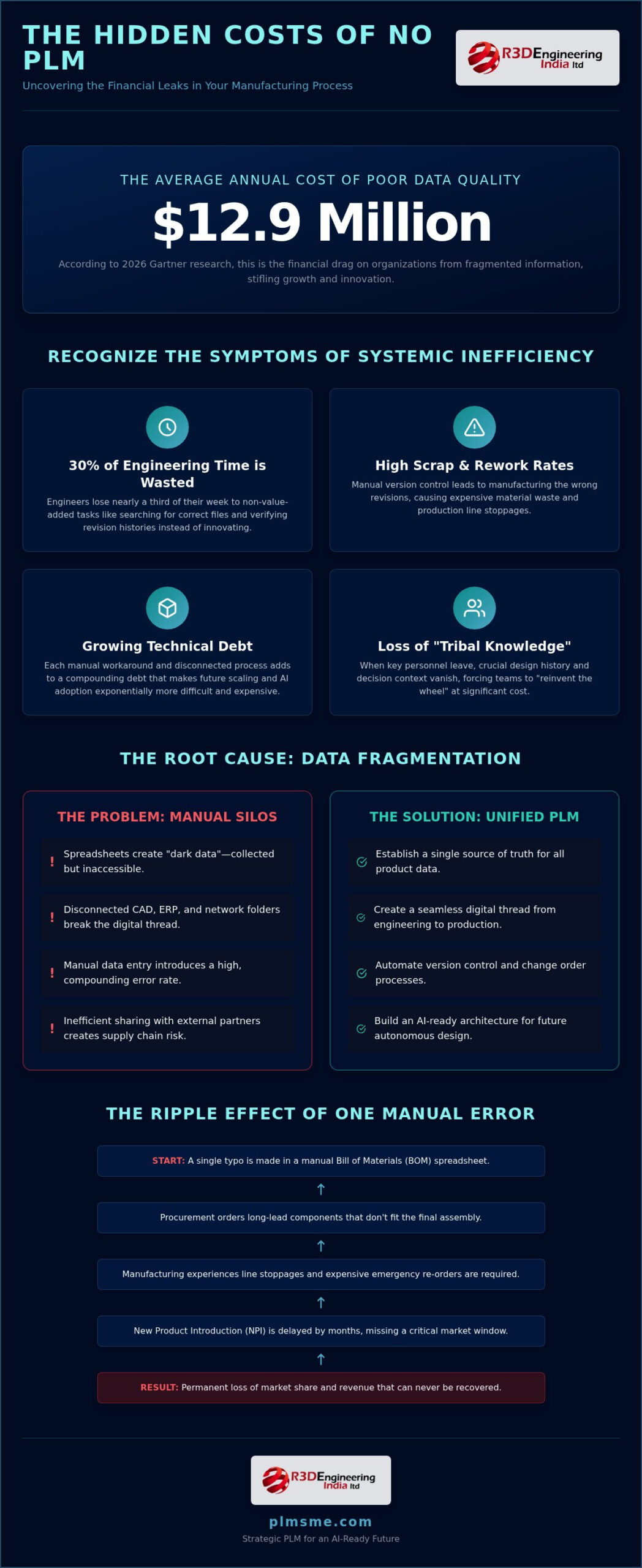
Can your organization afford to lose $12.9 million this year to poor data quality? According to 2026 Gartner research, that is the average annual cost of fragmented information. Many manufacturers still treat Product Lifecycle Management as an optional software line item rather than a critical financial strategy. You likely recognize the symptoms of this oversight: engineers losing 30% of their time to data retrieval and high scrap rates caused by version control errors. These systemic inefficiencies represent the hidden costs of not having PLM, creating a compounding technical debt that stifles growth.
It’s clear that manual silos and disconnected CAD and ERP systems are no longer sustainable in a market demanding AI-driven innovation. This analysis uncovers the invisible financial leaks in your manufacturing process and explains how a strategic PLM framework prevents long-term technical debt. We’ll provide a clear framework for assessing your digital maturity and a roadmap to transition your operations into a unified, AI-ready architecture. By moving beyond document-focused workflows, you can establish a single source of truth that secures your margins and enables autonomous design capabilities.
Key Takeaways
- Identify the systemic leaks, such as “dark data” and spreadsheet-based silos, that drive the hidden costs of not having PLM.
- Understand the direct correlation between manual version control and the compounding financial impact of manufacturing the wrong revisions.
- Assess the regulatory and supply chain risks inherent in sharing fragmented, outdated product documentation with external partners.
- Discover how a structured digital maturity assessment identifies specific pockets of inefficiency across the engineering-to-production value chain.
- Establish a vendor-independent roadmap to transition from legacy technical debt toward an integrated, AI-ready digital architecture.
Quantifying the Invisible Leaks in Manual Product Management
Financial leadership often focuses on visible line items like software licensing fees or raw material overhead. However, the most damaging financial drains are frequently systemic. These hidden costs of not having PLM manifest as efficiency leaks that don’t appear on a balance sheet but directly erode your EBITDA. While a visible cost is a one-time transaction, a systemic leak is a recurring tax on every project your organization undertakes.
Spreadsheets and disconnected network folders are the primary architects of “dark data.” This term describes information that is collected and stored but remains inaccessible for analysis or cross-departmental use. When product data lives in a siloed Excel sheet, it lacks a digital thread. This forces teams to rely on manual data entry, which creates a compounding error rate. A single typo in a manual Bill of Materials (BOM) can ripple through procurement and manufacturing, leading to expensive emergency change orders or line stoppages during production.
Many organizations rely on “good enough” manual processes that function during low-volume periods. However, these workflows create a glass ceiling for organizational scaling. As complexity increases, the manual effort required to maintain data integrity grows exponentially rather than linearly. Without a centralized architecture, your ability to scale is limited by the number of manual checks your staff can perform before the system inevitably fails.
The True Cost of Data Fragmentation
Data fragmentation forces your most expensive resources to perform low-value tasks. Senior engineers often spend 30% of their time searching for the correct CAD files or verifying revision histories instead of designing new products. This isn’t just a productivity issue; it’s a retention risk. High-performing talent thrives on innovation, not administrative archaeology. Additionally, organizations without a central repository suffer from the loss of “tribal knowledge.” When key personnel leave, the historical context of design decisions often vanishes with them, forcing the remaining team to reinvent the wheel at a significant cost.
The Information Silo Penalty in 2026 is the measurable financial drag created when disconnected data systems force technical experts to prioritize administrative verification over product innovation.
Opportunity Costs of Delayed Time-to-Market
In a competitive manufacturing landscape, being first to market is often the difference between capturing a category or fighting for scraps. A three-month delay in a New Product Introduction (NPI) can result in a permanent loss of market share that no amount of late-stage marketing can recover. Manual product management lacks the agility required to respond to shifting consumer demands or supply chain disruptions. Without the real-time visibility provided by an integrated system, decision-makers operate on stale data, leading to missed windows of opportunity and eroded margins. The hidden costs of not having PLM are ultimately found in the revenue that never materialized because your process was too slow to compete.
Evaluating the Erosion of Engineering Productivity
Engineering productivity isn’t defined solely by how quickly a designer can operate CAD software. It’s measured by the ratio of innovation to administrative friction. The “30% rule” remains a stark reality for manufacturers operating without a centralized system; nearly a third of an engineer’s week is consumed by non-value-added data management. This includes searching for files, manually updating spreadsheets, and verifying part numbers across disconnected systems. These activities represent the hidden costs of not having PLM, as they quietly drain your most expensive technical resources without producing a single billable asset.
Version control errors represent one of the most expensive failures in a manual environment. When the shop floor pulls an outdated PDF from a network folder, the result is high scrap rates and wasted materials. This friction extends directly into procurement. Manual Bill of Materials (BOM) management is inherently prone to human error. A single incorrect part number in a spreadsheet can lead to procurement catastrophes, such as ordering long-lead components that don’t fit the final assembly, forcing expensive emergency re-orders and production delays.
Disconnected CAD, CAM, and CAE environments further stifle throughput. When these systems don’t communicate, data must be manually exported and re-imported, creating “data islands” that break the digital thread. This lack of integration means a design change in CAD isn’t automatically reflected in manufacturing tooling or simulation models. Teams are forced into a cycle of constant manual verification, which significantly slows the pace of development and increases the likelihood of downstream errors.
Redundant Work and the ‘Re-invention’ Cycle
Engineers often recreate parts simply because they cannot find an existing equivalent in a cluttered file system. This lack of standardization leads to bloated part libraries and redundant inventory. While manual part searching relies on luck and tribal memory, automated Siemens Teamcenter classification allows engineers to locate existing components in seconds based on specific geometric parameters or attributes. Identifying these efficiency gaps through a digital maturity assessment is the first step toward reclaiming lost engineering hours and reducing part proliferation.
Engineering Change Management (ECM) Friction
Slow change approval cycles delay production and increase the risk of “uncontrolled changes” reaching the factory floor. When changes are managed via email or paper, the lack of a formal audit trail leads to field failures and costly warranty claims. Implementing automated workflows within a PLM framework can reduce ECM overhead by up to 70% by streamlining the review and approval process. This ensures every stakeholder works from the latest approved data, eliminating the guesswork that often leads to manufacturing errors and lost revenue.
Analyzing Supply Chain Fragmentation and Compliance Risks
Supply chain resilience depends on the integrity of the data shared between manufacturers and their global partners. When organizations rely on manual processes, they’ll often fall into the “communication gap” where outdated PDFs are sent to suppliers via email. This lack of a digital thread means a supplier might manufacture thousands of units based on a superseded revision. These errors represent significant hidden costs of not having PLM, as they lead to material waste, emergency freight charges, and strained vendor relationships.
Beyond material waste, fragmented data creates severe regulatory risks. Inaccurate product documentation can lead to non-compliance with global standards, resulting in heavy fines or the total exclusion of products from specific markets. A centralized PLM system acts as the single source of truth, ensuring that every stakeholder, from internal engineering to external vendors, accesses the most current compliance data. Inefficient vendor onboarding also carries a high administrative cost; without a standardized portal, teams spend weeks manually verifying supplier certifications and quality standards.
The Technical Debt of Poor System Architecture
Technical debt in industrial digitalization refers to the long-term cost of choosing easy, short-term software workarounds over a structured foundation. Many manufacturers attempt to solve data silos by using “bolted-on” software fixes that offer temporary relief but don’t integrate with ERP, MES, or MOM systems. These fragmented landscapes are expensive to maintain and difficult to upgrade. Investing in professional PLM system architecture consulting ensures that your digital infrastructure is built for scalability rather than immediate convenience, preventing the accumulation of architectural debt.
Compliance and Quality Management (QMS) Integration
Manual audit preparation is a labor-intensive process that can take weeks of engineering time in highly regulated industries. Without automated traceability, proving compliance requires a manual search through paper trails and disconnected folders. This inefficiency increases the risk of human error during an audit. By integrating QMS functions, Siemens Teamcenter enables “Compliance by Design.” This approach ensures that digital traceability is baked into the product lifecycle from the start, significantly reducing warranty liabilities and ensuring that every component meets the required safety and environmental standards without manual intervention.
Assessing Your Digital Maturity to Uncover Waste
Many manufacturing leaders operate on intuition when identifying operational waste. However, an independent digital maturity assessment is the primary mechanism for cost recovery. It moves the organization away from “gut feeling” and toward data-driven investment decisions. By identifying specific pockets of inefficiency across the engineering-to-production value chain, you can quantify the hidden costs of not having PLM in terms of lost hours and material waste. These assessments reveal where technical debt is accumulating and provide a baseline for future performance improvements.
Securing executive buy-in for digitalization requires more than technical jargon. A digital maturity report in manufacturing provides the financial justification needed for board approval. It translates systemic bottlenecks into financial risks, highlighting how current data silos prevent the organization from achieving its strategic goals. This transparency builds trust with stakeholders, showing that PLM is a strategic investment in long-term stability rather than just another IT expense.
Benchmarking Your Current Digital State
Evaluating your current CAD, ERP, and MES connectivity levels is essential for identifying manual hand-offs. These bottlenecks often hide in plain sight; they’re the “temporary” workarounds that have become permanent fixtures in your workflow. Mapping the flow of data helps you see where information stops being digital and starts being manual. For companies operating in competitive regions, establishing a strategic industrial digitalization roadmap UAE provides a structured path toward total system integration. This benchmarking ensures that your technology stack supports your production targets rather than hindering them.
The Financial Roadmap to AI Readiness
The industrial AI revolution is already here, but it requires high-quality, structured data to function. AI cannot optimize what it cannot see. Without the digital thread provided by PLM, your AI initiatives will likely produce unreliable results. The cost of being left behind is significant. By 2028, it’s predicted that over 60% of product innovation will be powered by AI-driven systems, a jump from just 25% today. A phased investment plan allows you to mitigate upfront financial pressure while building a robust foundation. This strategic approach ensures you aren’t just reacting to the hidden costs of not having PLM, but actively building an architecture capable of autonomous design and optimization.
Ready to uncover the financial leaks in your manufacturing process? Contact our team for a professional digital maturity assessment to start your journey toward cost recovery.
Mitigating Long-term Risks with a Strategic PLM Roadmap
Transitioning from reactive troubleshooting to proactive system optimization requires a structured roadmap that addresses both current inefficiencies and future growth. A strategic roadmap isn’t just a software deployment schedule; it’s a financial safeguard. By establishing a clear path for digitalization, organizations can systematically eliminate the hidden costs of not having PLM, such as the technical debt incurred by fragmented data and manual processes. Partnering with a vendor-independent Siemens Teamcenter consulting expert allows for an objective analysis of your architecture, ensuring the solution fits your specific industrial requirements rather than a generic software template.
An end-to-end PLM implementation prevents future integration headaches by creating a unified data model from the outset. This holistic approach ensures that engineering, manufacturing, and procurement operate within a shared environment. It eliminates the need for expensive, custom-coded bridges between systems that often break during software updates. By investing in a structured foundation, you move from a state of constant data firefighting to a streamlined, AI-ready operation that supports rapid scaling.
Designing a Scalable System Architecture
A robust digital architecture uses Siemens Teamcenter as the central hub to connect disparate systems like ERP, CRM, and MES. This connectivity ensures that customer requirements in CRM flow directly into engineering specifications, while manufacturing data from the MES provides real-time feedback for design optimization. Understanding the Teamcenter CRM integration benefits is crucial for building a future-proof architecture that evolves with your business. This integrated approach allows for seamless data exchange across the entire value chain, reducing the risk of information bottlenecks and ensuring that every department works from a single source of truth.
The Role of Ongoing Administration
Many PLM initiatives lose momentum because they lack dedicated long-term support. Self-managed systems often become obsolete as internal teams struggle to keep up with updates, patch management, and user training. A specialized PLM system administration retainer provides a higher ROI than hiring a full-time in-house specialist who may lack the broad expertise required for complex Siemens environments. This proactive support model ensures continuous performance, data integrity, and system health. It effectively prevents the slow degradation of data quality that often occurs when systems run on autopilot. By choosing a retainer, you secure the longevity of your digital investment and ensure that your architecture remains a strategic asset rather than a legacy burden, ultimately mitigating the hidden costs of not having PLM through consistent expert oversight.
Securing Your Manufacturing Future through Digital Maturity
Addressing the financial leaks within your product lifecycle is no longer a matter of operational preference; it’s a strategic necessity for 2026. We’ve explored how manual data silos and fragmented systems erode engineering productivity and create significant compliance risks. By quantifying the hidden costs of not having PLM, organizations can shift from reactive firefighting to a proactive, data-centric architecture. This transition secures your margins and ensures your operations are ready for the upcoming industrial AI revolution.
As an independent Siemens Digital Industries Alliance Partner, PLM-Sme FZC provides the technical expertise needed to navigate this transformation. Our team specializes in complex Teamcenter ERP and MES integrations, functioning as a vendor-neutral thinking partner for your long-term vision. You can start reclaiming lost efficiency today. Request a Digital Maturity Assessment from PLM-Sme FZC to uncover your specific waste pockets and build a resilient digital foundation. Establishing a single source of truth is the most effective way to eliminate technical debt and drive sustainable growth.
Frequently Asked Questions
What are the most common hidden costs in discrete manufacturing?
The primary hidden costs of not having PLM include systemic efficiency leaks such as “dark data” trapped in spreadsheets and the loss of tribal knowledge when key personnel depart. These invisible costs manifest as a recurring tax on every project, leading to manual data entry errors that ripple through procurement. Identifying these leaks requires a shift from viewing software as an expense to recognizing it as a critical financial strategy for long-term organizational scaling.
How does PLM reduce the cost of quality and warranty claims?
PLM reduces quality costs by establishing a single source of truth that eliminates the use of outdated revisions on the factory floor. By integrating Quality Management Systems (QMS), manufacturers achieve full digital traceability, which significantly lowers warranty liabilities. This “Compliance by Design” approach ensures every component meets safety standards automatically. Automated change management workflows also reduce the risk of uncontrolled changes, which are a leading cause of expensive field failures and recalls.
Can a digital maturity assessment actually predict ROI?
A digital maturity assessment predicts ROI by quantifying existing waste pockets and translating technical bottlenecks into measurable financial risks. These reports move investment decisions from “gut feeling” to data-driven strategies by benchmarking current CAD, ERP, and MES connectivity levels. By identifying the specific percentage of engineering time lost to administrative friction, the assessment provides a clear baseline for cost recovery. This transparency is essential for securing board approval for digitalization initiatives.
Is Siemens Teamcenter suitable for small to medium-sized industrial firms?
Siemens Teamcenter is highly suitable for small and medium-sized firms due to its scalable, modular architecture. It allows organizations to start with core functionality and expand as their complexity grows, avoiding the need for massive upfront investments. This flexibility ensures that smaller manufacturers can build an AI-ready foundation without the overhead of enterprise-scale legacy systems. A phased implementation approach helps manage financial pressure while still establishing a robust digital thread across the value chain.
What is the difference between PLM implementation and system architecture consulting?
PLM implementation focuses on the deployment and data migration of the software, while system architecture consulting defines the foundational logic connecting PLM with ERP, CRM, and MES systems. Consulting ensures that the digital infrastructure is built for long-term scalability rather than immediate convenience. It prevents the accumulation of technical debt by designing a “Future-Proof” environment where data flows seamlessly between departments. This distinction is critical for ensuring that the software supports the broader business vision.
How long does it take to see a return on investment after implementing PLM?
ROI timelines vary depending on the initial state of digital maturity, but many firms see significant gains within the first year through reduced scrap rates and reclaimed engineering time. By addressing the “30% rule” of lost productivity, organizations realize immediate savings in high-value technical labor. Long-term ROI is further driven by faster time-to-market and the elimination of emergency procurement re-orders. A structured roadmap ensures that these financial benefits are tracked and achieved through phased milestones.
Why is a system administration retainer necessary for PLM success?
A system administration retainer is necessary because it ensures continuous performance and data integrity without the expense of a full-time in-house specialist. PLM systems are complex and require regular updates, patch management, and user support to remain effective. Without expert oversight, systems often become obsolete or suffer from data quality degradation. A specialized retainer provides proactive optimization, ensuring your digital architecture remains a strategic asset rather than a legacy burden that incurs new costs.
How does PLM prepare my manufacturing facility for AI integration?
AI requires structured, high-quality data to function effectively, as algorithms can’t optimize design parameters if the underlying information is fragmented. By establishing a digital thread, PLM ensures that AI initiatives have a reliable dataset for autonomous design and customer experience optimization. This data-centric foundation is the prerequisite for participating in the predicted 60% surge in AI-driven innovation by 2028. PLM-Sme FZC helps organizations build this architecture to ensure long-term AI readiness.